
High-Profile Corporate Reputation Risk Example Lessons
When examining how quickly market valuation and stakeholder trust can evaporate, real-world case studies provide the clearest picture. Analyzing past failures allows corporate leaders to identify blind spots in their own crisis communications, governance, and enterprise risk management strategies.
Healthcare and Corporate Litigation: The UnitedHealth Defamation Lawsuit
Using the legal system as a public relations buffer is one of the most dangerous strategies an enterprise can adopt. A stark reputation risk example unfolded when UnitedHealth Group pursued a defamation lawsuit against The Guardian over critical media coverage. The legal attempt ultimately backfired when a federal judge dismissed the bid to silence the news outlet, as detailed in this analysis of the Judge Dismisses UnitedHealth Bid to Silence the Guardian Over Coverage ruling.
Instead of suppressing the negative coverage, the lawsuit triggered the Streisand Effect—a phenomenon where attempting to hide or remove information actively draws wider public attention to it. Every legal brief, motion, and court date extended the news cycle’s natural half-life, creating prolonged public scrutiny.
This legal dispute did not happen in a vacuum. UnitedHealth was already navigating severe operational and reputational headwinds, including:
- A massive cyberattack on its subsidiary, Change Healthcare, in February 2024, which exposed the protected health information of an estimated 100 million Americans—making it the largest healthcare data breach in U.S. history.
- Escalating public scrutiny and nationwide regulatory debate over automated healthcare insurance claim denials.
- Heightened secondary regulatory exposure under the HIPAA Privacy Rule (45 CFR §164.512) when submitting claim records during legal disputes.
For an organization generating over $370 billion in annual revenue, reputational damage isn’t just about bad press. It directly affects complex employer contract negotiations, healthcare provider network relationships, and long-term member retention. Attempting to manage public perception through courtroom fights frequently transforms a manageable media cycle into a compounding corporate liability. This reinforces why evaluating vendor exposure and third-party dependencies during thorough Reputational Risk in Due Diligence is crucial before crisis hits.
Brand Equity Collapse: A Founder Feud Reputation Risk Example
Tying an entire corporate valuation to a single personality creates acute founder dependency risk. When public sentiment toward an individual shifts, the underlying business can collapse overnight—even if the physical product, pricing, and supply chains remain entirely intact.

A prominent illustration of this dynamic occurred during the public dispute surrounding the launch of Blake Lively’s hair care brand, Blake Brown, alongside the release of the film It Ends With Us. As detailed in this coverage on how the Blake Lively And Justin Baldoni’s Feud Ruined A $100 Million Brand, viral social media commentary regarding promotional tone and personal friction severely damaged consumer goodwill.
The operational and financial fallout was swift:
- Brand sales plunged by over 87 percent in the immediate aftermath of the controversy.
- The company’s projected valuation plummeted from $100 million down to $15 million.
- Millions in potential retail expansion and long-term influencer partnerships were instantly derailed.
When a brand relies on executive or celebrity clout, public likability functions as the company’s primary cooling system. If that likability evaporates due to a personal scandal or defensive messaging, the brand loses its protection against consumer fallout.
Consumer Boycotts: A Marketing Reputation Risk Example
Modern consumers increasingly treat purchasing decisions as moral or ideological votes. According to data from the Edelman Trust Barometer, 71 percent of global consumers divide brands into ‘buy’ or ‘boycott’ categories based on corporate values and public behavior.
Consider these high-profile marketing and rebranding missteps:
- Bud Light: A single sponsored Instagram post with influencer Dylan Mulvaney sparked intense consumer backlash, leading to a 25 to 30 percent decline in sales and an immediate $27 billion loss in market value for parent company Anheuser-Busch InBev.
- Cracker Barrel: Following public pushback against a proposed logo change and brand refresh, the restaurant chain firmly defended its modern rebrand against its core customer base, resulting in a swift $94 million loss in market capitalization before the strategy was reconsidered.
When brands fail to align marketing campaigns with core customer expectations—or double down defensively during a viral backlash—they risk turning loyal customers into vocal boycotters overnight.
Drivers of Reputation Risk in Banking and Financial Services

In the financial sector, reputation risk is uniquely dangerous because financial institutions operate entirely on public trust. While a retail company losing brand equity faces declining quarterly sales, a bank experiencing a severe loss of confidence faces an immediate existential liquidity crisis.
How Public Sentiment Impacts Financial Solvency and Bank Stability
In banking, negative public sentiment can convert directly into financial insolvency in a matter of hours. The 2023 regional banking crisis demonstrated that social media and instant digital banking apps can accelerate bank runs at unprecedented speeds.
When rumors or negative sentiment spread regarding a bank’s capital position, deposit flight can occur almost instantaneously:
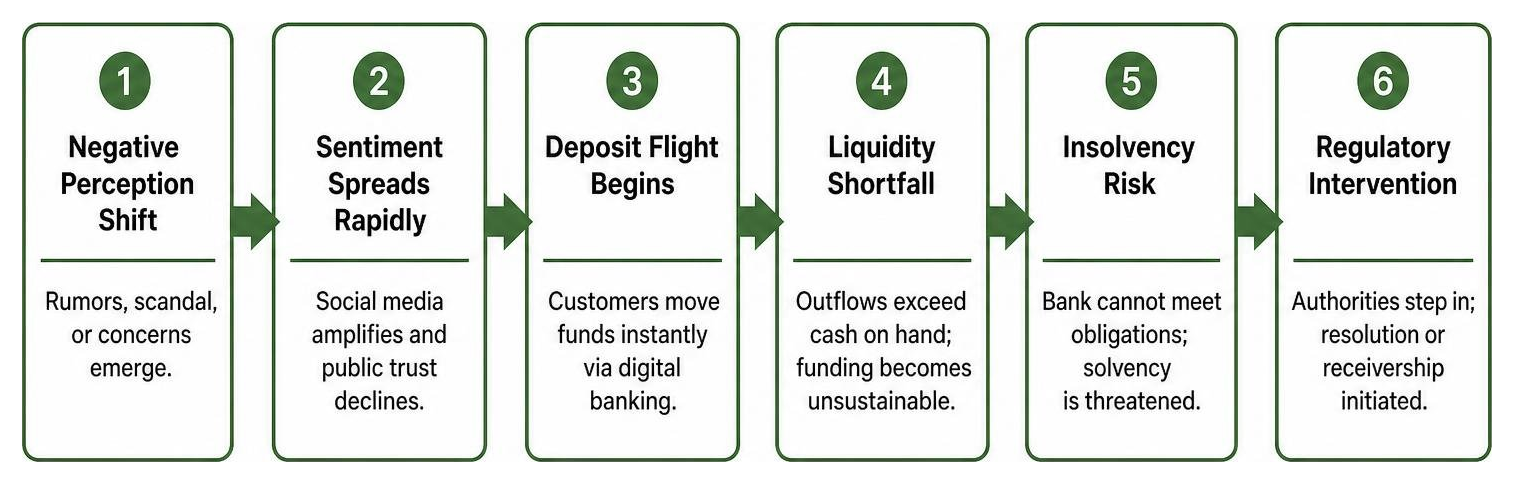
When depositors lose faith, they do not wait for official quarterly statements; they initiate mobile transfers immediately. This digital contagion highlights why conducting regular Reputation Risk Assessment processes is vital for maintaining operational stability and liquidity buffers.
Regulatory Supervision and the FDIC/OCC Reputational Risk Rule
Because reputation risk is inherently subjective, bank regulators have spent years debating how examiners should evaluate it. Historically, bank examiners could cite generic “reputational risk” as a reason to issue supervisory warnings or urge banks to sever ties with certain higher-risk or controversial business sectors—a process often criticized as political “debanking.”
To address this subjectivity, federal agencies took regulatory action:
- The FDIC and OCC finalized rules restricting bank examiners from issuing formal supervisory notices based solely on subjective reputational concerns.
- The Solvency Exception: The rule explicitly preserves an examiner’s authority to take supervisory action if public perception issues directly threaten a firm’s operational stability or financial solvency.
As highlighted in the analysis on how the Reputational risk rule shows why subjectivity is so hard to ban, separating reputational risk from core safety and soundness is complex. If public outrage causes massive deposit outflows, an examiner cannot ignore the issue simply because it began as a public perception problem. Consequently, regulators often reframe reputational issues under objective categories such as operational risk, third-party compliance, customer concentration, or CAMELS rating sensitivities.
Quantifying Financial Impact and Board Culture Governance

Managing corporate reputation requires moving beyond reactive PR spin toward board-level governance and structured enterprise risk modeling.
Board-Level Culture Oversight and Governance Frameworks
Reputation risk is fundamentally created by an expectation-reality gap—the distance between what a company promises to its stakeholders and how it actually operates. When executive behavior or corporate culture breaches those expectations, enterprise value drops.
Consider a real-world executive misconduct case where a senior executive at a major food manufacturer made disparaging public comments regarding his own enterprise. The comments surfaced publicly via a lawsuit, causing immediate governance challenges, activist investor scrutiny, and sharp drops in industry reputational benchmarks (where the company ranked near the bottom of its 66-peer industry cohort).
As noted in the analysis on how Reputation Crises Remind Boards of Culture Oversight Responsibility, boards cannot rely strictly on basic compliance checklists to prevent public blowups. Boards must establish formal oversight over corporate culture, ensure alignment across executive incentives, and utilize comprehensive Corporate Due Diligence to identify culture gaps before they explode into public scandals.
Quantifying Potential Losses Through Scenario Planning
A common misconception is that reputational damage cannot be quantified. While intangible, its financial impact can be modeled through structured scenario planning:
- Direct Revenue Loss Modeling: Estimating immediate customer churn, canceled contracts, and lower conversion rates across various risk tiers.
- Operational and Legal Cost Projections: Factoring in emergency crisis management counsel, increased regulatory compliance audits, internal investigations, and legal defense costs.
- Cost of Capital Adjustments: Calculating potential debt rating downgrades, increased borrowing costs, and equity discount rates applied by institutional investors.
- Establishing Thresholds: Setting quantitative risk tolerance boundaries that trigger automatic escalation protocols to executive leadership and the board.
Practical Frameworks to Build Reputational Resilience
Building reputational resilience requires shifting from reactive damage control to proactive infrastructure. The table below outlines how leading organizations transform their approach to crisis management:
| Operational Area | Reactive Crisis Response | Proactive Reputational Resilience |
|---|---|---|
| Monitoring & Intelligence | Tracking news after a story breaks | Real-time social listening and sentiment benchmarking |
| Vendor Management | Remediation after a vendor data breach | Rigorous third-party due diligence and onboarding audits |
| Legal Strategy | Aggressive defamation suits and gag orders | Transparent communications aligned with legal compliance |
| Crisis Protocols | Ad-hoc executive statements and delay | Pre-approved rapid response playbooks and clear spokesperson chains |
| Governance | PR team owns reputational cleanup | Board-level oversight of culture, risk tolerance, and ESG metrics |
To safeguard enterprise operations, organizations should execute a structured resilience playbook:
- Deploy real-time digital monitoring to capture shifts in public sentiment across channels before they reach mainstream news.
- Use a comprehensive Reputational Risk Management Checklist during all major operational, marketing, or structural changes.
- Mandate formal Third Party Reputational Risk Management controls, ensuring suppliers and partners adhere to strict data security and ethical guidelines.
- Conduct continuous Third Party Risk Assessment reviews to prevent vendor missteps from damaging your core brand equity.
Frequently Asked Questions About Corporate Reputation Risk
What is the Streisand Effect and why should companies avoid litigation for reputation management?
The Streisand Effect occurs when an attempt to suppress, censor, or sue over negative coverage inadvertently draws significantly more attention to the original issue. Companies should avoid litigation as a primary PR strategy because defamation lawsuits involving public entities face extremely high legal burdens (such as proving actual malice). Legal proceedings reset news cycles with every court filing, extending negative media exposure and making the organization appear defensive or aggressive in the court of public opinion.
How do banks quantify potential financial losses from reputational damage?
Banks quantify reputational losses by integrating sentiment metrics into financial stress-testing models. They analyze historical deposit withdrawal velocity during sentiment downturns, calculate potential net interest margin degradation, project higher deposit retention premiums, and estimate the cost of secondary regulatory compliance oversight. By modeling liquidity drawdowns under severe public backlash scenarios, institutions can reserve adequate capital buffers.
What role does public sentiment monitoring play in mitigating crisis escalation?
Public sentiment monitoring provides early warning indicators before a minor issue transforms into an unmanageable public crisis. Real-time media tracking and social listening tools allow organizations to detect unusual spikes in negative volume, track sentiment shifts across demographics, and evaluate whether a narrative is gaining organic traction. This intelligence enables communications teams to issue swift, humble, and accurate responses within hours—frequently defusing backlash before consumer boycotts or partner departures take hold.
Conclusion
A corporate crisis rarely happens without warning. Whether driven by founder friction, third-party vendor breaches, regulatory enforcement, or legal missteps, a single reputation risk example highlights how fragile enterprise value can be when public trust erodes.
Building true reputational resilience requires proactive governance, real-time intelligence, and rigorous pre-transaction analysis. At Rule Ltd, we deliver AI-enhanced third-party risk management, corporate intelligence, and jurisdictional due diligence to help global enterprises protect their brand and balance sheet before crisis hits.
To protect your organization against emerging brand and vendor liabilities, explore detailed reputational risk examples in business and discover how our global intelligence solutions strengthen your enterprise governance.