
Why a Third-Party Risk Assessment Needs More Than a Questionnaire
A third-party risk assessment is a structured review of the risks a vendor, supplier, agent, distributor, contractor, or partner may introduce to your organisation. It should establish the relationship’s inherent risk, test the evidence behind the third party’s claims, document residual risk, and support a clear decision: approve, approve with conditions, monitor, or decline.
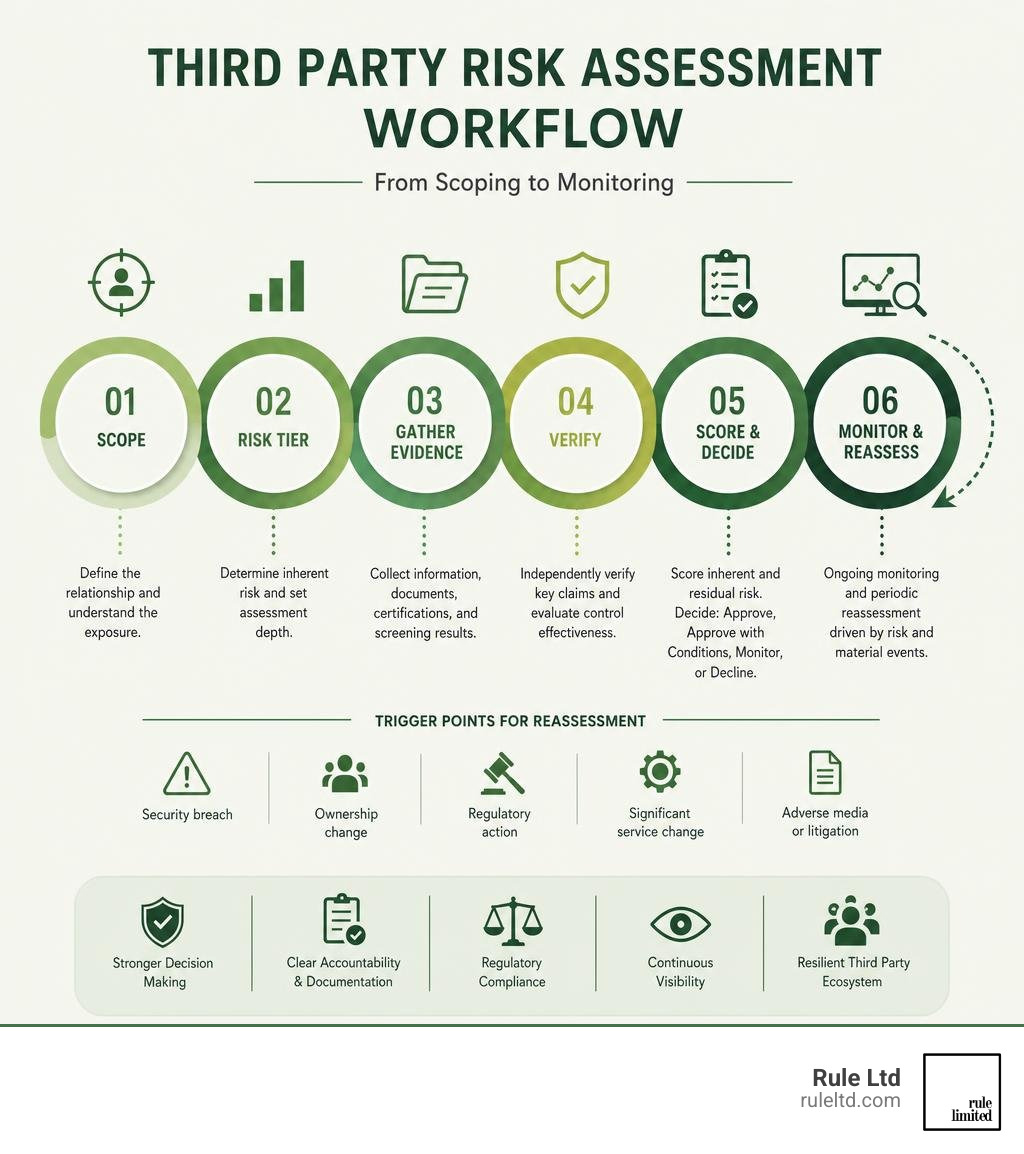
For a quick, defensible assessment, focus on:
- Scope the relationship – Identify the service, countries involved, data access, system access, spend, and business dependency.
- Assign a risk tier – Prioritise third parties that support critical activities, handle sensitive data, interact with public officials, or rely on complex subcontractors.
- Gather evidence – Use a proportionate questionnaire, documents, certifications, ownership information, and relevant screening.
- Verify material disclosures – Check key claims independently, including ownership, adverse media, sanctions exposure, litigation, financial health, and control evidence.
- Score and decide – Record inherent and residual risk, required remediation, ownership, approval conditions, and escalation points.
- Monitor and reassess – Review on a risk-based cadence and after material events, such as a breach, ownership change, regulatory action, or significant service change.
A third party can create exposure well beyond cyber security. The assessment may need to cover bribery and corruption, sanctions, privacy, financial stability, operational resilience, reputation, human rights, modern slavery, and fourth-party dependencies. A completed questionnaire is useful evidence, but it is not proof that controls work or that undisclosed risks do not exist.
The stakes are practical. Under the UK Bribery Act 2010 and the US Foreign Corrupt Practices Act, organisations can face liability arising from improper payments made through intermediaries. Other obligations, including sanctions controls and supply-chain reporting requirements, make it essential to understand who a third party is, what it does, and who sits behind it. The right depth of review depends on the relationship and should be assessed case by case; this guide is not legal advice.
I am Judy Lee, Founder and CEO of Rule Ltd, and a Singapore-trained lawyer qualified in Singapore, the UK, and Belgium, with more than a decade leading global legal and compliance operations. My work on third-party risk assessment and cross-border due diligence has supported global enterprises managing supplier and partner exposure across Asia and other high-risk markets.
What Is a Third-Party Risk Assessment and Why Is It Critical?
A robust third-party risk assessment evaluates the operational, financial, regulatory, and reputational risk profile of external entities before and throughout a commercial engagement. Modern enterprises rely heavily on specialised vendors, cloud service providers, and regional sales agents to maintain commercial agility. However, extended operations create external vulnerability points. When an enterprise transfers operational dependencies or sensitive commercial assets to an external partner, it inherits that partner’s control weaknesses.
Regulatory expectations across major legal frameworks have heightened the necessity for rigorous oversight. Enforcement authorities, including the US Department of Justice under the Foreign Corrupt Practices Act (FCPA) and the UK Serious Fraud Office under the UK Bribery Act 2010, explicitly hold parent corporations accountable for corrupt acts committed by foreign intermediaries or sales consultants. Similarly, mandatory frameworks such as the EU General Data Protection Regulation (GDPR), the Digital Operational Resilience Act (DORA), and the EU Corporate Sustainability Due Diligence Directive (CSDDD) legally obligate enterprises to maintain direct governance over vendor data processing and ESG supply-chain integrity.
Understanding what is third-party due diligence requires recognising that static, onboarding-only reviews no longer satisfy statutory standards. Effective risk management requires an active evaluation framework that establishes baseline exposure, tests disclosures, and adjusts risk posture as business conditions change.
Understanding Inherent vs Residual Risk
A fundamental requirement of defensible risk evaluation is distinguishing between inherent risk and residual risk.
- Inherent Risk: The baseline exposure introduced by a third party before considering internal controls or contractual safeguards. Inherent risk is driven by factors such as geographical exposure, access to confidential networks, interaction with state-owned enterprises, or operational criticality.
- Residual Risk: The exposure that remains after testing and validating the effectiveness of the third party’s operating controls and risk mitigations.
Evaluating risk requires validating whether claimed mitigations operate effectively in practice. For instance, a third party providing cloud software may exhibit high inherent risk due to extensive system integration. If independent verification confirms robust encryption controls, audited access policies, and ISO certifications, the residual risk may be brought within acceptable tolerances.
When conducting corporate due diligence, organisations should avoid reducing residual risk scores based on unverified self-attestations. Unvalidated questionnaire responses should carry a capped trust score until independent documentation confirms control performance.
Core Types of Third-Party Risk
An enterprise-grade evaluation must extend across six essential risk categories:
- Cybersecurity and Data Privacy Risk: Evaluates how external vendors collect, store, and process sensitive internal networks and customer data. Unvetted third-party access remains a primary vector for unauthorised corporate network intrusions.
- Reputational Risk: Addresses brand damage caused by vendor misconduct. Effective third-party reputational risk management investigates adverse media, executive misconduct, regulatory sanctions, and ethical controversies.
- Compliance and Legal Risk: Encompasses regulatory non-compliance, including anti-bribery violations under the FCPA or UK Bribery Act, trade sanction non-compliance enforced by OFAC or OFSI, and data handling non-compliance.
- Financial Stability: Assesses vendor credit health, balance sheet liquidity, and solvency metrics to prevent sudden operational disruptions caused by supplier insolvency.
- Operational Resilience: Measures business continuity preparedness, disaster recovery infrastructure, single-source dependency risks, and recovery time objectives (RTOs).
- ESG and Human Rights Standards: Evaluates vendor adherence to modern slavery statutes, labour laws, environmental regulations, and fair trade practices down the extended supply chain.
Navigating the Vendor Risk Evaluation Lifecycle
Managing third-party exposure requires a structured, multi-stage governance framework embedded directly into corporate procurement and risk operations.

Prioritising Vendors for Assessment
Enterprise vendor inventories often encompass thousands of entities, ranging from software providers to facilities maintenance contractors. Attempting equal levels of due diligence across all vendors leads to resource exhaustion and delayed procurement cycles.
Prioritising vendors requires systematically categorising suppliers based on risk criticality. Reconciling Accounts Payable records with contract management databases ensures an accurate inventory. Organisations must assess vendors against established risk criteria:
| Risk Tier | Inherent Exposure Factors | Required Assessment Depth | Monitoring Cadence |
|---|---|---|---|
| Tier 1: Critical Risk | Direct access to confidential data, core system infrastructure, direct public official interactions, single-source operational dependencies. | Comprehensive questionnaire, independent evidence validation, OSINT screening, ultimate beneficial ownership (UBO) mapping. | Continuous real-time monitoring; formal annual or bi-annual reassessment. |
| Tier 2: High / Moderate Risk | Non-critical software services, access to non-sensitive internal networks, moderate operational impact if service fails. | Standardised questionnaire, target evidence sampling, media and sanctions screening. | Annual reassessment; event-triggered reviews. |
| Tier 3: Low Risk | Off-the-shelf physical commodities, non-sensitive facilities services, no data or network access. | Streamlined onboarding check, automated sanctions, PEP, and adverse media screening. | Periodic reassessment every 2-3 years. |
By aligning screening rigor with vendor criticality, risk teams can focus resources on complex exposures while maintaining efficient onboarding for low-risk vendors. Evaluating vendor onboarding reputational risk early prevents high-risk entities from integrating into corporate workflows without adequate review.
Key Steps in the Third-Party Risk Assessment Process
A structured assessment process follows six distinct operational phases:
- Scope and Intake: Define the engagement scope, data access levels, geographical touchpoints, and commercial spend. Use a standardised corporate due diligence checklist for vendors and partners to capture intake metadata.
- Information Collection: Issue a proportionate questionnaire tailored to the assigned risk tier, requesting supporting artifacts such as SOC 2 Type II reports, financial statements, and policy documentation.
- Independent Verification: Cross-reference vendor self-attestations against external intelligence databases, corporate registry records, international sanctions lists, and open-source intelligence (OSINT).
- Risk Analysis and Scoring: Apply standardised scoring models to measure inherent and residual risk across the core risk categories.
- Remediation and Decisioning: Formally document the risk decision. If gaps are identified, require binding Corrective Action Plans (CAPs) before contract signature, or reject high-risk entities.
- Ongoing Oversight: Implement a structured third-party risk assessment checklist to guide periodic reassessments and continuous threat monitoring.
For high-risk third parties operating in complex jurisdictions, compliance teams must apply a structured enhanced due diligence checklist process to uncover latent risks before committing capital or network access.
Designing Effective Assessment Questionnaires and Gathering Evidence

Questionnaires form a standard baseline for vendor information gathering, but their design dictates their effectiveness. Generic, overly broad questionnaires often result in low response accuracy, delayed onboarding times, and compliance friction.
Key Elements of a Comprehensive Risk Questionnaire
To generate actionable intelligence, risk questionnaires should feature closed-ended, objective questions linked directly to evidence collection requirements. Freeform responses can yield vague disclosures that complicate objective risk scoring.
Core structural domains in a comprehensive assessment questionnaire include:
- Organisational and Ownership Governance: Identification of ultimate beneficial owners (UBOs) holding direct or indirect controlling interests, corporate control structures, political involvement (PEPs), and subsidiary networks.
- Data Protection and IT Security: Incident response protocols, data encryption methodologies, network access controls, and alignment with frameworks like NIST CSF or ISO 27001.
- Regulatory Compliance Standards: Active anti-bribery policies, trade compliance controls, modern slavery reporting adherence, and whistleblowing infrastructure.
- AI and Subprocessor Governance: Disclosures regarding third-party usage of artificial intelligence, foundation model integration, data retention for AI training, and fourth-party subprocessor dependencies.
Questionnaires should serve as a starting point rather than the final risk determination. Compliance teams must require concrete supporting artefacts – such as independent SOC 2 Type II audits, ISO certifications, or audited balance sheets – to validate self-reported answers.
Verifying Disclosures with Open-Source Intelligence

Vendor self-disclosures naturally present the vendor in a favourable light. High-risk relationships require independent verification through open-source intelligence (OSINT) and corporate intelligence research.
Relying solely on questionnaire disclosures leaves significant compliance blind spots. Vendors facing reputational challenges or foreign legal disputes rarely self-report these liabilities. Analysing reputational risk in due diligence requires evaluating external data sources:
- Multi-Jurisdictional Media Analysis: Reviewing local, regional, and non-English media archives across local languages to uncover adverse coverage, environmental disputes, or local labour grievances.
- Corporate Registry and UBO Mapping: Examining corporate filings across global registries to map complex holding structures, identify undisclosed state ownership, or detect offshore shell entity arrangements.
- Litigation and Regulatory Filings: Screening international court records, bankruptcy dockets, regulatory enforcement actions, and tribunal decisions.
- Sanctions and PEP Databases: Checking global watchlists managed by OFAC, OFSI, the European Union, and the UN Security Council.
At Rule Ltd, we deliver defensible risk intelligence by combining AI-enhanced data gathering with experienced human analysts. Our analysts resolve false positives, analyse local-language legal records, and evaluate complex global ownership structures. Where standard questionnaires capture what a vendor claims, our corporate intelligence investigation services help compliance teams establish documented facts.
When scoped engagement pricing is required, we offer transparent, fixed-price solutions designed to provide cost certainty:
- Screenings Report: Fixed price from ~$1,595, delivered in approximately 2 working days.
- Corporate Intelligence Report: Fixed price from ~$7,850, delivered in approximately 5 working days.
- Enhanced Due Diligence: Custom-scoped based on jurisdiction complexity and relationship depth.
Integrating Assessments into a Broader TPRM Programme
A standalone risk evaluation provides a point-in-time snapshot. To protect the organisation effectively, third-party assessments must integrate directly into the broader Third-Party Risk Management (TPRM) lifecycle.
Integrating assessment findings into procurement workflows ensures risk insights inform contract terms. For example, identified security or operational gaps can be addressed by incorporating specific remediation timelines, right-to-audit clauses, and service-level agreements (SLAs) into final agreements. When evaluating IT infrastructure, completing a dedicated third-party cybersecurity risk assessment helps ensure technical controls are verified before network permissions are granted.
How Often to Perform a Third-Party Risk Assessment
Relying exclusively on onboarding evaluations exposes organisations to unmonitored risk accumulation over time. A vendor’s security posture, ownership structure, financial health, or legal exposure can shift significantly during a multi-year contract.
Reassessment schedules should be calibrated using a risk-based framework:
- Critical Risk Third Parties: Reassessed annually, supplemented by continuous real-time monitoring. Under regulatory frameworks like DORA Article 28, critical ICT service providers must undergo structured performance and security reviews.
- Moderate Risk Third Parties: Reassessed every two years, or upon significant scope expansions.
- Low Risk Third Parties: Reassessed every three years, relying primarily on automated background screening.
In addition to scheduled reviews, organisations should establish event-triggered reassessments. Key triggers include material corporate restructurings, M&A activity, major cybersecurity incidents, regulatory enforcement actions, or sudden geopolitical instability in key operational regions. Implementing formal vendor compliance monitoring ensures these events are surfaced promptly.
Harnessing Technology, Security Ratings, and Continuous Monitoring
While periodic reassessments provide structured reviews, automated risk technologies enable continuous oversight between formal assessment cycles.
Modern TPRM technology suites integrate automated workflow platforms, artificial intelligence, and security rating tools to streamline risk management operations:
- Automated Evidence Processing: Machine learning models can analyse complex SOC 2 reports, financial statements, and compliance certifications to extract exception findings and flag control deficiencies.
- Security Rating Services: Data-driven security platforms provide continuous visibility into external cyber security postures by analysing perimeter vulnerabilities, credential exposures, and patch management performance.
- Real-Time Threat and Sanctions Alerts: Integrating automated threat monitoring surfaces immediate notifications regarding adverse media reports, sanctions list additions, or regulatory enforcement actions.
Configuring real time monitoring alerts allows compliance teams to respond swiftly when a supplier encounters regulatory scrutiny or financial distress. Prompt awareness of vendor cybersecurity breaches enables IT teams to isolate external network access before secondary intrusions occur. Furthermore, active sanctions risk management protects organisations from unintended non-compliance when foreign ownership structures change.
Best Practices for Enterprise-Grade Risk Assessments
Building a defensible third-party risk assessment function requires establishing clear governance, transparent methodologies, and cross-functional alignment across executive stakeholders.
- Establish Cross-Functional Governance: Ensure alignment between Legal, Compliance, Information Security, Procurement, and Internal Audit. Establishing a unified oversight committee prevents siloed decision-making and ensures consistent risk tolerance application across business units.
- Decouple Scoring Logic from Individual Discretion: Define category scoring weights and risk tier thresholds in documented policies. Standardised scoring rubrics reduce subjective bias and provide auditable documentation during regulatory examinations.
- Mandate Independent Evidence Validation: Maintain a strict policy capping self-attested questionnaire scores until verified by independent documentation or external intelligence checks.
- Incorporate Geopolitical and Country Risk: Evaluate macro-environmental conditions, including regional political stability, trade restrictions, and jurisdictional corruption indices. Applying vendor risk assessment geopolitical screening helps identify supply-chain risks before entering complex international arrangements.
- Vet Executive Leadership and Key Personnel: Conduct thorough background verification on key leadership figures associated with high-risk partners. Implementing background checks key personnel vetting services helps detect prior corporate fraud, undisclosed conflicts of interest, or regulatory bans.
- Develop Enforceable Exit Strategies: Ensure contracts contain clear termination clauses linked to due diligence findings, failure to remedy control deficiencies, or sanctions compliance violations. Regulators, including the OCC and FCA, explicitly mandate documented exit strategies for critical vendor relationships.
Frequently Asked Questions About Third-Party Risk Assessments
What is the difference between inherent risk and residual risk in vendor evaluations?
Inherent risk represents the raw exposure a third party poses based on relationship characteristics – such as access to critical networks, volume of sensitive data handled, or geographical operating region – before evaluating vendor controls. Residual risk is the level of exposure remaining after assessing and verifying the effectiveness of the third party’s operational mitigations and risk controls.
Can security questionnaires alone satisfy regulatory due diligence mandates?
No. Regulatory enforcement bodies, including the US OCC (Bulletin 2013-29), the UK FCA, and European supervisory agencies, explicitly state that unverified questionnaires do not constitute sufficient due diligence for high-risk vendors. Questionnaires reflect self-reported vendor assertions. Regulators expect organisations to independently verify key claims using supporting documentation, independent audit reports, public records, and open-source intelligence checks.
What is fourth-party risk and how should organisations manage it?
Fourth-party risk refers to the exposure introduced by subcontractors and downstream vendors engaged by your primary (third-party) suppliers. If a primary vendor relies on an unvetted cloud host or offshore processing contractor, a breach at that subprocessor can compromise your corporate data. Organisations manage fourth-party risk by requiring primary vendors to disclose key subprocessors, enforce subprocessor security standards contractually, notify the enterprise of subprocessor changes, and submit proof of ongoing fourth-party oversight.
Conclusion
Conducting a thorough, defensible third-party risk assessment is a foundational requirement for protecting modern enterprises against complex regulatory liabilities, financial losses, and operational disruptions. While static questionnaires provide a useful baseline, relying solely on self-reported assertions leaves critical compliance blind spots. Organisations require a structured framework that combines risk-based vendor prioritisation, objective evidence validation, independent intelligence research, and continuous risk oversight.
At Rule Ltd, we deliver comprehensive, AI-enhanced corporate intelligence and due diligence solutions tailored to the needs of General Counsel, Chief Compliance Officers, and enterprise risk leaders. Operating globally across diverse languages and legal jurisdictions, our expert analysts help risk teams verify complex ownership structures, uncover latent adverse media, and navigate regulatory mandates with complete cost certainty.
To strengthen your vendor governance programme with defensible, intelligence-led evaluations, explore our third-party risk assessment solutions or contact our team to request a tailored project quote.