
Red Flag Identification for Third-Party Risk Starts With Patterns
Effective red flag identification requires isolating diagnostic anomalies across complex corporate structures, transaction channels, and governance arrangements. Rather than treating anomalies as isolated compliance friction, investigative due diligence evaluates how disparate irregularities interconnect. A convoluted ownership structure, sudden changes in senior management, atypical payment routing, or uncorroborated commercial rationale rarely emerge in isolation. When observed concurrently, these indicators signal heightened operational, regulatory, and legal vulnerability.
Advanced counterparty evaluation demands evidential corroboration across corporate registries, regulatory filings, and cross-border intelligence networks. When anomalous traits surface, compliance teams must assess the findings against enterprise risk appetite, international sanctions regimes, and statutory anti-financial crime obligations. Evidentiary clarity and contextual scrutiny ensure risk determinations withstand rigorous regulatory examination.
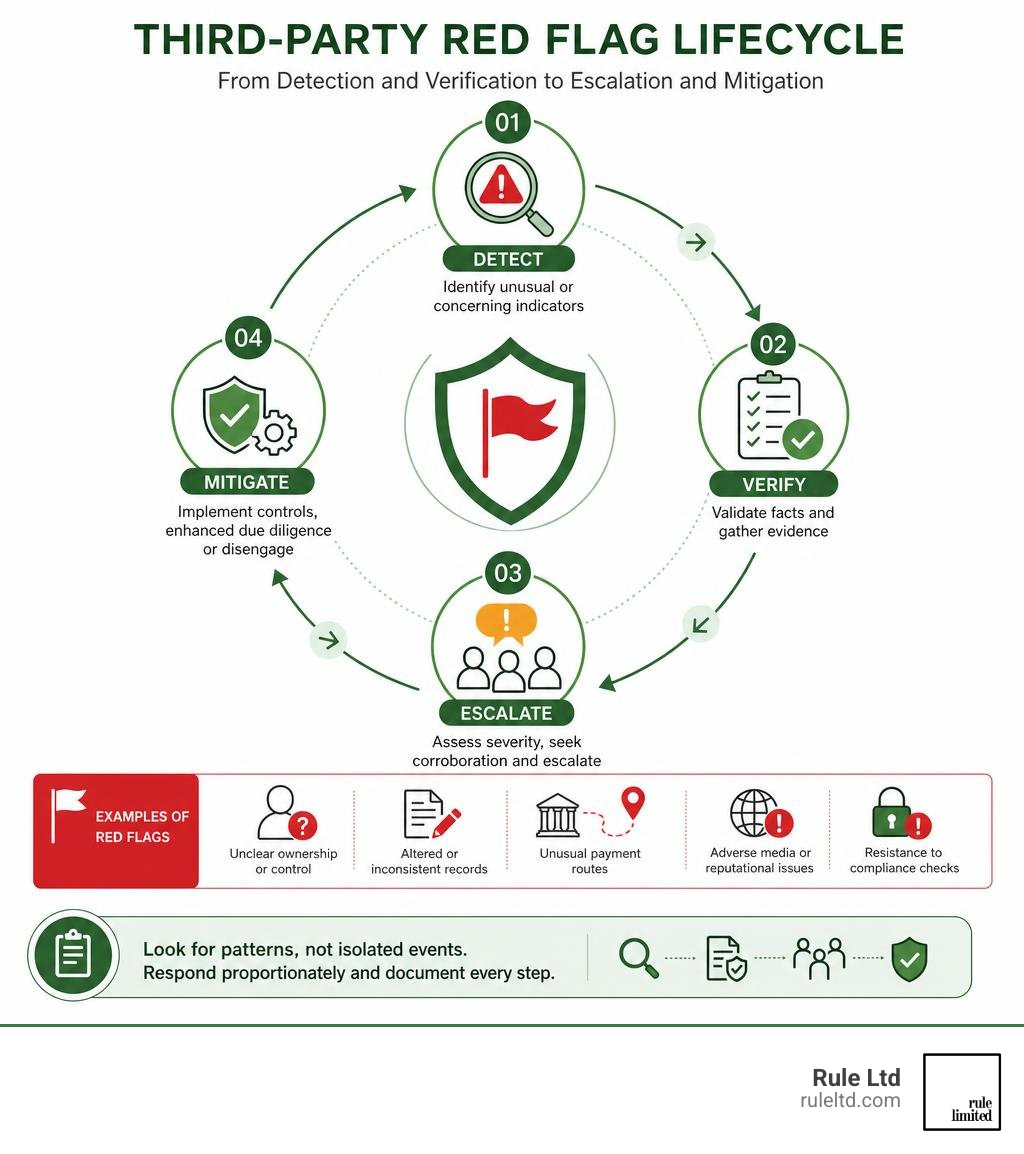
Structural Warning Signs: Defining Early Risk Across Partnerships
In commercial counterparty assessment, risk is rarely binary. Practitioners must differentiate between an anomalous data point requiring clarification and a systemic indicator of operational compromise. Cognitive bias, particularly confirmation bias during high-stakes procurement or investment cycles, frequently leads teams to dismiss friction points as administrative oversights.
According to FATF guidance on risk indicators, effective risk management requires identifying patterns of behaviour and transactional traits rather than evaluating individual events in a vacuum. A comprehensive evaluation framework ensures diagnostic signals are categorised systematically:
| Indicator Category | Diagnostic Red Flag | Non-Negotiable Deal-Breaker | Immediate Action Required |
|---|---|---|---|
| Ownership Structure | Complex offshore holding entities without commercial rationale | Confirmed presence of a sanctioned individual on OFAC, UK, or EU lists | Halt onboarding; initiate formal escalation |
| Corporate Governance | Frequent, unexplained changes in senior management or registered address | Refusal to disclose the ultimate natural person behind an entity | Deploy source corroboration; pause approvals |
| Financial Integrity | Sudden divergence between reported turnover and industry benchmarks | Documented fraud convictions or active debarment by multilateral institutions | Escalate to legal counsel; reject engagement |
| Operational Conduct | Subcontracting portions of delivery to unverified secondary suppliers | Direct involvement in forced labour or prohibited cross-border jurisdictions | Issue contractual stop-notice; terminate review |
Distinguishing Deal-Breakers from Initial Red Flag Identification
A red flag functions as an evidential trigger. It signals that an entity’s structure or commercial activity exhibits characteristics outside standard operating baselines, requiring diagnostic confrontation. In contrast, a deal-breaker is an explicit, non-negotiable boundary, such as a direct breach of the UK Bribery Act, the Foreign Corrupt Practices Act (FCPA), or statutory provisions under the Modern Slavery Act 2015 s.54.
When conducting What is Third Party Due Diligence, compliance officers must maintain behavioural consistency. While an isolated administrative delay may be resolved through dialogue, evasive conduct upon direct questioning indicates structural dysfunction.
Interpersonal Parallels in Corporate and Financial Risk
Organisational dysfunction mirrors interpersonal warning signs. Where human relationships break down over boundary violations, obscured histories, and power imbalances, commercial counterparts exhibit analogous behaviours through evasive communication, audit resistance, and structural opacity.
As noted in Investopedia’s financial red flag guide, financial warning signs such as deteriorating profit margins, debt imbalances, or litigation buried in reporting footnotes serve as clear diagnostic markers of broader operational distress.

7 Critical Pillars of Third-Party Red Flag Identification
1. Opaque Corporate Ownership and Hidden Beneficial Owners
Concealing beneficial ownership remains the primary mechanism for circumventing regulatory controls. Intermediaries often deploy shell companies, corporate vehicles incorporated in secrecy jurisdictions, and nominee director arrangements to mask illicit influence.
Under global transparency mandates and domestic frameworks such as the Economic Crime and Corporate Transparency Act 2023 (ECCTA), understanding corporate hierarchies is essential. Conducting an Ultimate Beneficial Owner Check allows compliance practitioners to unwind layered offshore holding structures and identify the true natural persons exerting control.
2. Regulatory Scrutiny, Sanctions Violations, and Political Exposure
Direct exposure to designated individuals or entities subject to Office of Foreign Assets Control (OFAC), UK Office of Financial Sanctions Implementation (OFSI), or European Union asset freezes presents severe operational and legal liability. Beyond explicit list matches, organisations must evaluate indirect risk under the OFAC 50% Rule and parallel European provisions.
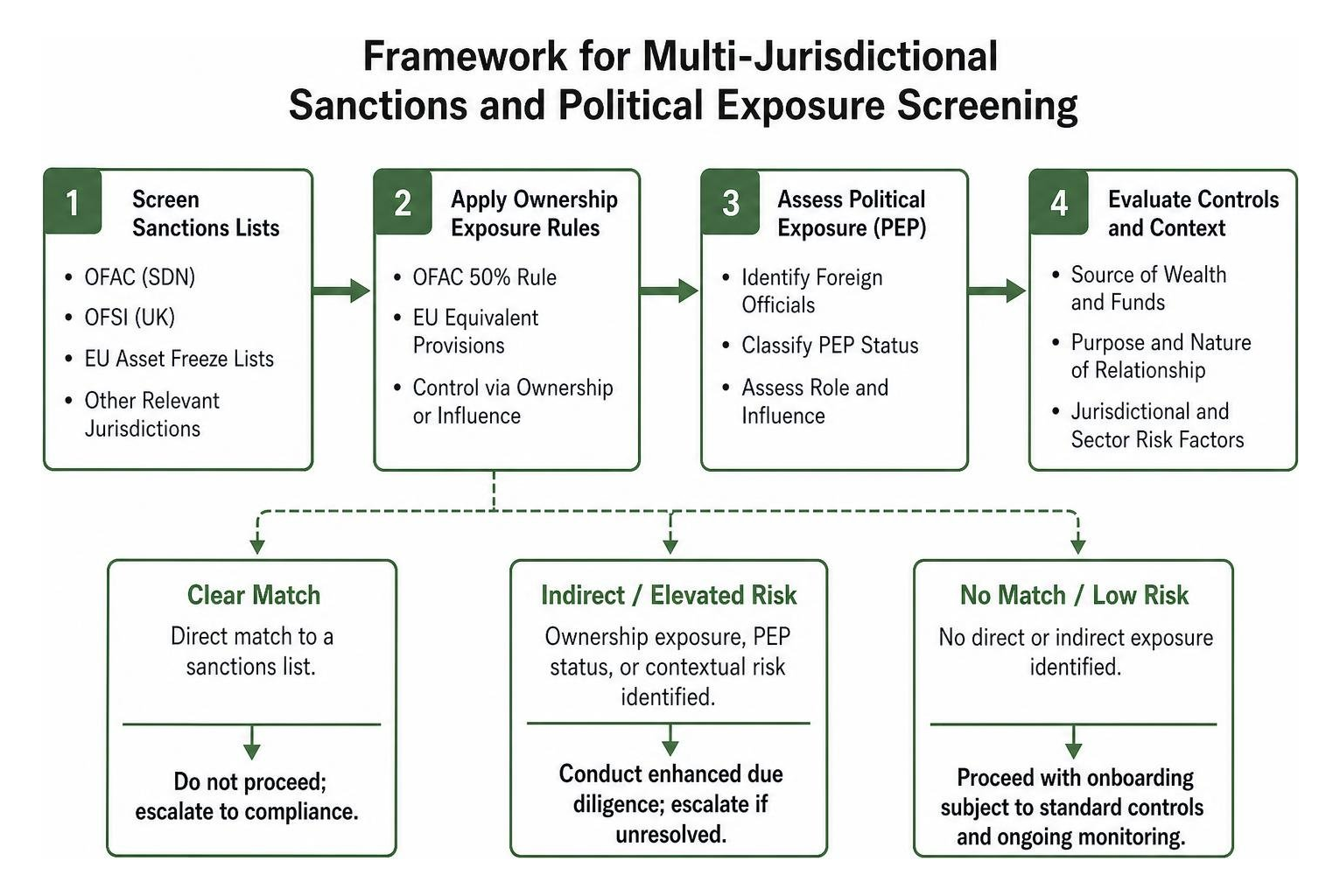
Furthermore, business interactions involving foreign officials require thorough PEP Identification and Classification to mitigate corruption risks. Integrating proactive Sanctions Risk Management ensures that export control restrictions and secondary sanctions vulnerabilities are captured before commercial execution.
3. Financial Statement Inconsistencies and Document Alterations
Financial statements must withstand forensic review. Discrepancies between cash flow and recognised revenue, abrupt debt-to-equity spikes, or irregular vendor invoicing often precede commercial insolvency or reveal underlying balance sheet manipulation.
Parallel standards apply when detecting synthetic documentation. As detailed in the FTC Red Flags Rule for business, businesses must detect altered identity records, inconsistent operational addresses, and unverified filings. In the United States alone, an estimated nine million individuals experience identity theft annually, illustrating the prevalence of compromised credentials and forged identity patterns across enterprise channels.
4. Severe Adverse Media and Documented Reputational Risk
Open-source and unstructured media intelligence often reveals regulatory investigations years before formal convictions occur. Serious allegations concerning environmental misconduct, child labour violations under supply chain frameworks like Germany’s Lieferkettensorgfaltspflichtengesetz (LkSG) or the US Uyghur Forced Labor Prevention Act (UFLPA), and state-level corruption necessitate rigorous validation.
Applying an established Reputational Risk Management Checklist helps organisations screen out irrelevant coverage while escalating genuine integrity concerns.
5. Inadequate Data Governance and Cyber Vulnerabilities
A third party’s digital architecture represents an extension of your own enterprise boundary. Vendors operating legacy systems, unencrypted communications, or substandard access governance introduce significant operational risk.
Executing a dedicated Third-Party Cybersecurity Risk Assessment identifies vulnerabilities in data residency, sub-processor security protocols, and compliance with statutory data privacy standards.
6. Anomalous Supply Chain Routing and Cross-Border Trade Discrepancies
Illicit trade networks frequently rely on transshipment hubs, Free Trade Zones (FTZs), and opaque logistics corridors to obscure provenance. Warning signs include cargo descriptions that contradict manifest classifications, switching Bills of Lading mid-voyage, unjustified Letters of Indemnity, and trade routes that circumvent standard shipping lanes to bypass trade restrictions.
Verifying product origin and physical transit integrity protects businesses from trade-based money laundering and customs enforcement actions.
7. Resistance to Compliance Audits and Contractual Evasion
A reliable counterparty readily accommodates reasonable compliance verification. Objections to standard audit clauses, demands for broad confidentiality waivers that conceal subcontracting arrangements, or reluctance to provide source-of-wealth documentation indicate structural non-compliance.
When a prospective vendor displays audit hostility, implementing EDD for High-Risk Entities is necessary to establish baseline transparency before contract finalisation.

Moving from Detection to Strategic Risk Mitigation
Embedding Continuous Red Flag Identification Across Vendor Lifecycles
Due diligence does not conclude upon contract execution. Corporate structures evolve, ownership stakes transfer, and regulatory lists update continuously. Enterprises must transition from static onboarding checks to dynamic, ongoing oversight.
Deploying Vendor Compliance Monitoring combined with calibrated Real-Time Monitoring Alerts ensures that emerging litigation, corporate changes, or newly imposed sanctions are flagged immediately.
Conducting Rigorous Investigative Analysis
When preliminary screening surfaces unresolved inconsistencies, automated keyword tools cannot substitute for forensic human investigation. Disentangling beneficial ownership, verifying local operational presence, and contextualising adverse intelligence require human analysts with deep jurisdictional expertise.
Initiating proportionate Enhanced Due Diligence equips decision-makers with the defensible intelligence needed to engage or disengage safely.
Frequently Asked Questions About Third-Party Warning Signs
What is the difference between a red flag and an immediate deal-breaker?
Risk calibration distinguishes between diagnostic indicators that warrant proportionate inquiry and non-negotiable boundaries that trigger contract termination. A diagnostic anomaly, such as opaque sub-contracting or sudden balance-sheet divergence, necessitates enhanced evidential corroboration. Conversely, confirmed statutory breaches, such as direct sanctions designations, debarment by multilateral development banks, or violations under the UK Bribery Act, establish immediate legal barriers to engagement.
How should a compliance team react when a vendor exhibits multiple low-level red flags?
Individual low-level anomalies across corporate governance, logistics, or financials frequently indicate systemic operational risk when evaluated in aggregate. Compliance teams should aggregate these indicators, initiate targeted inquiries to secure primary source documentation, and require formal remediation protocols before advancing commercial commitments.
When is basic screening insufficient to resolve detected warning signs?
Automated database screening fails when counterparties operate across high-risk jurisdictions, utilise multi-tiered corporate layers, or maintain undisclosed ties to state entities. In such circumstances, human-led investigative due diligence is necessary to establish ultimate beneficial ownership, verify local physical operations, and uncover off-balance-sheet liabilities.
Conclusion
Systematic third-party risk management relies on structured inquiry, evidential corroboration, and disciplined judgment. Rather than relying solely on automated scoring algorithms, Rule Ltd provides human analyst investigations that deliver clear corporate intelligence across international jurisdictions.
We deliver fixed-price, cost-certain reports with transparent timelines, completing screening assessments within two to three working days and enhanced due diligence investigations in approximately five working days. To safeguard your enterprise, review our comprehensive Third Party Due Diligence capabilities.
Note: The analysis provided in this article is for informational purposes only and does not constitute legal advice. Regulatory compliance requirements vary by jurisdiction and require case-by-case assessment by qualified legal and compliance professionals.
Sources
- Financial Action Task Force (FATF) Guidance on Risk-Based Due Diligence
- U.S. Department of the Treasury, Office of Foreign Assets Control (OFAC) Sanctions Frameworks
- Federal Trade Commission (FTC) Red Flags Rule
- Investopedia Guide to Financial Red Flags
- Economic Crime and Corporate Transparency Act 2023 (UK)
- Modern Slavery Act 2015 s.54 (UK)