
Supplier Risk Evaluation Starts with Exposure, Not a Questionnaire
A defensible supplier risk evaluation ranks each supplier by the harm its failure or misconduct could cause, then tests the evidence behind that risk rating. Start by mapping the legal entity, beneficial ownership, country exposure, service or product criticality, spend concentration, and access to data or systems.
Then assess the risk areas that matter:
- Financial resilience: liquidity, debt pressure, late filings, profit warnings, and reliance on fragile subcontractors.
- Operational continuity: single-source dependency, capacity constraints, quality history, delivery performance, and recovery plans.
- Compliance and integrity: sanctions, bribery, fraud, forced labour, export controls, and ownership opacity.
- Cybersecurity and data: system access, data location, incident history, and subcontractor controls.
- Reputational, ESG, and geopolitical exposure: adverse media, labour practices, environmental harm, trade restrictions, and regional instability.
The point is not to create one neat score and move on. A low-spend supplier in a high-risk jurisdiction, or one that provides a hard-to-replace component, may need deeper review than a larger but easily substituted supplier. Self-completed questionnaires can help, but they are a starting point rather than proof. Match the depth of due diligence to the supplier’s real exposure, document the evidence, and set clear actions where concerns emerge.
This is a commercial and compliance judgement, not legal advice. Requirements under regimes such as the UK Bribery Act 2010, the Modern Slavery Act 2015, sanctions rules, and the UFLPA depend on the facts, entities, supply chain, and jurisdictions involved.
Defensible supplier risk evaluation relies on analyst-led due diligence into counterparties, suppliers, intermediaries, ownership structures, sanctions exposure, and hidden compliance liabilities.
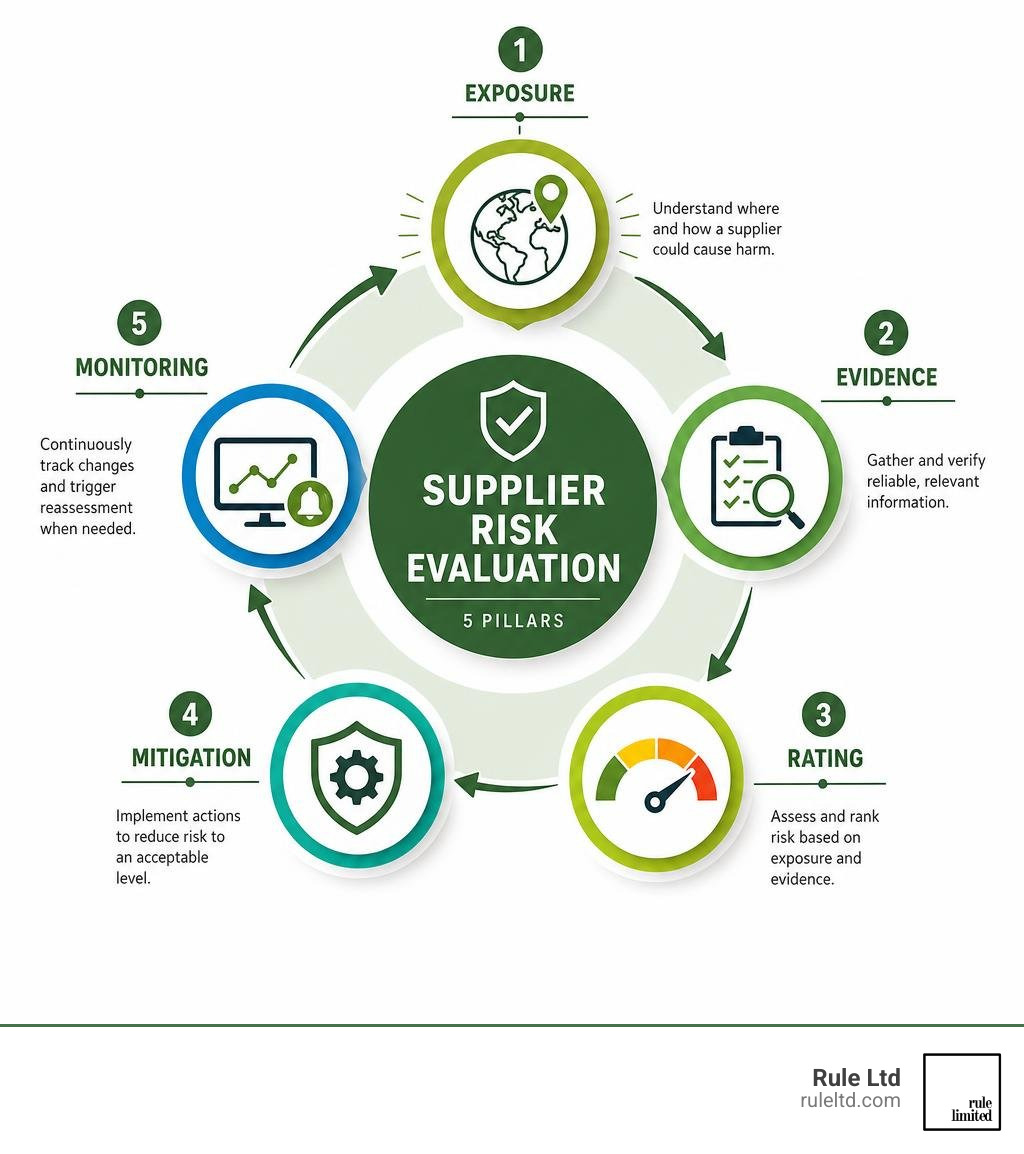
Core Dimensions of Modern Supplier Risk Evaluation
Global procurement networks operate under acute operational and legal volatility. Supply chain disruptions cost companies substantial annual revenue growth potential, turning supplier governance into an enterprise imperative. Evaluating a counterparty requires looking beyond basic solvency. A robust framework measures multiple operational vectors simultaneously to establish whether a trading partner can perform securely over the contract lifecycle.

Recent adaptive decision-making research demonstrates that static supplier scorecards fail because risk profiles shift dynamically across interconnected operating environments. When assessing enterprise exposure, organisations must address balance sheet fragility, physical bottlenecks, cross-border regulatory liabilities, and emerging ESG Reputational Risk to build an accurate counterparty profile.
Financial, Operational, and Geopolitical Indicators
Financial fragility remains a primary leading indicator of downstream operational failure. Research from Moody’s indicates that over 1,100 automotive suppliers alone are flashing active warning signals of financial distress. Standard evaluation methods track fundamental liquidity ratios, working capital cycles, and debt-service coverage. However, backward-looking statutory filings often mask sudden cash-flow deteriorations, making access to current management accounts, debtor concentrations, and credit default trajectory crucial for critical contracts.
Operational metrics focus on single-source dependencies, site-level capacity constraints, quality discrepancy rates, and historical delivery reliability. An operational failure often compounds when secondary suppliers lack required certifications or technical tooling.
Geopolitical risks have escalated from secondary concerns to core procurement variables. A survey by Thomson Reuters revealed that 76% of trade professionals view tariffs and protectionist measures as permanent fixtures of international commerce. Assessing geopolitical exposure demands granular geographic screening. Teams must track exposure to cross-border tariff schedules, export restrictions, and regional infrastructure vulnerabilities through proactive Vendor Risk Assessment Geopolitical Screening.
Regulatory Compliance, Cyber, and Reputational Vectors
The regulatory perimeter for enterprise supply chains has expanded significantly under statutory frameworks such as the UK Bribery Act 2010, the US Foreign Corrupt Practices Act (FCPA), the Corporate Sustainability Due Diligence Directive (CSDDD), the German Supply Chain Act (LkSG), and the Uyghur Forced Labor Prevention Act (UFLPA). In the UK, the failure to prevent fraud offence introduced by the Economic Crime and Corporate Transparency Act 2023 (ECCTA) places direct corporate liability on organisations whose associated persons, including suppliers and agents, commit fraud intended to benefit the business.
Compliance reviews must trace multi-layered beneficial ownership structures to identify sanctions exposure under OFAC, OFSI, and EU frameworks, particularly concerning the 50% aggregate ownership rule and minority politically exposed person (PEP) shareholdings. Conducting thorough Supplier Reputational Risk Due Diligence verifies that adverse media, illicit market activities, and regulatory penalties are identified before onboarding.
Simultaneously, third-party network access creates substantial attack surfaces. Reviewing a supplier’s information governance requires verifying data encryption standards, access privilege boundaries, sub-processor hosting locations, and external vulnerability exposure through a dedicated Third-Party Cybersecurity Risk Assessment.
Supplier Risk Assessment vs Vendor Risk Assessment
Evaluating external commercial counterparties requires distinguishing between service-oriented vendors and physical supply chain partners, as their operational exposure, statutory triggers, and disruption profiles diverge considerably.
Engagements with service providers, professional consultancies, software platforms, and digital infrastructure entities centre primarily on data governance, intellectual property protection, regulatory licensing, and information security standards such as SOC 2 and ISO/IEC 27001.
In contrast, physical supply networks spanning raw materials, precision manufacturing, and multi-tier logistics demand scrutiny over production continuity, deep subcontracting tiers, labour standards, trade sanctions enforcement, and customs integrity.
| Dimension | Supplier Risk Assessment | Vendor Risk Assessment |
|---|---|---|
| Primary Scope | Physical goods, raw materials, manufacturing, logistics, and multi-tier sub-suppliers | IT services, professional services, software providers, and outsourced business processes |
| Dominant Risk Vectors | Operational continuity, trade tariffs, single-sourcing, forced labour, quality defect rates, and solvency | Cybersecurity vulnerabilities, data breaches, regulatory licensing, confidentiality, and SOC compliance |
| Key Regulatory Drivers | UFLPA, CSDDD, LkSG, Modern Slavery Act 2015 s.54, UK ECCTA 2023, and customs regulations | GDPR, UK Data Protection Act, DORA, CCPA/CPRA, and sector-specific financial conduct rules |
| Verification Focus | Site audits, material provenance, beneficial ownership, export licences, and financial liquidity | Penetration testing reports, ISO/SOC certifications, data processing agreements, and access controls |
| Disruption Impact | Production line shutdowns, delivery delays, inventory stockouts, and customs detentions | Data breaches, privacy regulatory fines, operational software downtime, and confidentiality leaks |
Organisations managing complex operations deploy tailored assessment mechanisms for both categories within their overarching Third-Party Risk Assessment architecture.
Structured Methodology for Defensible Supplier Risk Evaluation
Executing an objective supplier evaluation requires robust analytical frameworks rather than ad-hoc vendor questionnaires. Relying strictly on basic office spreadsheets, a practice documented across 92% of manufacturing firms in industry research, creates substantial gaps in evidence verification.
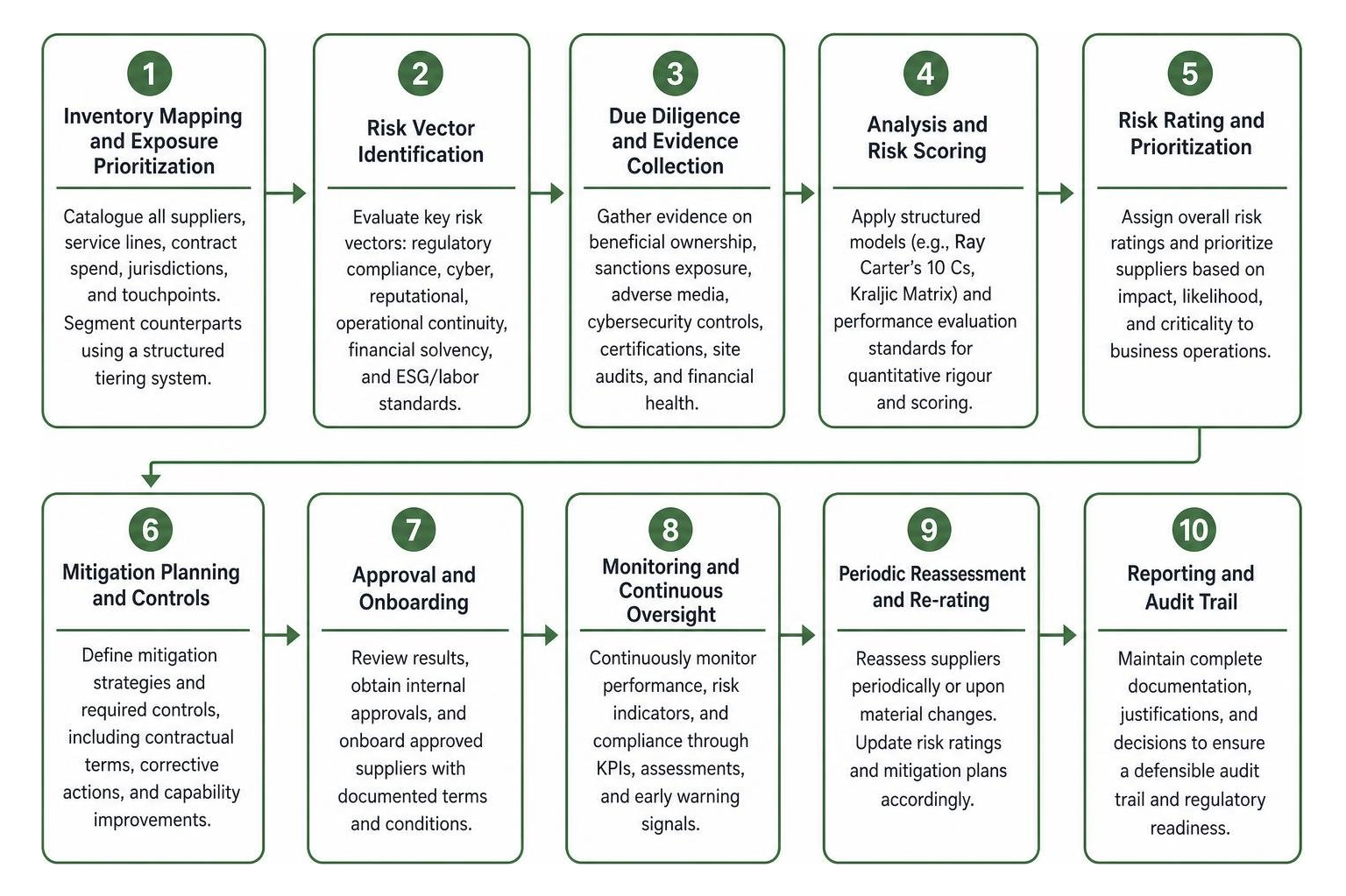
A defensible evaluation architecture applies structured models, such as Ray Carter’s 10 Cs (Competency, Capacity, Commitment, Control, Cash, Cost, Consistency, Culture, Clean, Communication) and the Kraljic Portfolio Matrix, while integrating empirical defense performance evaluation standards for quantitative rigour. Organisations standardise onboarding governance using an established Corporate Due Diligence Checklist for Vendors and Partners.
Inventory Mapping and Exposure Prioritisation
Rigorous evaluation begins by cataloguing active suppliers, service lines, direct contract spend, operating jurisdictions, and operational touchpoints. Counterparties are segmented into risk categories using a structured criticality tiering system:
- Tier 1 (High Criticality / Gold): Suppliers providing critical sole-source components, handling sensitive intellectual property, operating in high-risk corruption or forced-labour jurisdictions, or generating high annual contract expenditure.
- Tier 2 (Medium Criticality / Silver): Vendors with moderate spend, readily available commercial substitutes, or standardised manufacturing specifications in stable jurisdictions.
- Tier 3 (Low Criticality / Bronze): Commoditised, off-the-shelf service providers with minimal spend and zero integration with critical systems or customer data.
Where elevated risk markers appear, such as complex offshore holding structures or politically connected directors, organisations escalate the entity to Enhanced Due Diligence before committing capital.
Calibrating Data in Supplier Risk Evaluation
Raw assessment scores can be misleading if historical data is treated without context. Rigorous evaluation frameworks apply age-weight decay to performance infractions, ensuring recent quality discrepancies or delivery delays carry greater mathematical significance than historical events that have been remediated.
Furthermore, compliance teams avoid reliance on unverified self-assessments. Self-reported questionnaires often introduce confirmation bias and conceal operational vulnerabilities. For an evaluation to withstand regulatory and audit scrutiny, primary source documentation must be independently verified. Overcoming Third-Party Risk Assessment Failures That Leave Vendor Exposure Unverified requires cross-referencing company filings, litigation databases, export control lists, and local language public registries.
Mitigation Workflows and Contractual Remedies
Once exposure is quantified, structured risk treatment strategies must be established. Research from The Hackett Group indicates that 44% of services organisations select risk avoidance as their primary mitigation strategy, whereas manufacturing firms lean toward operational risk reduction and diversification.
Mitigation controls are formalised through enforceable contractual provisions, including:
- Parent Company Guarantees and Performance Bonds: Securing balance sheet backstops from ultimate parent entities when contracting with thinly capitalised subsidiaries or Special Purpose Vehicles (SPVs).
- Financial Distress Schedules: Contractual clauses defining specific financial distress triggers (such as late statutory filings, material debt defaults, or credit rating downgrades) that grant audit rights or step-in options.
- Corrective Action Plans (CAPs): Structured remediation plans with binding milestones for non-critical quality, labour, or security deficiencies.
- Subcontractor Transparency Mandates: Requirements for prime contractors to disclose and seek approval for material changes in Tier-2 and Tier-3 suppliers.
Integrating these controls within broader Risk Mapping Scenario Planning Supply Chains initiatives ensures the enterprise maintains practical options if a counterparty falters.
Transitioning from Periodic Audits to Continuous Risk Surveillance
Annual point-in-time audits become obsolete shortly after completion. Corporate structures change, sanctions lists update daily, beneficial owners divest or acquire shares, and financial health can deteriorate rapidly between reporting cycles.
Effective compliance functions run systematic continuous monitoring programmes. Continuous intelligence surveillance tracks real-time signals, including:
- Global sanctions and export restriction list updates (OFAC, OFSI, EU, UN).
- Adverse regulatory actions, fines, and environmental enforcement notices.
- Material legal filings, corporate insolvencies, and court judgments.
- Media coverage alleging bribery, fraudulent invoicing, or labour abuses.
- Significant changes in ultimate beneficial ownership (UBO) or executive leadership.
Integrating continuous Vendor Compliance Monitoring alongside automated Real Time Monitoring Alerts ensures compliance teams receive immediate notice when a partner’s risk posture shifts, avoiding unexpected supply disruptions or regulatory liability.
Overcoming Data Blindspots in Supplier Risk Evaluation
Enterprise risk frequently originates deep within downstream supply chains rather than with prime contractors. Tier-2 sub-assemblers, commodity processors, and outsourced logistics providers often operate in opaque jurisdictions with limited regulatory transparency.
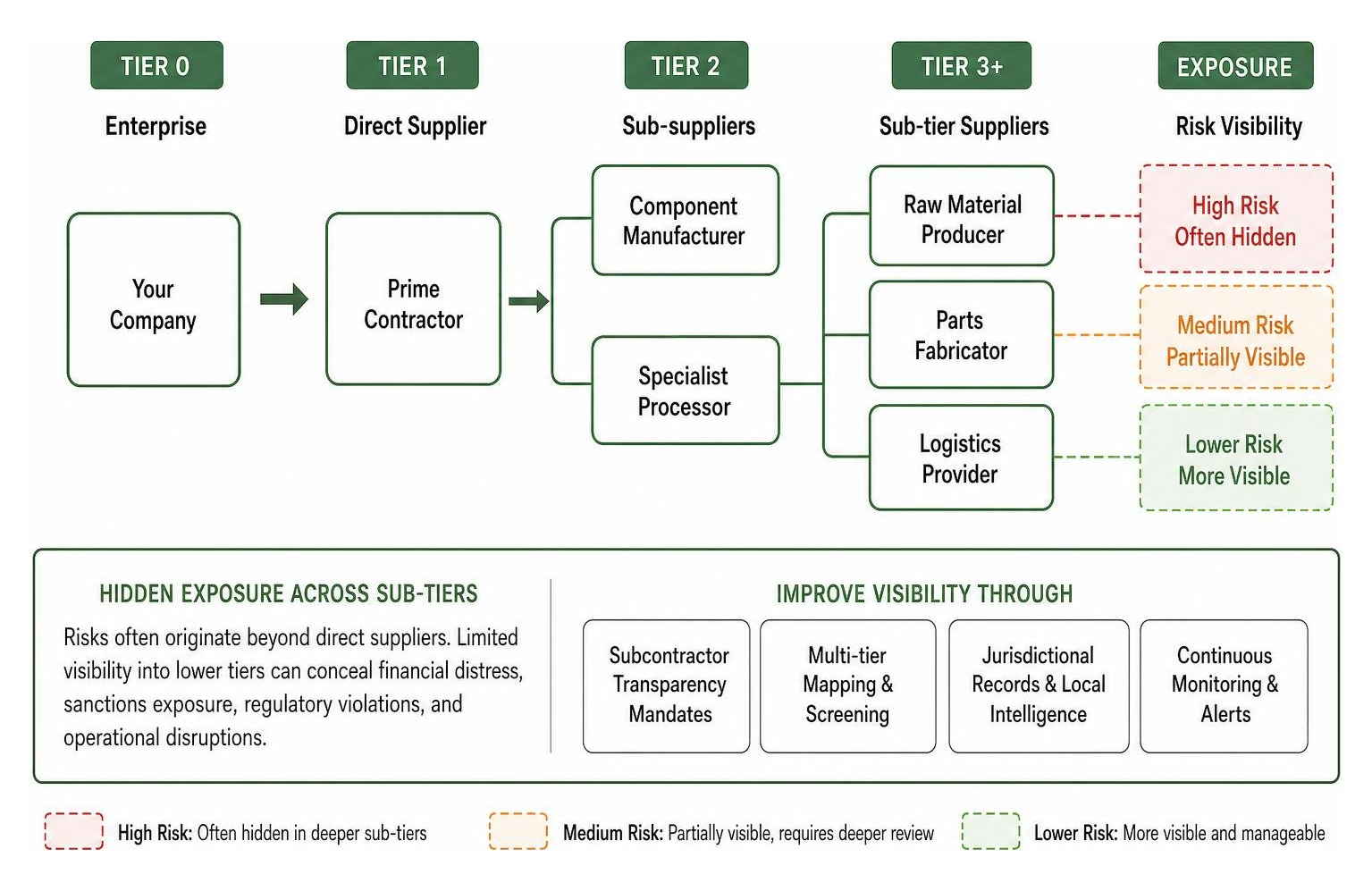
Uncovering vulnerabilities in multi-tiered supply chains requires investigative due diligence. Standard commercial databases often miss regional corporate linkages, local shell entities, and disguised state ownership. Overcoming these blindspots requires examining jurisdictional records, regional corporate registries, and on-the-ground intelligence sources to manage Supplier Security Risk Managing Risks Beyond Borders.
Frequently Asked Questions About Supplier Risk Evaluation
How often should an enterprise conduct a supplier risk evaluation?
High-criticality and high-spend suppliers (Tier 1) should undergo comprehensive re-evaluation annually, supplemented by continuous screening for sanctions, adverse media, and material corporate changes. Medium-risk suppliers (Tier 2) are typically reviewed every two to three years. In addition to scheduled cycles, event-driven assessments should occur immediately upon material trigger events, such as mergers, acquisitions, regulatory investigations, credit downgrades, or shifts in key subcontractors.
What are the main red flags in a supplier financial risk assessment?
Critical financial warning signals include recurring delays in filing statutory annual accounts, negative working capital trends, rapid turnover of chief financial officers or external auditors, significant spikes in debt-service costs, qualified audit opinions, and emerging county court judgments or payment defaults with sub-tier vendors.
How does human-led intelligence improve third-party risk verification?
Algorithmic screening tools and compliance software can aggregate data, but they often produce false positives, misidentify entities in jurisdictions with non-Latin scripts, and fail to interpret nuanced political and corporate connections. Human analysts review local-language registries, evaluate complex multi-layered shareholdings, examine beneficial ownership thresholds, and place findings in appropriate jurisdictional context to produce legally defensible risk intelligence.
Conclusion
Managing supply chain exposure requires proactive, evidence-based oversight rather than passive checklist ticking. An effective supplier risk evaluation framework identifies operational, financial, and compliance vulnerabilities early, allowing organisations to protect their operations, reputation, and commercial performance.
Rule Ltd provides independent, analyst-driven intelligence to verify high-risk counterparties, map complex corporate ownership, and uncover hidden compliance liabilities. Our team delivers clear, cost-certain reports quoted before work begins, with screening assessments completed in two to three working days and enhanced corporate intelligence delivered in approximately five working days. To review how structured counterparty due diligence can support your compliance and procurement functions, explore our Third-Party Due Diligence services.
Sources
- adaptive decision-making research
- defense performance evaluation standards
- Foreign Corrupt Practices Act (FCPA) (15 U.S.C. § 78dd-1)
- UK Bribery Act 2010
- UK Economic Crime and Corporate Transparency Act 2023 (ECCTA)
- EU Corporate Sustainability Due Diligence Directive (CSDDD)
- US Uyghur Forced Labor Prevention Act (UFLPA)
- UK Modern Slavery Act 2015 s.54
- German Supply Chain Due Diligence Act (Lieferkettensorgfaltspflichtengesetz – LkSG)