
Anatomy of an Actionable Due Diligence Report
A comprehensive due diligence report identifies and evaluates critical findings across five core disciplines: financial quality of earnings, unrecorded legal liabilities, verified asset title and encumbrances, operational counterparty dependencies, and integrity risks such as sanctions or PEP exposure. Acting as an evidential instrument rather than a passive data repository, an actionable due diligence report establishes the factual baseline required to navigate information asymmetry during corporate acquisitions, joint ventures, or vendor onboarding. Understanding what is corporate due diligence and when do you need it ensures that the scope of investigation remains proportionate to the underlying transaction risk.
Effective reports establish an evidential baseline by distinguishing between validated primary documentation, self-reported management assertions, public-record filings, and intelligence gathered from human sources. Without rigorous structural discipline, vital risk signals become obscured by secondary operational narratives.
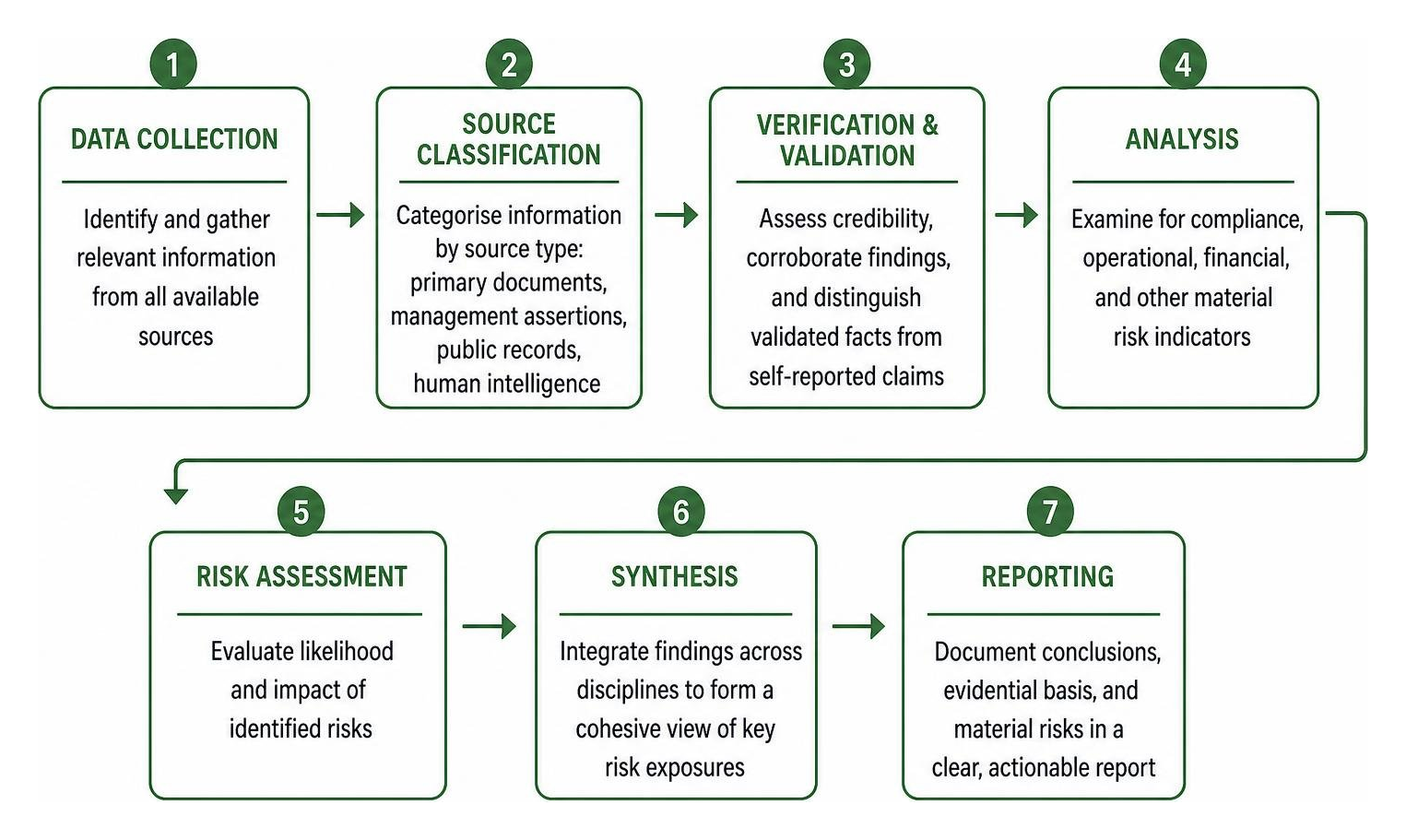
Core Sections Comprising a Comprehensive Due Diligence Report
To deliver actionable intelligence, a transaction report synthesises distinct analytical disciplines into an integrated document. The underlying review evaluates the sustainability of revenue, the legal integrity of corporate assets, and the counterpart’s operational resilience.
- Quality of Earnings and Financial Normalisation: Scrutinises historical revenue recognition policies under relevant accounting standards, isolating non-recurring gains, unrecorded liabilities, and working capital adjustments.
- Asset Ownership and Encumbrances: Verifies legal title to tangible properties, IP portfolios, and operational infrastructure, confirming the absence of undisclosed liens or adverse security interests.
- Legal, Statutory, and Regulatory Adherence: Evaluates ongoing litigation, regulatory enforcement exposure, historical filings, and compliance with anti-corruption frameworks such as the UK Bribery Act 2010 and the US Foreign Corrupt Practices Act (FCPA).
- Operational Continuity and Counterparty Dependencies: Audits key supplier agreements, customer concentration, key-person dependencies, and operational bottleneck vulnerabilities.
- Compliance and Integrity Baseline: Executes detailed integrity screening across global sanctions lists, watchlists, politically exposed persons (PEP) databases, and local regulatory registries, following standard protocols for EDD report preparation.
Executive Summaries Versus Operational Appendices
Senior executives and investment committees require immediate, decision-ready intelligence. The executive summary must distill complex legal and operational findings into clear commercial implications, supported by an explicit risk rating and structured recommendations. Conversely, technical specialists, legal counsel, and forensic accountants require comprehensive appendices containing transaction schedules, full court docket entries, complete ultimate beneficial ownership (UBO) charts, and detailed data reconciliation tables.
| Diligence Dimension | Executive Summary Focus | Detailed Appendix Disclosures |
|---|---|---|
| Financial Sustainability | Normalised EBITDA bridges, debt-like items, and material capital expenditure deficits | Full historical P&L adjustments, working capital variance schedules, and accounting policy reconciliations |
| Legal & Regulatory | Material litigation exposure, regulatory non-compliance, and change-of-control risks | Comprehensive court dockets, statutory filing chronologies, and licence verification registers |
| Integrity & Sanctions | Direct and indirect PEP exposure, sanctions touchpoints, and adverse media findings | Entity-by-entity ownership verification tables, source documentation transcripts, and registry extracts |
| Commercial Integrity | Customer and supplier concentration thresholds and unhedged contract risks | Top 20 customer contract breakdowns, supplier pricing agreements, and dependency audit logs |
Critical Risk Findings and Structural Deficiencies
The primary objective of investigative due diligence is uncovering structural vulnerabilities that threaten value creation, regulatory compliance, or enterprise continuity. Historical enforcement actions demonstrate the severe cost of inadequate counterparty scrutiny. Major multinational corporations have incurred substantial multi-million-pound regulatory penalties and criminal settlements under statutory frameworks such as the Foreign Corrupt Practices Act after failing to execute sufficient anti-corruption due diligence on third-party intermediaries managing international operating permits. Similarly, supply chain blind spots and unvetted supplier tiers routinely cause severe operational disruptions and brand contamination across international commercial networks.
Interpreting Critical Risk Findings in a Due Diligence Report
Risk findings must be prioritised by evaluating their financial severity, likelihood of regulatory enforcement, and strategic impact. Identifying material customer concentration, questionable revenue recognition practices, or undisclosed off-balance-sheet commitments requires immediate operational escalation. Transaction teams must balance technical exposures against wider governance liabilities, assessing reputational risk in due diligence alongside transactional parameters.
When transactions involve counterparties operating in high-risk sectors or opaque jurisdictions, institutions routinely mandate enhanced due diligence for high risk entities to examine whether underlying commercial structures mask systemic non-compliance.
UBO Tracing, Sanctions, and Integrity Exposures
Multi-jurisdictional transactions frequently involve complex, multi-tiered corporate holding structures designed across offshore financial centres. Unravelling these structures is necessary to identify the ultimate beneficial owners exercising control behind intermediate holding companies and nominee arrangements. Regulatory mandates enforce strict liability on organisations that transact with sanctioned entities or individuals, including exposures arising under the OFAC 50% Rule and equivalent UK/EU sanctions frameworks.
Deploying corporate intelligence investigation services ensures that corporate investigations extend beyond surface-level company registries to access primary-source public records, court archives, and localized media in the counterparty’s operating language.
- Multi-Tiered Beneficial Ownership Mapping: Tracing shareholdings across intermediate holding companies, trusts, and special purpose vehicles (SPVs) to verify ultimate individuals holding direct or indirect controlling stakes.
- Sanctions and Watchlist Verification: Cross-referencing entities, key executives, and beneficial owners against OFSI, OFAC, EU, and international sanctions and enforcement registers.
- Politically Exposed Persons (PEP) Assessment: Identifying connections to government officials, state-owned enterprises (SOEs), or close associates that introduce foreign bribery and anti-corruption risks under the UK Bribery Act and FCPA.
- Adverse Media and Reputational Screening: Reviewing local-language news sources, judicial records, and investigative journalism archives to identify unresolved financial crime allegations, labour violations, or regulatory sanction histories.
- Corporate Register and Disqualification Audits: Validating filing histories, identifying undeclared related-party transactions, and confirming the executive standing of board members and statutory directors.
Translating Findings into Defensible Governance and Valuation Adjustments

A comprehensive due diligence review provides the empirical foundation for commercial negotiations and risk mitigation. Identifying operational liabilities or regulatory exposures does not automatically necessitate deal termination. Rather, structured findings empower transaction teams to construct contractual remedies, adjust transaction terms, and ensure internal decision-making remains legally defensible.
Valuation Adjustments, Indemnities, and Conditions Precedent
Transaction teams convert confirmed due diligence findings into specific contractual safeguards within the Sale and Purchase Agreement (SPA) or counterparty onboarding contract:
- Purchase Price Adjustments: Direct reductions in headline enterprise value derived from forensic quality of earnings adjustments, unrecorded tax arrears, or mandatory post-acquisition capital expenditures.
- Specific Indemnities and Escrow Holdbacks: Segregating transactional funds into third-party escrow accounts to cover quantified exposures, such as ongoing litigation liabilities or historical tax exposures.
- Conditions Precedent (CPs): Mandating structural remediation prior to deal completion, including the pre-closing divestment of non-target entities, regulatory filings, or the acquisition of minority shareholdings to clear title.
- Representations and Warranties: Requiring counterparty principals to formally attest to the accuracy of material operational, environmental, and financial representations, supported by structured risk assessments using a third-party risk assessment checklist.
Buy-Side Scrutiny Versus Sell-Side Readiness
While buy-side due diligence focuses on risk detection and downside protection, sell-side due diligence (vendor due diligence) enables sellers to proactively address corporate deficiencies prior to marketing assets. Sellers who audit their operational records, intellectual property portfolios, and change-of-control provisions avoid value erosion during negotiations. Intellectual property verification represents a crucial component in high-growth acquisitions; major technology organisations, for instance, maintain extensive portfolios of registered patents that require rigorous title and encumbrance auditing prior to acquisition.
Proactive seller preparation mitigates the risk of catastrophic transaction failures observed in unvetted acquisitions where inadequate operational integration and compliance oversights precipitated protracted financial distress. Dealmakers frequently review published due diligence case studies to understand how structured investigations protect transaction outcomes.
Frequently Asked Questions About Investigative Due Diligence
How do confirmed issues differ from potential risks in diligence?
Confirmed issues represent verified, documented facts identified through primary evidence during the review process, such as recorded tax liens, formal regulatory fines, or documented customer cancellations. In contrast, potential risks represent unquantified exposures that require probability-weighted assessments, such as pending legislative changes, unasserted litigation claims, or ambiguous tax filing positions. Due diligence reports distinguish clearly between confirmed liabilities and theoretical risks to prevent transaction paralysis while ensuring proportionate contractual protection.
What legal implications arise from inadequate diligence reviews?
Failing to conduct reasonable due diligence exposes organisations and corporate directors to significant civil, regulatory, and criminal liability. Under strict liability regimes and statutory corporate offences, such as the UK Economic Crime and Corporate Transparency Act 2023 (ECCTA) and the UK Bribery Act 2010, maintaining documented, adequate compliance procedures is often the primary statutory defence against corporate prosecution. Inadequate counterparty review can result in substantial monetary penalties, director disqualification, and contractual rescission. However, compliance assessments must be conducted on a case-by-case basis.
How should deal teams handle unresolved information gaps?
When counterparties refuse access to critical operational records or public registries cannot yield conclusive data, transaction teams must treat unresolved gaps as elevated risk factors. Investigators document the boundaries of the review within an explicit scope limitation disclosure. Dealmakers manage remaining uncertainties by implementing targeted conditions precedent, expanding post-closing indemnity protections, securing representation and warranty insurance, or establishing structural holdbacks until the requisite verification can occur.
Conclusion
Independent due diligence reporting transforms complex corporate, financial, and regulatory data into defensible transaction intelligence. In an evolving regulatory environment governed by statutory transparency and supply chain accountability mandates, organisations cannot rely on passive, automated screening tools alone.
Rule Ltd provides comprehensive, human analyst-led investigations that combine local language expertise with rigorous public-record analysis. Our investigative reports deliver clarity and risk certainty across global jurisdictions. We operate on a fixed-price, cost-certain model, with screening reports delivered in two to three working days and enhanced corporate intelligence engagements completed in approximately five working days, fully quoted prior to work commencing.
To structure your next transaction or evaluate counterparty risk, request a custom EDD report quote to consult directly with our investigative specialists.
Sources
- UK Public General Acts, Economic Crime and Corporate Transparency Act 2023 (c. 56), Part 5: Corporate offences and information sharing.
- UK Public General Acts, Bribery Act 2010 (c. 23), Section 7: Failure of commercial organisations to prevent bribery.
- US Department of Justice & US Securities and Exchange Commission, A Resource Guide to the U.S. Foreign Corrupt Practices Act (Second Edition, July 2020).
- Financial Action Task Force (FATF), Guidance on Beneficial Ownership and Transparency of Legal Arrangements (March 2023).
- Office of Financial Sanctions Implementation (OFSI), HM Treasury, General Guidance for Financial Sanctions (Updated 2026).