
Why supply chain diversification protects modern enterprise value
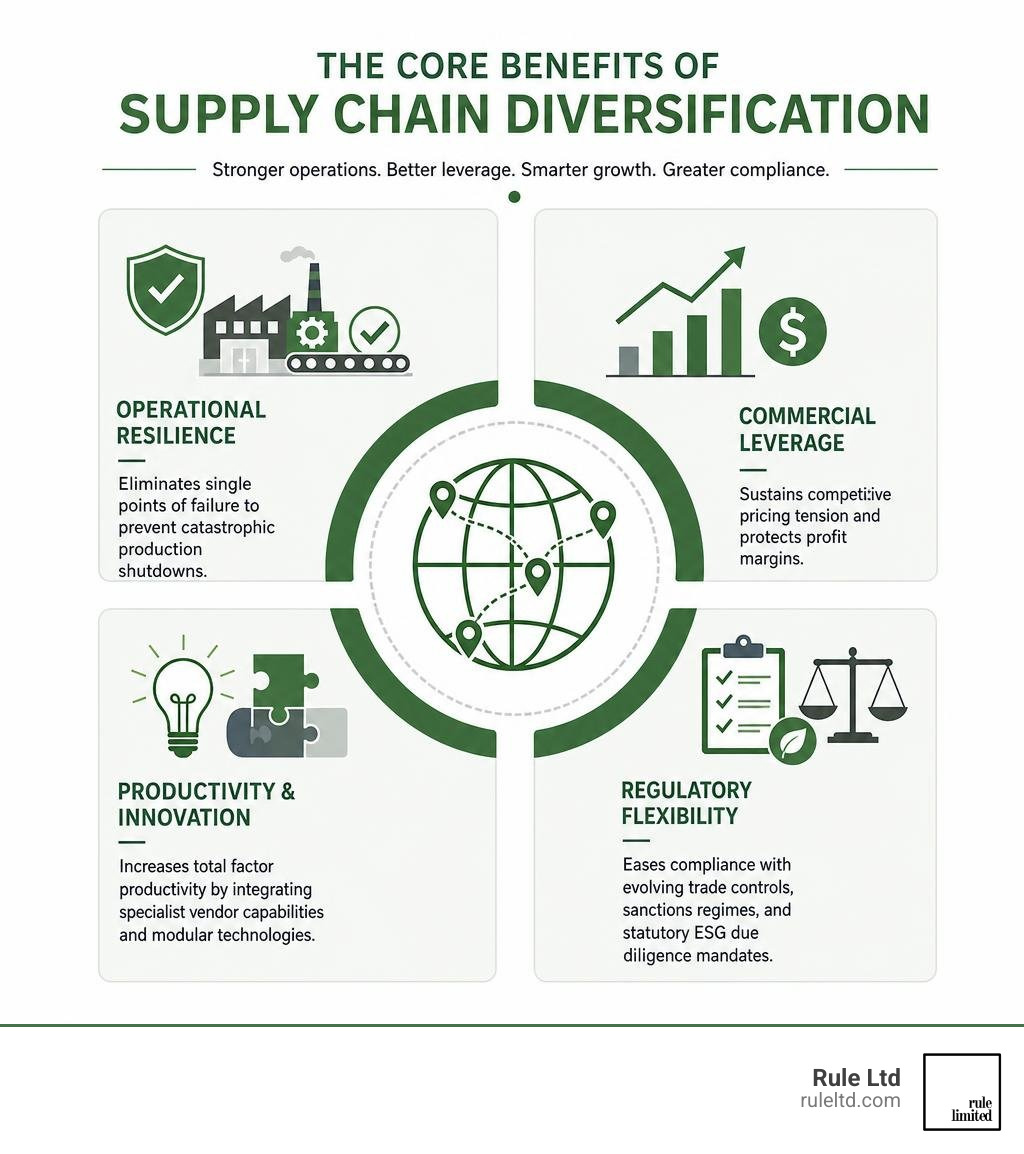
The primary benefits of supply chain diversification extend well beyond basic crisis management. By distributing sourcing across multiple qualified suppliers, geographic regions, and transport modes, organisations secure four decisive advantages:
- Operational resilience: Eliminates single points of failure to prevent catastrophic production shutdowns during localised disruptions.
- Commercial leverage: Sustains competitive pricing tension and protects profit margins by preventing supplier lock-in.
- Productivity and innovation: Increases total factor productivity by integrating specialist vendor capabilities and modular technologies.
- Regulatory flexibility: Eases compliance with evolving trade controls, sanctions regimes, and statutory ESG due diligence mandates.
Single-source procurement models prioritise short-term unit cost efficiency at the expense of enterprise stability. With global supply disruptions rising substantially and costing businesses severe volumes of unrealised annual revenue, concentration risk represents an active balance-sheet liability.
Institutional corporate intelligence and risk management practice demonstrate that the benefits of supply chain diversification rely on objective, evidence-based third-party due diligence to verify alternative counterparties before contracts are signed.
The Modern Risk Landscape: Why Single-Sourcing Fails

As of August 2026, globalised value chains engineered purely for lean, single-origin efficiency face acute structural fragilities. When commercial vessels rerouted around the Cape of Good Hope following maritime disruptions in the Red Sea corridor, transit times between Asia and Europe increased by up to 14 days. This geographic chokepoint bottleneck added significant freight inflation and disrupted just-in-time manufacturing schedules across Europe. Macroeconomic data for 2026 confirms that these sustained maritime diversions contributed 0.7 percentage points to global core goods inflation.
Relying on an isolated vendor or single geographic hub exposes an organisation to systemic shocks, as explored in our review of The Hidden Costs of Ignoring Supply Chain Risk. When a production node halts due to industrial action, power rationing, extreme weather, or regional unrest, buyers without pre-qualified secondary partners face prolonged operational paralysis. Academic analysis highlights that Why Supply Chain Diversification Is Essential for Business Resilience centres on avoiding the severe contract stickiness that prevents firms from switching producers during emergencies.
Examining the Top 13 Geopolitical Risks Supply Chain managers confront reveals that structural shocks are operational certainties that demand distributed network architecture.
Concentration Risk and the Fallacy of Low Cost Sourcing
Procurement strategies that concentrate purchasing volume with a single low-cost vendor capture marginal piece-price discounts while introducing disproportionate downside exposure. Economists measure this exposure through the Herfindahl-Hirschman Index (HHI). When a single vendor supplies more than 50% of an essential intermediate component, an enterprise crosses into critical dependency territory.
Strategic approaches for Mitigating Supply Chain Vulnerabilities in a Geopolitical Climate demonstrate that transition losses incurred when replacing an unvetted supplier during a crisis far exceed the fractional peacetime savings of single-sourcing. Network rigidities, capital immobility, and lengthy qualification cycles convert initial cost advantages into balance-sheet losses whenever disruptions occur.
Macroeconomic Fragility and Border Policy Friction
Trade developments across 2026 reflect heightened geopolitical fragmentation, statutory export controls, and tariff escalations. Sourcing critical inputs from a single foreign jurisdiction leaves cross-border operations vulnerable to retaliatory duties and import restrictions.
Organisations adopting a structured China Trade Diversification Strategy reduce their exposure to bilateral trade friction by establishing secondary production capacity in Southeast Asia, India, or nearshore European and American hubs. Distributing production across trade blocs insulates operating margins against sudden tariff increases and customs blockages.
Core Strategic Benefits of Supply Chain Diversification
Beyond defensive risk reduction, multi-vendor structures deliver direct commercial and operational dividends. Spreading volume across qualified counterparties improves Total Factor Productivity (TFP) by integrating distinct manufacturing proficiencies and eliminating single-vendor pricing monopolies.
| Operational Metric | Single-Sourced Procurement | Diversified Multi-Sourced Network |
|---|---|---|
| Pricing Leverage | Low; buyer faces high supplier switching costs | High; active competitive bidding tension |
| TFP Growth | Stagnant; dependent on single-vendor R&D | Accelerated; knowledge diffusion across partners |
| Disruption Recovery | 6 to 18 months to qualify new source | Immediate rerouting to pre-qualified vendors |
| Capacity Elasticity | Constrained by single plant capacity limits | Flexible volume scaling across partners |
| ESG & Regulatory Agility | High systemic exposure to local non-compliance | Segmented risk; rapid replacement of non-compliant nodes |
Maintaining live allocations with alternative producers preserves purchasing agility, a dynamic detailed in our analysis of the Agile Supply Chain Global Crisis. Procurement teams negotiate from strength because incumbent vendors recognise that order volume can shift to secondary partners if commercial terms or delivery standards deteriorate.
Quantifying the Operational Benefits of Supply Chain Diversification
Empirical trade models confirm that targeted supply chain diversification delivers immediate resilience without excessive overhead. A secondary supplier that increases piece prices by 3% represents sound commercial governance if an unmitigated factory closure would halt production lines for months.
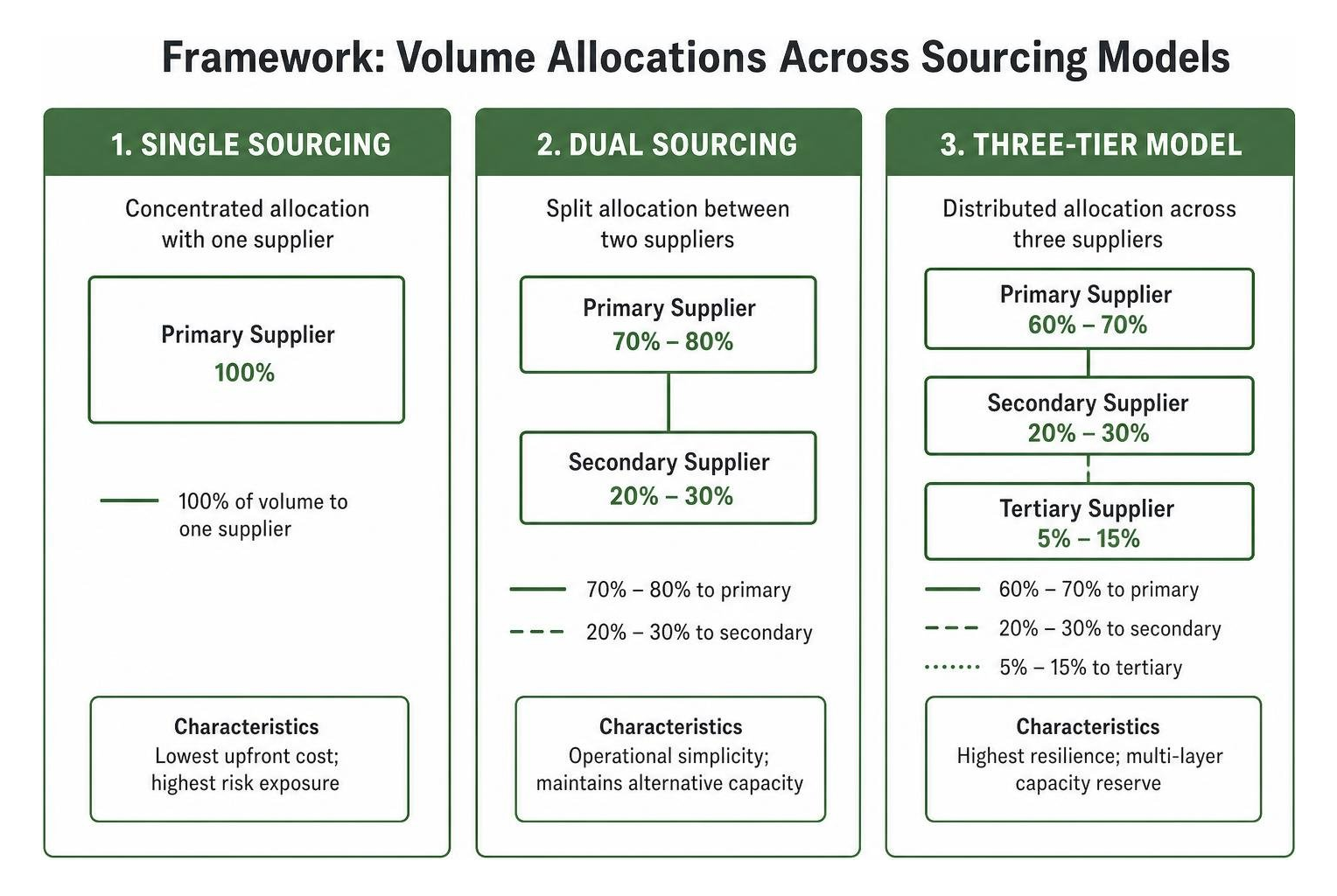
Dual-sourcing models assigning 70% to 80% of volume to a primary producer and 20% to 30% to a secondary partner maintain operational simplicity while keeping alternative facilities active. For vital assemblies, a three-tier model (60% to 70% primary, 20% to 30% secondary, and 5% to 15% tertiary) provides capacity reserves that absorb localised shocks without commercial interruption.
Unlocking ESG and Innovation: The Broader Benefits of Supply Chain Diversification

Diversification functions as an engine for collaborative engineering and sustainability performance. Engaging specialised regional suppliers provides access to novel manufacturing techniques, lower-emission materials, and proprietary processes that a single legacy vendor cannot offer.
Multi-region sourcing structures also help enterprises comply with stringent regulatory mandates, including the German Supply Chain Due Diligence Act (Lieferkettensorgfaltspflichtengesetz, LkSG), the EU Corporate Sustainability Due Diligence Directive (CSDDD), Section 54 of the UK Modern Slavery Act 2015, and the US Uyghur Forced Labor Prevention Act (UFLPA). An anonymised case study on Safeguarding Innovation A Global Tech Giants Enhanced Due Diligence Journey illustrates how deep supply chain mapping protects intellectual property and ensures strict adherence to international labour standards.
Multi-Dimensional Diversification Framework
Comprehensive resilience requires an operational model that addresses four distinct dimensions rather than relying solely on geographic relocation:
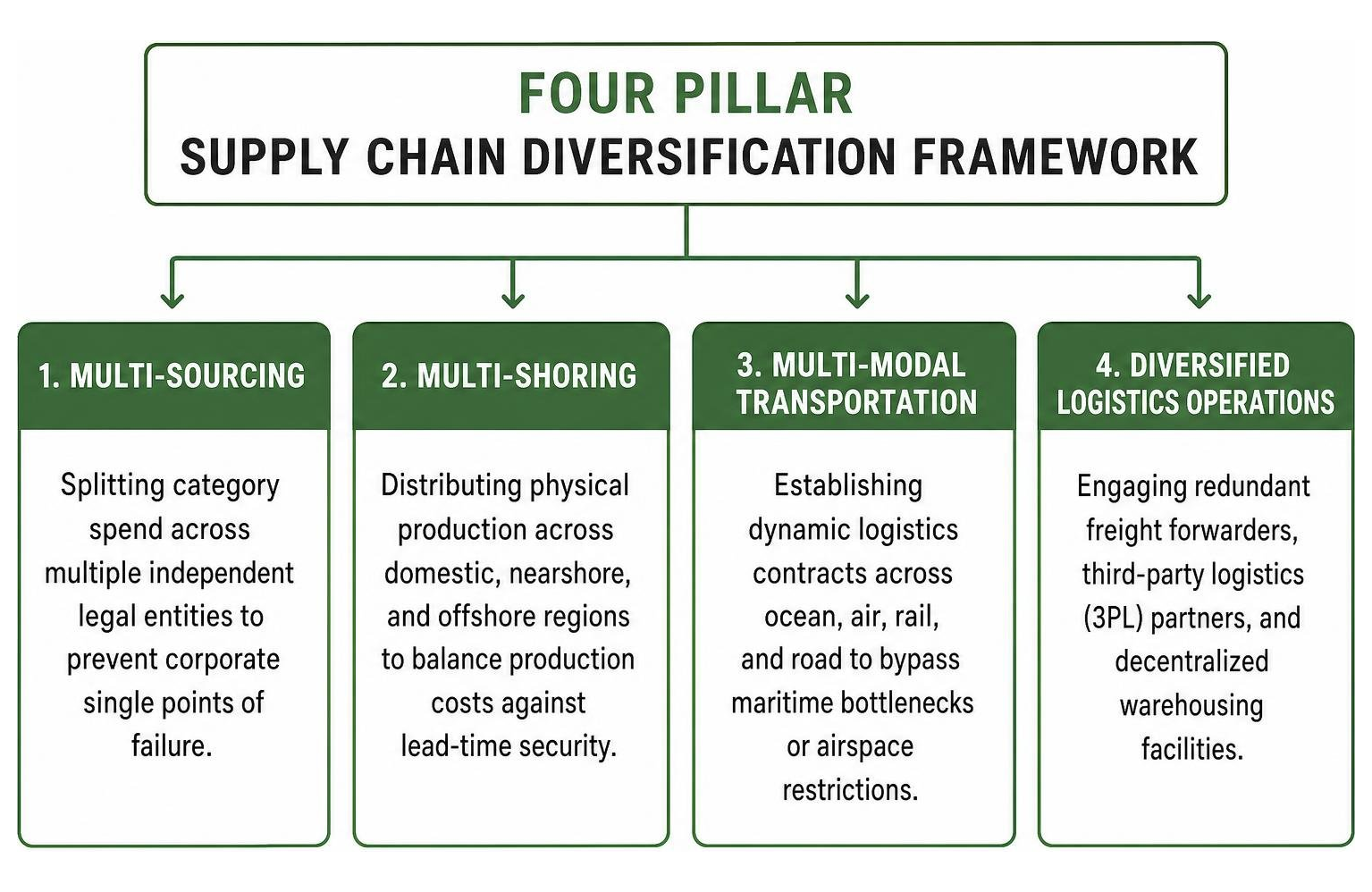
- Multi-Sourcing: Splitting category spend across multiple independent legal entities to prevent corporate single points of failure.
- Multi-Shoring: Distributing physical production across domestic, nearshore, and offshore regions to balance production costs against lead-time security.
- Multi-Modal Transportation: Establishing dynamic logistics contracts across ocean, air, rail, and road to bypass maritime bottlenecks or airspace restrictions.
- Diversified Logistics Operations: Engaging redundant freight forwarders, third-party logistics (3PL) partners, and decentralised warehousing facilities.
Navigating the China Dilemma Supplier Diversification Strategy involves blending cost-effective offshore production with regional manufacturing nodes. For enterprises in the United Kingdom and Europe, building Supply Chain Resilience UK entails coupling offshore production with domestic and European suppliers to guard against geopolitical friction .
Tiered Volume Allocation and Portfolio Optimisation
Allocating 10% to 20% of category spend to secondary or emerging suppliers establishes a live operational testbed. This allocation keeps secondary tooling active, preserves supply lines, and validates vendor performance under actual production conditions .
If a primary partner suffers an operational failure, the secondary supplier can scale production immediately, bypassing the lengthy delays of emergency onboarding.
Technology and Digital Supply Chain Moderation
Digital monitoring tools and predictive analytics enhance the benefits of physical diversification. Automated platforms track sub-tier relationships, delivery variances, and geopolitical alerts across the supplier base .
Our review of Supply Chain Risk Technology How AI and Analytics Are Transforming Risk Management highlights how predictive systems detect supplier distress, such as extended payment cycles or declining fulfilment rates, before an actual default occurs .
Governance, Compliance, and Third-Party Due Diligence
Expanding the supplier network increases operational flexibility, but it also broadens the enterprise risk perimeter. Onboarding unvetted third parties creates severe regulatory exposure under anti-bribery statutes, trade sanctions regimes, and anti-fraud legislation.
Procuring entities must enforce rigorous Third Party Due Diligence before integrating alternative vendors into enterprise resource planning (ERP) workflows. Failure to identify ultimate beneficial owners (UBOs) or offshore ownership layers risks violating OFSI and OFAC sanctions, the UK Bribery Act 2010, the US Foreign Corrupt Practices Act (FCPA), and the failure to prevent fraud offence under the UK Economic Crime and Corporate Transparency Act 2023 (ECCTA). Specific compliance matters require case-by-case assessment, and generic guidance does not constitute formal legal advice.
Screening and Evaluating Alternative Sourcing Partners
Qualifying an alternative supplier for a critical component under standard procurement cycles requires between 6 and 18 months. This timeline encompasses factory floor audits, component sample validation, financial viability analysis, and regulatory screening.
Conducting structured Vendor Risk Assessment Geopolitical Screening protects organisations from onboarding vendors tied to military end-users, state-sponsored subsidies, or forced labour corridors. Using a rigorous Corporate Due Diligence Checklist for Vendors and Partners ensures that secondary and tertiary suppliers meet regulatory and operational benchmarks prior to contract award.
Ongoing Risk Monitoring and Dynamic Vendor Auditing
Due diligence is not a point-in-time exercise. Active supply networks require continuous oversight to identify emerging integrity and operational risks. Implementing structured Vendor Compliance Monitoring ensures continuous screening against dynamic global sanctions lists, export control registries, and insolvency databases.
Proactively monitoring Supplier Reputational Risk Due Diligence allows enterprises to identify adverse media, corporate governance disputes, or environmental violations early, enabling corrective action before supply chains or corporate reputations suffer damage.
Frequently Asked Questions about Supply Chain Diversification
How long does it take to qualify an alternative supplier?
Qualifying a substitute supplier for a critical industrial component typically takes 6 to 18 months under normal operating conditions . The process requires technical capability audits, sample production runs, quality testing, and comprehensive legal and ESG compliance reviews. Attempting to qualify secondary vendors during an active supply disruption incurs premium expediting costs and elevates compliance risks.
What is the optimal allocation ratio between primary and secondary suppliers?
For most critical components, an 80/20 or 70/30 volume split between a primary and secondary supplier provides an effective balance. The primary vendor receives sufficient volume to deliver scale economies, while the secondary partner maintains active production lines. For mission-critical inputs, a three-supplier model allocating 60% to 70% to the primary, 20% to 30% to the secondary, and 5% to 15% to a tertiary partner ensures maximum operational security .
How can companies prevent vendor sprawl while diversifying?
Organisations control vendor sprawl by establishing strict category segmentation policies, maintaining centralised vendor master data, and enforcing cross-functional approval gates involving procurement, legal, finance, and quality assurance teams. Setting minimum spend thresholds and requiring formal business justifications before adding new third parties prevents operational fragmentation.
Conclusion
Supply chain diversification is a fundamental commercial discipline that drives total factor productivity, sharpens competitive pricing leverage, and safeguards enterprise continuity. Relying on single-source suppliers or unexamined geographic hubs creates balance-sheet vulnerability in a volatile global trade environment.
At Rule Ltd, we help global compliance officers, procurement leaders, and general counsel build resilient supply networks. Our human-analyst corporate intelligence and due diligence reports deliver evidence-based, defensible assessments across global jurisdictions. We provide fast, cost-certain solutions without variable fees: screening reports turn around in two to three working days, while enhanced due diligence and corporate intelligence reviews are delivered in approximately five working days, with every engagement quoted as a fixed price before work begins.
To secure your supply network against emerging vulnerabilities, commission a comprehensive Third Party Risk Assessment with our specialist intelligence team.
Sources
Academic and Industry Research:
- Economy.ac Review (2026): Why Supply Chain Diversification Is Essential for Business Resilience – Contract stickiness, macroeconomic transit bottlenecks, and multi-sourcing operational resilience.
- Herfindahl-Hirschman Index (HHI) Concentration Frameworks: Market concentration metrics, procurement dependencies, and critical single-vendor thresholds.
Statutory and Regulatory Authorities:
- UK Modern Slavery Act 2015 (Section 54): Supply chain transparency requirements and statutory reporting obligations.
- UK Bribery Act 2010: Corporate criminal liability and anti-corruption compliance controls across foreign intermediaries.
- UK Economic Crime and Corporate Transparency Act 2023 (ECCTA): Corporate attribution principles and the failure to prevent fraud offence.
- German Supply Chain Due Diligence Act (Lieferkettensorgfaltspflichtengesetz – LkSG): Human rights and environmental risk management standards.
- EU Corporate Sustainability Due Diligence Directive (CSDDD): Mandatory supply chain due diligence and risk mitigation frameworks.
- US Foreign Corrupt Practices Act (FCPA): Third-party intermediary vetting and anti-bribery enforcement.
- US Uyghur Forced Labor Prevention Act (UFLPA): Rebuttable presumption standards and sub-tier supply chain tracing requirements.
- Sanctions Regimes: Trade control and asset-freeze enforcement by the UK Office of Financial Sanctions Implementation (OFSI) and the US Office of Foreign Assets Control (OFAC).