
Core Pillars of an Effective Sanctions Compliance Programme
A defensible compliance architecture requires practical execution rather than theoretical policy manuals. Under A Framework for OFAC Compliance Commitments, the U.S. Department of the Treasury’s Office of Foreign Assets Control sets out five essential components that define operational sufficiency: senior management commitment, risk assessment, internal controls, testing and auditing, and training.
Operating cross-border commerce without continuous governance exposes an enterprise to strict liability enforcement. Establishing sound sanctions risk management demands board-level oversight and an unambiguous tone from the top. Executive leadership must grant compliance personnel direct reporting lines to leadership, structural autonomy, and sufficient operational resources to interdict commercial activity when illicit touchpoints emerge.
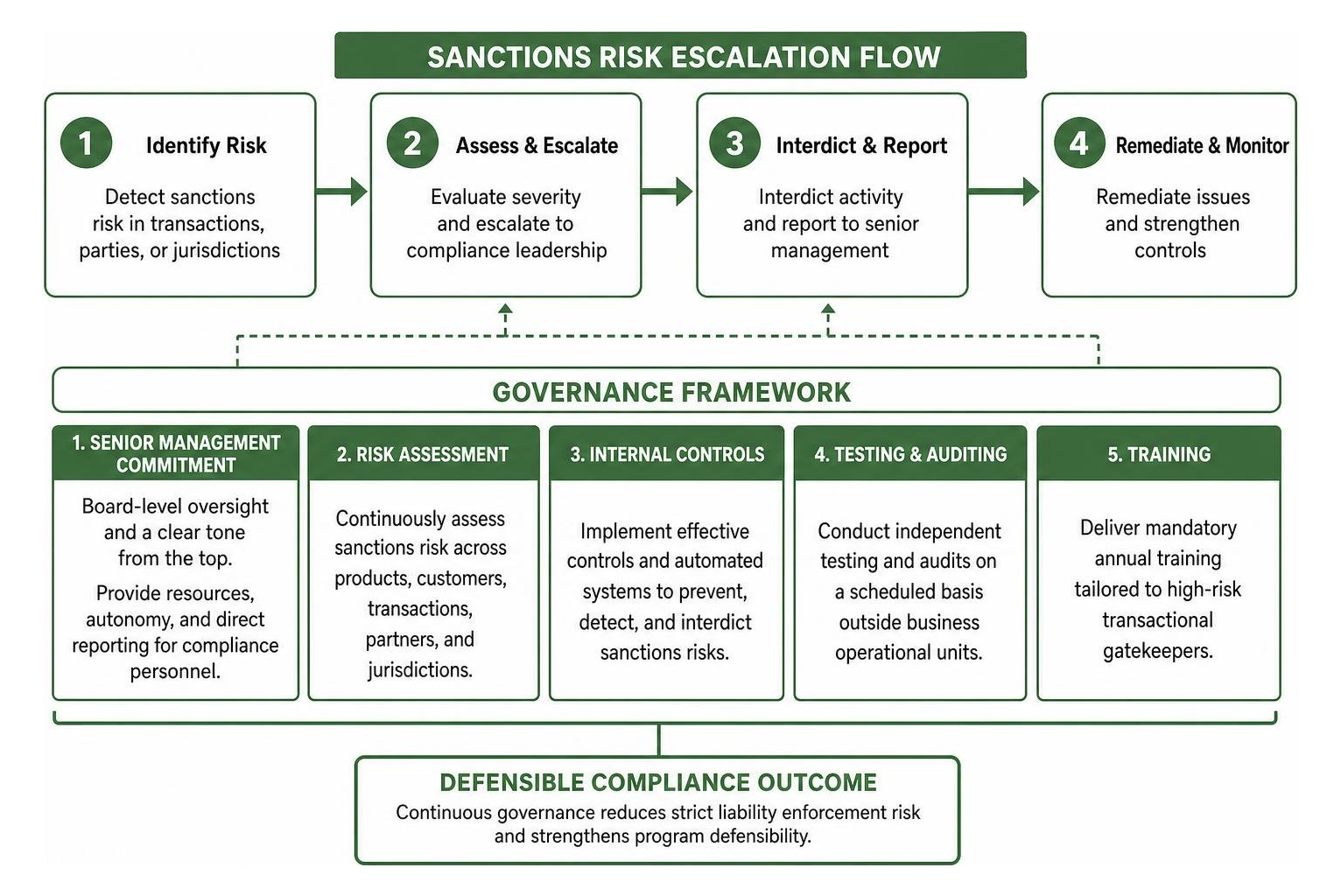
Regulatory authorities, including international bodies issuing Guidance on the Implementation of an Effective Sanctions Compliance Programme, consistently look beyond paper-based assertions. Defensibility rests on independent testing schedules executed outside business operational units, dynamic calibration of automated systems, and mandatory annual training tailored directly to high-risk transactional gatekeepers.
7 Fatal Pitfalls That Break a Sanctions Compliance Programme

Root-cause analysis across regulatory enforcement actions demonstrates that compliance breakdowns rarely stem from administrative oversights alone. Instead, systemic control gaps allow prohibited transactions to clear undetected through standard commercial channels. When enforcement agencies review apparent breaches, failures in baseline governance limit the availability of statutory mitigation.
| Structural Failure Point | Core Compliance Vulnerability | Required Internal Control |
|---|---|---|
| 50% Rule Blind Spots | Aggregating fractional minority stakes across blocked parties | Deep corporate entity unravelling and direct UBO tracing |
| Screening Filter Drift | Phonetic variations, transliterations, and omitted SWIFT BICs | Algorithmic fuzzy matching and periodic engine calibration |
| USD Clearing Facilitation | Non-U.S. entities routing payments via domestic correspondent banks | Comprehensive payment message scrubbing and nexus audits |
| Concealed Gatekeepers | Nominees, professional proxies, and opaque corporate vehicles | Politically exposed person identification and source of wealth vetting |
| Supply Chain Diversion | Intermediate logistics handlers, transshipment hubs, and re-export | Multi-tier vendor screening and end-user verification protocols |
| M&A Legacy Liabilities | Undetected historical breaches in foreign acquired targets | Pre-acquisition corporate intelligence and post-closing audits |
| Decentralised Silos | Inconsistent regional escalation pathways and paper-only rules | Centralised compliance oversight and protected reporting channels |
Maintaining mandatory 5-year recordkeeping trails and meeting statutory 10-day blocking reports require operational procedures designed to withstand regulatory scrutiny.
1. Misinterpreting the OFAC 50% Rule and Beneficial Ownership
Surface-level watchlist matching consistently fails when dealing with complex corporate holding structures. Under OFAC guidance, an entity is automatically blocked if one or more Specially Designated Nationals (SDNs) own 50 percent or more of the equity in aggregate, directly or indirectly. The entity itself does not need to appear on any designated list.
Unravelling opaque cross-border holding vehicles requires an exhaustive ultimate beneficial owner check to evaluate aggregated minority stakes held across layered subsidiaries, offshore trusts, and nominee arrangements. Where corporate ownership structures obscure control, deploying comprehensive enhanced due diligence ensures hidden beneficial ownership connections are documented before commitments are executed.
2. Screening Filter Faults and Fuzzy Matching Gaps
Automated screening architectures frequently suffer from algorithmic drift, rigid thresholds, and alert fatigue. Standard exact-match search parameters miss targets due to non-standard transliterations, Cyrillic or Arabic script variants, and regional geographic spellings, such as variations between Havana and Habana or Sudan and Soudan.
Defensible systems deploy calibrated fuzzy-matching rules capable of identifying phonetic similarities while screening complete SWIFT Business Identifier Codes (BICs). Real-time verification is essential; integrating real time monitoring alerts ensures that ongoing lifecycle changes trigger immediate review rather than waiting for annual audit cycles.
3. Non-U.S. Subsidiary Facilitation and U.S. Dollar Clearing
A frequent cross-border compliance trap involves non-U.S. subsidiaries transacting with sanctioned territories or individuals. While non-U.S. entities may believe their foreign incorporation insulates them from U.S. jurisdiction, transactions denominated in U.S. Dollars inevitably pass through domestic correspondent bank accounts, establishing extraterritorial nexus.
Furthermore, domestic parent personnel are strictly prohibited from approving, facilitating, or supporting third-country deals that would be unlawful if executed directly. Organisations must implement structured vendor risk assessment geopolitical screening to identify jurisdictional touchpoints and prevent unlawful transactional facilitation across global operating units.
4. Overlooking PEP Connections and Concealed Gatekeepers
Sanctioned principals frequently obscure their commercial presence through intermediary networks, trusted wealth managers, legal agents, and politically connected associates. Direct list screening often yields a false negative when interacting with front companies managed by nominee fiduciaries.
Rigorous governance mandates proactive PEP identification and classification alongside forensic analysis of corporate registries and share capital histories. Applying targeted EDD for high-risk entities uncovers sovereign exposure, political dependencies, and proxy relationships that automated compliance software regularly misses.
5. Inadequate Counterparty and Multi-Tier Supply Chain Due Diligence
Managing trade compliance requires visibility across extended supply networks. Global enterprises remain vulnerable to diversion risks, dual-use goods evasion, and illicit transshipment hubs when vetting stops at direct tier-1 suppliers.
Sanctioned goods and components frequently enter supply networks through downstream freight forwarders, re-exporters, and regional distributors. Maintaining defensible operational posture requires thorough third-party due diligence across the entire value chain, combined with continuous vendor compliance monitoring to detect unauthorised changes in logistics routes or operational ownership.
6. M&A Due Diligence Blind Spots and Legacy Liabilities
Corporate acquisitions present significant successor liability under international sanctions regulations. Acquiring an overseas enterprise that maintains historical business ties with prohibited jurisdictions imports direct exposure into the buyer’s balance sheet upon closing.
Transaction teams must integrate specialised mergers and acquisitions due diligence into pre-deal assessment workflows. Evaluating legacy customer ledgers, distributor agreements, and historic supply routes identifies latent non-compliance, enabling post-merger integration teams to remediate structural deficiencies before corporate liability attaches.
7. Decentralised Compliance Structures and Paper-Only Controls
A compliance programme that exists solely within documented manuals without functional execution offers no regulatory protection. Operating decentralised regional units without standard operating procedures leads to uneven screening thresholds, neglected escalations, and unmonitored local commercial agreements.
Defensibility requires unified operational oversight, secure internal reporting channels, and dynamic compensating controls. Implementing systematic contract compliance monitoring services ensures standard sanctions warranties, audit rights, and contractual termination remedies are consistently enforced across all legal entities.
Designing Defensible Controls for Your Sanctions Compliance Programme

Building a defensible sanctions architecture demands moving beyond tick-box compliance toward investigative verification. Automated databases provide baseline alerts, but resolving complex entity ownership, state control, and cross-border commercial touchpoints requires experienced corporate intelligence professionals.
Integrating structured corporate due diligence directly into counterparty onboarding protects the enterprise against regulatory enforcement and systemic brand damage. By combining thorough reputation risk assessment with forensic entity unravelling, compliance leaders build audit trails capable of withstanding scrutiny by regulatory bodies worldwide.
Frequently Asked Questions About Sanctions Compliance
How does OFAC evaluate a sanctions compliance programme during enforcement actions?
OFAC reviews compliance maturity under its Economic Sanctions Enforcement Guidelines. Under General Factor E, OFAC assesses the existence, adequacy, and sophistication of the organisation’s compliance programme at the time of the violation. Under General Factor F, authorities review the speed and quality of the enterprise’s remedial response. Maintaining an effective programme can significantly reduce civil monetary penalties and help prevent an enforcement matter from being classified as an egregious violation.
What is the OFAC 50% Rule and how is aggregate ownership calculated?
The 50% Rule dictates that any entity owned 50 percent or more, directly or indirectly in the aggregate, by one or more blocked persons is automatically considered blocked by operation of law. For example, if SDN Party A owns 25 percent and SDN Party B owns 25 percent of a commercial entity, the business is blocked even though neither party holds a majority stake and the entity does not appear on the SDN list.
What specific due diligence is required for high-risk foreign counterparties?
Managing high-risk foreign entities requires a formal enhanced due diligence checklist process that extends beyond standard screening. This involves multi-layered beneficial ownership verification, sovereign connection analysis, adverse media investigations, screening of executive leadership and authorised signatories, and detailed supply chain routing assessments.
Conclusion
Effective sanctions risk mitigation requires investigative clarity and defensible evidence. At Rule Ltd, our dedicated corporate intelligence analysts uncover hidden risks, untangle complex offshore structures, and verify international supply chains. We operate with fixed-price scoping and deliver standard screening reports in two to three working days, with complex corporate intelligence investigations completed in approximately five working days. To safeguard your business operations, commission a structured sanctions risk management engagement to secure your global compliance posture.
Sources
- U.S. Department of the Treasury, Office of Foreign Assets Control (OFAC). A Framework for OFAC Compliance Commitments. Washington, D.C.: U.S. Department of the Treasury. https://ofac.treasury.gov/media/16331/download
- Qatar Financial Centre Regulatory Authority (QFCRA). Guidance on the Implementation of an Effective Sanctions Compliance Programme. Doha: QFCRA. https://www.qfcra.com/en-us/AML%20Law%20and%20Legislation/QFCRA%20Guidance%20on%20Sanctions%20%28FINAL%29.pdf?_t=1738050615
- U.S. Department of the Treasury. Economic Sanctions Enforcement Guidelines, 31 C.F.R. Part 501, Appendix A.
- Federal Financial Institutions Examination Council (FFIEC). Bank Secrecy Act/Anti-Money Laundering Examination Manual: Office of Foreign Assets Control — Overview. Washington, D.C.: FFIEC.
- Financial Action Task Force (FATF). Guidance on Politically Exposed Persons (Recommendations 12 and 22). Paris: FATF.