
Customer Due Diligence vs. Heightened Verification Standards
Managing counterparty risk requires proportionate allocation of compliance resources. Baseline screening and automated verification provide necessary administrative hygiene, but higher-risk entities necessitate a rigorous standard of proof. The transition across verification tiers reflects increasing evidential burdens and deeper investigative enquiry.
| Due Diligence Tier | Target Counterparty Profile | Verification Depth & Scope | Evidential Standard | Approval & Governance |
|---|---|---|---|---|
| Simplified Due Diligence (SDD) | Low-risk entities (e.g., publicly listed issuers, regulated European credit institutions, public bodies). | Basic entity verification via authoritative registries; identity confirmation of designated signatories. | Registry confirmations; official government records. | Standard operational compliance sign-off. |
| Customer Due Diligence (CDD) | Standard-risk corporate counterparties, trading entities, commercial suppliers. | Identification and verification of the corporate vehicle and individuals holding 25% or more equity; standard screening against sanctions and Politically Exposed Person (PEP) lists. | Independent registry extracts; certified constitutional documents; basic utility/address documentation. | Compliance officer approval within regular onboarding frameworks. |
| Enhanced Due Diligence (EDD) | High-risk jurisdictions, PEPs, layered offshore vehicles, complex supply chains, adverse media matches. | Complete unravelling of control structures to natural persons; independent corroboration of source of funds and source of wealth; local-language open-source intelligence; integrity and litigation assessment. | Primary-source documentary proof (e.g., audited statements, tax filings, sale agreements); regulatory filings; analyst-led contextual vetting. | Senior management or compliance committee sign-off; tailored ongoing monitoring. |
Understanding these distinctions ensures that regulated institutions apply third-party due diligence standards that withstand regulatory audit. While standard screening identifies known entries on published databases, enhanced scrutiny establishes operational substance, commercial rationale, and integrity when automated systems return ambiguities.
Mandatory and Operational Triggers for Enhanced Due Diligence
Enhanced scrutiny is activated by specific statutory mandates or contextual operational risks. From a supervisory perspective, regulatory examiners evaluate whether an institution identifies initial risk triggers and applies proportionate measures before establishing a business relationship.
Key operational and statutory triggers include:
- Geographic Exposure: Counterparties incorporated in, operating from, or transacting through jurisdictions identified on the FATF grey and black lists, or territories subject to UK, EU, or US economic sanctions.
- Sanctions Proximity: Entities operating in jurisdictions contiguous to sanctioned states, or sectors exhibiting heightened diversion and transhipment risk under global export control regimes.
- Cash-Intensive and High-Risk Sectors: Dealing with commodities, defence, extractive industries, payment intermediaries, or virtual asset service providers (VASPs) displaying rapid transaction dispersal.
- Adverse Media and Reputational Flags: Plausible allegations of fraud, bribery, modern slavery, or environmental non-compliance identified during adverse media screening.
- Transactional Anomalies: Unexplained payment routing, mismatch between declared turnover and transaction volume, or payments routed via unrelated third parties.
Applying high-risk entity screening ensures that compliance teams isolate these indicators early, establishing a defensible risk posture before contractual commitments occur.
Politically Exposed Persons and State-Connected Entities
Engagements involving Politically Exposed Persons present elevated exposure to bribery, corruption, and the misuse of public funds. Statutory frameworks, including FATF Recommendation 12 and the UK Money Laundering Regulations 2017 (MLR 2017), mandate heightened scrutiny for foreign PEPs and a risk-calibrated approach for domestic officials, their immediate family members, and close associates.
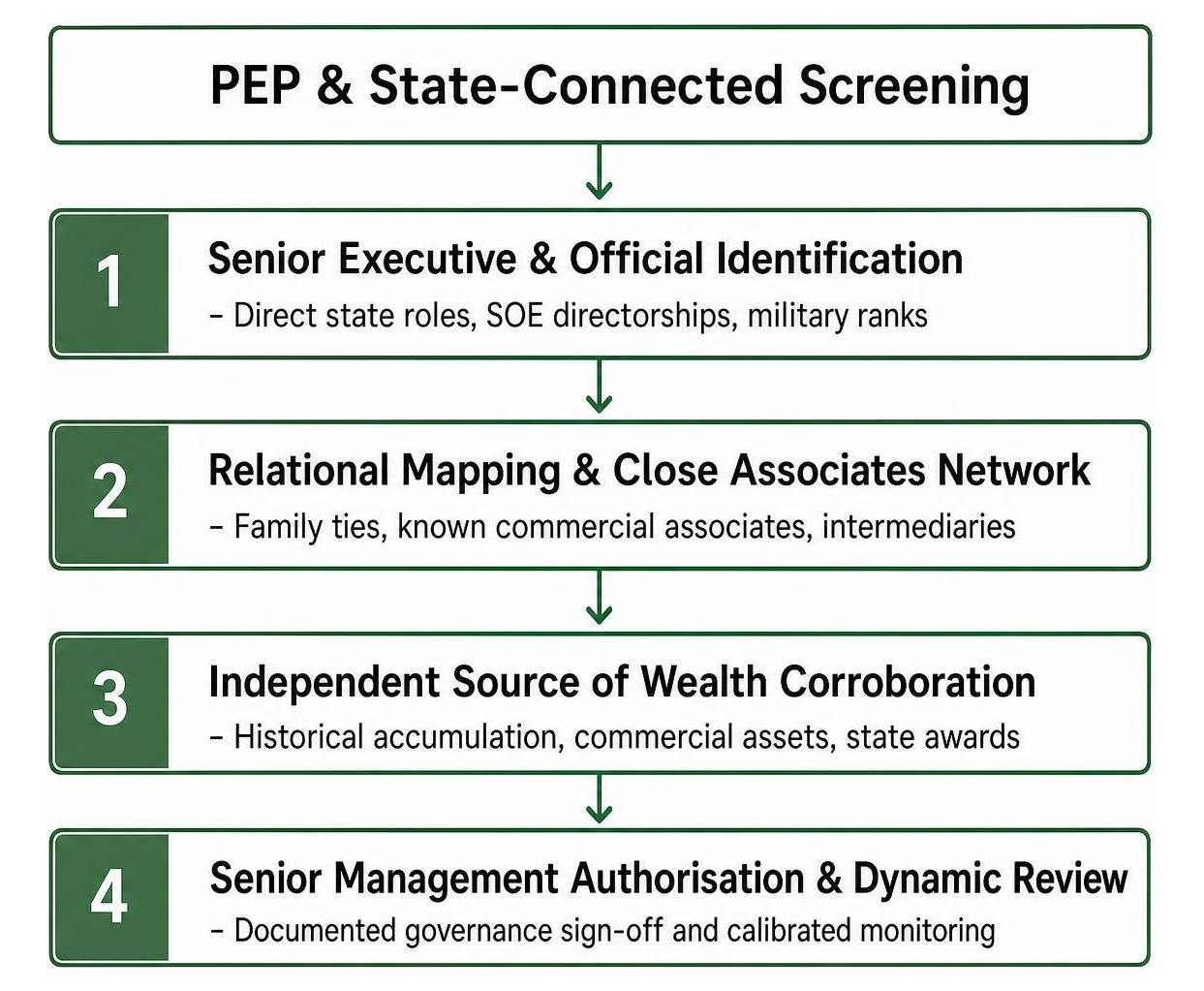
State-Owned Enterprises (SOEs) and private counterparties led by politically connected executives require rigorous assessment. Compliance analysts must establish whether commercial contracts derive from legitimate tender processes or political patronage. Identifying family networks and corporate affiliations through systematic PEP identification and classification is critical to prevent corrupt capital from entering regulated systems. Formal senior management sign-off is mandatory before onboarding or continuing relationships with PEPs.
Complex Ownership Structures and Layered Offshore Vehicles
Opaque corporate architectures involving offshore jurisdictions, discretionary trusts, nominee directorships, and historical bearer shares frequently serve to conceal beneficial control. Under standard regulatory expectations, identifying equity owners at a statutory 25% threshold represents a starting baseline. In higher-risk contexts, corporate structures must be unravelled to identify every individual exercising ultimate effective control, regardless of formal percentage holdings.
Executing an ultimate beneficial owner check requires cross-referencing multi-jurisdictional registers, shareholder registries, and trust instruments to confirm that corporate vehicles possess genuine operational substance rather than serving as shell arrangements.
Core Investigative Methodology and High-Risk Verification
An effective investigation operates on evidence-first principles. Rather than compiling unstructured documentation, analysts formulate a clear risk hypothesis based on the initial trigger, systematically gathering primary-source records to corroborate or refute potential vulnerabilities.

A defensible review tests identity, corporate substance, regulatory track record, and asset provenance. Documenting this methodology within a structured framework ensures repeatability and audit readiness.
Step-by-Step Methodology for Enhanced Due Diligence
A rigorous investigation follows an established sequence:
- Trigger Identification and Scoping: Record the exact statutory or contextual trigger prompting enhanced review. Formulate the investigative scope tailored to the counterparty’s sector, geographic footprint, and corporate profile.
- Corporate Registry and Entity Resolution: Retrieve official company records, certificates of incorporation, and filings directly from authoritative corporate registries across all relevant jurisdictions.
- Key Stakeholder and Personnel Vetting: Execute background checks and key personnel vetting services on directors, board members, and executive leadership to identify undisclosed conflicts of interest, past corporate insolvencies, or disqualifications.
- Source of Funds (SoF) Verification: Trace the specific origin, commercial path, and remitting financial institutions involved in capital flows for the immediate transaction.
- Source of Wealth (SoW) Corroboration: Examine the historical, economic activities that generated the counterparty’s total net worth, corroborating narratives through audited financial statements, tax records, property registers, and divestment contracts.
- Commercial Rationale Assessment: Evaluate whether the counterparty’s corporate structure, geographic presence, and stated transaction volume correspond with legitimate economic activity.
- Synthesis, Four-Eyes Review, and Audit Trail: Compile findings into an evidence-backed report reviewed independently by senior compliance analysts, preserving an unalterable audit log for regulatory inspection.
Institutions executing these workflows can refer to a structured EDD checklist and process to ensure investigative consistency across high-risk accounts.
Analyst-Led Intelligence and Local-Language Verification
Automated databases often fail to capture adverse information published in regional languages, local press, or regional court filings. In jurisdictions where public corporate transparency is limited, open-source intelligence (OSINT) and analyst-led research provide critical context.
Analyst investigations bridge database blind spots by:
- Reviewing native-language litigation databases, gazettes, and local regulatory enforcement actions.
- Analysing corporate networks and cross-directorships across regional corporate filings.
- Evaluating digital footprints and counterparty infrastructure through specialised digital risk due diligence services to detect shell company indicators.
- Identifying nuanced, unindexed adverse reporting that standard English-language media aggregators overlook.
This contextual analysis ensures that institutions reach defensible conclusions based on primary-source verification rather than incomplete automated search queries.
Defensible Compliance Across Global Regulatory Frameworks
Regulated institutions operate across intersecting international legal regimes. While the risk-based approach is universal, statutory requirements vary across jurisdictions:
- Financial Action Task Force (FATF): Recommendations 10, 12, and 19 establish baseline standards for customer due diligence, PEP management, and heightened controls for high-risk jurisdictions.
- United States: The USA PATRIOT Act and FinCEN’s Customer Due Diligence (CDD) Final Rule mandate verification of beneficial owners at the 25% equity threshold and require explicit due diligence on foreign correspondent banking and private banking relationships.
- United Kingdom: The Money Laundering, Terrorist Financing and Transfer of Funds Regulations 2017 (MLR 2017), notably Regulations 33 to 36, along with the Economic Crime and Corporate Transparency Act 2023 (ECCTA), mandate enhanced scrutiny where high-risk factors exist, prohibiting statutory reliance on third parties for EDD execution.
- European Union: Directives 2015/849 (4AMLD) and 2018/843 (5AMLD), alongside incoming direct regulations under the EU AML Single Rulebook (Regulation EU 2024/1624), enforce mandatory EDD for transactions involving high-risk third countries and opaque corporate structures.
Adhering to rigorous corporate due diligence standards ensures that institutions remain audit-ready. Statutory compliance requires case-by-case assessment based on applicable legal rules, and organisations must evaluate their legal duties within their specific operational frameworks.
Regulatory Expectations for Enhanced Due Diligence Programmes
Regulatory authorities and supervisory bodies assess anti-money laundering frameworks on their demonstrable effectiveness and evidential rigour. Supervisory audits consistently penalise institutions that rely on uncorroborated, self-declared customer attestations.
To satisfy regulatory expectations, compliance teams must maintain:
- Independent Evidential Corroboration: Verifiable primary documentation confirming ownership and asset provenance rather than passive document acceptance.
- Clear Governance and Dual Control: Documented rationale for risk ratings, incorporating four-eyes review and named senior management approvals for high-risk accounts.
- Dynamic Event-Driven Refresh: Automated or rule-based mechanisms that prompt immediate re-examination upon the occurrence of material triggers, such as adverse media, ownership restructuring, or unexpected transactional spikes.
Overcoming High-Risk Screening Challenges
Executing enhanced investigations at scale presents distinct operational obstacles. Compliance departments frequently encounter fragmented cross-border corporate registries, elevated rates of false-positive matches during watchlist screening, and operational backlogs that delay commercial transactions.
Automated tools assist in initial data gathering and triage, but evaluating legal risk, contextual adverse media, and the economic plausibility of wealth requires experienced human analysis. Standardising the EDD report preparation workflow allows institutions to maintain consistent evidential standards, producing decision-ready reports that support prompt, defensible onboarding decisions.
Rule Ltd provides human analyst-led investigations that deliver cost certainty and rapid turnaround. Screening assessments are completed in two to three working days, while comprehensive corporate intelligence and enhanced due diligence reports are delivered in approximately five working days, with fixed pricing agreed prior to commencing work.
Frequently Asked Questions About High-Risk Counterparties
How do evidential thresholds shift between standard verification and enhanced investigative screening?
Enhanced investigative screening requires moving beyond statutory registry extracts to primary-source evidentiary proof. While standard verification establishes legal existence and nominal shareholding, enhanced reviews mandate corroborating commercial rationale, resolving ultimate natural-person control across multi-layered jurisdictions, conducting deep-web and local-language open-source intelligence, and securing formal senior management sign-off to satisfy supervisory scrutiny.
What documentary standards are required to substantiate complex Source of Wealth and Source of Funds narratives?
Substantiating complex wealth profiles requires independent documentary triangulation rather than reliance on self-certified declarations. Compliance teams must obtain verifiable records—such as historical audited accounts, cross-border tax returns, certified divestment agreements, or capital distribution notices—to establish the legitimate economic progression of total net worth, alongside transactional bank confirmations demonstrating the clean origin of immediate transaction funds.
What governance controls should govern event-driven review triggers?
Institutions must deploy automated and intelligence-led triggers that instantly mandate re-examination when risk parameters shift. Key triggers requiring four-eyes escalation and senior compliance review include material ownership or directorship changes, litigation filings in high-risk jurisdictions, adverse media alleging economic crime, or transaction velocity departing from established historical patterns.
Conclusion
Managing high-risk counterparty relationships demands clear evidential standards, disciplined investigative methodology, and defensible governance. By shifting from reactive document collection to hypothesis-driven corporate intelligence, organisations protect themselves from financial crime exposure and regulatory scrutiny while maintaining commercial momentum.
Rule Ltd delivers fixed-price, analyst-led enhanced due diligence and corporate intelligence across global jurisdictions. To assess your high-risk counterparties with cost certainty and rigorous analytical depth, request a custom EDD report quote or explore our Corporate Due Diligence services.
Sources
- Financial Action Task Force (FATF): International Standards on Combating Money Laundering and the Financing of Terrorism & Proliferation (The FATF Recommendations), Recommendation 10 (Customer Due Diligence), Recommendation 12 (Politically Exposed Persons), and Recommendation 19 (Higher-Risk Countries).
- UK Government / HM Revenue & Customs: The Money Laundering, Terrorist Financing and Transfer of Funds (Information on the Payer) Regulations 2017 (MLR 2017), Statutory Instrument 2017 No. 692, Part 3 (Customer Due Diligence), Regulations 33–36.
- UK Legislation: Economic Crime and Corporate Transparency Act 2023 (ECCTA), provisions on corporate transparency and beneficial ownership verification.
- European Parliament and Council of the European Union: Directive (EU) 2015/849 (4AMLD) and Directive (EU) 2018/843 (5AMLD) on the prevention of the use of the financial system for the purposes of money laundering or terrorist financing; Regulation (EU) 2024/1624 (AML Single Rulebook Regulation).
- US Department of the Treasury / Financial Crimes Enforcement Network (FinCEN): Customer Due Diligence Requirements for Financial Institutions (CDD Final Rule), 31 CFR Parts 1010, 1020, 1023, 1024, and 1026; Bank Secrecy Act (BSA); USA PATRIOT Act of 2001, Section 312.
- Joint Money Laundering Steering Group (JMLSG): Prevention of Money Laundering/Combating Terrorist Financing Guidance for the UK Financial Sector, Part I, Chapter 5 (Customer Due Diligence and Enhanced Due Diligence).