
ABAC due diligence starts with beneficial ownership
ABAC due diligence should establish who ultimately owns, controls, or benefits from a third party before that party is approved, paid, or retained. Rigorous anti-bribery governance requires legal entity and shareholding chain mapping, independent verification of ultimate beneficial owners against official corporate registries, screening for political exposure, sanctions, adverse media, and state ownership, as well as formal escalation protocols for opaque holding structures or unusual commercial terms.
This is not a box-ticking exercise. Under the UK Bribery Act 2010, a commercial organisation may rely on its adequate-procedures defence only where its controls are proportionate, defensible, and effective. Under the US Foreign Corrupt Practices Act, ignoring clear warning signs around an intermediary creates immediate enforcement exposure. A self-certified questionnaire cannot prove whether a declared owner is the true directing mind and will.
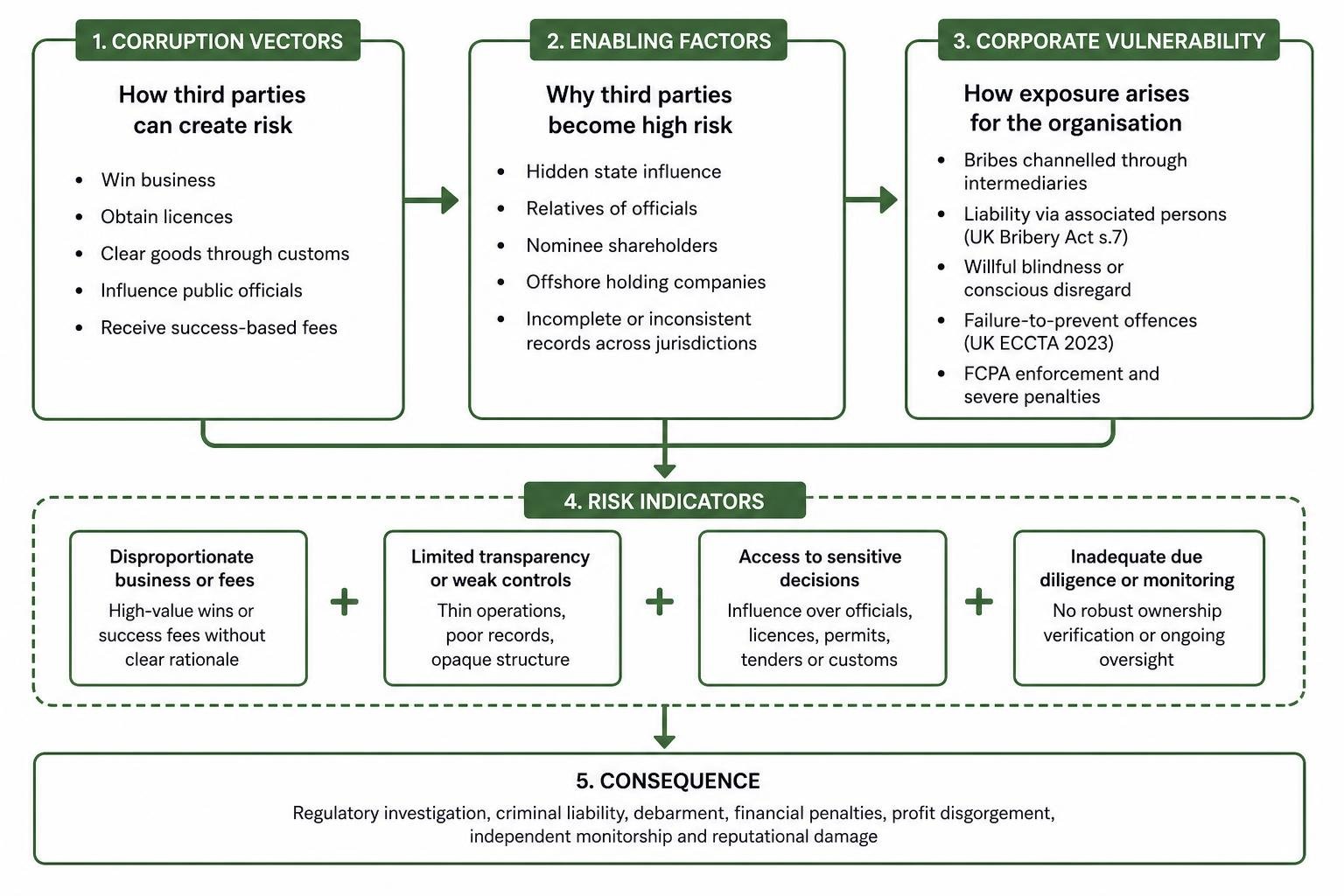
Beneficial ownership verification matters most where a third party possesses the capacity to win business, obtain licences, clear goods through customs, influence public officials, or receive success-based fees. Hidden state influence, relatives of officials, nominee shareholders, and offshore holding companies can turn an apparently standard supplier or agent into a material corruption exposure. Each matter requires a case-by-case assessment, particularly where corporate filings are incomplete or inconsistent across multiple jurisdictions.
Rule Ltd’s human analysts prepare defensible ABAC due diligence and corporate intelligence reports designed to explain ownership, control, and integrity risk in terms that withstand rigorous regulatory scrutiny.
The regulatory landscape driving global anti-corruption compliance
Corporate liability for bribery has moved far beyond domestic borders. Global enforcement agencies actively cross-reference evidence, share intelligence, and prosecute corporate misconduct under statutes featuring severe extraterritorial reach. Compliance frameworks must navigate a multi-jurisdictional web consisting of the US Foreign Corrupt Practices Act (FCPA), the UK Bribery Act 2010, the French Sapin II law, and the corporate offences introduced under the UK Economic Crime and Corporate Transparency Act 2023 (ECCTA 2023).
Extraterritorial liability and strict failure-to-prevent offences
The legal exposure confronting international businesses often turns on strict liability provisions. Under Section 7 of the UK Bribery Act 2010, a commercial organisation commits a criminal offence if an associated person bribes another person intending to obtain or retain business or a business advantage for the organisation. The only statutory defence available is proving that the organisation had in place “adequate procedures” designed to prevent such conduct.
Similarly, the UK ECCTA 2023 expands the failure-to-prevent doctrine to fraud, removing the traditional “directing mind and will” requirement for large organisations whose associated persons commit fraud intended to benefit the business. Under the FCPA, the US Department of Justice (DOJ) and the Securities and Exchange Commission (SEC) evaluate whether a company maintains an active, defensible compliance architecture. While voluntary self-disclosure, proactive co-operation, and timely remediation under the DOJ Corporate Enforcement Policy can lead to substantial fine reductions, a systemic failure to execute rigorous sanctions risk management or third-party scrutiny leaves a company open to uncapped financial penalties, profit disgorgement, and independent compliance monitorships.
M&A risks and successor liability for historical misconduct
Corporate transactions present immediate corruption exposure through the doctrine of successor liability. When an acquiring company merges with or absorbs a target entity, it assumes the legal liabilities and historical regulatory violations of that target—even if the corrupt payments or illicit schemes occurred prior to the transaction without the buyer’s knowledge.
Pre-acquisition integrity audits must operate alongside technical due diligence frameworks to examine the commercial channels through which target revenues are generated. Discovering pre-existing bribery arrangements post-close can trigger regulatory enforcement, require target indemnification claims, lead to severe transaction write-downs, and undermine deal valuation.
Why third parties and opaque ownership represent the primary corruption vector
Third parties represent one of the most persistent vulnerabilities in corporate compliance. A substantial share of published FCPA enforcement actions involve bribes funnelled through third-party intermediaries, including sales agents, customs brokers, logistics providers, and consultants.
Intermediary risk and the doctrine of willful blindness
Under international anti-corruption jurisprudence, liability does not require direct corporate knowledge of a bribe. The legal standard encompasses “conscious disregard,” “deliberate ignorance,” and “willful blindness.” When an organisation engages a third party under circumstances suggesting a high probability that corrupt conduct will occur, regulatory bodies treat that deliberate indifference as equivalent to actual knowledge.
High-risk commercial agents frequently operate in sectors heavily reliant on state tenders, regulatory authorisations, or customs clearance. Where an intermediary secures lucrative public contracts while possessing thin operational infrastructure, an absence of documented vetting exposes the principal company to immediate prosecution and public procurement debarment.
The critical role of ultimate beneficial ownership verification
Corrupt arrangements rarely feature direct payments to public officials. Instead, transactions are routed through complex, multi-layered shell entities, offshore jurisdictions, and nominee arrangements designed to obscure the true recipient of corporate funds.

A comprehensive ultimate beneficial owner check is essential to unwrap these corporate vehicles. Unmasking the ultimate beneficial owners (UBOs) confirms whether a counterparty is secretly owned by politically exposed persons (PEPs), public officials with regulatory authority over the company, or sanctioned individuals hiding behind corporate secrecy jurisdictions.
Core pillars of an effective ABAC due diligence programme
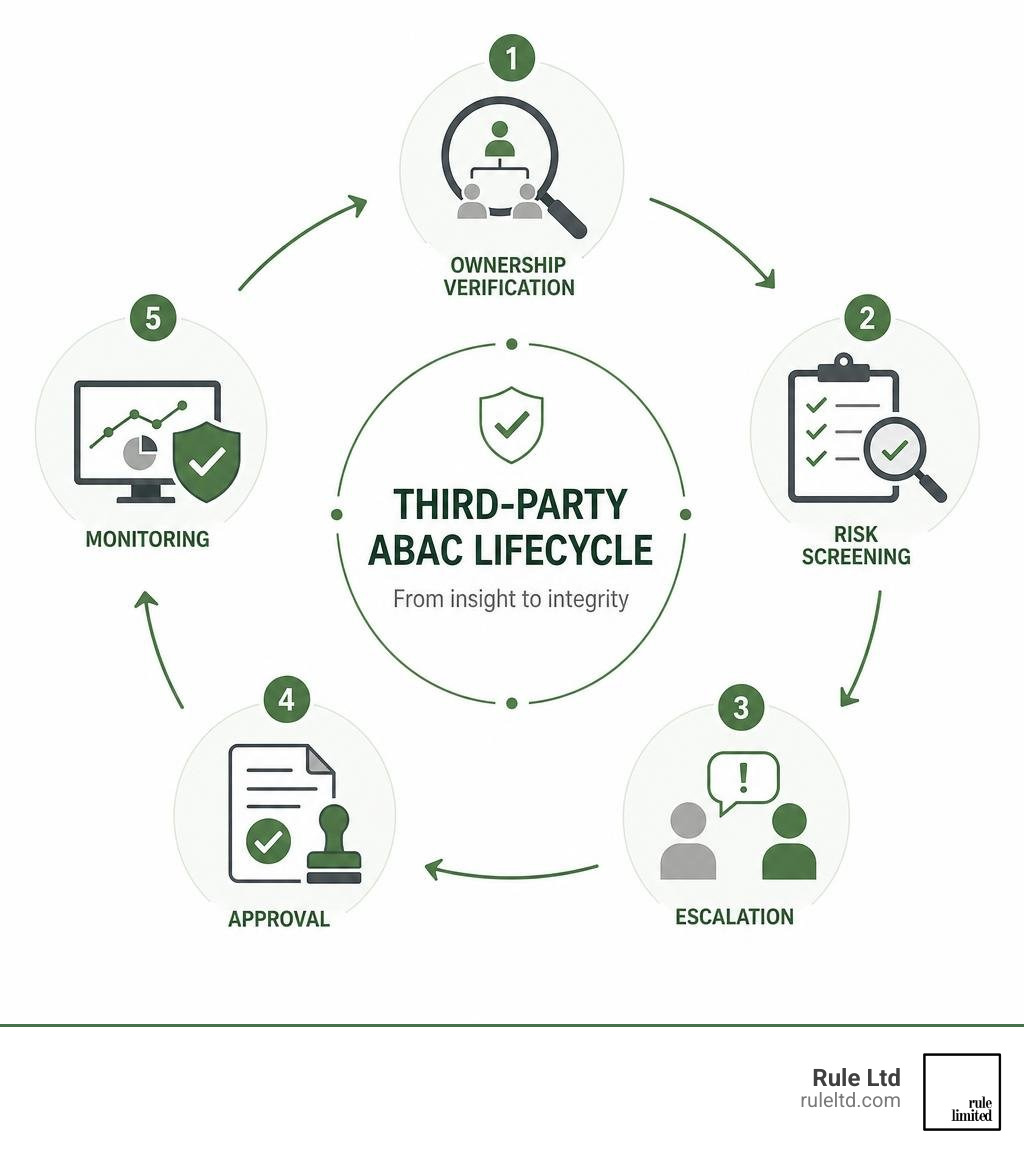
A defensible anti-bribery and anti-corruption compliance architecture must translate high-level governance into enforceable operational controls across the entire third-party lifecycle.
Executing risk-tiered ABAC due diligence across third-party networks
A one-size-fits-all model inevitably fails. Applying heavy investigative resources to low-risk domestic suppliers creates operational paralysis, while applying basic screening to high-risk agents creates dangerous compliance blindspots.
| Diligence Tier | Target Counterparty Profile | Investigative Scope & Core Methodology | Typical Turnaround & Delivery |
|---|---|---|---|
| Tier 1: Standard Screening | Low-risk domestic suppliers, commoditised vendors with zero public sector interaction. | Automated global sanctions, basic PEP matching, corporate registry confirmation, and standard watchlist checks. | Fast turnaround in 2–3 working days; fixed-price per entity. |
| Tier 2: Enhanced Review | Mid-tier distributors, cross-border suppliers in moderate-risk markets, entities with indirect state interaction. | Primary corporate registry retrieval, full shareholding chain mapping, secondary adverse media screening, litigation history checks. | Analyst-led delivery within 3–4 working days; cost-certain pricing. |
| Tier 3: In-Depth Corporate Intelligence | Sales agents, customs brokers, partners in high-risk jurisdictions, JV targets, consortium allies. | Enhanced due diligence for high-risk entities, full UBO unwrapping, local-language media and court records, source-of-wealth vetting, human intelligence. | Deep-dive analyst investigation in ~5 working days; fixed-price quoted upfront. |
Aligning operational procedures with proportionate risk frameworks ensures regulatory defensibility without unnecessary operational friction.
Critical bribery red flags and conflict of interest indicators
During the execution of third-party reviews, analysts frequently encounter indicators that demand immediate escalation:
- Unusual compensation models: Requests for success fees, abnormal commission structures, or fees significantly above local market benchmarks.
- Offshore payment routing: Instructions to transfer funds to accounts located in secrecy havens unrelated to the vendor’s operational jurisdiction.
- Political exposure and close connections: Direct or indirect links identified through systematic PEP identification and classification, including family members or close business associates of decision-making public officials.
- Internal personnel alignments: Undisclosed relationships between vendor executives and internal procurement staff uncovered during conflict of interest screening.
- Vague commercial justifications: Broad scopes of work described as “government relations,” “strategic consulting,” or “facilitation assistance” without tangible deliverables.
Overcoming the flaws of legacy compliance methods
Traditional compliance methods often rely on passive data collection. In modern cross-border investigations, these legacy practices fail to identify concealed risks.
Limitations of traditional ABAC due diligence methods
- Questionnaire vulnerability: Standard self-certification surveys depend entirely on supplier honesty. Illicit actors will not voluntarily disclose undisclosed beneficial interests, PEP relationships, or kickback schemes.
- Database latency and false-positive fatigue: Standard automated databases rely on structured data, often missing emerging adverse media published in local languages or non-Latin scripts. Furthermore, generic name-matching algorithms create false-positive backlogs that distract compliance analysts from material issues.
- Superficial desk reviews: Basic web searches often fail to penetrate corporate holding structures registered across offshore jurisdictions that lack public digital registries.
Combining investigative corporate intelligence with automated screening
To build a defensible file, organisations must combine technology-enabled screening with human intelligence. Automated ingestion accelerates data parsing across millions of records, but human analysts are necessary to evaluate unstructured data, interpret local litigation filings, and review jurisdictional nuances.

Our human-led corporate intelligence investigation services bridge this gap by examining local-language press, regulatory archives, and regional corporate filings. This process ensures that complex corporate networks are accurately analysed before commercial commitments are executed.
Evidential methodology for beneficial ownership verification and corruption risk mitigation
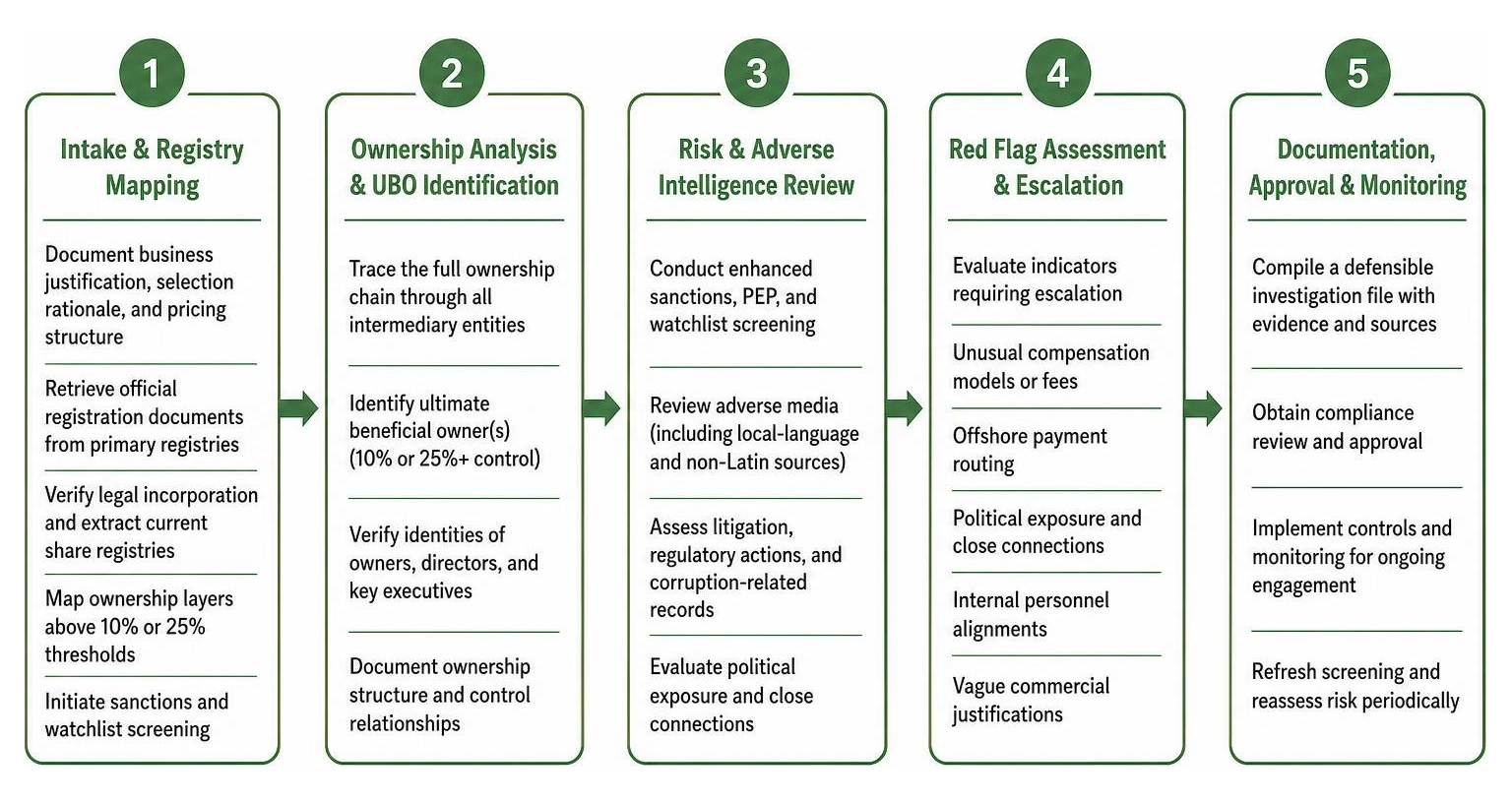
Establishing an auditable beneficial ownership verification architecture requires a structured evidential methodology.
Registry mapping and corporate structure analysis
Third-party assessments evaluate the commercial justification of the engagement, the selection rationale, and the proposed remuneration structure.
Primary corporate registration documents must be retrieved directly from official registries. Compliance teams deploy a structured corporate due diligence checklist for vendors and partners to verify legal incorporation, extract current share registries, map every ownership layer above statutory thresholds, and execute initial sanctions and watchlist screening.
Enhanced due diligence, source-of-wealth analysis, and intelligence gathering
When counterparties feature opaque corporate vehicles, foreign holding layers, or exposure to public procurement, review escalates to enhanced due diligence. Analysts unwrap multi-tiered structures to identify natural persons exercising ultimate control, examine the commercial background and source of wealth of key principals, and assess historical reputation.
Evidence from published due diligence case studies demonstrates that hidden state affiliations frequently surface only when secondary, local-language records and regional litigation registries are cross-referenced against primary business filings.
Contractual safeguards and continuous compliance monitoring
Defensible due diligence integrates investigative findings into ongoing legal protections. Commercial agreements must incorporate enforceable ABAC provisions, including absolute representations of compliance with applicable anti-corruption statutes, explicit prohibitions on unauthorised sub-contracting, full audit and inspection rights over transactional records, and unilateral termination triggers for substantiated integrity breaches. Post-execution, counterparties remain subject to automated monitoring for sanctions updates, PEP appointments, and adverse media.
Frequently Asked Questions about anti-bribery and corruption compliance
What is the legal threshold for third-party liability under global anti-corruption laws?
Under the UK Bribery Act 2010 (Section 7), commercial organisations are strictly liable for bribes paid by “associated persons” performing services on their behalf, unless the company can prove it maintained adequate procedures. Under the US FCPA, liability extends to third-party actions where a company had actual knowledge, exhibited conscious disregard, or demonstrated willful blindness to circumstances indicating a high probability of corruption.
Why are standard questionnaires insufficient for high-risk third-party vetting?
Questionnaires represent unverified self-declarations. Corrupt counterparties routinely conceal beneficial owners, omit PEP relationships, and disguise conflicts of interest on onboarding forms. Questionnaires cannot cross-reference local-language litigation, verify corporate shareholding records, or unwrap offshore structures.
How does beneficial ownership verification prevent successor liability in M&A transactions?
Verifying the ultimate beneficial owners of an acquisition target confirms whether historical revenues were derived from corrupt ties, undisclosed state interests, or sanctioned individuals. Identifying these liabilities prior to deal close enables the acquiring party to renegotiate terms, demand specific indemnities, insist on remediation, or walk away from problematic transactions.
Conclusion
Relying on superficial database checks or unverified questionnaires leaves global organisations exposed to severe regulatory and financial consequences. In an international enforcement environment characterised by extraterritorial jurisdiction and strict failure-to-prevent offences, unmasking the individuals who ultimately own, control, and profit from commercial intermediaries is an essential operational requirement.
At Rule Ltd, we deliver fixed-price, cost-certain corporate intelligence and due diligence reports prepared exclusively by experienced human analysts. By pairing rapid automated ingestion with deep-dive investigative analysis across worldwide languages and jurisdictions, we provide compliance leaders and General Counsel with the defensible evidence required to make confident risk decisions.
To review your third-party integrity controls or request an enhanced corporate background assessment, explore our third-party due diligence services.
Sources
- UK Ministry of Justice, The Bribery Act 2010: Guidance about procedures which relevant commercial organisations can put into place to prevent persons associated with them from bribing, Section 7 and Section 9 statutory guidance.
- UK Parliament, Economic Crime and Corporate Transparency Act 2023, sections covering failure to prevent fraud and corporate liability.
- US Department of Justice and US Securities and Exchange Commission, A Resource Guide to the U.S. Foreign Corrupt Practices Act, Second Edition, updated guidance on third-party due diligence, successor liability, and corporate compliance programmes.
- Financial Action Task Force (FATF), Guidance on Beneficial Ownership of Legal Persons, standards for identifying natural persons behind legal persons and arrangements.
- OECD, Convention on Combating Bribery of Foreign Public Officials in International Business Transactions, supply-side anti-corruption enforcement standards.
- Agence Francaise Anticorruption (AFA), Guidelines on the French Law on Transparency, Fight Against Corruption and Modernization of Economic Life (Sapin II), anti-corruption compliance expectations under Sapin II.
Disclaimer: This article is published for informational purposes only and does not constitute legal advice. Anti-bribery and corruption compliance requirements vary by jurisdiction, sector, and counterparty profile, requiring specific review on a case-by-case basis.