
The Structural Failure of Modern Corporate Fraud Detection
Many enterprise compliance programmes treat fraud risk as an automated onboarding check. They deploy binary screening tools that compare vendor registries and client databases against sanction lists, politically exposed persons (PEP) databases, and static corporate records. When the software issues a clear alert log, the compliance file closes.
This approach creates severe systemic risk. Modern financial crime and procurement abuse rarely manifest as simple nominal matches against restricted lists. Instead, illicit actors operate through multi-tiered corporate vehicles, layered holding entities in secrecy jurisdictions, and informal networks of influence that bypass deterministic filters.
When organisations rely on automated binary thresholds to clear counterparties, they leave structural blind spots. Effective risk management requires robust Sanctions Risk Management integrated with behavioural scrutiny, forensic accounting, and deep contextual verification.
| Detection Dimension | Deterministic Screening Systems | Multi-Layered Corporate Intelligence |
|---|---|---|
| Analytical Scope | Direct nominal checks and strict percentage thresholds | Deep entity unwrapping, relational graphing, and informal control mapping |
| Data Focus | Structured corporate registry and sanction database feeds | Mixed structured registers, unstructured communications, adverse media, and field verification |
| Control Assessment | Legal equity ownership percentages (for example, nominal 50% cutoffs) | Operational dominion, nominee directors, shadow governance, and familial ties |
| False-Positive Profile | High alert volumes generated by trivial name similarities | Low operational noise via human analyst contextual evaluation |
| Dynamic Responsiveness | Periodic, scheduled batch rescanning | Continuous behavioural anomaly detection and event-driven review |
Why Static Ownership Screening Collapses Under Regulatory Scrutiny
Deterministic threshold rules, such as the OFAC 50 Percent Rule or equivalent UK and EU sanctions aggregation principles, state that an entity is blocked if one or more sanctioned persons own fifty percent or more in aggregate. In compliance operations, automated tools frequently reduce this legal standard to a mechanical database query.
Illicit counterparties exploit this reductionist methodology by designing ownership structures specifically engineered to remain below mathematical triggers. A sanctioned entity or corrupt executive might retain a 49.9% direct stake while distributing the remaining equity across offshore nominee vehicles, family members, or trust arrangements.
Uncovering these relationships requires rigorous execution of an Ultimate Beneficial Owner Check that traces capital flows and voting rights past nominal declarations. Without meticulous entity unwrapping, an organisation might onboard an entity that appears legally independent but is subject to indirect control.
This failure mode is common in corporate procurement. A routine vendor check can obscure an undisclosed conflict of interest, where a supplier is managed by an employee’s immediate family member or former business associate. Identifying a Beneficial Ownership Red Flag from a Routine Corporate Intelligence Check demands jurisdictional awareness and investigative skill that simple algorithmic tools cannot deliver.
The High Cost of False Declines and Detection Blind Spots
While static filters miss hidden risks, they simultaneously flood compliance teams with irrelevant alerts. Automated systems generate false alarms from common surnames, minor spelling variations, and generic corporate names.
This dynamic causes significant financial and operational strain:
- Severe revenue interruption: Legitimate transactions and commercial partnerships stall inside operational queues awaiting manual review.
- Customer and counterparty attrition: Genuine commercial counterparties experience transaction friction and take their business to more agile competitors.
- Alert fatigue: Compliance teams overwhelmed by false alarms suffer diminished vigilance, increasing the likelihood that sophisticated fraud indicators will be overlooked.
- Inflated operational overhead: Enterprise resources are wasted on resolving administrative false alarms rather than investigating high-risk third parties.
When compliance models rely purely on automated screening, they encounter systematic Third Party Risk Assessment Failures That Leave Vendor Exposure Unverified. True risk mitigation requires balancing automated anomaly detection with seasoned human analyst review to verify genuine exposure.
Beyond Deterministic Rules: Behavioural Intelligence and Data Analytics

Modern corporate fraud detection requires shifting from static record checks to continuous data analytics and behavioural intelligence. Rather than assessing a third party only at the point of onboarding, organisations must evaluate operational patterns across enterprise resource planning (ERP) systems, general ledgers, and procurement pipelines.
By integrating contextual intelligence with Vendor Compliance Monitoring, compliance teams can spot complex fraud signatures, including invoice splitting to circumvent delegation of authority limits, sudden alterations to vendor banking coordinates, and identical billing patterns across competing suppliers.
Academic research demonstrates the necessity of this shift. As detailed in the systematic review on Using Data Analytics in Financial Statement Fraud Detection and Prevention, traditional periodic auditing approaches miss subtle balance-sheet manipulations and earnings misstatements. Advanced data analytics identify anomalies across complex transaction sets, converting compliance from a backward-looking exercise into a proactive governance control.
Integrating Advanced Analytics into Corporate Fraud Detection Workflows
Modern fraud risk management frameworks deploy statistical anomaly scoring alongside rule-based governance. Unsupervised machine learning models uncover statistical outliers across invoice volumes, vendor delivery timeframes, and approval sequences.
Embedding continuous monitoring into an enterprise Third Party Risk Assessment programme enables teams to catch irregularities, such as:
- Invoice sequencing anomalies: A newly onboarded supplier submitting sequentially numbered invoices across several months, indicating an exclusive billing channel fabricated for internal fund extraction.
- Out-of-band payment authorisations: High-value manual journal entries posted outside regular working hours, bypassing standard dual-authorisation controls.
- Geographical and telemetry mismatches: Inconsistencies between a vendor’s registered operating jurisdiction, the originating IP address of its payment submissions, and the routing coordinates of its destination bank accounts.
These automated analytical signals must feed directly into structured investigative protocols. Alerts are not conclusions; they are starting points for human analysts to examine underlying documentation and commercial context.
Cross-Document Correlation in Supply Chains and Procurement
Procurement fraud and asset misappropriation often manifest across multiple unlinked operational documents. A corrupt supplier colluding with an internal procurement manager will produce an invoice that matches an approved purchase order, easily passing single-document automated checks.
Uncovering the fraud requires cross-document entity correlation. As established in the study on the AI-Driven Multi-Document Correlation Framework for Enterprise Financial Compliance and Fraud Detection, linking entities across separate data corpora—including tax filings, shipping manifests, customs declarations, and internal payroll records—uncovers structural discrepancies that isolated document evaluations fail to detect.
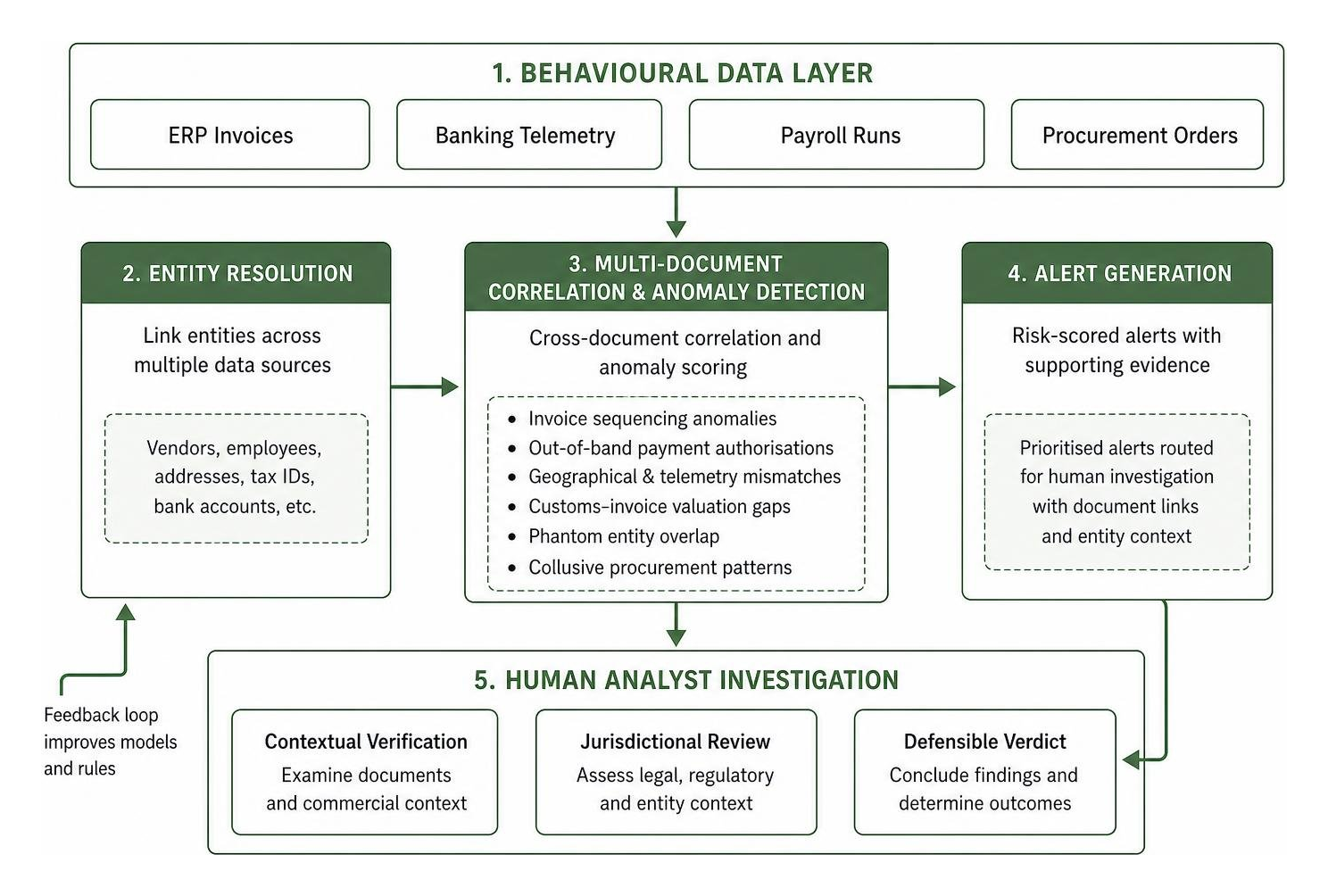
This cross-document approach uncovers:
- Phantom employee and vendor overlap: Shared telephone numbers, residential addresses, tax identifiers, or bank accounts between internal staff and external suppliers.
- Customs and invoice valuation gaps: Substantial differences between unit prices declared to customs authorities on import documentation and amounts submitted on internal commercial invoices.
- Collusive procurement rings: Rotating bidding patterns and shared metadata across supplier proposals, revealing artificial price inflation and anti-competitive collusion.
The Triad of Governance: Audits, Tip Lines, and Statutory Defences

Technology and data analytics form only one pillar of an effective anti-fraud architecture. Sustainable fraud detection requires a balance across internal audit mechanisms, external verification, and active employee whistleblowing channels.
Relying on any single method leaves systemic weaknesses. External statutory audits evaluate financial statements against accounting standards (such as AU-C Section 240) using materiality thresholds, which are not designed to uncover targeted occupational fraud or operational asset misappropriation.
Comprehensive risk mitigation requires pairing internal controls with objective, investigative Enhanced Due Diligence when red flags appear across any operational channel.
Hybrid Neuro-Symbolic Models and the Future of Corporate Fraud Detection
As enterprise data volumes grow, modern detection frameworks are incorporating neuro-symbolic systems. These architectures pair the natural language understanding of large language models with the structured entity tracing of graph neural networks and the auditable constraints of finite-state machines.
The research paper on A Hybrid Neuro-Symbolic Framework for Corporate Fraud Detection Using Large Language Models, Graph Neural Networks, and Automata-Based Reasoning details how combining linguistic deception analysis with relational graph reasoning yields detection accuracy while preserving full procedural transparency.
Unlike opaque black-box machine learning systems that issue risk scores without contextual reasoning, hybrid neuro-symbolic models provide a traceable audit path for every flagged item. This transparency is vital for corporate investigations, regulatory disclosures, and legal proceedings.
Establishing Reasonable Procedures Under ECCTA 2023 and Global Standards
Under the UK Economic Crime and Corporate Transparency Act 2023 (ECCTA), the failure to prevent fraud offence exposes large commercial organisations to strict corporate criminal liability if an associated person commits a specified fraud offence intended to benefit the business.
The primary statutory defence is proving that the organisation had reasonable prevention procedures in place at the time of the misconduct. To support this defence, organisations often engage independent Corporate Intelligence Investigation Services to audit exposure and evaluate high-risk counterparties.
Establishing a credible statutory defence requires meeting several key operational criteria:
- Top-level commitment: Executive leadership and board members must actively oversee, resource, and review the organisation’s fraud prevention framework.
- Dynamic risk assessment: Regular, documented evaluations of fraud risks across all operating jurisdictions, subsidiaries, and business units.
- Proportionate, risk-based due diligence: Tiered due diligence applied to all third-party suppliers, agents, and joint-venture partners based on their risk profile.
- Active communication and training: Accessible, confidential whistleblowing channels supported by mandatory fraud awareness training for all staff.
- Continuous monitoring and testing: Regular forensic reviews, data audits, and control testing to identify and address emerging operational vulnerabilities.
Frequently Asked Questions About Corporate Fraud Prevention
How do hybrid AI models improve fraud detection accuracy while maintaining auditability?
Hybrid neuro-symbolic systems combine deep learning methods (such as graph neural networks for mapping hidden business relationships and language models for analysing unstructured communications) with rule-based systems like finite-state machines.
This structure delivers high classification accuracy across vast datasets while ensuring every alert traces back to deterministic compliance rules and verifiable evidence. The resulting audit trail provides the transparency required by corporate audit committees, legal counsel, and regulatory bodies.
What constitutes reasonable fraud prevention procedures under corporate criminal liability frameworks?
Under corporate criminal statutes, including the UK ECCTA 2023 and the UK Bribery Act 2010, reasonable procedures depend on the organisation’s scale, operating sector, and risk exposure.
A defensible framework requires a demonstrated commitment from executive leadership, structured fraud risk assessments across business units, risk-tiered third-party due diligence, clear and protected whistleblowing hotlines, and continuous auditing of financial controls. A static compliance manual or an automated onboarding screen alone does not meet the statutory threshold.
Why are internal tip lines more effective than periodic external audits in detecting enterprise fraud?
Whistleblower tip lines consistently uncover enterprise fraud faster and with lower financial losses than periodic external financial audits. External audits rely on sampling methodologies and balance-sheet materiality thresholds, which are not designed to catch hidden operational schemes, kickbacks, or asset misappropriation.
In contrast, employees, vendors, and counterparties possess direct visibility into operational anomalies, management override of controls, and collusive conduct. Providing secure, confidential reporting channels allows organisations to identify and resolve misconduct before systemic damage occurs.
Conclusion
Detecting and preventing corporate fraud requires moving beyond check-the-box compliance and mathematical ownership thresholds. Determining true beneficial ownership, operational control, and commercial legitimacy demands deep contextual awareness, cross-document analysis, and rigorous investigation.
We provide comprehensive third-party risk management and enhanced due diligence solutions to help organisations address complex fraud and compliance risks worldwide. Our work relies on seasoned human analysts rather than automated tools, delivering clear, evidence-backed intelligence across opaque jurisdictions.
We provide fixed-price, cost-certain reports with fast turnaround times, completing initial screening reports in two to three working days and enhanced corporate intelligence engagements in approximately five working days, with every scope quoted prior to work commencing.
Protect your organisation against structural fraud and regulatory exposure by integrating expert Third Party Due Diligence into your compliance framework.
Disclaimer: This article is published for informational purposes only and does not constitute formal legal advice or create a professional-client relationship. Compliance requirements, sanctions regulations, and corporate criminal liabilities require tailored, case-by-case assessment by qualified legal and risk advisory professionals.
Sources
- Association of Certified Fraud Examiners (ACFE), Report to the Nations: Global Study on Occupational Fraud and Abuse, 2024.
- UK Home Office, Economic Crime and Corporate Transparency Act 2023: Guidance on the Offence of Failure to Prevent Fraud, HM Government, 2024.
- U.S. Department of the Treasury, Office of Foreign Assets Control (OFAC), Revised Guidance on Entities Owned by Persons Whose Property and Interests in Property are Blocked (50% Rule).
- American Institute of Certified Public Accountants (AICPA), AU-C Section 240: Consideration of Fraud in a Financial Statement Audit, Professional Standards.
- Cureus Journal of Computer Science, A Hybrid Neuro-Symbolic Framework for Corporate Fraud Detection Using Large Language Models, Graph Neural Networks, and Automata-Based Reasoning, 2024.
- MDPI Journal of Risk and Financial Management, Using Data Analytics in Financial Statement Fraud Detection and Prevention: A Systematic Review of Methods, Challenges, and Future Directions, 2024.
- International Journal of Intelligent Systems and Applications in Engineering, AI-Driven Multi-Document Correlation Framework for Enterprise Financial Compliance and Fraud Detection, 2024.