
Why corporate intelligence examples matter in risk management
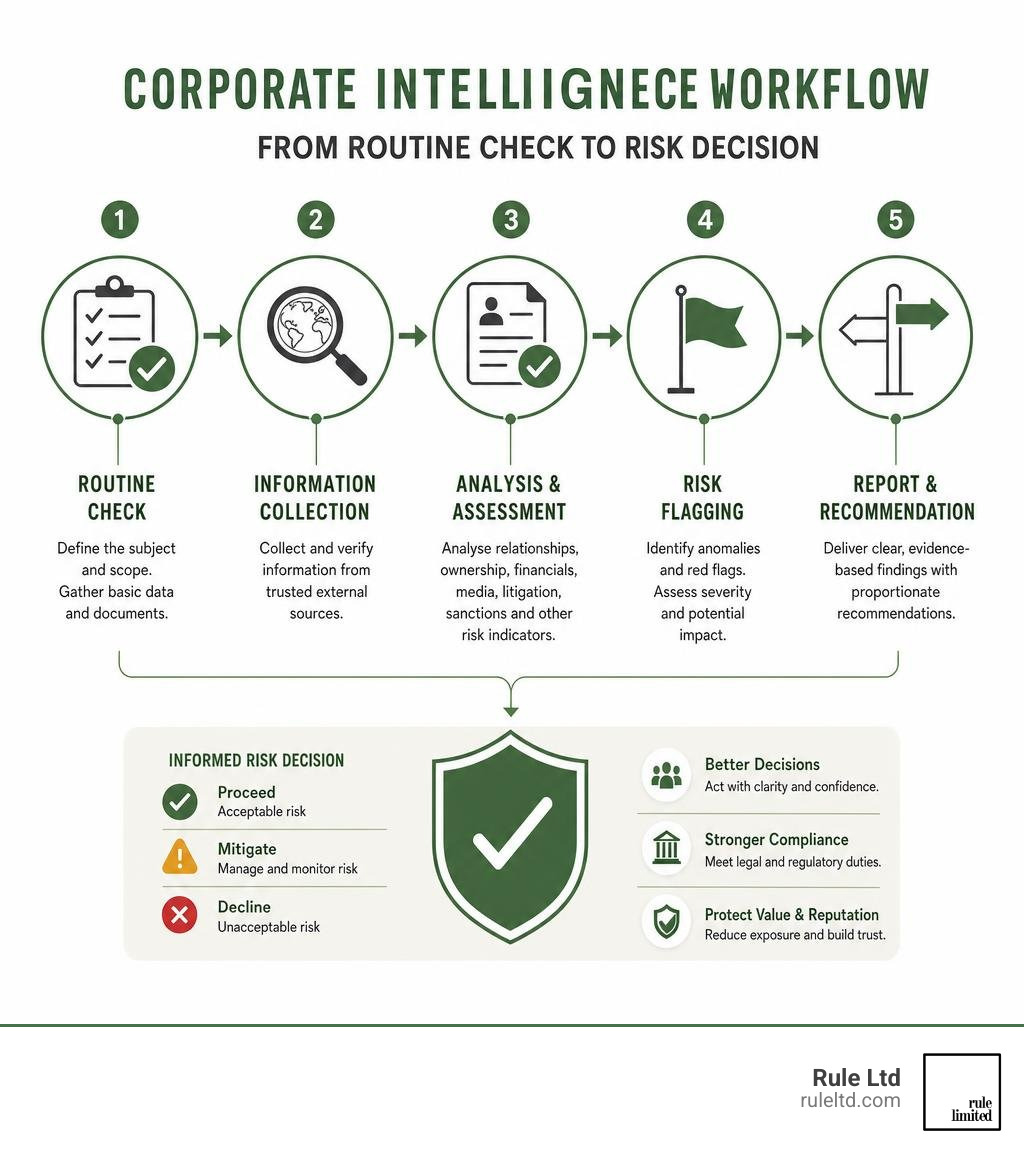
Corporate intelligence examples show how a routine check on a company, supplier, executive or intermediary can reveal risks that internal reporting cannot see.
- Beneficial ownership checks can expose hidden control, nominee arrangements or links between entities that are not apparent from a single registry extract.
- Third-party due diligence can identify adverse media, litigation, sanctions proximity and undisclosed reputational concerns before reliance is placed on a third party.
- M&A intelligence can test claims made by a target, its founders and key executives before transaction documents and warranties are finalised.
- Supply chain intelligence can flag ownership, trade or regulatory risks that may affect a critical supplier or sourcing route.
- Competitive and market monitoring can track a rival’s patent activity, legal disputes, public contracts and market moves using lawfully available external records.
The value of corporate intelligence lies in evidential discipline. A beneficial ownership red flag may begin with a small inconsistency: a director with unexplained connections, a corporate shareholder in an opaque jurisdiction, or control that does not match the stated ownership structure. The judgement call is whether that inconsistency is immaterial, explainable, or significant enough to affect onboarding, pricing, warranties, escalation or exit.
The point is not to treat every anomaly as wrongdoing. It is to establish what can be supported by reliable records and proportionate research before a commercial decision is made. Legal and compliance implications always require case-by-case assessment.
Rule Ltd focuses on analyst-produced, defensible research into corporate intelligence examples, ownership opacity, sanctions exposure and the third parties on which global organisations depend.
Understanding beneficial ownership red flags in enterprise risk
Beneficial ownership scrutiny becomes material when formal ownership records, operating control and economic influence point in different directions. For senior legal and compliance teams, the risk is rarely a missing data field. It is reliance on a registry position that does not explain who can direct the counterparty, benefit from the relationship, or create sanctions, bribery, fraud or reputational exposure.
Opaque structures can be lawful, commercially routine or deliberately evasive. The investigative task is to distinguish administrative complexity from control risk using records that can be cited, reconciled and challenged. Under frameworks such as the UK Economic Crime and Corporate Transparency Act 2023 (ECCTA 2023), FATF standards, OFAC sanctions, OFSI sanctions and EU sanctions measures, counterparties with unverifiable ownership or control may require escalation rather than routine approval.
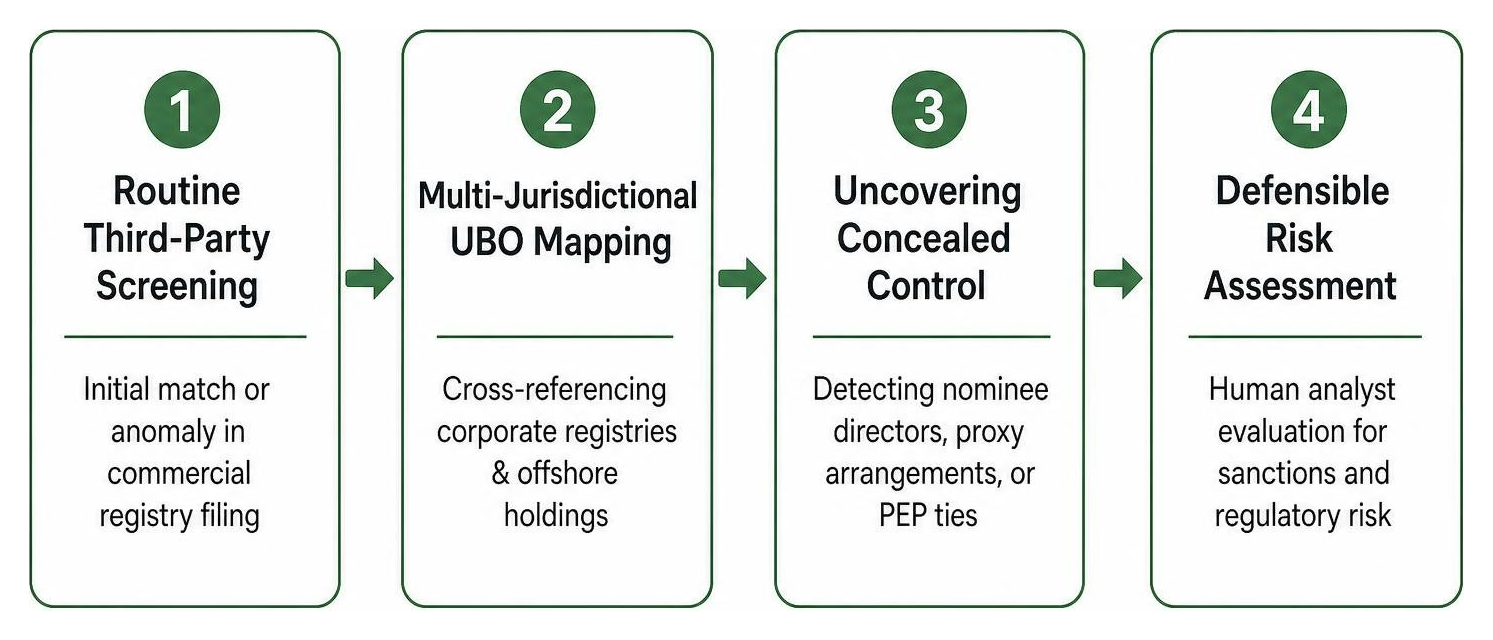
In onboarding, renewal and transaction contexts, the recurring failure mode is over-reliance on a single corporate registry extract or screening result. Where a shareholder chain crosses trusts, private investment vehicles, nominee structures or opaque jurisdictions, proportionate enhanced due diligence is often needed before a risk owner can make a defensible decision. For a detailed review of when deeper risk screening becomes necessary, see our analysis on What is Corporate Due Diligence and When Do You Need It?.
Key corporate intelligence examples in beneficial ownership detection
Practical corporate intelligence examples in beneficial ownership work are usually built from discrepancies between filings, transaction documents, public statements and third-party records. The evidential challenge is not identifying a single red flag in isolation but assessing whether a cluster of indicators, taken together, undermines confidence in the stated ownership and control position.
Consider a cross-border acquisition where the target’s majority shareholder is a holding vehicle registered in a jurisdiction with limited public disclosure. Registry filings name a corporate director that itself is owned through a further layered structure. Analyst review may reveal that the same registered agent address, the same formation date pattern and the same professional adviser network appear across several apparently unrelated entities linked to a sanctioned individual’s known associates. No single record is conclusive, but the cumulative picture raises a control question that cannot be resolved from the target’s own representations alone.
The judgement call for the risk owner is whether these indicators are sufficient to require enhanced verification, adjusted warranties, escrow arrangements or a decision not to proceed. That assessment depends on the regulatory context, the transaction value, the jurisdiction mix and the organisation’s own risk appetite, and it always requires case-by-case evaluation.
During cross-border transactions, identifying ownership opacity early can inform warranties, covenants, approval conditions or a decision not to proceed. For organisations preparing for strategic investments, structured investigation is essential, as detailed in our guide on Mergers and Acquisitions Due Diligence.
Differences between corporate intelligence and internal business intelligence
The practical distinction between internal business intelligence and corporate intelligence is not definitional but operational: it concerns what each can and cannot resolve when a risk decision must be documented and defended.
Internal dashboards can show payment volumes, procurement concentration or sales exposure. They cannot, on their own, resolve whether a distributor is acting for an undisclosed sanctioned controller, whether a target’s founder has material litigation history in another jurisdiction, or whether a supplier’s trade flows indicate a forced-labour or sanctions concern. These are evidential gaps that sit outside the organisation’s own data perimeter.
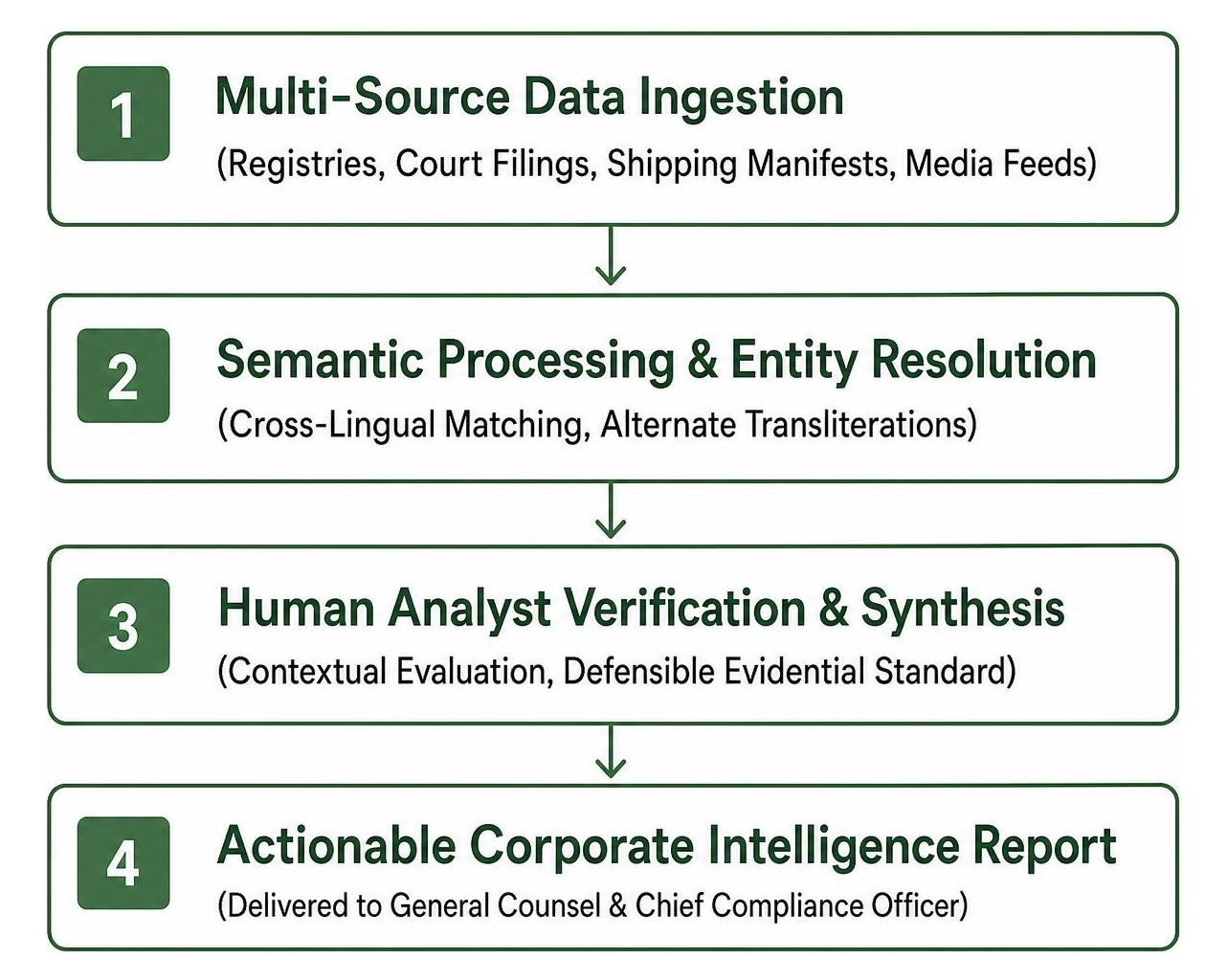
Corporate intelligence therefore relies on human analyst verification across external sources: corporate registries, court records, insolvency notices, regulatory publications, adverse media, trade data and other lawful open sources. The output should be a defensible assessment with source references, confidence levels and unresolved questions, rather than an automated pass or fail result. For senior compliance and legal teams, the value lies in escalation quality: a report that enables a documented, proportionate decision rather than one that merely confirms a screening tool returned no exact-match result.
Top corporate intelligence examples across global enterprise risk sectors
Examining practical corporate intelligence examples across global trade, finance and industrial operations shows how deep research can reduce exposure to regulatory enforcement, sanctions breaches, litigation risk and reputational harm.
Third-party vendor risk and corporate intelligence examples in supply chain
Global supply chains are exposed to sanctions enforcement, forced-labour import controls and supplier integrity risks under regimes such as the US Uyghur Forced Labor Prevention Act (UFLPA), the German Supply Chain Due Diligence Act (LkSG) and the UK Modern Slavery Act 2015 section 54. Standard third-party risk management (TPRM) checks frequently miss indirect vendor risks buried within extended supplier, logistics and ownership networks.
In trade-related investigations, the relevant question is often not whether the immediate supplier is listed, but whether the surrounding structure points to circumvention, diversion or concealed control. Analyst review may compare ownership records, bills of lading, Harmonised System (HS) codes, port calls, consignees, freight forwarders and adverse media to test whether declared trade routes and counterparties match commercial reality. Where restricted goods, dual-use indicators or high-risk transshipment patterns appear, escalation should be documented and assessed case by case.
To review how structured intelligence secures supply networks, read our analysis on Strategic Supplier Intelligence.
M&A due diligence and executive vetting case studies
In corporate acquisitions and senior appointments, routine background screening may not resolve the questions that matter to transaction and governance teams. A database result may miss overseas litigation, insolvency history, adverse regulatory commentary, undisclosed conflicts, digital exposure, identity inconsistencies or reputational issues that sit outside the candidate’s home jurisdiction.
Enhanced corporate intelligence supports deal teams by testing management claims against external records and by identifying issues that may affect valuation, warranties, governance arrangements or post-completion integration. Executive vetting can also assess whether a proposed director’s public profile, corporate associations and litigation footprint are consistent with the role being considered.
For further examples of anonymised investigative outcomes, view Rule Ltd’s summary of Due Diligence Case Studies.
Geopolitical risk and cross-functional corporate intelligence examples
Global corporations operating across multiple legal jurisdictions face regulatory change, foreign government intervention, sanctions volatility and political exposure. The corporate intelligence challenge is not simply gathering updates. It is maintaining a centralised, source-led view that legal, compliance, corporate affairs and communications teams can rely on when market conditions change.
Cross-functional intelligence can help reconcile stakeholder records, litigation developments, regulatory notices, media reporting and ownership changes across jurisdictions. This is particularly important where a market entry, supplier renewal or acquisition involves state-linked entities, PEP exposure, disputed assets or sectors subject to export controls and sanctions.
For enterprises expanding into high-risk markets, establishing local intelligence baseline checks is vital. Learn more about managing jurisdictional hazards in our overview of Market Entry Risk Assessment.
Essential investigative methodologies and technology tools

Corporate intelligence work depends on lawful open-source research, disciplined source handling and human analytical rigour. Large datasets are useful only where the provenance, coverage, translation quality, timeliness and evidential limits are understood.
Human analysts use data fusion techniques to cross-reference unstructured records such as foreign corporate registries, regulatory notices, social media histories and trade manifests into defensible investigative reports. The objective is not volume of data. It is a reasoned assessment that distinguishes verified findings, plausible indicators, false positives and issues requiring further clarification.
Advanced data sources: corporate registries, litigation records, and trade data
Comprehensive investigative work relies on verified, primary-source records wherever available. Key investigative data streams include:
- Official Corporate Registries: Historical filings, share capital allocations, registered agent addresses, directorship filings, beneficial ownership declarations and changes in control.
- Litigation and Bankruptcy Records: Local court dockets, insolvency notices, international commercial arbitration references and judgment databases that may identify undisclosed liabilities or fraud allegations.
- Global Trade Data and Bills of Lading: Container shipping records, customs declarations and Harmonised System (HS) codes used to assess real-world trade routes and potential sanctions evasion indicators.
- Regulatory and Sanctions Databases: Entity and individual screening against international watchlists maintained by OFAC, OFSI, the European Union and the United Nations, with attention to ownership and control analysis rather than name matching alone.
To review how specialised research solves complex business risk challenges, explore our full suite of Corporate Intelligence Investigation Services.
Ethical standards, legal compliance, and data privacy in intelligence gathering
Corporate intelligence must be conducted within strict legal and ethical parameters. Unlawful data collection methods such as unauthorised computer access, phone hacking or unlawful pretexting expose organisations to serious legal and reputational consequences under regimes including the UK Computer Misuse Act 1990, GDPR and applicable anti-bribery, corruption and privacy laws.
Ethical corporate intelligence relies on lawfully accessible open sources, public registries, official records and proportionate analyst review. Human analysts ensure that collected information is contextualised, verified and processed responsibly. Because regulatory obligations vary significantly by jurisdiction, counterparty type and commercial structure, specific compliance matters always require case-by-case assessment.
To understand how reputational concerns are ethically evaluated during transactions, see our guide on Reputational Risk in Due Diligence.
Frequently asked questions about corporate intelligence
What is the difference between business intelligence and corporate intelligence?
Business intelligence typically draws on internal operational data — sales figures, procurement metrics, financial reporting — to support management decisions. Corporate intelligence addresses a different evidential problem: whether an external counterparty, asset, executive or market position carries risk that internal systems cannot surface. The distinction matters most at the point of escalation, where a compliance or legal team needs source-referenced findings on external parties rather than internal performance dashboards.
How does corporate intelligence uncover hidden beneficial owners?
Analyst-led research cross-references corporate registry filings, historical directorship records, trust and nominee indicators, court records and adverse media across multiple jurisdictions. The objective is to reconcile formal ownership declarations with indicators of actual control — including shared addresses, common professional advisers, layered holding structures and voting or contractual arrangements that may concentrate influence away from the apparent majority shareholder. Where ownership chains cross opaque jurisdictions or involve private investment vehicles, multi-jurisdictional primary-source research is typically required to reach a defensible position.
Is corporate intelligence legal and ethically compliant?
Corporate intelligence conducted by reputable providers relies exclusively on lawfully accessible open sources, public registries, official records and proportionate analyst review. Unlawful methods — such as unauthorised computer access, phone interception or unlawful pretexting — expose organisations to serious legal and reputational consequences under regimes including the UK Computer Misuse Act 1990, GDPR and applicable anti-bribery and privacy laws. Because regulatory obligations vary by jurisdiction, counterparty type and commercial structure, specific compliance matters always require case-by-case assessment.
Conclusion: Mitigating beneficial ownership risks with structured intelligence
Routine corporate checks frequently surface early warning indicators that require deeper analysis. Uncovering beneficial ownership opacity, concealed PEP relationships, or indirect sanctions exposure requires specialized research that extends beyond automated software databases.
Rule Ltd delivers human-analyst-produced, defensible corporate intelligence and due diligence reports tailored to senior legal and compliance leaders. Our global research capabilities provide fixed-price, cost-certain coverage across international jurisdictions. Standard vendor screening reports are completed in two to three working days, while enhanced due diligence and corporate intelligence investigations are delivered in approximately five working days—with exact fixed fees agreed upon prior to instruction.
To discuss how our analyst-led investigations can assist your organisation in verifying counterparty integrity and mitigating regulatory risk, explore our core Corporate Intelligence services.
Sources relied upon
- LexisNexis, “What is Corporate Intelligence? Definition & Use Cases” (2026).
- Oracle NetSuite, “23 Case Studies and Real-World Examples of How Business Intelligence Keeps Top Companies Competitive” (2024).
- Tableau, “Real-world applications of business intelligence” (2024).
- Coursera, “What Is Business Intelligence? Examples, Benefits, and How It Works” (2025).
- Klue, “Eight Competitive Intelligence Examples in Practice” (2026).
- Marymount University, “Customer Intelligence Examples: How to Gain Better Customer Insights” (2024).
- Constella Intelligence, “Optimizing Executive Due Diligence Through Verified Identity Pedigree” (2025).
- TSC.ai, “How a Global Commodities Trader Built a Cross-Functional Intelligence Layer Spanning Media Relations, Corporate Affairs, and Legal” (2024).
- Relativity, “Sensitive whistleblower investigation handled with speed using Relativity aiR” (2025).
- Strider Technologies, “Countering PRC IP Theft at a Fortune 100 Chemical Company” (2024).
- TransVoyant, “The Bridgestone Execution: Predictive Interdiction and Saving Millions in the Supply Chain” (2024).
- StoneTurn, “Uncovering a Global Sanctions Evasion Network Through AI-Enabled Trade Analysis” (2024).
- Neotas, “Third-Party Due Diligence: Uncovering Hidden Risks in Potential Partnerships” (2026).