
How Corporate Intelligence Uncovers Hidden Counterparty Risks
Commercial databases and automated web screeners struggle when counterparty risk is intentionally masked. Offshore corporate structures, nominee directors, and regional corporate registries missing digital indexes routinely obscure ultimate beneficial ownership. Corporate intelligence firms address this gap by combining Open-Source Intelligence (OSINT) with discreet Human Intelligence (HUMINT) tradecraft.
Relying on database algorithms alone often produces a false sense of security. Automated platforms standardly fail to connect disparate entities across jurisdictions with non-standard naming conventions, or miss regulatory enforcement actions locked inside physical court records.
Through structured Enhanced Due Diligence, corporate intelligence practitioners trace proxy networks, analyse corporate filings in native languages, and assess real-world business reputations to surface liabilities before contracts are signed or capital is committed.
OSINT and HUMINT Integration in Risk Analysis
Robust intelligence methodologies structure research through a clear hierarchy. Baseline automated OSINT (Tier 3) aggregates global watchlists, electronic corporate databases, and public news sources. While useful for initial screening, automated collection cannot interpret local nuance or unearth buried liabilities.
Tier 2 research examines deep public records. Experienced analysts inspect local language litigation dockets, historical regulatory archives, property deeds, and corporate filings that are not indexed by commercial engines. In many jurisdictions across South America, Central Europe, or the Asia-Pacific region, critical litigation filings exist solely in physical courthouse archives requiring manual, on-the-ground retrieval.
When public records reach their structural limits, Tier 1 Human Intelligence provides qualitative context. By engaging industry observers, former business partners, and sector specialists within strict legal and ethical parameters, human source networks explain why a joint venture collapsed, how a key executive lost their regulatory licence, or whether an offshore trade entity acts as an illegitimate proxy.
Integrating human source commentary with physical records prevents false positives while establishing the evidential context behind complex corporate transactions.
Uncovering Third-Party Red Flags and Misconduct
Specialised investigations target specific risk categories that standard financial audits miss. Identifying Reputational Risk in Due Diligence requires evaluating historical corporate conduct, undisclosed conflict-of-interest networks, and recurrent patterns of litigious behaviour.
A common failure in third-party management is treating background checks as a single “smoking gun” search. In practice, operational risk usually presents as a cumulative pattern of behaviour. A prospective partner may lack a formal criminal record, yet display a history of brief corporate directorships ending in insolvency, recurring unpaid vendor suits, and regulatory fines under previous business aliases.
Corporate intelligence reports consolidate these fragmented indicators into a coherent risk narrative, helping compliance teams spot systemic integrity risks prior to engagement.
Comparing Top Corporate Intelligence Firms Across Key Sectors
Selecting the right corporate intelligence provider depends on organisational requirements, jurisdiction, regulatory pressure, and budgetary constraints. Global enterprises balance the vast network footprint of major multidisciplinary consultancies against the speed, discretion, and high-touch focus of specialised boutique intelligence agencies.
| Firm Category | Typical Footprint & Structure | Primary Methodology | Key Strengths | Potential Trade-offs |
|---|---|---|---|---|
| Big Four Consultancies | Massive global office networks; thousands of risk professionals. | Integrated risk suites, web-enabled diligence tools, financial auditing integrations. | Broad multi-disciplinary capabilities; extensive geographic office presence. | Higher overheads; potential conflict of interest; variable analyst engagement. |
| Global Specialised Firms | International boutique networks; multi-lingual regional hubs. | Deep public records retrieval, native OSINT, structured HUMINT networks. | High jurisdictional expertise; rapid execution; senior analyst oversight. | Focused scope (less emphasis on broad management consulting). |
| Niche Boutique Agencies | Dedicated regional or sector specialists; former intelligence leadership. | Targeted human tradecraft, bespoke source interviews, litigation support. | Absolute discretion; specialised high-stakes handling; partner-led research. | Smaller total headcount; specialised geographic or operational focus. |
Big Four Consultancies vs. Specialised Corporate Intelligence Firms
Multinational professional services networks bring significant scale to corporate risk management. Global firms deploy substantial multidisciplinary teams across dozens of countries, offering web-enabled integrity due diligence platforms integrated directly with broad financial, tax, and forensic accounting services.
Organisations undergoing massive global supply chain audits or enterprise-wide compliance overhauls often draw on these large networks to coordinate standardised vendor intake.
However, large multi-tiered consultancies can face structural limitations in specialised, high-stakes investigations. Broader corporate client portfolios increase the likelihood of legal or commercial conflicts of interest during adverse counterpart investigations or cross-border disputes.
Additionally, high-volume automated due diligence platforms run the risk of outputting standardised risk scores that require extensive internal legal review to interpret correctly.
Regional Tradecraft and Boutique Corporate Intelligence Firms
Boutique corporate intelligence firms offer an alternative model centred on specialised tradecraft, analytical agility, and senior expert involvement. Often founded by former investigative journalists, legal practitioners, or intelligence professionals, these specialised agencies focus on deep investigative due diligence, complex litigation support, and strategic risk advisory.
Instead of routing projects through junior analyst pools or automated database filters, boutique firms staff mandates based on direct regional expertise, native language fluency, and verified local source networks.
This model is particularly effective when navigating opaque business environments across emerging markets, where local political dynamics, non-digitised court records, and proxy networks demand nuanced human evaluation.
Core Services and Strategic Use Cases for Global Enterprises

Global organisations retain external intelligence specialists to manage major transaction risk, preserve legal privilege, and guide strategic expansion. Different corporate stakeholders deploy these services for targeted operational objectives:
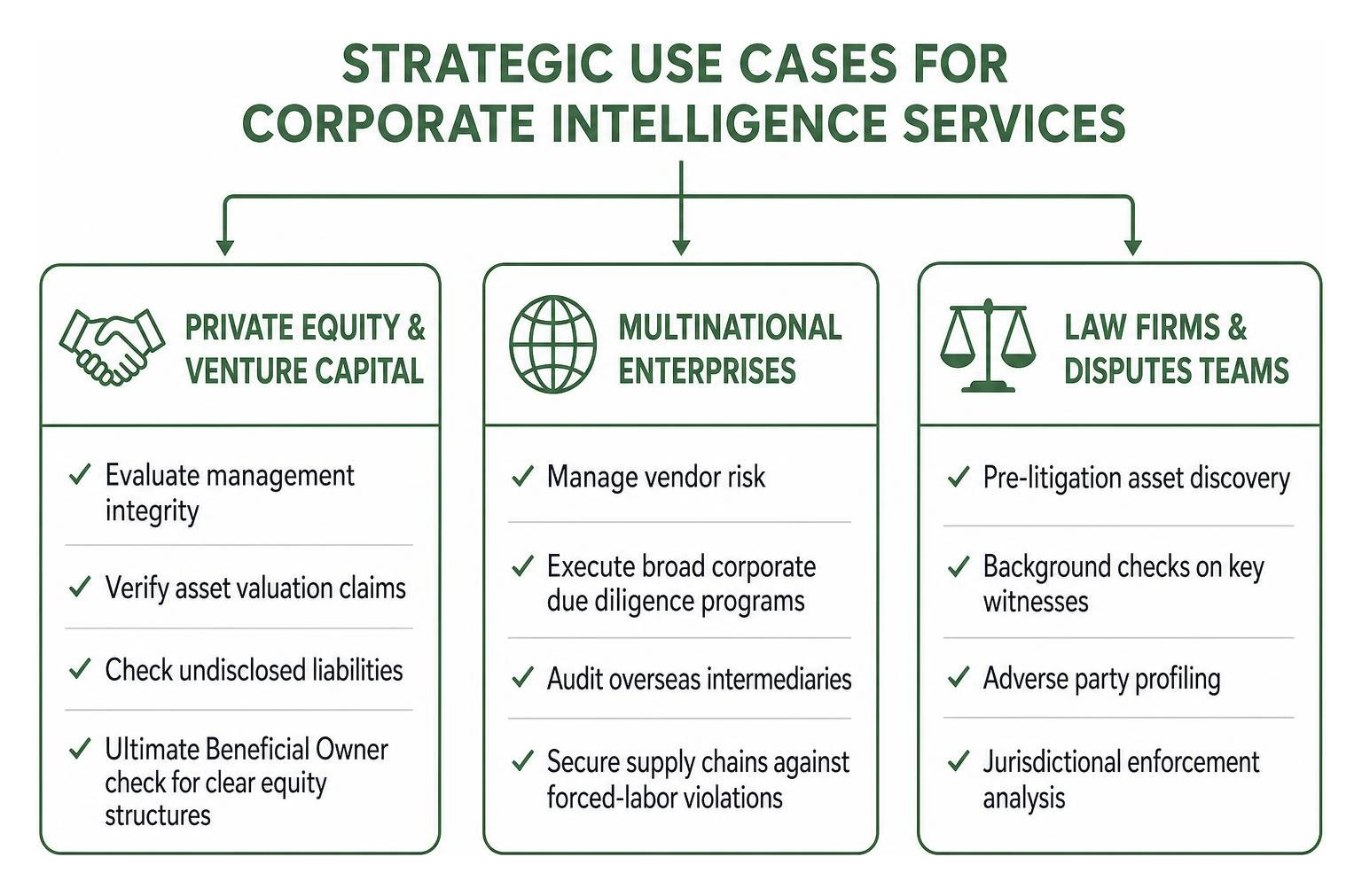
- Private Equity & Venture Capital: Evaluating management integrity, verifying asset valuation claims, checking undisclosed liabilities, and conducting an Ultimate Beneficial Owner Check to ensure clear equity structures.
- Multinational Enterprises: Managing vendor risk, executing broad Corporate Due Diligence programmes, auditing overseas intermediaries, and securing supply chains against forced-labour violations.
- Law Firms & Disputes Teams: Pre-litigation asset discovery, background checks on key witnesses, adverse party profiling, and jurisdictional enforcement analysis.
Pre-M&A Due Diligence and Third-Party Risk Management
Corporate acquisitions and major supplier contracts represent significant financial commitments where unvetted counterparty risks can trigger severe regulatory penalties or operational losses. Standard legal and financial reviews examine balance sheets and contractual terms, but rarely uncover hidden political connections, ethical lapses, or underlying ownership networks.
Detailed investigative diligence systematically audits prospective M&A targets and key third-party vendors. Specialists analyse:
- Ultimate Beneficial Ownership (UBO): Unravelling multi-layered offshore holding structures, trust arrangements, and family proxies designed to conceal beneficial control or sanctioned affiliations.
- Anti-Bribery and Corruption Exposure: Reviewing government contracting histories, intermediary commission arrangements, and foreign agent networks for potential exposure under anti-corruption frameworks.
- Labour and Supply Chain Integrity: Auditing overseas manufacturing nodes and tiers of sub-contractors to detect forced labour risks or regulatory non-compliance.
Uncovering these factors before transaction closure gives deal teams crucial leverage to adjust valuations, introduce specific indemnities, or abort unviable acquisitions entirely.
Litigation Support, Asset Tracing, and Geopolitical Risk
In contentious disputes, commercial success depends on actionable, legally defensible evidence. Corporate intelligence specialists support legal teams by locating hidden counterparty assets, identifying potential witnesses, and evaluating enforcement options across multiple jurisdictions.
By mapping property holdings, corporate directorships, maritime registries, and foreign court filings, investigators trace asset transfers through shell entities to support post-judgment enforcement or freezing orders.
Simultaneously, shifting international stability requires continuous geopolitical threat analysis. Firms entering emerging markets or adjusting international supply chains rely on tailored intelligence to evaluate sovereign risk, regulatory shifts, asset expropriation potential, and local security dynamics.
Proactive intelligence mapping ensures organizations build supply chain resilience before regional crises or trade restrictions interrupt operations.
Regulatory Drivers and Limitations of AI Diligence

Strict enforcement across global regulatory regimes has made third-party oversight a primary governance requirement for multinational leadership. Modern corporate compliance programmes must prove that due diligence procedures are active, risk-based, and legally defensible.
The regulatory landscape demands thorough oversight. For example, statutory provisions such as the corporate offence of failing to prevent fraud under the UK Economic Crime and Corporate Transparency Act 2023 (ECCTA), alongside established frameworks like the US Foreign Corrupt Practices Act (FCPA) and the UK Bribery Act 2010, mean that turning a blind eye to third-party misconduct creates direct corporate liability.
Similarly, strict sanctions enforcement by bodies like OFAC in the US and OFSI in the UK mandates deep ownership checks to prevent dealing with entities controlled by sanctioned parties under the 50% Rule. Specific compliance requirements must always be assessed on a case-by-case basis.
Evolving Regulatory Mandates and Enforcement Standards
Regulatory enforcement has expanded from financial counterparty screening into broad supply chain oversight and ESG compliance. Standards such as the German Supply Chain Due Diligence Act (LkSG), the EU Corporate Sustainability Due Diligence Directive (CSDDD), and the US Uyghur Forced Labor Prevention Act (UFLPA) require companies to audit multi-tier supplier networks for human rights and environmental violations.
Furthermore, international anti-money laundering standards established by the Financial Action Task Force (FATF) continue to drive domestic legislation globally.
Compliance programmes relying purely on superficial database checks risk severe regulatory fines, import seizures, and significant brand damage when hidden vendor infractions surface.
Why Human Judgment Outperforms Automated Screening
While artificial intelligence and machine learning tools accelerate initial data collection, relying entirely on automated due diligence creates major vulnerabilities. Large Language Models (LLMs) and automated scrapers regularly suffer from data processing limitations:
Automated scrapers are highly susceptible to targeted online reputation management (ORM). Individuals seeking to hide background risks frequently publish low-grade promotional news articles or optimise web content to confuse search algorithms and language models.
Furthermore, AI models cannot physically visit regional courthouses to inspect sealed dockets, evaluate source credibility, or weigh local political dynamics.
Decision-grade reports rely on expert human analysts to cross-reference primary sources, verify documentation, and synthesise complex facts into actionable risk advice.
Frequently Asked Questions About Corporate Intelligence
What distinguishes corporate intelligence from standard private investigations?
While traditional private investigations generally focus on localised, individual fact-finding tasks, corporate intelligence firms address strategic corporate risk, regulatory compliance, and cross-border commercial transactions. Their methodologies are structured specifically to meet legal evidentiary standards, withstand corporate governance scrutiny, and deliver actionable insights for executive leadership, compliance teams, and legal counsel.
How do corporate intelligence providers ensure legal compliance across jurisdictions?
Reputable corporate intelligence providers operate strictly within applicable national and international legal frameworks. This includes complying with data protection legislation (such as GDPR), respecting privacy laws, holding required regional investigative licences, and maintaining strict compartmentalisation of client information. Legitimate firms do not use illegal wiretapping, unauthorised computer access, or pretexting methods that could compromise a client’s legal privilege or expose them to liability.
What are the main limitations of relying purely on automated risk screening?
Automated screening platforms rely on indexed digital databases, leaving them blind to physical court records, regional registries lacking digital APIs, and native-language media in obscure markets. Automated systems also struggle with high false-positive rates, cannot analyse nuance or local context, and remain vulnerable to synthetic online content and search engine manipulation designed to fool scrapers.
Navigating Counterparty Risk with Confidence
Managing corporate risk requires balancing speed, thoroughness, and evidential rigour. While basic automated screening helps surface immediate watchlist matches, complex transactions and high-risk vendor relationships demand deeper investigative diligence.
Organisations that rely solely on automated “check-the-box” screening frequently miss buried liabilities, offshore proxy networks, and underlying integrity risks that can disrupt operations or invite regulatory enforcement.
At Rule Ltd, we deliver clear, defensible corporate intelligence and enhanced due diligence reports to help General Counsel and Chief Compliance Officers evaluate third-party risks with certainty.
Our human analyst reports combine multi-lingual open-source tradecraft with deep public record research across international jurisdictions. Every engagement is provided on a fixed-price basis with agreed delivery timelines prior to commencing work, ensuring cost certainty without compromising analytical depth.
To discuss an upcoming M&A transaction, audit an international supply chain, or enhance your vendor due diligence framework, learn more about our specialised Corporate Intelligence Investigation Services or contact our analyst team to Request a Custom EDD Report Quote.
Relied-Upon Sources and Regulatory References
- UK Legislation: UK Bribery Act 2010 – Ministry of Justice guidance on adequate procedures for commercial organisations.
- UK Legislation: Economic Crime and Corporate Transparency Act 2023 (ECCTA) – Statutory framework governing corporate liability and failure to prevent fraud.
- US Department of Justice: Foreign Corrupt Practices Act (FCPA) – Enforcement guidelines and compliance standards for foreign counterparty interactions.
- US Department of the Treasury: Office of Foreign Assets Control (OFAC) – Sanctions compliance frameworks and the 50% Ownership Rule guidelines.
- UK Office of Financial Sanctions Implementation (OFSI): Financial Sanctions Guidance – Ownership and control enforcement rules across corporate structures.
- Financial Action Task Force (FATF): Guidance on Beneficial Ownership – International standards on transparency and identification of ultimate beneficial owners.
- Federal Ministry of Labour and Social Affairs (Germany): Act on Corporate Due Diligence Obligations in Supply Chains (LkSG) – Human rights and environmental due diligence mandates for international supply networks.
- European Parliament & Council: Corporate Sustainability Due Diligence Directive (CSDDD) – European regulatory framework for environmental and operational supply chain oversight.
- US Customs and Border Protection: Uyghur Forced Labor Prevention Act (UFLPA) – Supply chain verification and import enforcement standards.