
Scope and Strategy for AI Vendor Evaluation
Before you can assess third-party AI risk, you need to know what you are actually trying to evaluate. That sounds obvious, but in practice, establishing a clear scope is one of the hardest hurdles enterprise procurement teams face.
Without explicit boundary lines, organizations either get bogged down attempting to audit every basic rule-based Excel macro, or they swing to the opposite extreme: letting complex machine learning systems enter the business completely unvetted. A comprehensive Third Party Risk Assessment strategy must establish a precise, repeatable scoping mechanism right at the intake gate.
Defining AI Capabilities and System Scope
To set a practical scope for your AI vendor risk management program, you must establish clear definitions for what constitutes an “AI system” within your enterprise context. In practice, third-party AI usually enters an organization through three primary software architecture archetypes:
- Direct AI/LLM Vendors: Specialized providers offering standalone machine learning or generative AI applications (such as custom enterprise LLMs, predictive maintenance engines, or automated fraud detection tools).
- Embedded Background AI Features: Established SaaS platforms (like enterprise CRMs, ERPs, or HR portals) that quietly roll out embedded AI modules into existing workflows.
- AI-Enabled Service Providers: Service vendors (such as external law firms, marketing agencies, or management consultancies) who utilize proprietary or third-party AI tools behind the scenes to deliver their work product.
When defining scope, focus on the functional mechanism of the software rather than marketing buzzwords. Modern frameworks usually classify systems based on machine learning models, neural networks, computer vision, natural language processing (NLP), or complex automated decision-making engines. Conducting thorough Third Party Due Diligence ensures you uncover whether a vendor’s tool actively processes data through algorithmic inference, rather than simple deterministic logic.
Generative AI vs. Traditional Third-Party Vendor Assessments
Traditional software operates deterministically: given input A, it consistently returns output B according to fixed code. Generative AI, however, introduces dynamic, non-deterministic behaviors that render standard third-party questionnaires obsolete.
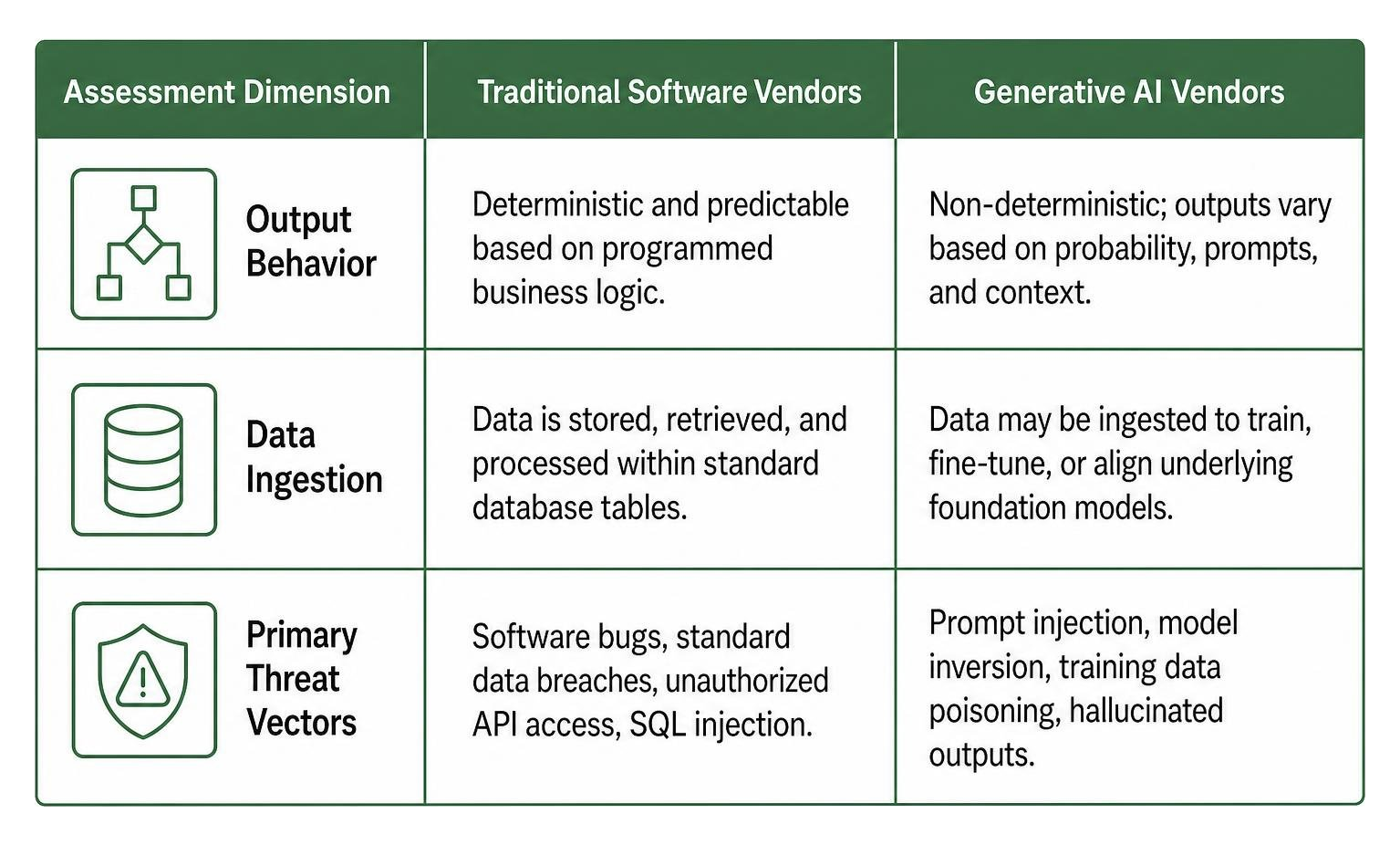
| Assessment Dimension | Traditional Software Vendors | Generative AI Vendors |
|---|---|---|
| Output Behavior | Deterministic and predictable based on programmed business logic. | Non-deterministic; outputs vary based on probability, prompts, and context. |
| Data Ingestion | Data is stored, retrieved, and processed within standard database tables. | Data may be ingested to train, fine-tune, or align underlying foundation models. |
| Primary Threat Vectors | Software bugs, standard data breaches, unauthorized API access, SQL injection. | Prompt injection, model inversion, training data poisoning, hallucinated outputs. |
| Intellectual Property | Clear software licensing, clear copyright ownership of static output. | Unclear training data provenance, risk of infringing third-party IP in generated outputs. |
| Dependency Risk | Standard third-party library and database dependencies. | Multi-layered Nth-party reliance on foundational model providers and API hosting infrastructures. |
Designing a Scalable Framework for AI Vendor Risk Management
If your vendor risk evaluation process takes six months, your business teams will bypass you. It is that simple. When procurement friction becomes intolerable, business units turn to shadow IT—signing up for cloud AI tools with corporate credit cards and feeding sensitive company IP into unvetted public models.
To balance speed with security, build a standardized risk playbook. This framework should define standard versus non-standard risk thresholds, pre-approved fallback contract terms, and specialized questionnaires. Harnessing Supply Chain Risk Technology How Ai And Analytics Are Transforming Risk Management enables organizations to automate early risk scoring, ensuring that low-risk pilot projects move swiftly while high-risk enterprise deployments undergo rigorous inspection.
Key Challenges in AI Vendor Risk Management
Implementing a robust AI vendor risk management framework introduces novel operational friction. Understanding where these challenges originate allows enterprise risk teams to build proactive controls rather than reactive firewalls.
Essential Assessment Domains in AI Vendor Risk Management
A thorough AI vendor evaluation cannot rely solely on a standard security questionnaire. It requires cross-functional scrutiny across seven vital assessment categories:
- Data Privacy, Retention, and Deletion: Does the vendor retain your inputs or prompt histories? Are corporate inputs explicitly excluded from foundational model training? Can the vendor execute a true data deletion request if model weights have already adapted?
- Model Training, Validation, and Maintenance: How was the underlying model trained? What measures prevent algorithmic bias, drift, or hallucinations? How frequently is the model re-validated against performance baselines?
- Information Security: How are API keys and model parameters secured? Are robust defenses in place against prompt injection, data exfiltration, and model inversion attacks? Conducting a focused Third Party Cybersecurity Risk Assessment is mandatory to verify these technical controls.
- Technology Integration: How does the AI tool interface with your existing IT stack? Does it require elevated permission levels or broad access to core databases?
- Nth-Party Risk: AI ecosystems are deeply layered. Does your direct SaaS vendor rely on an underlying LLM provider, who in turn relies on cloud infrastructure hosters? You must assess the entire downstream supply chain.
- Legal, Regulatory, and Compliance Alignment: Does the tool satisfy regulatory expectations across applicable operating jurisdictions (e.g., ISO/IEC 42001 standards, NIST AI Risk Management Framework 1.0, or regional AI statutes)?
- General Vendor Viability: Does the vendor possess the financial stability and operational resilience to support critical AI dependencies long term?
Separating Tool Risk from Use Case Exposure
A foundational principle of modern AI vendor risk management is distinguishing between inherent tool risk and contextual use case risk.
- Tool Risk: Inherent vulnerabilities present within the software itself—such as security gaps in the vendor’s API architecture, poor access controls, or lack of SOC 2 certifications.
- Use Case Risk: The risk created by how your enterprise intends to deploy the tool.
For example, deploying a general-purpose LLM tool to help research analysts summarize public financial filings presents a minimal corporate risk profile. However, deploying that exact same tool to automatically screen candidate resumes for HR hiring decisions introduces significant legal, regulatory, and bias exposure.
Evaluating the technology in isolation is never enough; you must evaluate the technology combined with its intended business deployment context.
Managing Mid-Contract Feature Additions and Shadow IT
One of the most persistent operational headaches in enterprise compliance is contract drift. You approve a software platform for standard document editing, and six months later, the vendor pushes an over-the-air update introducing an “AI Assistant” that automatically ingests user content to optimize public models.
To mitigate this challenge, implement continuous Vendor Compliance Monitoring. Establish contractual trigger events requiring vendors to provide advance written notice before enabling generative or machine learning features on existing corporate accounts. Combine these contractual safeguards with network-level cloud access monitoring to detect unauthorized AI endpoint connections across your corporate network.
Tiered Diligence and Operational Safeguards
To prevent compliance teams from drowning in paperwork while maintaining rigorous oversight, successful organizations implement structured, tiered due diligence workflows aligned with external governance frameworks like ISO/IEC 42001 or the NIST AI Risk Management Framework (NIST AI RMF).
Tiered Due Diligence and Risk Appetite Alignment
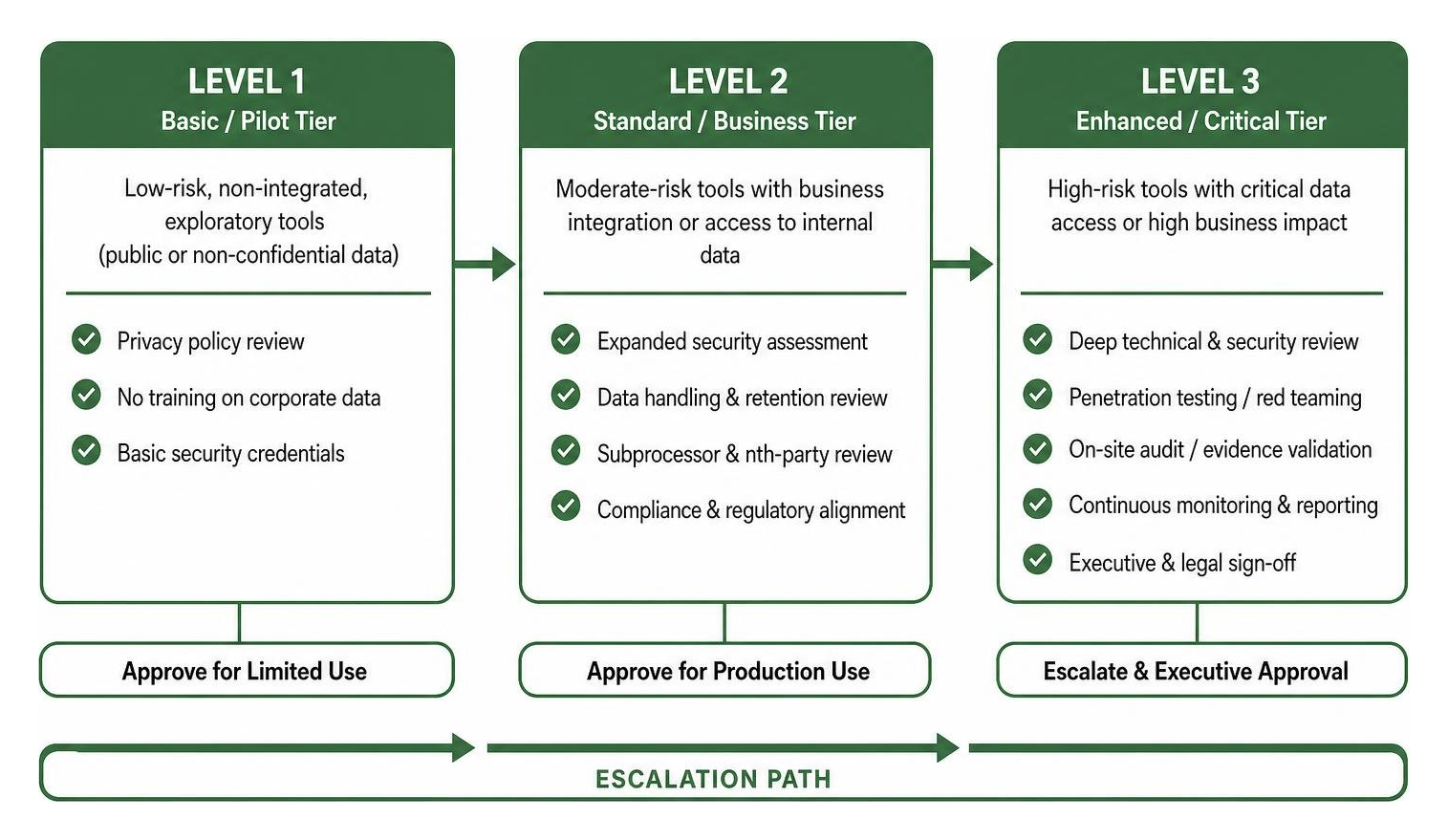
A one-size-fits-all questionnaire satisfies no one. Instead, tailor your evaluation depth across three dynamic due diligence tiers based on your organization’s defined risk appetite (Risk Averse, Balanced, or Risk Tolerant):
- Level 1 (Basic / Pilot Tier): Applied to low-risk, non-integrated, or exploratory R&D tools that process only public or non-confidential data. Focuses on foundational privacy policies, confirming no model training on corporate inputs, and basic security credentials.
- Level 2 (Integrated / Operational Tier): Applied to systems integrated into internal operational workflows or handling internal business data. Evaluates data retention policies, access management, technical architecture, and baseline vendor security controls.
- Level 3 (Comprehensive / High-Risk Tier): Applied to mission-critical applications, customer-facing generative bots, tools making automated legal/financial/employment decisions, or systems ingesting highly sensitive business data. Requires full technical audits, red-teaming validation, deep sub-processor disclosures, and specialized Enhanced Due Diligence reviews.
Frameworks like the AI Vendor Assessment — Responsible AI Studio offer structured 30-question scored workbooks mapped across weighted categories, enabling risk teams to evaluate alignment against ISO/IEC 42001 or NIST AI RMF baselines with defined pass, conditional, or reject thresholds.
When conducting risk analysis across multiple operational domains—such as business integration, confidential data handling, business resiliency, and exposure potential—a high-risk classification in any single domain (e.g., scoring high risk in Business Resiliency) should automatically escalate the overall engagement to Level 3 comprehensive due diligence.
Practical Mitigations Beyond Vendor Questionnaires
Contractual indemnities and vendor questionnaires are essential, but they cannot restore lost trade secrets if a vendor suffers a catastrophic breach. You must deploy technical and operational mitigants directly within your control environment:
- Data Masking and Sanitization: Implement automated data loss prevention (DLP) gateways to strip Personally Identifiable Information (PII), credentials, and proprietary code before outbound prompts reach third-party API endpoints.
- Access Restrictions and Role-Based Permissions: Limit AI tool integration strictly to required business roles, blocking broad enterprise-wide automated data scraping.
- Operational Workarounds: Design operational business continuity plans so that critical business functions can operate manually if a third-party AI model suffers severe performance degradation, outage, or legal disruption.
Internal Stakeholders and Ongoing Periodic Re-assessments
Effective AI vendor risk management is not a static point-in-time procurement check; it is an ongoing operational lifecycle.
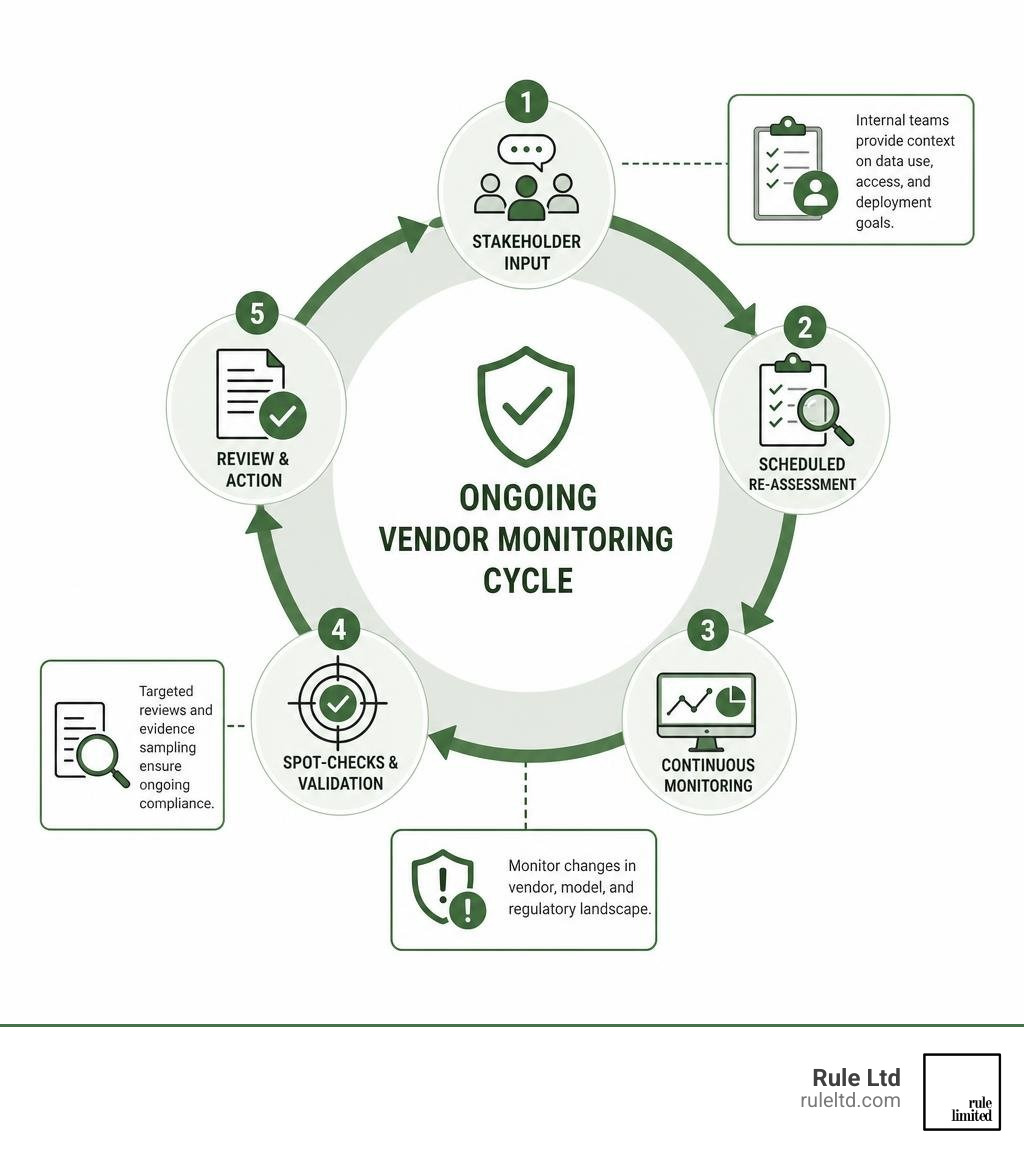
First, always issue an internal stakeholder questionnaire to your own business unit leaders before contacting the vendor. Internal teams provide vital context regarding actual data usage, proposed access levels, and deployment goals that vendor sales reps might understate.
Second, establish structured periodic re-assessment schedules aligned with your corporate policy and regulatory shifts:
- High-Risk (Level 3) AI Systems: Re-assess bi-annually or annually, combined with mandatory review whenever model architecture updates occur.
- Moderate-Risk (Level 2) AI Systems: Re-assess every 18 to 24 months.
- Low-Risk (Level 1) AI Systems: Perform lightweight periodic spot-checking to ensure scope creep has not introduced hidden risks.
To preserve audit readiness, compliance teams should export auto-populated assessment workbooks directly to immutable formats (such as signed PDF records) to maintain a permanent point-in-time record for internal auditors and external regulators.
Frequently Asked Questions About AI Vendor Risk Management
How often should AI vendors be re-assessed?
AI vendors should be re-assessed on a schedule determined by their risk tier, but also upon specific operational triggers. High-risk systems require annual or bi-annual reviews. However, any major platform update, shift in foundational model provider, material change in data retention policies, or addition of new automated decision capabilities should instantly trigger an off-cycle re-assessment regardless of the calendar schedule.
What is the biggest difference when evaluating generative AI tools?
The primary difference lies in output predictability and data persistence. Traditional third-party tools store data predictably; generative AI tools convert input data into complex statistical probability distributions. Risk managers must specifically evaluate whether enterprise input data is used to train or fine-tune public models, how prompt injection attacks are contained, and how the organization mitigates non-deterministic output risks like hallucinations and intellectual property infringement.
How can companies prevent shadow AI adoption?
To eliminate shadow AI adoption, bridge the gap between risk governance and business agility. Fast-track approval pathways for low-risk AI tools, establish pre-approved corporate AI sandbox environments, clear list pre-vetted AI platforms, and maintain continuous employee education regarding data privacy hazards. When legitimate business teams have access to safe, rapid procurement channels, the incentive to utilize unvetted third-party AI tools disappears.
Conclusion: Building a Defensible AI Risk Strategy
As enterprise adoption of machine learning and generative tools expands throughout 2026 and beyond, standard vendor evaluation tactics are no longer sufficient. Establishing a mature AI vendor risk management program requires clear scoping, rigorous multi-domain assessments, tiered due diligence, and ongoing technical safeguards.
By balancing rigorous compliance standards with business speed, risk leaders can safely unlock the transformative power of third-party AI without exposing their enterprises to unmanaged threats.
At Rule Ltd, we deliver comprehensive third-party risk assessment, corporate intelligence, and global due diligence services tailored to complex international operating environments. To evaluate how your current risk posture aligns with modern governance standards, explore our Vendor Risk Assessment Geopolitical Screening capabilities or contact our team today to implement a defensible, framework-aligned vendor risk program.