
Why Third-Party Data Breaches Put Your Business at Risk
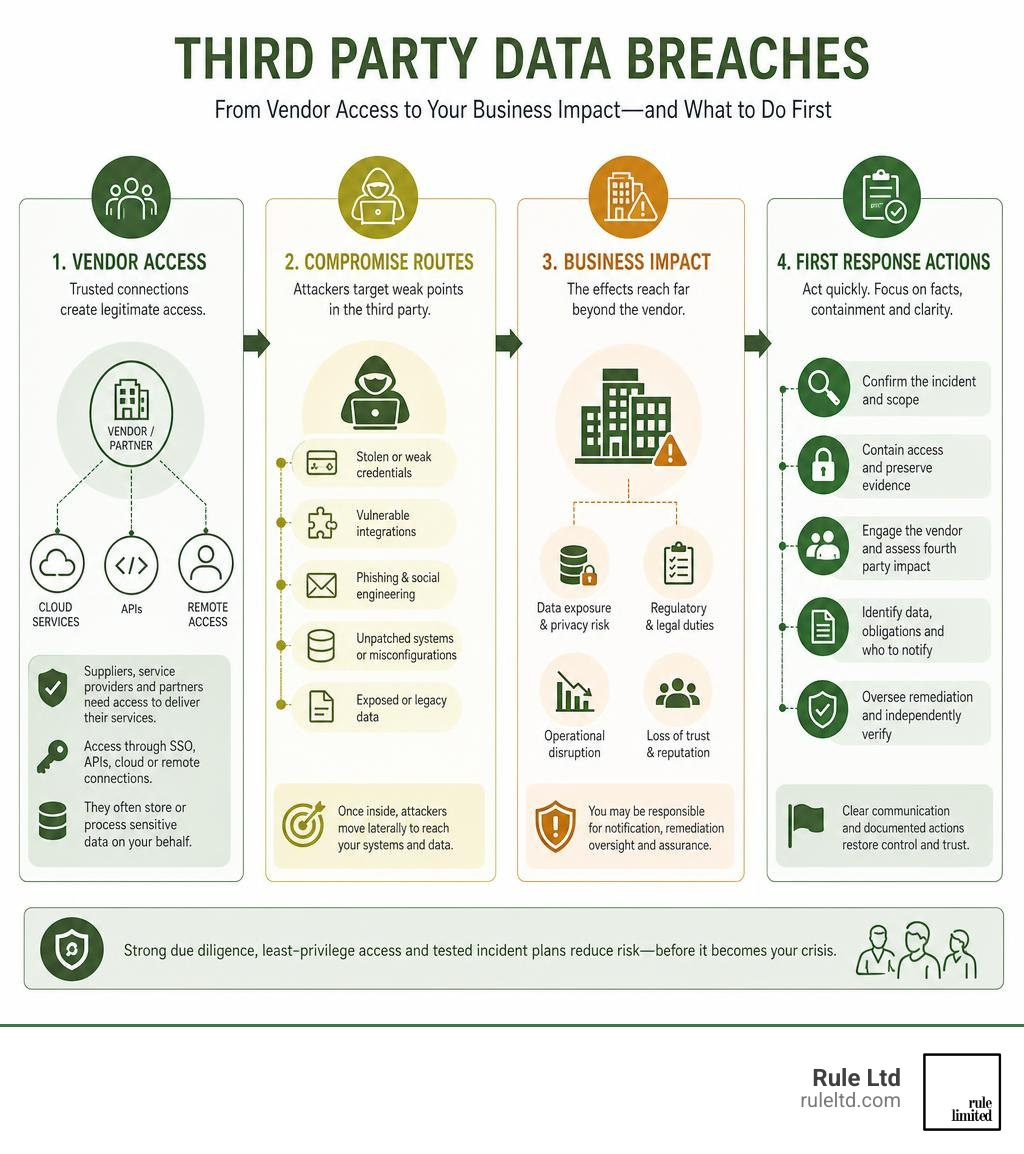
Organisations face severe operational disruption, statutory liability, and reputational erosion when an external supplier, service provider, or operational counterparty suffers a security compromise. When managing exposure to third-party data breaches, enterprise legal and compliance functions must evaluate counterparty risk across complex digital integrations.
Key evaluative priorities include:
- Which third parties process or retain sensitive commercial and personal datasets?
- Which counterparties maintain continuous connectivity to critical infrastructure via cloud environments, APIs, or single sign-on mechanisms?
- Do existing contractual terms, access governance controls, and incident response frameworks accurately reflect technical and legal exposures?
Exposure extends well beyond primary IT vendors. Payroll processors, employee benefits administrators, logistics counterparties, billing intermediaries, and cloud platforms frequently retain customer, workforce, or proprietary commercial records. Compromised credentials, unmonitored integration pipelines, or retained legacy datasets provide threat actors with direct pathways into enterprise networks.
Technical containment represents only the initial phase of incident remediation. Legal and compliance leaders must establish the precise scope of compromised records, identify affected fourth parties, execute statutory notifications, and independently verify vendor remediation. Regulatory duties vary significantly across jurisdictions, necessitating case-by-case compliance assessment.
Independent corporate intelligence and human-led due diligence remain essential to uncover hidden counterparty, beneficial ownership, and supply-chain vulnerabilities before operational failures occur.
The Compounding Mechanisms and Drivers of Third-Party Data Breaches
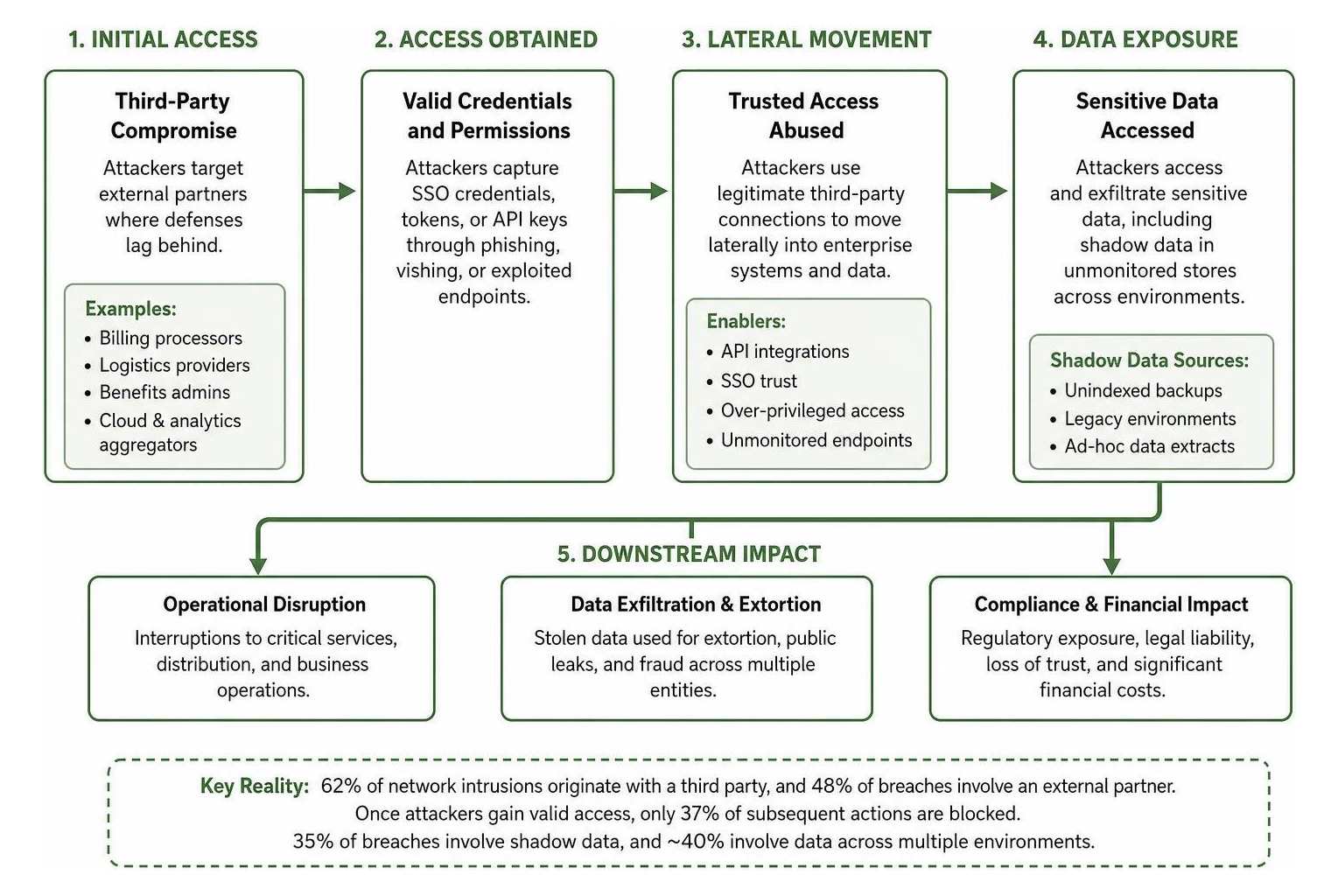
External partners have become the primary pathway into enterprise environments. Industry breach research indicates that 62% of network intrusions originate with a third party, and 48% of all breaches now involve an external partner [1]. Rather than assaulting hardened corporate perimeters directly, threat actors deliberately target external links where defensive spending lags behind data access.
Modern digital architecture relies heavily on persistent, interconnected integrations. When an external supplier establishes application programming interface (API) connections, synchronises customer relationship management (CRM) records, or integrates single sign-on (SSO) authentication, traditional network boundaries disappear. Attackers harvest privileged access tokens, exploit unmonitored API endpoints, and use trusted external permissions to move laterally into core corporate databases. Once an adversary acquires valid credentials within a trusted partner’s environment, standard preventative controls deteriorate sharply, with simulations showing that only 37% of subsequent malicious actions are blocked [2].
This exposure is compounded by shadow data: unmanaged, unmonitored data stores created across multi-cloud environments without central oversight. Approximately 35% of breaches involve shadow data, and roughly 40% involve data spread across multiple hosting environments [1]. When vendors create unindexed backups, legacy staging environments, or ad-hoc data extracts to fulfil operational requirements, they introduce unmonitored attack surfaces that evade point-in-time security evaluations.
High-Risk Vendor Classifications Across the Supply Chain
Enterprise risk management often suffers from an availability heuristic, focusing defensive resources on tier-one software providers while ignoring operational vendors handling sensitive records. Threat actors actively exploit this governance blind spot.
- Billing Intermediaries and Payment Processors: Aggregating transactional records, banking identifiers, and customer identity data, these entities represent high-value targets for exfiltration-only extortion campaigns.
- Logistics and Fulfilment Providers: Operational partners frequently receive plain-text customer names, physical addresses, delivery notes, and customs documentation. The disruption of automated distribution hubs exposes proprietary operational data and halts commercial distribution.
- Third-Party Benefits Administrators: These organisations process extensive tranches of highly sensitive identity files, including national identification numbers, payroll details, and health coverage records, often operating on legacy infrastructure that fails to match the maturity of the enterprises they serve.
- Cloud Hosting and Analytics Aggregators: Centralised analytics databases consolidate vast repositories of cross-client data. A misconfiguration or credential compromise at this level permits mass exfiltration across thousands of downstream clients concurrently.
Understanding Why Cyber Attacks in Supply Chains Are the Silent Killer of Modern Business requires recognising that non-technical suppliers frequently handle the exact datasets required to facilitate enterprise-wide fraud and identity compromise.
Notable Third-Party Data Breaches and Lessons Learned
Recent market disruptions demonstrate that third-party compromises have evolved from simple operational interruptions into systematic corporate extortion campaigns.
Major healthcare distributor McKesson disclosed an unauthorized intrusion into third-party cloud environments following claims by extortion group ShinyHunters involving 284 million records [3]. The attack vector relied on voice phishing (vishing) campaigns utilising deceptive domains mimicking internal help desks to capture legitimate single sign-on credentials.
Similarly, clothing manufacturer Carhartt suffered the exposure of 12.9 million customer and employee accounts following the compromise of an external cloud-based data analytics platform [4]. In the healthcare administration space, benefits administrator DentaQuest experienced an intrusion resulting in the exfiltration and subsequent dark-web publication of 15 million patient records after refusing extortion demands [5].
In cloud healthcare technology, CareCloud confirmed that 3.75 million patient records were compromised across its Amazon Web Services infrastructure, impacting thousands of downstream clinical practices [6]. Compounding the challenge, the full scale of the CareCloud data breach escalated dramatically as national regulatory filings exposed exposures that preliminary state filings had failed to reveal.
These incidents reveal consistent failure modes across enterprise supply chains, documented in the 2026 third-party breaches index:
- Extortion without encryption: Attackers increasingly bypass operational malware deployment, focusing exclusively on silent exfiltration and public leak pressure.
- Credential weaponisation: Valid user access, once harvested via third-party service desks, permits attackers to operate under the cover of legitimate administrative actions.
- Downstream aggregation: Centralised SaaS providers concentrate multi-tenant exposure, transforming an isolated supplier vulnerability into a multi-entity compliance crisis.
The True Cost: Financial, Operational, and Legal Fallout

The economic impact of a third-party compromise is disproportionately higher than an internal incident. Research establishes that third-party involvement is the third highest predictor of increased breach costs, raising total expenditure by 5% above the baseline average [1]. With average global breach costs continuing to climb, supply-chain incidents impose severe compounding friction across operational, legal, and financial functions.
| Impact Dimension | Direct Internal Compromise | Third-Party Originating Breach |
|---|---|---|
| Detection Pathway | Identified by internal security operations teams in the majority of instances. | Only 42% discovered internally; frequently disclosed by external researchers, dark-web monitoring, or regulatory inquiries [1]. |
| Containment Timeframe | Contained through direct internal administrative authority and credential revocation. | Prolonged containment dependent on external vendor coordination, forensic validation, and SLA enforcement. |
| Operational Impact | Localised to infected servers or isolated corporate network segments. | Cascades across fulfilment networks, payment integrations, and downstream client billing systems. |
| Legal Exposure | Direct liability as data controller or direct system operator. | Dual-layer exposure: statutory data controller liability plus contractual indemnity and breach notification disputes. |
| Forensic Clarity | Full access to raw disk images, firewall telemetry, and endpoint logs. | Constrained by vendor non-disclosure, third-party log sanitisation, and legal privilege barriers. |
Regulatory Scrutiny and Controller Liability Under Global Frameworks
A persistent misconception among corporate boards is that outsourcing data operations transfers legal accountability. Under global data protection and regulatory frameworks, the legal duty to protect data remains strictly with the data controller.
- UK and EU GDPR: Articles 28 and 33 establish that while a vendor acts as a data processor, the primary commercial client remains the data controller. Controllers are legally required to report qualifying personal data breaches to competent supervisory authorities (such as the UK Information Commissioner’s Office) within 72 hours of becoming aware of the incident, irrespective of whether the external vendor has concluded its forensic investigation [7].
- HIPAA and Sectoral Rules: The HIPAA Breach Notification Rule mandates that covered entities notify affected individuals without unreasonable delay and no later than 60 calendar days following discovery, alongside formal reporting to regulatory authorities when large populations are compromised [8].
- Financial Market Mandates: Regulatory frameworks like the EU Digital Operational Resilience Act (DORA) and public company disclosure rules enforce rigorous third-party risk oversight, requiring material cyber incidents originating in the supply chain to be formally disclosed within strict operational windows [9].
Managing Vendor Cybersecurity Breaches requires explicit recognition that reliance on an outsourced provider does not absolve the data controller of statutory liability or supervisory sanctions.
Forensic Complexities and Downstream Contractual Exposure
When a third-party environment is compromised, quantifying the precise scope of exposed records requires forensic data matching across massive, unstructured datasets. In complex outsourcing models, vendors frequently process composite datasets containing overlapping customer identities, legacy records, and unsegmented corporate archives.
Forensic reconstruction must de-duplicate records across multiple corporate clients, a process that frequently takes months. This analytical delay creates substantial legal risk. If an organisation delays notification while waiting for the vendor to finalise exact record counts, it risks breaching statutory reporting windows. Conversely, issuing broad, unverified disclosures can create unnecessary reputational damage and invite premature class-action litigation. Furthermore, contractual Business Associate Agreements (BAAs) and master services agreements often lead to complex indemnity disputes regarding the allocation of customer credit-monitoring expenses, legal defence costs, and regulatory fines.
Strategic Prevention Across the Vendor Lifecycle
Preventing third-party breaches requires moving beyond mechanical, check-box compliance. Static questionnaires and self-attestation surveys provide zero assurance regarding an external counterparty’s live operational controls, ultimate beneficial ownership risks, or corporate integrity. Enterprise defences demand an integrated, human-led due diligence process across the entire supplier lifecycle.
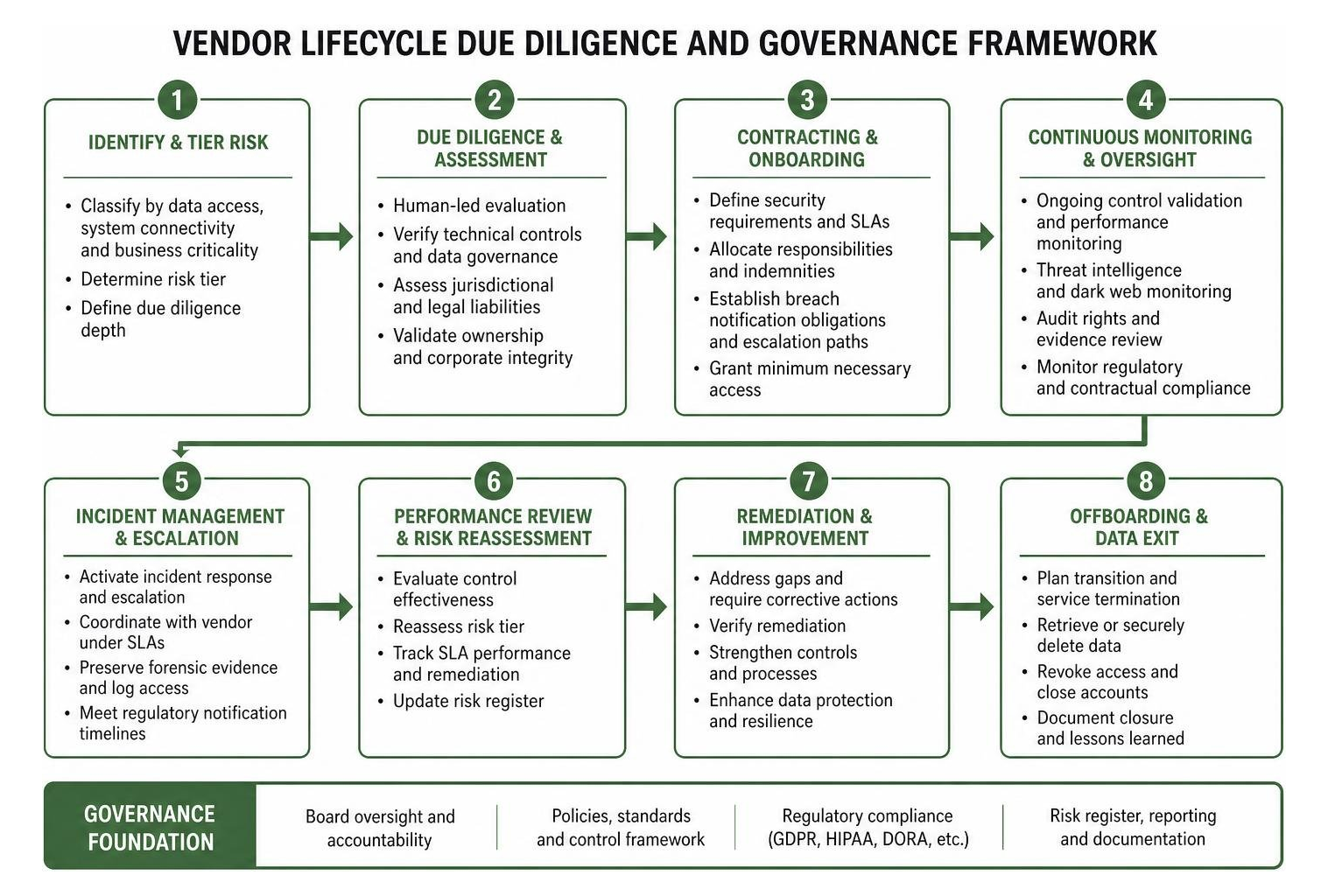
A rigorous Third Party Cybersecurity Risk Assessment must verify technical controls, data governance policies, and jurisdictional legal liabilities prior to granting external network access or transferring sensitive records.
Risk Tiering and Enhanced Due Diligence Frameworks
Not all suppliers present equivalent risk profiles. Tiering vendors based on their data access levels, system connectivity, and business criticality enables organisations to allocate governance resources effectively.
Enhanced due diligence must also extend into fourth-party relationships, evaluating the sub-processors, cloud dependencies, and subcontractors that suppliers rely on to deliver their services. Initiating a structured Third Party Risk Assessment provides leadership teams with clear visibility into multi-tiered operational exposure. Furthermore, when external partners integrate automated models or algorithmic processing into client workflows, organisations must apply A Complete Practical Guide to AI Vendor Risk Management to ensure that proprietary training data and corporate intellectual property are not exposed through unverified machine-learning integrations.
Ongoing Monitoring and Contractual Safeguards
Point-in-time assessments provide only a snapshot of a vendor’s risk profile on a single day. Continuous oversight is essential to maintain security across the contract lifecycle.
- Contractual Breach Notification Timelines: Mandate that third parties notify your corporate incident response team within a defined window (such as 24 to 48 hours) of discovering a suspected compromise, backed by financial penalties for non-compliance.
- Independent Verification Rights: Reserve unequivocal contractual rights to conduct independent security assessments, request third-party forensic audit reports (such as SOC 2 Type II or ISO 27001 certifications), and inspect remediation evidence.
- Data Minimisation and Technical Segmentation: Enforce strict data governance protocols that restrict suppliers to the absolute minimum dataset required for operational delivery. Where feasible, mandate pseudonymisation or client-side encryption.
- Continuous Threat Intelligence: Monitor dark-web forums, threat-actor communication channels, and external credential leaks for early indicators of compromised supplier credentials.
Using a comprehensive Supply Chain Vendor Risk Cybersecurity Checklist ensures that legal, procurement, and risk functions apply uniform contractual protections across all procurement channels.
Offboarding Protocols and Legacy Data Decommissioning
Incomplete vendor offboarding is an overlooked cause of data exposure. In many cases, threat actors compromise data stores held by former vendors years after the underlying commercial contract has ended.
Addressing Third Party Risk Assessment Failures That Leave Vendor Exposure Unverified requires a systematic offboarding procedure. Upon contract termination, internal security teams must immediately revoke external API keys, disable single sign-on tokens, rotate shared secrets, and delete persistent service accounts. Crucially, organisations must exercise audit rights to obtain written, legally binding certifications of data destruction, verifying that the vendor has permanently sanitised all corporate datasets, unstructured staging files, and offsite backups.
Post-Incident Containment and Recovery Protocols
When an external supplier experiences a security incident, immediate, decisive action is necessary to limit operational damage and satisfy regulatory disclosure obligations.
Immediate Incident Response for Third-Party Data Breaches
Upon receiving notification or intelligence indicating a vendor compromise, the enterprise incident response team should execute a structured containment process:
- Sever Connectivity and Revoke Privileges: Immediately terminate all active API integrations, revoke OAuth permissions, and disable supplier access credentials across all single sign-on portals.
- Preserve Digital Evidence: When isolating internal endpoints connected to the compromised supplier, take hardware offline immediately without powering down the machines. Preserving volatile RAM contents is essential for downstream digital forensics.
- Establish Independent Validation: Do not rely solely on vendor self-reporting. Require direct access to forensic indicators of compromise (IOCs), verified log exports, and independent incident reports to confirm that threat actors have not traversed integration pathways into your core networks.
- Review Statutory Reporting Obligations: Convene legal and compliance leadership to evaluate mandatory reporting obligations under applicable statutory frameworks (such as GDPR, HIPAA, or SEC disclosure rules). Prepare regulatory notifications based on preliminary risk assessments, ensuring compliance with strict statutory windows.
- Coordinate Crisis Communications: Deploy pre-approved communication templates for affected customers, institutional counterparties, and regulatory authorities. Transparent, accurate communication limits reputational damage and reduces post-incident litigation risk.
Frequently Asked Questions About Third-Party Breaches
Who is legally responsible when a third-party vendor suffers a data breach?
Under most global data protection frameworks, including the UK GDPR and EU GDPR, the direct customer-facing entity remains the data controller and bears primary legal responsibility for the security of personal data. While the vendor acts as a data processor, the controller retains statutory liability for reporting the breach to supervisory authorities and notifying affected individuals. Specific liability, indemnification obligations, and regulatory penalties must be assessed on a case-by-case basis depending on applicable statutory regimes and contractual terms.
How do threat actors primarily compromise external vendors?
Adversaries target external vendors through credential harvesting, voice phishing (vishing) campaigns against service desks, unpatched zero-day vulnerabilities in enterprise file transfer software, and unmonitored API connections. Once threat actors acquire legitimate single sign-on credentials or persistent OAuth tokens, they exploit these trusted permissions to access connected multi-tenant databases and downstream corporate environments without triggering traditional network perimeter alarms.
Why do vendor breach victim counts increase over time?
Preliminary incident disclosures typically reflect only localised system compromises or state-level reporting thresholds. As forensic investigations proceed, analysts must de-duplicate and match complex, unstructured records across multi-client datasets, offsite backups, and legacy database snapshots. This analytical process frequently uncovers wider historical exposure, leading to upward revisions in victim counts months after the initial intrusion was identified.
Conclusion
Third-party data breaches represent a structural reality of modern commercial operations. As corporate perimeters dissolve into distributed networks of cloud aggregators, billing intermediaries, and operational suppliers, managing counterparty risk requires rigorous, proactive governance.
Rule Ltd provides human-led corporate intelligence, enhanced due diligence, and comprehensive third-party risk analysis for global enterprises. Operating in the compliance and risk management industry, our bespoke intelligence reports are produced entirely by experienced human analysts, delivering the nuanced context and defensible analysis that automated screening platforms and algorithms cannot replicate. We support corporate boards, general counsel, and compliance executives with fixed-price cost certainty quoted before work begins, delivering screening assessments in two to three working days and enhanced due diligence or corporate intelligence reports in approximately five working days.
To secure your supply chain and independently verify vendor integrity, engage our specialist analysts for defensible Third Party Due Diligence before counterparty risks compromise your enterprise.
Sources
- IBM Security / Ponemon Institute, Cost of a Data Breach Report.
- Mandiant / Google Cloud Security, M-Trends Threat Intelligence Report.
- US Department of Health and Human Services (HHS) Office for Civil Rights, Breach Portal Notifications.
- Office of the Maine Attorney General, Data Breach Notifications Database.
- Cybersecurity and Infrastructure Security Agency (CISA), Threat Actor Advisory Compendium.
- US Securities and Exchange Commission (SEC), Form 8-K Cyber Incident Disclosures.
- UK Information Commissioner’s Office (ICO), Personal Data Breach Reporting Guidance under UK GDPR Article 33.
- Health Insurance Portability and Accountability Act (HIPAA), Breach Notification Rule, 45 CFR §§ 164.400–414.
- European Parliament and Council of the European Union, Regulation (EU) 2022/2554 on Digital Operational Resilience for the Financial Sector (DORA).