
Core Frameworks for Supply Chain Transparency
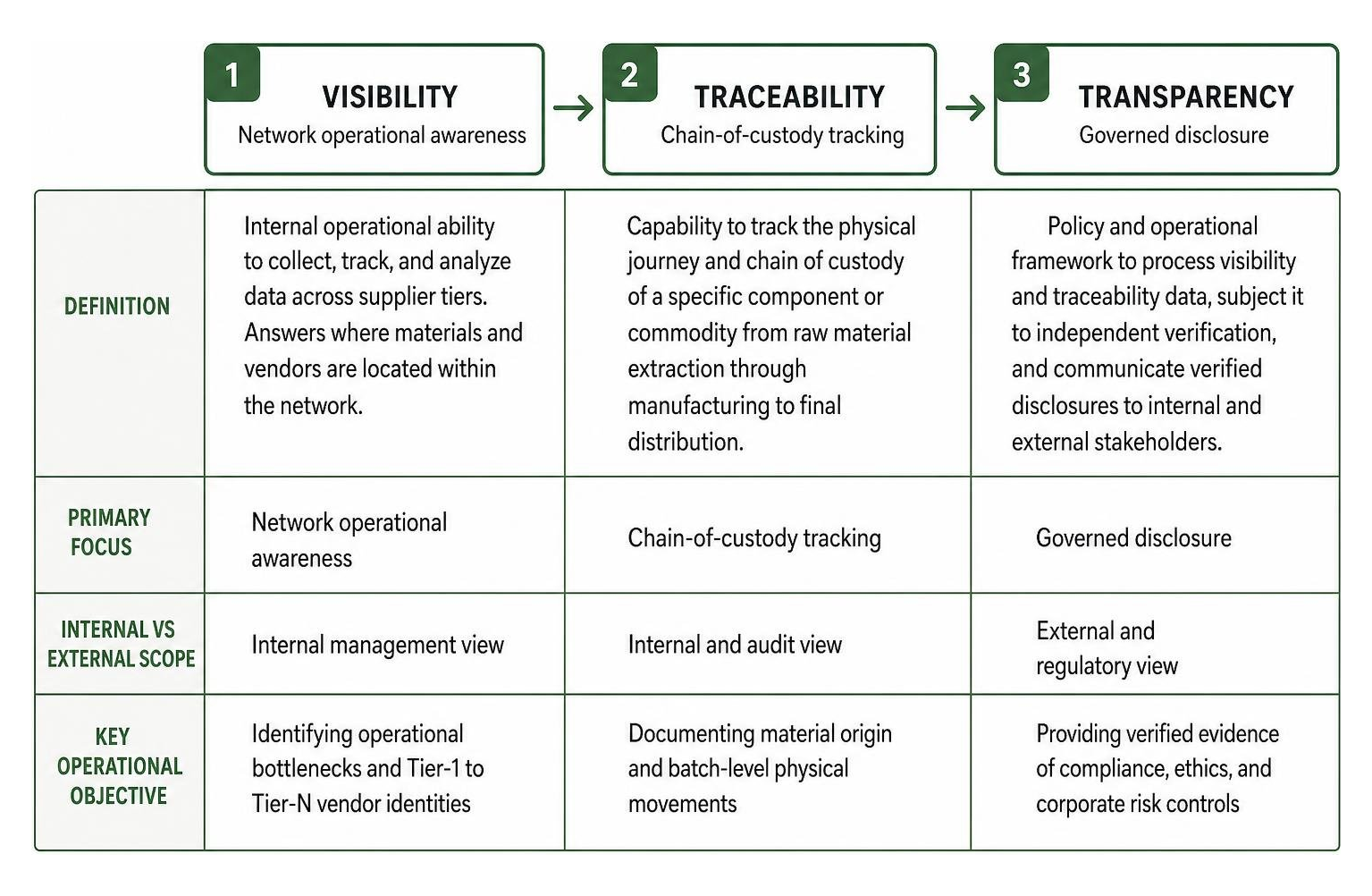
For General Counsel and Chief Compliance Officers, the central issue is not terminology but evidential alignment. A supply chain transparency programme is defensible only where operational data, chain-of-custody records, supplier attestations, ownership information, and external disclosures can be reconciled under audit pressure.
| Governance layer | Evidential question | Common failure mode | Assurance requirement |
|---|---|---|---|
| Supplier population control | Can the organisation evidence which direct and indirect third parties are relevant to a product, geography, or regulated commodity? | Tier-1 records omit processors, brokers, labour providers, or unauthorised subcontractors | Reconciled vendor master data, procurement records, site-level identifiers, and risk-based sub-tier mapping |
| Material and batch evidence | Can goods, inputs, or components be linked to origin, movement, processing, and custody records? | Mass-balance claims, shipment documents, and supplier declarations cannot be tied to specific lots or production periods | Documented chain-of-custody controls, exception handling, and audit-ready retention standards |
| Disclosure governance | Can public, investor, regulator, and customer statements be substantiated by underlying records? | Sustainability or modern slavery statements rely on generic policies rather than verified operating evidence | Legal, compliance, procurement, and sustainability sign-off against documented evidence and known limitations |
To move beyond baseline compliance, organisations align their disclosures with established standards. The ISCC PLUS 203-1 TRACEABILITY standard provides technical rules for chain-of-custody data integrity and material tracking across complex global value chains. Cross-border public policy initiatives, such as the Transparency Pathway, also demonstrate how spatial data and national regulatory frameworks can support verification of sustainable land use and legal sourcing at origin.
Integrating these frameworks into an enterprise’s broader third-party risk assessment programme helps ensure that public statements are supported by verifiable evidence rather than isolated supplier assurances.
Regulatory Drivers Mandating Upstream Governance
Legal and regulatory mandates globally have shifted from voluntary reporting frameworks to statutory requirements backed by strict liabilities, trade enforcement, and market access limitations.
Key legislative regimes driving upstream due diligence include:
- UK Modern Slavery Act 2015 (Section 54): Requires commercial entities carrying on business in the UK exceeding statutory annual turnover thresholds to publish an annual slavery and human trafficking statement. This statement must detail the due diligence processes implemented across direct and indirect supply chains.
- German Supply Chain Due Diligence Act (LkSG): Mandates that covered enterprises implement systematic risk management procedures to identify, prevent, and minimise human rights and environmental risks across their direct suppliers and indirect sub-tier vendors.
- EU Corporate Sustainability Due Diligence Directive (CSDDD): Enforces statutory human rights and environmental due diligence requirements across entire upstream and downstream value chains, introducing administrative penalties and civil liability for non-compliance.
- US Uyghur Forced Labor Prevention Act (UFLPA): Establishes a rebuttable presumption that goods mined, produced, or manufactured wholly or in part in the Xinjiang Uyghur Autonomous Region involve forced labour. Importers must supply clear and convincing English-language chain-of-custody evidence to secure release from US Customs and Border Protection.
- EU Digital Product Passport (DPP) & EUDR: Regulations such as the EU Deforestation Regulation mandate precise plot-level geolocation mapping for forest-risk commodities, while DPP frameworks require dynamic lifecycle reporting across material components.
Failure to establish multi-tier visibility exposes businesses to severe enforcement actions, product seizures, regulatory fines, and reputational degradation. Effective oversight requires continuous vendor compliance monitoring and comprehensive geopolitical risk assessment and digital due diligence to identify legal exposures early. Specific compliance requirements must be evaluated on a case-by-case basis.
Execution Strategies for Transparent Multi-Tier Supply Networks
Multi-Tier Supply Network Mapping
The material risk usually sits where contractual control is weakest: processors, brokers, labour providers, component manufacturers, logistics intermediaries, and raw material sites that do not appear in standard Tier-1 onboarding files. Industry analysis has highlighted how operational, ESG, and regulatory exposures frequently emerge deep within Tier-2 and sub-tier supplier networks.
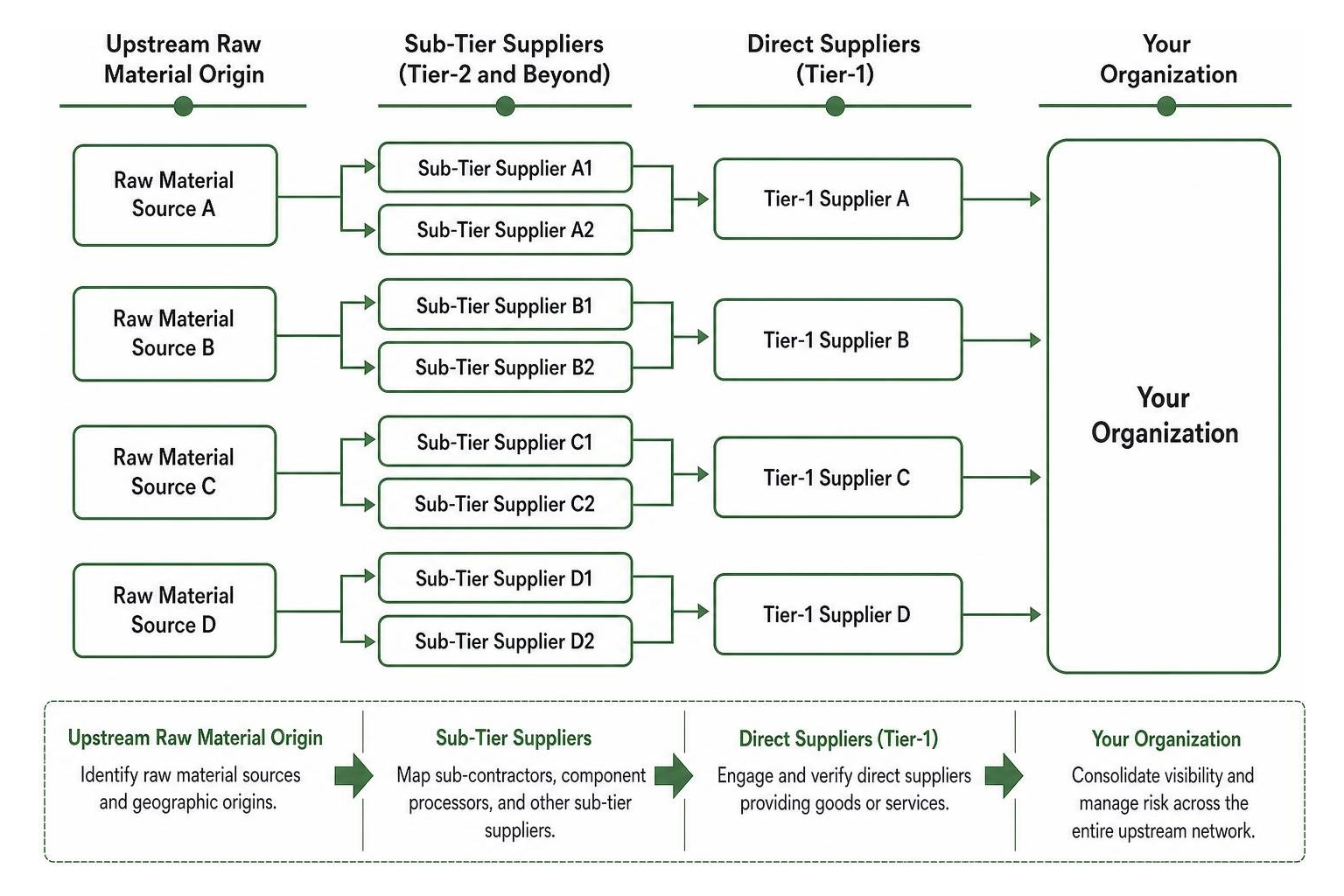
A defensible mapping exercise is less a data-gathering exercise than an exercise in evidential triage. Material spend, geography, commodity type, ownership opacity, adverse media, sanctions exposure, forced labour indicators, and known trans-shipment routes all affect the depth of inquiry required. Supplier self-declarations should be cross-checked against corporate registries, Ultimate Beneficial Ownership (UBO) records, official sanctions lists, trade data where available, and credible local-language sources.
Deploying structured risk mapping and scenario planning for supply chains supports earlier identification of hidden concentration risk, unauthorised subcontracting, and jurisdiction-specific regulatory exposure before disruption or enforcement action crystallises.
Managing Sub-Tier Supplier Resistance and Data Gaps
Sub-tier resistance is rarely solved by repeated questionnaire requests. It is often a signal of commercial sensitivity, weak record-keeping, limited administrative capacity, or concern that disclosed relationships will be bypassed. The compliance question is whether the organisation can demonstrate reasonable, proportionate escalation when evidence is incomplete.
Key judgement areas include:
- Commercial Leverage: Preferred vendor status, longer contractual commitments, or improved payment terms may support disclosure, provided incentives do not compromise the independence of compliance review.
- Low-Burden Evidence Channels: Mobile uploads, standardised digital questionnaires, and translated document requests can reduce friction for low-tech Tier-2 and Tier-3 suppliers while preserving an auditable evidence trail.
- Confidentiality Boundaries: Data handling protocols should distinguish compliance evidence from commercially sensitive pricing, customer lists, and competitive intelligence.
- Escalation Thresholds: Refusal to identify origin sites, unexplained document inconsistencies, adverse media, ownership opacity, or unusual routing should trigger enhanced scrutiny rather than passive acceptance of an attestation.
When red flags appear in sub-tier disclosures, conducting enhanced due diligence allows human intelligence analysts to independently assess local operating conditions, corporate controls, ownership structures, and regulatory exposure.
Integration of Technology and Human Intelligence
Digital tools create scale, but they do not remove the need for accountable human judgement. For senior compliance teams, the issue is whether technology outputs can be explained, challenged, and evidenced in a regulator, customs, investor, or litigation context.

- IoT and Real-Time Tracking: Sensors and satellite monitoring can supply objective location and handling data during transport, but exceptions require contextual review.
- AI and Predictive Analytics: Machine learning tools may flag anomaly patterns, adverse news mentions, and disruption risks across multilingual datasets, but false positives and source reliability must be assessed.
- Immutable Audit Trails: Centralised repositories can improve record retention and version control, provided access rights, data lineage, and exception handling are governed.
- Human Analyst Verification: Experienced intelligence analysts evaluate context, verify corporate documentation, eliminate false positives, and conduct localised background checks.
As explored in industry whitepapers like The Glass Pipeline, technology may create operational visibility, but human oversight is needed to translate raw data into defensible compliance evidence. Integrating robust supply chain risk technology should therefore be paired with documented analyst review and clear accountability for final risk judgements.
Evaluating the ROI of Supply Chain Governance
Investment in supply chain governance should be assessed against both avoided downside and measurable commercial resilience. The business case is strongest where compliance, procurement, legal, sustainability, and finance teams use the same evidence base rather than maintaining fragmented records.
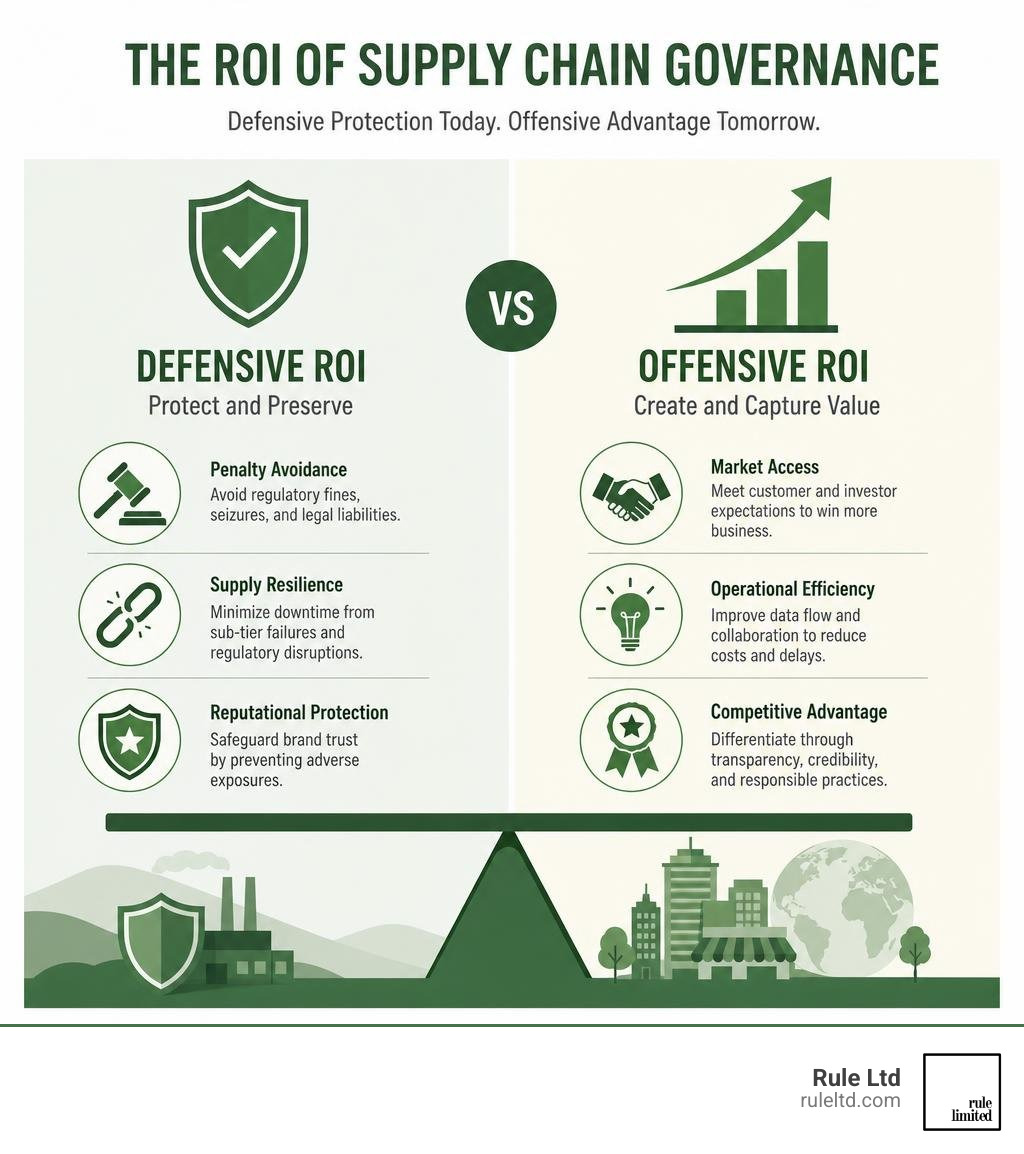
Defensive Return
- Penalty Avoidance: Reduces exposure to regulatory fines, customs border seizures under UFLPA, contractual disputes, and litigation risk where evidence is incomplete.
- Supply Resilience: Limits operational downtime caused by unmonitored sub-tier failures, abrupt regulatory blockades, or concentration in high-risk jurisdictions.
- Reputational Protection: Reduces the likelihood that modern slavery, environmental, sanctions, or sourcing allegations develop into unmanaged public controversies.
Offensive Return
- Capital Access and ESG Benchmarking: Supports institutional investor scrutiny where sustainability claims must be supported by auditable records.
- Commercial Differentiation: Detailed product transparency disclosures can support market access and premium product positioning where substantiated by evidence.
- Talent and Customer Retention: Demonstrable governance standards can strengthen trust among customers, employees, and business partners.
Evaluating reputational risk in due diligence helps executive leadership understand the financial relevance of proactive compliance, particularly where a single sourcing failure could affect market access, investor confidence, or brand integrity.
Frequently Asked Questions about Evidential Supply Chain Risk and Compliance
Which evidence gaps most often undermine supply chain transparency statements?
Common weaknesses include unsupported supplier attestations, unverified Tier-2 declarations, missing lot-level linkage, inconsistent site identifiers, opaque UBO structures, unexplained trans-shipment routes, and incomplete records of how adverse findings were assessed. These gaps matter because regulators, customs authorities, investors, and customers increasingly expect statements to be tied to underlying evidence rather than policy language alone.
How should companies treat low-tech sub-tier evidence in an audit file?
Low-tech suppliers may still provide relevant evidence, but the record should show how the organisation assessed authenticity, completeness, translation issues, and local context. Companies can utilise simple mobile reporting interfaces, localised document collection, field audit inputs, and human-in-the-loop review without treating automated uploads as conclusive proof.
Which global laws create the most acute evidential pressure for multi-tier due diligence?
Core regulatory drivers include the UK Modern Slavery Act 2015 s.54, the German Supply Chain Due Diligence Act (LkSG), the EU Corporate Sustainability Due Diligence Directive (CSDDD), and the US Uyghur Forced Labor Prevention Act (UFLPA). Each regime has distinct scope, thresholds, enforcement mechanisms, and evidential expectations, so specific compliance requirements should be assessed case by case.
Conclusion
Building a resilient, fully compliant supply chain requires shifting from superficial vendor assurances to rigorous, evidence-based verification. As regulatory frameworks expand worldwide, global enterprises must establish continuous visibility across every supplier tier to protect operations, ensure regulatory access, and uphold brand integrity.
At Rule Ltd, we deliver comprehensive third-party risk management, corporate intelligence, and enhanced due diligence solutions tailored for global enterprises. Operating with worldwide language and jurisdictional capability, our experienced human analysts cut through corporate opacity to provide defensible, cost-certain insights. Whether evaluating complex Ultimate Beneficial Ownership (UBO) structures, verifying sub-tier compliance, or screening high-risk counterparties, every engagement is quoted as a fixed price prior to commencing work, delivering initial screening reports in 2 to 3 working days and detailed corporate intelligence within approximately 5 working days.
To discuss your organisation’s supply chain compliance strategy or request an independent risk assessment, visit our Corporate Intelligence service page or contact our team directly.
Sources & Regulatory References
- UK Parliament, Modern Slavery Act 2015, Section 54: Transparency in supply chains etc.
- European Parliament and Council, Directive on Corporate Sustainability Due Diligence (CSDDD) (2024).
- German Federal Ministry for Economic Affairs and Climate Action, Supply Chain Due Diligence Act (Lieferkettengesetz – LkSG).
- US Congress, Uyghur Forced Labor Prevention Act (UFLPA) (Public Law 117-78).
- ISCC System GmbH, ISCC PLUS 203-1 Traceability Specification Standard v1.1.
- Transparency Pathway Framework, Subnational Commodity Mapping Protocols.
- Chartered Supply Chain Professionals, The “Glass Pipeline”: Achieving Radical Transparency in Multi-Tier Supply Chains (2026).