
Beyond Checklists: Why Counterparty Due Diligence Defines Commercial Resilience
Commercial counterparties routinely present immaculate credentials during contract negotiations. Yet, a substantial proportion of corporate losses in cross-border transactions stems directly from insufficient counterparty verification and neglected due diligence. When an enterprise enters into an agreement without looking past self-attested documentation, it effectively assumes unhedged exposure to the partner’s latent liabilities. Rigorous third-party due diligence serves as an indispensable operational safeguard, ensuring that legal commitments reflect commercial reality rather than polished marketing presentations.
A formal compliance posture that prioritises volume over depth creates systemic blind spots. Frequent cases of account blocking across European and Asian banking corridors result from compliance procedural errors and superficial legal entity verification. When cross-border payments stall or law enforcement freezes critical settlement accounts, the underlying cause is rarely an absence of paperwork; it is the presence of unverified assumptions.
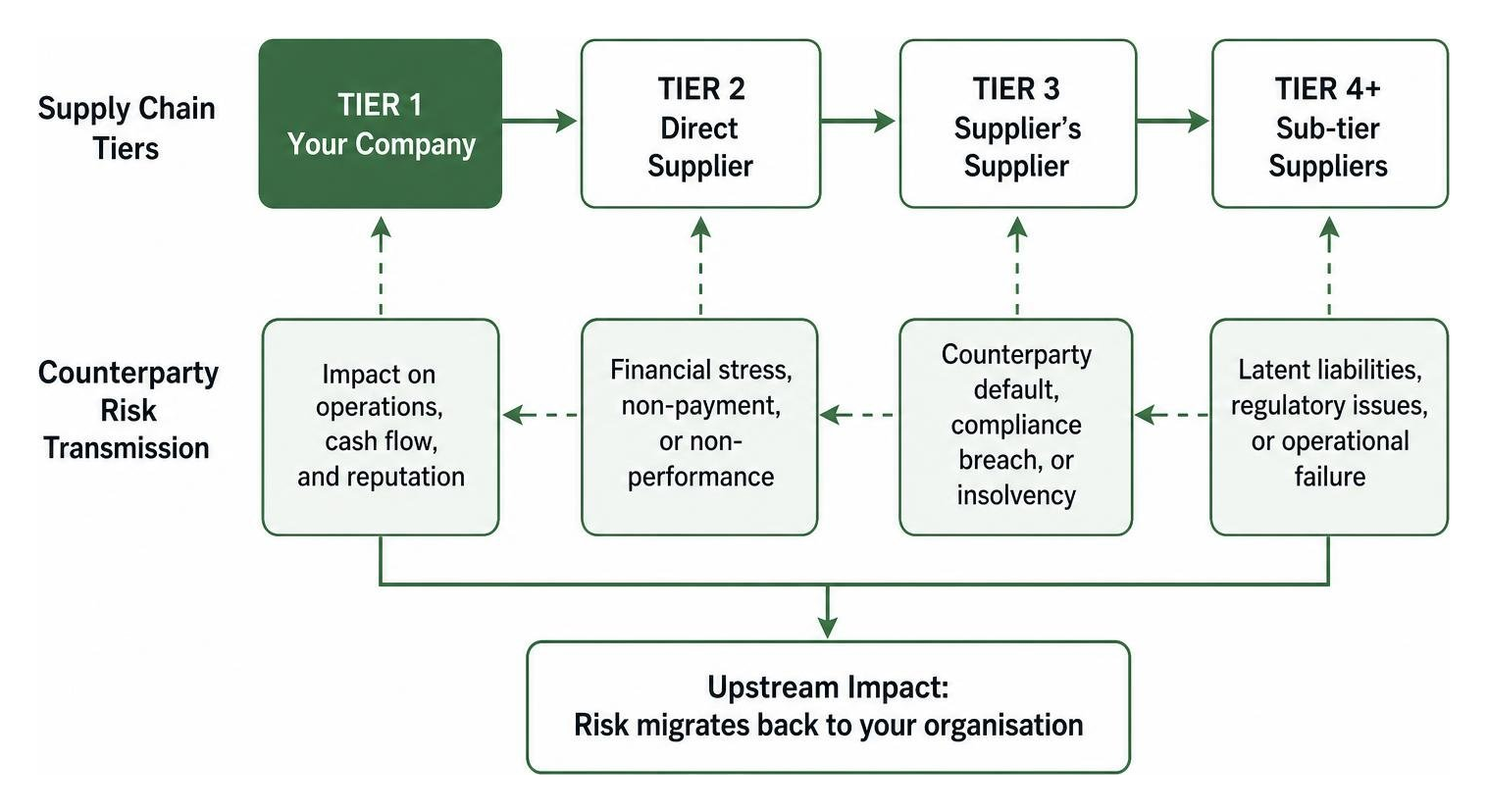
Strategic risk governance requires organisations to view counterparties not as isolated commercial entities, but as nodes within a wider, interconnected operational web. A partner’s structural insolvency, unhedged foreign exchange exposure, or regulatory non-compliance will inevitably migrate upstream. Defensible counterparty scrutiny evaluates whether a partner possesses the legal standing, capital adequacy, and operational resilience required to execute its contractual mandates under adverse market conditions.
Deconstructing the Core Vectors: Legal, Financial, and Operational Risk
Counterparty exposure rarely presents itself in a single dimension. A comprehensive risk evaluation examines three core vectors simultaneously:
- Legal legitimacy and corporate standing: Establishing that the counterparty is duly registered, active, and legally capable of entering into binding agreements. This includes verifying registration numbers across primary national registries, reviewing statutory filings, and confirming that the entity signing the contract matches the entity issuing invoices.
- Financial resilience and capital structure: Assessing the counterparty’s balance sheet health, working capital adequacy, and outstanding creditor obligations. Conducting pre-engagement commercial due diligence enables organisations to uncover registered liens, excessive debt leverage, or unsustainable customer concentration before capital is committed.
- Operational execution and capacity: Determining whether the partner maintains the physical infrastructure, personnel, supply chain dependencies, and business continuity protocols necessary to deliver on scope. This includes evaluating key-principal dependency, where an entire operational model rests upon a single individual whose departure would trigger severe delivery default.
Mitigating Flow-Through Liability in Multi-Tier Relationships
Legal and regulatory liabilities do not respect corporate boundaries. Under contemporary statutory enforcement frameworks, an enterprise can be held directly liable for the unlawful conduct of its intermediaries, distributors, and supply chain partners. Regulatory authorities regularly enforce strict liability provisions where organisations fail to prevent economic crime occurring within their commercial networks.
Conducting structured corporate due diligence across multi-tier relationships is essential to neutralise this flow-through liability. When an unvetted secondary supplier engages in corrupt practices, violates modern slavery statutes, or breaches international trade controls, the primary contractor faces regulatory sanctions, statutory fines, and contract termination. Mitigating these risks requires integrating comprehensive audit covenants, clear compliance warranties, and defined subcontracting boundaries directly into commercial agreements, substantiated by evidentiary verification of downstream participants.
The Anatomy of Counterparty Risk: Signals, Red Flags, and Opaque Structures

Detecting latent counterparty risk requires looking beyond surface-level corporate filings to analyse underlying behavioural patterns, governance anomalies, and transactional structures. Entities seeking to obscure unlawful activities or financial insolvency rarely display overt indicators; instead, they operate through layered corporate veils, nominee arrangements, and opaque offshore jurisdictions.
Unmasking Ultimate Beneficial Ownership and Sanctions Evasion
Sanctions enforcement in 2026 demands absolute clarity regarding beneficial ownership networks. Sanctioned individuals and state-linked enterprises routinely utilise complex holding chains to keep direct shareholdings below statutory thresholds, such as the OFAC 50 Percent Rule or equivalent EU and UK asset-freeze provisions. Conducting a comprehensive ultimate beneficial owner check is the only defensible method for determining who exercises actual economic control.
Opaque ownership structures often involve nominee directors, bearer shares, family proxies, and holding entities incorporated across jurisdictions that restrict public company registries. Effective sanctions risk management requires mapping every ownership tier to its natural persons, screening each layer against international asset-freeze lists, and analysing potential non-SWIFT financial channels utilised to bypass trade restrictions.

Detecting Governance Failures and Delivery Vulnerabilities
Superficial registry checks often fail to reveal entrenched operational and legal vulnerabilities. Assessing counterparty viability requires validating corporate declarations against authoritative primary sources:
| Evaluation Domain | Self-Attested Information | Independent Primary Intelligence | Critical Risk Signal Uncovered |
|---|---|---|---|
| Legal Standing | Standard Certificate of Incorporation | Multi-jurisdiction court dockets, insolvency filings | Undisclosed active litigation, winding-up petitions, recurring contract breaches |
| Corporate Control | Basic shareholder register declaration | Primary corporate registry filings, cross-directorship records | Undisclosed politically exposed persons, nominee arrangements, hidden holding entities |
| Financial Solvency | Self-reported financial summaries | Secured creditor registries, UCC filings, audited returns | Over-leveraged capital structure, active tax liens, structural liquidity shortfalls |
| Operational Scale | Polished commercial marketing collateral | Physical site inspection, local regulatory filings | Shell entity addresses, lack of manufacturing assets, severe principal dependency |
| Compliance Posture | Standard written compliance policy | Enforcement agency registries, global adverse media | Prior anti-corruption penalties, debarment records, chronic workplace safety breaches |
The Shift from Basic Screening to Enhanced Counterparty Due Diligence
Standard compliance models often treat due diligence as a binary onboarding gate. In practice, operational risk exists along a spectrum that demands proportional investigative rigour. While baseline watchlist checks may suffice for low-risk, domestic transactional vendors, complex commercial partnerships necessitate deep forensic inquiry.
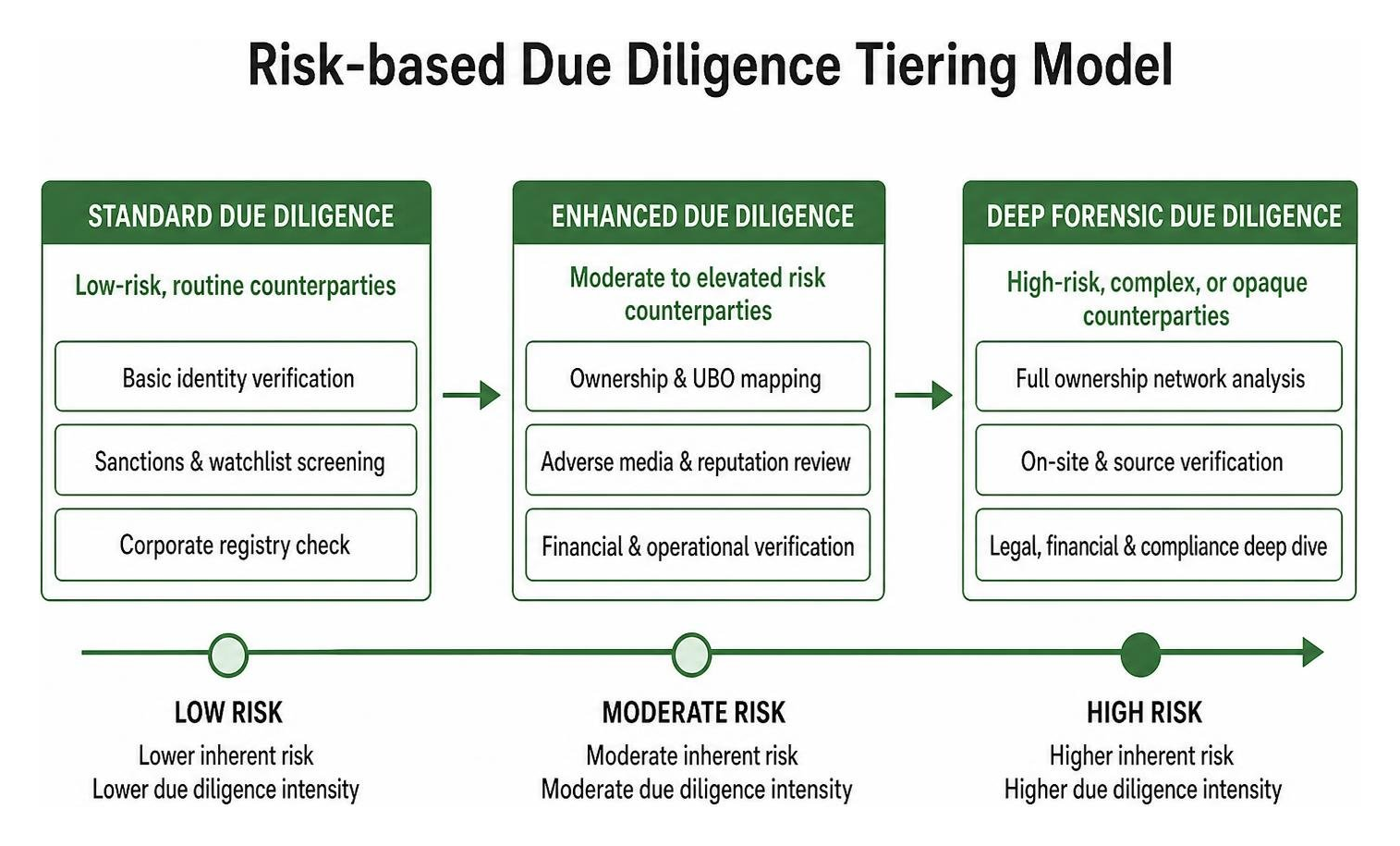
High-Risk Triggers Mandating Deep Forensic Scrutiny
Organisations must establish explicit operational thresholds that trigger an automatic escalation from standard checks to an enhanced due diligence checklist process. Key triggers include:
- Structural Opacity: Corporate arrangements involving tiered holding companies, trusts, or entities located across financial secrecy havens without clear commercial justification.
- Politically Exposed Persons (PEPs): Ownership, executive leadership, or operational control vested in individuals who hold, or have held, prominent public functions, creating heightened exposure to corruption and state-capture risks.
- High-Risk Operating Jurisdictions: Engagements touching markets characterised by systemic corruption, weak institutional governance, or active international trade measures.
- Credible Adverse Media: Verifiable public reports connecting the counterparty or its executives to fraud, environmental damage, labour exploitation, or financial impropriety.
- Information Resistance: Reluctance or refusal by the counterparty to provide beneficial ownership declarations, audited accounts, or standard contractual audit rights.
Navigating Cross-Border Regulatory Regimes from FCPA to ECCTA 2023
Cross-border commercial operations require alignment with multiple, overlapping statutory frameworks:
- US Foreign Corrupt Practices Act (FCPA): Imposes strict liability and severe penalties for corrupt payments made directly or indirectly through third-party intermediaries, with enforcement applying standards of wilful blindness and conscious disregard.
- UK Bribery Act 2010: Establishes corporate criminal liability for failing to prevent bribery committed by associated persons acting on the organisation’s behalf, where having proportionate due diligence procedures is the primary statutory defence.
- UK Economic Crime and Corporate Transparency Act 2023 (ECCTA): Introduces a corporate offence for the failure to prevent fraud, placing direct statutory responsibility on organisations to maintain robust, verified counterparty controls across global supply chains.
- FATF Recommendations & FinCEN CDD Rules: Mandate transparent verification of legal entity ownership, rigorous source-of-funds validation, and ongoing monitoring across all cross-border financial and commercial relationships.
Operationalising Continuous Monitoring and Data Privacy in Counterparty Due Diligence

Point-in-time due diligence captures a counterparty’s risk profile only at the moment of onboarding. In reality, corporate risk is dynamic: shareholding changes occur, new executives are appointed, regulatory enforcement actions emerge, and financial stability can deteriorate overnight. Treating due diligence as a one-off event leaves organisations vulnerable to risks that develop mid-contract.
Transitioning from Periodic Refresh Cycles to Real-Time Alerts
Traditional periodic reviews, typically conducted every one to three years, leave enterprises exposed to emerging liabilities during the intervening months. Deploying real time monitoring alerts transforms counterparty oversight from a static, reactive exercise into an active risk governance discipline.
Continuous monitoring tracks material corporate changes as they occur, including:
- New litigation, court filings, and winding-up petitions.
- Sanctions additions, watch-list updates, and PEP reclassifications.
- Material ownership shifts, directorship departures, and entity restructuring.
- Regulatory enforcement notices, licence cancellations, and adverse media reporting.
When material changes occur, human analysts evaluate the evidential context to determine whether the risk profile of the counterparty has fundamentally altered, allowing commercial and compliance teams to take proactive mitigation measures before operational disruption occurs.
Balancing AML Mandates with Cross-Border Data Privacy Standards
Executing rigorous counterparty investigations requires navigating the delicate intersection between mandatory anti-financial crime compliance and international data protection laws, such as the UK and EU General Data Protection Regulation (GDPR). Due diligence activities necessarily involve the collection and processing of personal data concerning beneficial owners, directors, and key management personnel.
Organisations must balance statutory compliance mandates with strict data minimisation principles:
- Lawful Processing: Establishing clear statutory and legitimate interest grounds for processing personal data during anti-money laundering, sanctions, and anti-corruption screening.
- Data Minimisation: Restricting evidence collection strictly to information necessary for establishing corporate legitimacy, financial health, and regulatory integrity.
- Defensible Retention Schedules: Storing investigative records, source documents, and analyst notes only for the durations mandated by relevant statutory frameworks.
- Cross-Border Transfer Protections: Ensuring that international intelligence gathering complies with standard contractual clauses and recognised cross-border data transfer mechanisms.
Frequently Asked Questions About Counterparty Due Diligence
What triggers the transition from basic screening to enhanced counterparty review?
The transition from standard screening to enhanced review is triggered whenever specific risk indicators cross predefined operational thresholds. These include identifying ultimate beneficial owners who are Politically Exposed Persons (PEPs), operations in jurisdictions subject to increased regulatory monitoring, multi-layered or offshore corporate ownership structures without clear commercial rationale, credible adverse media concerning financial crime or regulatory violations, or significant discrepancies between self-attested documentation and independent primary records.
How does counterparty due diligence protect against indirect sanctions exposure?
Counterparty due diligence protects organisations by looking beyond basic direct entity list-matching to map the full network of ownership and operational control. Sanctioned individuals and entities frequently hold non-majority stakes across multiple corporate vehicles, utilise close family members or nominee directors as proxies, or route transactions through non-SWIFT channels and intermediate holding companies in non-aligned jurisdictions. Comprehensive due diligence identifies these indirect relationships, ensuring compliance with global asset-freeze rules and the OFAC 50 Percent Rule.
Can organisations rely entirely on automated platforms for regulatory compliance?
Automated platforms are useful for high-volume data ingestion and initial database screening, but they cannot replace contextual analysis. Automated systems frequently generate high volumes of false positives, struggle with multilingual transliteration nuances in local court registries, and cannot independently verify whether a physical operating address actually exists. Defensible due diligence requires experienced human analysts to interpret primary public records, cross-examine corporate registries, verify adverse media in local languages, and provide nuanced risk assessments that satisfy regulatory scrutiny.
Conclusion
Commercial resilience depends upon making decisions supported by verifiable evidence rather than self-reported attestations. As regulatory expectations under regimes such as the UK Bribery Act, FCPA, and ECCTA 2023 continue to expand, organisations must maintain defensible, thorough standards of counterparty verification across their global operations.
Rule Ltd provides independent, analyst-led corporate intelligence and due diligence reporting designed to uncover hidden liabilities, clarify opaque beneficial ownership, and protect global enterprises from operational, regulatory, and reputational disruption. Every report is produced by dedicated research analysts who examine primary local registries, court dockets, and multilingual sources to deliver clear, actionable intelligence. We provide fixed-price, cost-certain reports with fast turnaround times, completing initial screening reports in two to three working days and enhanced corporate intelligence engagements in approximately five working days, with all pricing agreed before work begins.
Disclaimer: This article provides operational and risk management insights for informational purposes and does not constitute formal legal advice. Specific compliance obligations and regulatory matters require case-by-case assessment based on applicable statutory frameworks and factual circumstances.
Sources
- Financial Action Task Force (FATF) – Guidance on Transparency and Beneficial Ownership (Recommendations 10, 17, and 24/25), FATF/OECD.
- UK Parliament – Economic Crime and Corporate Transparency Act 2023 (ECCTA), Part 5: Failure to Prevent Fraud Offence, c. 56.
- UK Ministry of Justice – The Bribery Act 2010: Guidance about procedures which relevant commercial organisations can put into place to prevent persons associated with them from bribing, Section 9.
- US Department of Justice & US Securities and Exchange Commission – A Resource Guide to the U.S. Foreign Corrupt Practices Act (Second Edition).
- US Department of the Treasury, Office of Foreign Assets Control (OFAC) – Revised Guidance on Entities Owned by Persons Whose Property and Interests in Property are Blocked (50% Rule).
- Financial Crimes Enforcement Network (FinCEN) – Customer Due Diligence Requirements for Financial Institutions (31 CFR § 1010.230).
- Organisation for Economic Co-operation and Development (OECD) – OECD Due Diligence Guidance for Responsible Business Conduct, OECD Publishing.
- UK Information Commissioner’s Office (ICO) & European Data Protection Board (EDPB) – Guidelines on the Interplay between AML/CTF Obligations and GDPR Compliance.