
Understanding OFAC Watchlists and List Architecture
Executing an accurate OFAC sanctions list search requires calibrating fuzzy match thresholds to account for phonetic and transliteration variances, conducting dual-pass identifier queries across both SDN and Non-SDN datasets, and evaluating unlisted exposure under the 50 Percent Rule. Sanctions enforcement under the U.S. Department of the Treasury’s Office of Foreign Assets Control (OFAC) operates primarily on a strict liability standard for civil violations. Establishing a defensible framework for sanctions risk management requires compliance teams to understand the structural composition of U.S. sanctions lists rather than treating the search portal as a generic database.
OFAC publishes multiple datasets that serve distinct legal purposes, carry divergent blocking mandates, and impose specific prohibitions across global jurisdictions.
| List Architecture Category | Primary Identifier | Legal Mandate | Regulatory Action Required | Asset Blocking Status |
|---|---|---|---|---|
| SDN List | Specially Designated Nationals and Blocked Persons | Full asset freeze; comprehensive transaction bar | Prohibit all dealings by U.S. persons; block property | Mandatory blocking |
| SSI List (Non-SDN) | Sectoral Sanctions Identifications | Debt, equity, and targeted financing restrictions | Reject prohibited debt/financing transactions | Non-blocking (rejection) |
| FSE List (Non-SDN) | Foreign Sanctions Evaders | Prohibitions on U.S. transactions and services | Block transactions lacking specific OFAC licences | Non-blocking (rejection) |
| CAPTA List (Non-SDN) | Correspondent Account / Payable-Through Account | Prohibition/restriction on U.S. banking facilities | Close or restrict correspondent/payable-through accounts | Account restrictions |
| CMIC List (Non-SDN) | Non-SDN Chinese Military-Industrial Complex | Prohibitions on publicly traded securities | Prohibit purchasing/selling targeted securities | Securities transaction bar |
| NS-MBS / NS-PLC | Menu-Based / Palestinian Legislative Council | Programme-specific targeted restrictions | Apply regime-specific statutory measures | Varies by determination |
SDN List vs. Non-SDN Consolidated Sanctions List
The Specially Designated Nationals (SDN) List contains individuals, corporate entities, maritime vessels, and aircraft owned, controlled by, or acting for targeted regimes, as well as non-country-specific targets such as designated terrorists and narcotics traffickers. Property and interests in property of SDNs that come within the United States or the possession or control of U.S. persons are blocked (frozen), and U.S. persons are broadly prohibited from engaging in any transactions with them.
In contrast, the Non-SDN Consolidated Sanctions List unifies several distinct, non-blocking sanctions measures into standardised datasets. This consolidation includes the Sectoral Sanctions Identifications (SSI) List, the Foreign Sanctions Evaders (FSE) List, the List of Foreign Financial Institutions Subject to Correspondent Account or Payable-Through Account Sanctions (CAPTA), the Non-SDN Palestinian Legislative Council List (NS-PLC), the Non-SDN Menu-Based Sanctions List (NS-MBS), and the Non-SDN Chinese Military-Industrial Complex Companies List (NS-CMIC). Designations on non-SDN lists generally impose selective restrictions, such as limitations on transacting in new debt, new equity, or maintaining correspondent banking accounts, rather than an absolute asset freeze.
Sanctions Programme Codes and Legal Treatment
Every entry returned in an OFAC query contains one or more programme codes indicating the governing legal authority and executive orders underpinning the designation. A true match cannot be evaluated in isolation from its associated programme code:
- RUSSIA-EO14024: Directs comprehensive asset blocking across specified Russian Federation economic sectors, financial institutions, and operational networks under Executive Order 14024.
- SDGT (Specially Designated Global Terrorist): Imposes universal blocking mandates pursuant to Executive Order 13224, requiring immediate freezing of assets and formal reporting to OFAC within mandatory statutory timeframes.
- GLOMAG (Global Magnitsky): Targets serious human rights abuse and corruption worldwide pursuant to the Global Magnitsky Human Rights Accountability Act and Executive Order 13818.
- CYBER: Targets malicious cyber-enabled activities threatening U.S. national security and financial infrastructure under Executive Order 13694, as amended.
A match tagged under an SDN-level programme code requires immediate asset blocking, while a match tagged under a sectoral regime (such as UKRAINE-EO13662 directives) requires transactional evaluation to determine whether the proposed activity involves prohibited debt tenors or equity issuances.
Algorithmic Query Calibration and Search Mechanics
Executing an effective OFAC sanctions list search through official portals such as the Sanctions List Service requires rigorous query calibration to mitigate false positives without creating screening blind spots.
Screening Parameter Structures and Target Classifications
The search architecture separates target classes in ways that affect evidential weight, identifier priority, and false-positive handling:
- Entity: Prioritise exact legal names, former names, transliterated trading names, tax registrations, and known address variants before closing a potential match.
- Individual: Test primary names, patronymics, aliases, date-of-birth fields, nationality references, and passport or national identity numbers as separate resolution factors.
- Vessel & Aircraft: Treat International Maritime Organization (IMO) numbers, vessel call signs, and International Civil Aviation Organization (ICAO) transponder hex codes as higher-confidence identifiers than name similarity alone.
- Digital Currency Address: Screen cryptographic wallet identifiers exactly as published, with attention to blockchain-specific address formats and chain attribution.
Geographic filtering within U.S. jurisdictions relies on standard two-letter postal abbreviations. Because secondary address fields depend on exact character matching, regional address variants require independent verification.
Fuzzy Matching Mechanics and Scoring Thresholds
OFAC applies fuzzy logic matching exclusively to the Name field, while secondary identifier parameters rely on strict character-by-character alignment.
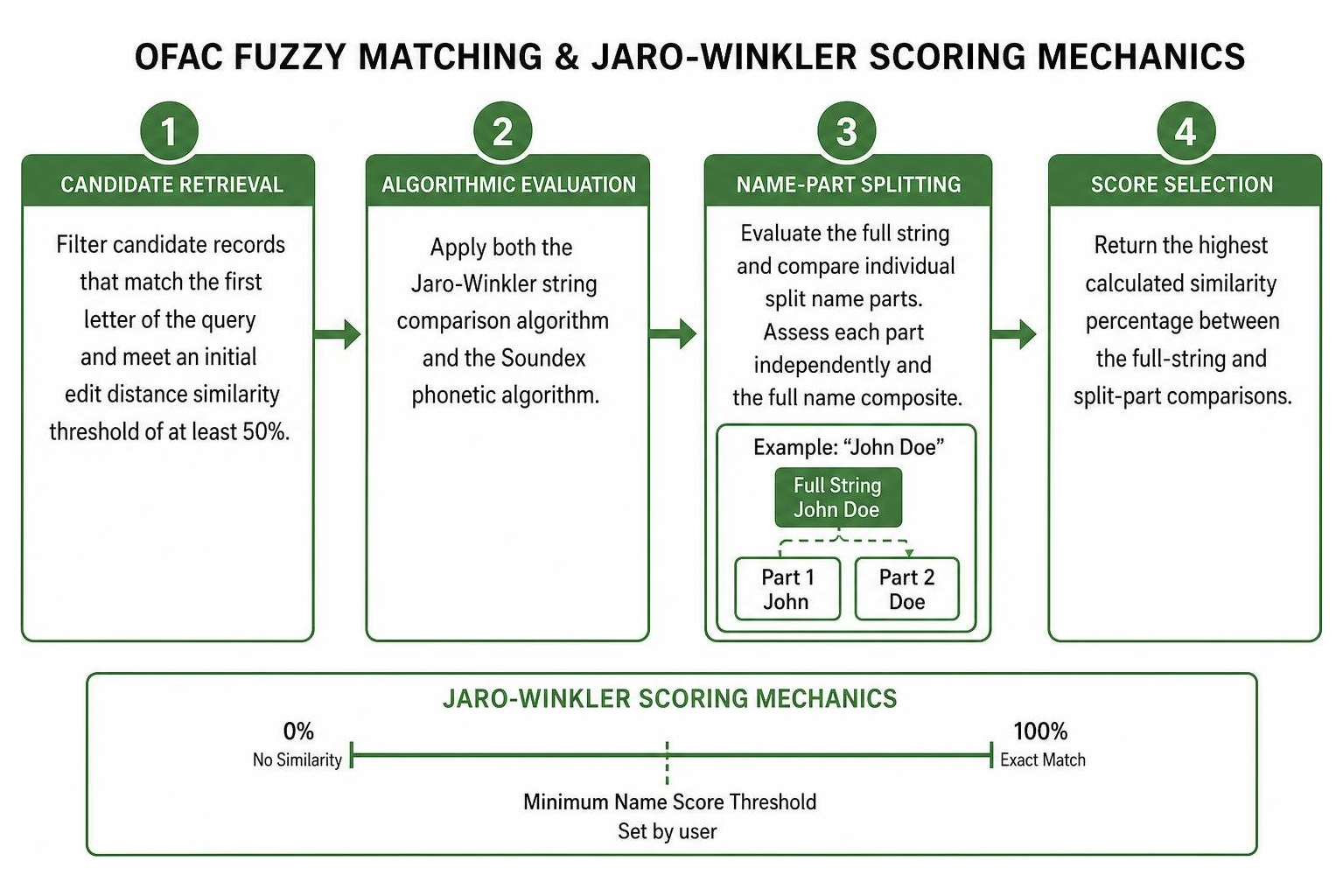
The underlying fuzzy matching engine operates through a multi-stage scoring architecture:
- Candidate Retrieval: The query filters candidate records sharing the first character and meeting a baseline 50% edit distance similarity threshold.
- Algorithmic Evaluation: The engine concurrently applies the Jaro-Winkler string comparison metric and Soundex phonetic algorithms.
- Name-Part Splitting: The algorithm evaluates the full string and compares individual constituent name tokens independently.
- Score Selection: The portal returns the highest calculated similarity percentage between the composite string and split-token comparisons.
The Minimum Name Score threshold dictates matching sensitivity. While a score of 100 enforces exact string identity, lowering thresholds to 80 or 85 captures transliteration divergences from non-Latin scripts (such as Cyrillic, Arabic, or Hanzi) and patronymic variations. Because OFAC does not prescribe a universal threshold, compliance functions must calibrate sensitivity to enterprise risk appetite and operational review capacity.
Non-Alphanumeric Identifier Formatting and Search Hygiene
Secondary identifier fields (such as tax registrations, national identity numbers, and passport credentials) do not automatically strip punctuation or normalise formatting. Queries containing hyphens, slashes, or spaces fail against records indexed without punctuation. Comprehensive verification requires dual-pass querying across both raw alphanumeric strings and punctuated formats to prevent false-negative determinations.
Screening Tools, Data Delivery Methods, and System Integration
Manual lookups on government portals support point-in-time checks, but enterprise compliance environments require systematic architectures for high-volume counterparty onboarding, vendor compliance monitoring, and ongoing PEP identification and classification.
Official Sanctions List Service and Automated Feeds
OFAC explicitly prohibits configuring automated scripts or bots to scrape its public web-based search portal. Organisations requiring continuous, real-time list ingestion must use the Sanctions List Service (SLS) data channels.
OFAC provides official datasets in legacy flat file formats (CSV, pipe-delimited, and fixed-field) as well as the modern Advanced Sanctions Data Model (XML/JSON). The SLS also provides an official API endpoint allowing compliance architectures to execute automated requests against backend databases. Technical teams should monitor published annual delta files to track designation additions, modifications, and removals chronologically.
Multi-Source Aggregators and Open-Source Intelligence
Global supply chains and financial transactions rarely interact with U.S. sanctions in isolation. Comprehensive screening frameworks must account for designations across the UK Office of Financial Sanctions Implementation (OFSI), the European Union External Action Service, the United Nations Security Council, and regional regulatory bodies.
Open-source intelligence aggregators and commercial screening engines integrate multi-jurisdictional watchlists, Politically Exposed Persons (PEP) registers, and debarment records. When deploying multi-source databases, compliance teams must ensure audit logging captures exact download dates, list versions, match parameters, and analyst resolution rationale to maintain defensibility during regulatory inquiries.
Beyond the Database: Navigating Blind Spots and Regulatory Liability
A clear result from an OFAC list query does not confer legal immunity or establish safe harbour protections. OFAC enforcement actions consistently highlight that screening a direct legal name represents only the initial step of a compliant sanctions risk framework.
Why an OFAC Sanctions List Search Cannot Replace Due Diligence
The official OFAC search tool contains inherent operational limitations:
- Zero Historical Visibility: The search portal only queries the active, current dataset. It does not display delisted entities, historically designated entities, or past aliases.
- Point-in-Time Fragility: Sanctions designations change continuously. A clean check executed during onboarding becomes obsolete if the counterparty is designated downstream.
- Absence of Adverse Media: The database does not index ongoing criminal investigations, export enforcement proceedings, or regulatory inquiries that precede official designation.
- Legal Liability Disclaimer: OFAC explicitly states that utilising its search tool does not substitute for comprehensive due diligence nor limit civil or criminal liability.
Mitigating enforcement exposure requires deploying systematic corporate intelligence that goes deeper than baseline database queries, particularly when evaluating counterparties operating in high-risk geographic regions or complex transactional sectors.
The 50 Percent Rule and Indirect Ownership Risks
The most critical regulatory blind spot in manual list searching is the OFAC 50 Percent Rule. Under OFAC guidance, any entity owned 50 percent or more in the aggregate, directly or indirectly, by one or more blocked persons is itself considered blocked by operation of law—regardless of whether the entity appears on the SDN List or the consolidated database.
Uncovering these indirect exposure vectors requires a rigorous ultimate beneficial owner check to pierce layered corporate holdings, offshore trusts, nominee arrangements, and dynamic shareholdings. For opaque structures and complex commercial transactions, compliance officers should commission human-led enhanced due diligence for high-risk entities to verify control chains and beneficial ownership structures before executing transactions.
Frequently Asked Questions About OFAC Sanctions Screening
How does fuzzy logic calculate match scores in OFAC searches?
OFAC applies fuzzy logic exclusively to the Name field by evaluating character strings and phonetic structures. Potential matches must first meet a minimum 50% edit distance similarity threshold and share the first character of the query string. The system then runs Jaro-Winkler string comparison and Soundex phonetic algorithms across the full name and split name parts, returning the highest calculated match score percentage.
Does clear screening on the OFAC search tool eliminate legal liability?
No. OFAC explicitly warns that running queries on its search portal does not create a legal safe harbour, nor does it limit civil or criminal liability under U.S. sanctions laws. Civil sanctions violations operate on a strict liability standard, meaning an organisation can be held liable even in the absence of wilful intent if it conducts prohibited business with a blocked person or an unlisted entity blocked under the 50 Percent Rule.
Can automated systems query the online search portal directly?
No. Direct scraping or configuring automated systems to query the public web search portal is prohibited by OFAC. Regulated entities must automate their screening workflows by ingesting official flat data files (XML, CSV, pipe-delimited files) or integrating with the Sanctions List Service API.
Conclusion
Conducting an accurate sanctions verification demands more than entering names into an online portal. A defensible compliance framework requires understanding data list structures, correctly calibrating fuzzy logic algorithms, addressing the 50 Percent Rule, and ensuring true matches are handled in accordance with governing programme codes. When navigating opaque ownership structures, cross-border counterparty risks, and multi-jurisdictional sanctions regimes, relying on human intelligence and thorough investigative analysis remains essential.
To verify high-risk counterparties, uncover ultimate beneficial ownership, and maintain audit-ready compliance files, request a custom EDD report quote from Rule Ltd. Our fixed-price enhanced due diligence reports are delivered by senior human analysts within clear turnaround timelines, providing the evidential depth required to safeguard your organisation.
Sources
- U.S. Department of the Treasury, Office of Foreign Assets Control (OFAC) – Sanctions List Service & Search Tool Technical Documentation.
- Code of Federal Regulations, Title 31, Subtitle B, Chapter V – Office of Foreign Assets Control Regulations.
- U.S. Department of the Treasury – Revised Guidance on Entities Owned by Persons Whose Property and Interests in Property Are Blocked (50 Percent Rule).
- Financial Action Task Force (FATF) – Guidance on Politically Exposed Persons and Counter-Terrorist Financing Standards.
- UK Office of Financial Sanctions Implementation (OFSI) – Financial Sanctions Enforcement Guidance and Ownership/Control Determinations.
Compliance Note: The information presented in this article is provided for general informational and compliance risk management purposes only and does not constitute formal legal advice. Specific cross-border compliance determinations require case-by-case assessment by qualified legal and compliance practitioners.