
Start With Evidence, Not Assumptions
An Unverifiable UBO Is a Finding, Not a Failure
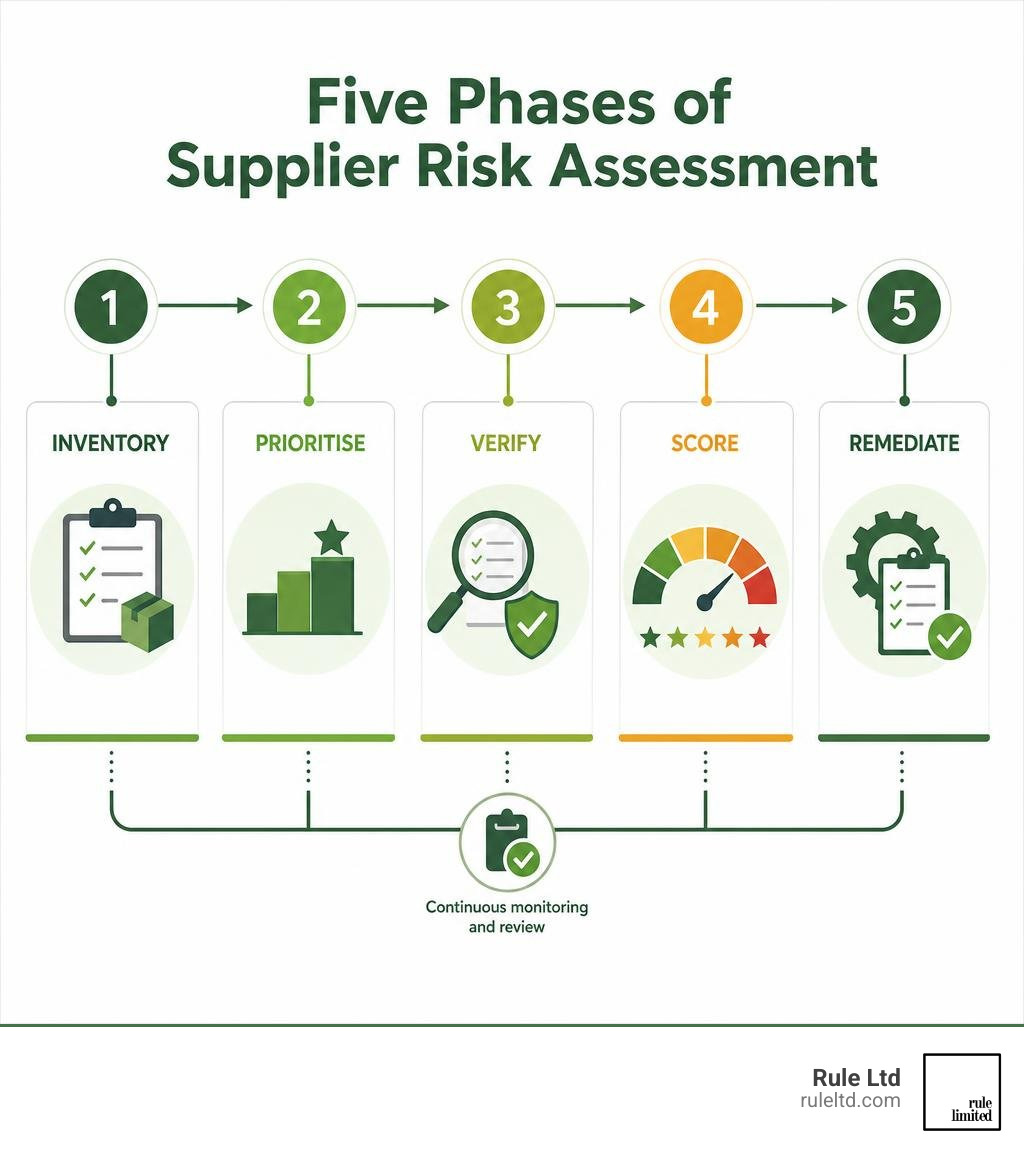
A robust supplier risk assessment process establishes comprehensive counterparty visibility, stratifies exposure by criticality and risk, validates material assertions with primary source evidence, and translates risk findings into enforceable governance controls. An effective operational framework incorporates five foundational pillars:
- Compiling an exhaustive supplier and contract inventory across all business units.
- Prioritising counterparties by expenditure, operational dependency, jurisdictional risk, data access, and regulatory exposure.
- Evaluating beneficial ownership, balance-sheet stability, international sanctions, statutory compliance, ESG criteria, and cyber vulnerabilities proportionate to exposure.
- Documenting calibrated risk ratings supported by verifiable evidentiary records and identifying diligence gaps.
- Establishing targeted remediation covenants, formal escalation thresholds, and periodic review triggers.
An unverifiable ultimate beneficial owner (UBO) does not automatically demonstrate illicit activity. It represents a material risk finding that undermines certainty in sanctions screening, anti-bribery controls, and human rights due diligence. Proportionate responses depend on counterparty function, jurisdictional context, organisational risk tolerance, and available public records, meaning specific compliance decisions require case-by-case assessment.
Rule Ltd provides human analyst-led corporate intelligence and due diligence reports that enable compliance and procurement teams to maintain defensible supplier risk assessments where corporate ownership, trade controls, and third-party risk require nuanced professional judgment.
Core Risk Dimensions: Beyond Basic Vendor Due Diligence

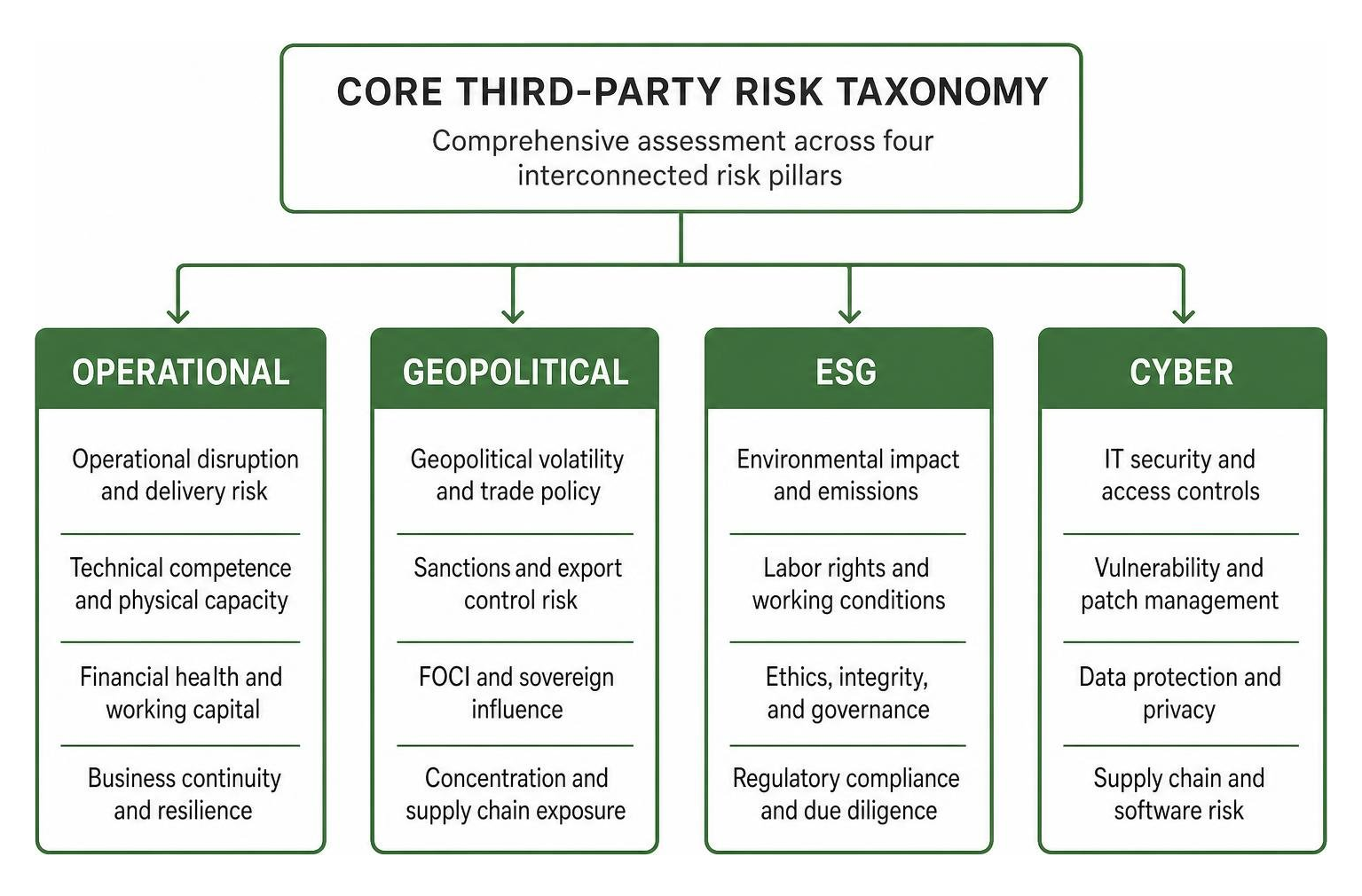
Modern procurement networks operate under acute operational, regulatory, and geopolitical friction. Treating third-party risk management as an administrative questionnaire exercise leaves material exposures unexamined. An effective third-party risk assessment analyses interconnected failure modes across distinct commercial and compliance domains.
Operational, Financial, and Capacity Exposures
Operational disruption carries immediate commercial consequences. Industry research indicates that systemic supply chain interruptions destroy substantial enterprise revenue growth potential across international sectors. Financial distress within intermediate manufacturing layers remains widespread, with credit analytics showing more than 1,100 automotive suppliers exhibiting severe financial warning signals across global markets.
Evaluating commercial viability requires assessing technical competence, physical plant capacity, working capital liquidity, and business continuity arrangements. When evaluated against structured models such as Ray Carter’s 10 Cs (competency, capacity, commitment, control, cash, cost, consistency, culture, clean, and communication), a supplier’s balance-sheet fragility frequently emerges as the leading indicator of delivery failure.
Geopolitical, Sanctions, and FOCI Risks
Trade policy shifts and regional conflicts have introduced structural volatility into cross-border logistics. International survey data indicates that 76% of trade professionals view tariffs as a permanent condition shaping trade lanes over multi-year horizons. Procurement teams must integrate vendor risk assessment geopolitical screening into standard vendor reviews to identify concentration hazards, trade restrictions, and export control risks.
Sovereign alignment presents acute legal challenges under the Foreign Ownership, Control, or Influence (FOCI) evaluation criteria detailed in the NIST C-SCRM due diligence standards. Complex intermediary networks, offshore trusts, and nominee arrangements obscure state ties or links to sanctioned individuals. The OFAC 50 Percent Rule and equivalent UK and EU provisions mandate that entities owned 50 percent or more in the aggregate by sanctioned parties are blocked, regardless of whether the legal entity appears on an official watchlist. Uncovering these links requires deep corporate registry investigation rather than basic database screening.
ESG, Human Rights, and Regulatory Compliance
Mandatory corporate sustainability and due diligence obligations have transformed corporate supply chain governance from voluntary self-policing into binding statutory mandates. Regulators enforce rigorous liability standards through:
- The Corporate Sustainability Due Diligence Directive (CSDDD)
- The Corporate Sustainability Reporting Directive (CSRD)
- The German Supply Chain Act (LkSG)
- The UK Modern Slavery Act 2015 Section 54
- The US Uyghur Forced Labor Prevention Act (UFLPA)
These frameworks require demonstrable oversight of working conditions, environmental emissions, and product claims. In consumer goods and food production, standards such as the IFS supply chain guidelines provide structured methodologies for substantiating product claims, auditing supplier facilities, and maintaining compliance with UN Global Compact principles.
IT, Cyber Hygiene, and Data Governance
Suppliers handling proprietary data or operating direct connections into core enterprise systems present critical attack vectors. A practical supply chain vendor risk cybersecurity checklist must examine external perimeter resilience, access controls, vulnerability management histories, and Software Bills of Materials (SBOMs) to identify insecure open-source packages and single-developer dependencies.
Supplier Risk Assessment Process: Tiering, Evidence, and Governance Failure Modes
A mature assessment framework does not succeed because it follows a linear workflow. It succeeds when fragmented commercial, ownership, financial, and compliance data can withstand challenge from procurement leadership, auditors, lenders, regulators, and dispute counsel. Established standardized supplier risk blueprints are useful where their outputs are translated into risk ownership, evidential sufficiency, and enforceable contracting controls.
| Assessment Tier | Target Scope | Key Diligence Requirements | Assurance Cadence |
|---|---|---|---|
| Tier 1: Strategic & Critical | High spend, single source, operational dependency, critical data access | Full beneficial ownership verification, sovereign filings, on-site audits, continuous intelligence | Annual comprehensive review and continuous monitoring |
| Tier 2: Operational & Tactical | Moderate spend, standard commercial terms, replaceable with alternative sources | Desktop registry checks, financial viability scoring, automated screening, compliance verification | Biennial review or event-driven re-assessment |
| Tier 3: Commodity & Low-Impact | Low spend, off-the-shelf items, zero network access, non-sensitive categories | Automated exclusion checks, negative media scans, standard contractual terms | Baseline check at onboarding and triennial review |
Inventory Integrity and Asset Dependency Risk
Inventory weakness is often the first control failure in the supplier risk assessment process. Fragmented procurement systems, unrecorded local engagements, and shadow spend can leave material third parties outside formal governance. Reconciling accounts payable records with contract registries is not merely an administrative exercise; it establishes whether the organisation knows which external counterparties support regulated products, customer commitments, physical sites, data environments, or critical operating processes.
The governance question is whether each supplier record carries enough context to support a risk decision. A low-value counterparty with privileged network access, sensitive data handling, or sole access to a specialist component may present a higher residual exposure than a high-spend supplier providing easily substituted goods.
Criticality Tiering and Review Fatigue
Review fatigue is a predictable failure mode where every supplier is subjected to the same diligence burden. Excessive uniformity can create procedural gridlock while leaving truly critical counterparties under-analysed. Criticality models, including spend analysis, the Kraljic Matrix, and control prompts reflected in a structured third-party risk assessment checklist, are most useful when they distinguish operational indispensability from procurement volume.
Tiering should expose the judgement calls that matter: whether a supplier is replaceable within acceptable timeframes, whether alternative sources are legally or technically viable, whether production depends on a single jurisdiction, and whether the third party can affect regulated data, sanctioned goods, or customer-facing continuity.
Evidentiary Due Diligence and Verification Failure Modes
Questionnaires provide self-reported assertions, not assurance. The evidentiary standard rises where the supplier operates through layered ownership, offshore holding companies, politically exposed relationships, restricted trade corridors, or opaque sub-tier sourcing. A corporate due diligence checklist for vendors and partners has value when it directs attention towards documents that can be independently tested, rather than creating a file of unverified declarations.
For high-risk or opaque counterparties, organisations commission enhanced due diligence to analyse primary registry filings, local language public records, litigation dockets, and adverse media. Human analysis verifies whether beneficial ownership structures match statutory declarations and whether ownership or control could cross sanctions thresholds, including aggregate ownership under applicable 50 percent rules.
Scoring, Segmentation, and False Precision
Risk scoring can assist governance, but it can also create false precision. A numeric score is defensible only where the underlying evidence, weighting assumptions, and escalation consequences are visible. Inherent risk factors, such as sector exposure, jurisdictional stability, sovereign influence, and product sensitivity, need to be assessed separately from control maturity, including audited systems, financial resilience, continuity capability, and verified compliance records.
FMEA-derived models can help compare probability, operational impact, and risk velocity, particularly where disruption speed matters more than annual spend. The resulting segmentation should affect commercial treatment in practice, including contractual conditions, payment terms, audit rights, remediation obligations, and executive sign-off thresholds.
Remediation Covenants and Continuing Assurance
Risk findings have limited commercial value unless they produce enforceable consequences. Corrective action plans, supplier corrective action request workflows, and contract covenants should identify the specific evidence required to close a finding, the individual accountable for acceptance, and the point at which unresolved risk requires escalation or exit consideration.
Ongoing vendor compliance monitoring gives procurement and compliance teams a basis for reassessment when corporate structures change, negative media emerges, regulatory action is announced, or delivery performance deteriorates. The central governance issue is not whether a supplier once passed onboarding, but whether the organisation can demonstrate proportionate and current oversight when the risk profile changes.
Navigating Complexities: Multi-Tier Supply Chains and Geopolitics
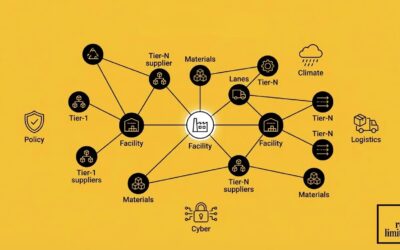
Supply chain risk rarely resides solely within immediate commercial relationships. Global supply models concentrate exposure in lower vendor tiers where visibility is lowest.
Overcoming Multi-Tier Visibility Gaps in the Supplier Risk Assessment Process
A primary contractor may maintain clean compliance records while relying on Tier 2 component specialists or Tier 3 raw material extractors in regions subject to import restrictions or forced labour prohibitions.
Illuminating these multi-tier networks uncovers indirect vulnerabilities before border detentions or sudden component shortages disrupt operations.
Regulatory Compliance and Enforceability: CSDDD, CSRD, and Sanctions
Regulatory enforcement regimes penalise supply chain negligence. The UK Economic Crime and Corporate Transparency Act 2023 (ECCTA) introduced failure-to-prevent fraud offences that demand rigorous third-party oversight across commercial interactions. In parallel, global sanctions regimes strictly enforce beneficial ownership rules across intermediate holding firms and cross-border joint ventures.
Maintaining contemporaneous, verified investigative files provides legal teams with the evidentiary foundation required to demonstrate proportionate due diligence before regulatory authorities.
Frequently Asked Questions About Supplier Risk Assessments
How often should formal supplier risk assessments be revalidated?
Tier 1 critical suppliers and high-risk counterparties should undergo formal re-assessment annually. Lower-risk commodity vendors typically follow biennial or triennial evaluation cycles.
Formal reviews should also be triggered immediately by specific material events:
- Changes in corporate ownership, executive leadership, or legal structure
- Mergers, acquisitions, or significant asset divestitures
- Relocation of primary manufacturing, assembly, or data hosting facilities
- Adverse regulatory actions, sanctions designations, or material litigation
- Significant operational disruptions or delivery failures
How should companies handle an unverifiable UBO during onboarding?
An unverifiable beneficial owner represents a material finding that limits an organisation’s ability to ensure sanctions compliance, evaluate PEP exposure, and enforce anti-bribery standards.
When standard corporate registries fail to confirm true beneficial ownership, organisations should commission specialist investigative research. Human analysts review local share registries, founding charters, litigation records, and sovereign regulatory filings to clarify the corporate structure. If ownership remains opaque due to jurisdiction-specific secrecy laws or layered holding entities, compliance leadership must evaluate the counterparty against corporate risk appetite, consider alternative suppliers, or implement strict contractual representations, enhanced audit rights, and ring-fenced payment mechanisms.
Conclusion: Building Defensible Supplier Governance
A resilient supply network requires moving beyond static surveys and unchecked assertions. Sustainable operational resilience depends on structured, repeatable assessment processes that uncover material vulnerabilities across all risk domains.
Rule Ltd provides specialist corporate intelligence and third-party due diligence services that give international enterprises the clear findings needed to manage counterparty risk. Human analysts examine public records, sovereign filings, and commercial registries across global jurisdictions to produce fixed-fee, defensible reports. Diligence reports are produced by human analysts, not algorithms, ensuring that complex legal structures and cross-border risks receive rigorous investigative review.
Because third-party risk profiles and regulatory frameworks vary across markets, specific compliance matters require individual assessment. Independent, analyst-led diligence provides the evidential basis needed to protect enterprise operations, comply with international standards, and make sound commercial decisions.
Sources
- NIST SP 1326 (Initial Public Draft): Cybersecurity Supply Chain Risk Management: Due Diligence Assessment Quick-Start Guide, National Institute of Standards and Technology.
- IFS Management GmbH (February 2025): How to Prepare the IFS Supply Chain Processes Check, Version 1 Guideline.
- European Parliament and Council: Directive (EU) 2024/1760 on Corporate Sustainability Due Diligence (CSDDD) and Directive (EU) 2022/2464 on Corporate Sustainability Reporting (CSRD).
- UK Parliament: Modern Slavery Act 2015 (Section 54) and Economic Crime and Corporate Transparency Act 2023 (ECCTA).
- German Federal Ministry of Labour and Social Affairs: Act on Corporate Due Diligence Obligations in Supply Chains (Lieferkettensorgfaltspflichtengesetz – LkSG).
- US Department of Homeland Security: Uyghur Forced Labor Prevention Act (UFLPA) Operational Guidance for Importers.
- US Department of the Treasury (OFAC): Revised Guidance on Entities Owned by Persons Whose Property and Interests in Property are Blocked (50% Rule).