
Integrate Third-Party Risk Data Beyond the 50% Rule
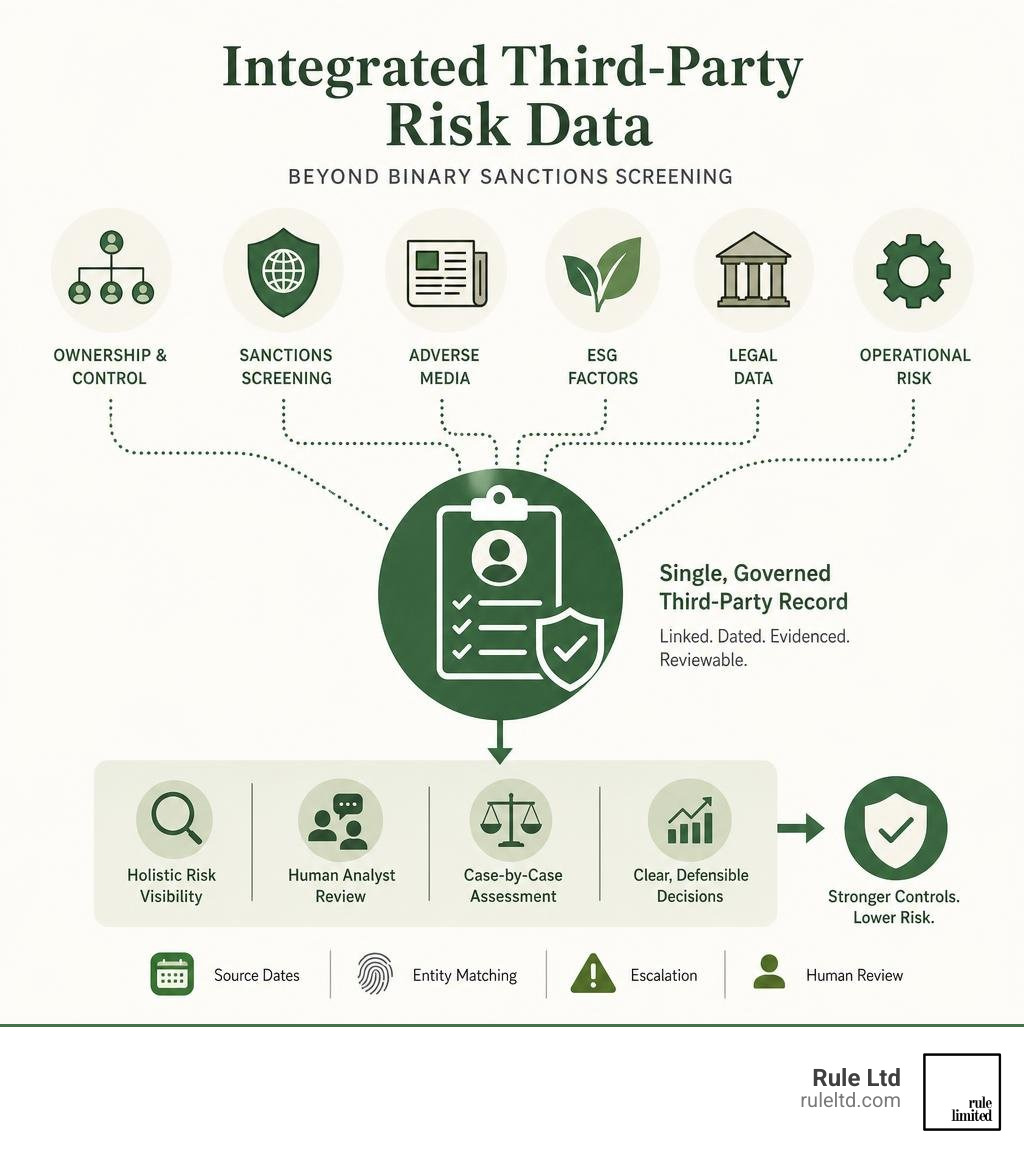
To integrate third-party risk data effectively, create a single, governed record for each third party that links ownership, control, sanctions, adverse media, ESG, legal and operational evidence. Then set clear rules for data quality, source dates, entity matching, escalation and human review.
The OFAC 50 Percent Rule is an important sanctions control. It requires an assessment of whether blocked persons own, in aggregate, 50% or more of an entity. But it is not a complete risk assessment. A third party may present material exposure through indirect control, opaque ownership, politically exposed connections, supply-chain concerns or adverse conduct even where a binary sanctions screen returns no obvious match.
Risk data integration joins those separate signals into an evidence trail that can be reviewed, challenged and explained. It should not turn uncertain data into a false sense of certainty. Each compliance decision requires a case-by-case assessment, particularly where ownership structures cross jurisdictions or control does not follow majority equity. This article provides general risk-management commentary and should not be treated as legal advice.
At Rule Ltd, risk data integration focuses on turning fragmented third-party information into clear, fixed-price reports prepared by human analysts rather than algorithms.
The Trap of Binary Sanctions Screening vs. Deep Ownership Aggregation
Standard sanctions screening engines operate primarily on direct string matching and predefined watchlists. This automated approach establishes whether an entity appears verbatim on a list issued by the Office of Foreign Assets Control (OFAC), the UK Office of Financial Sanctions Implementation (OFSI), or the European Union. However, modern corporate evasion strategies rarely present designated individuals as direct majority shareholders. Relying entirely on surface matching creates systemic exposure across complex supply networks.
Under the OFAC 50 percent rule, an entity is blocked if one or more blocked persons own, directly or indirectly, a 50 percent or greater aggregate interest. The European Union and the UK apply equivalent ownership thresholds, while also enforcing strict “control” criteria regardless of equity percentage. When ownership structures fragment across multiple jurisdictions or employ intermediary holding entities, standard matching tools frequently fail to aggregate these fractured stakes.

Establishing an accurate risk posture requires deep ownership calculation rather than binary checks. When assessing cross-border entities, organisations must look through multiple tiers of intermediate shareholding to quantify ultimate beneficial ownership (UBO). Enhanced Due Diligence provides the investigative depth required to pierce corporate opacity, unravelling deliberate holding webs designed to skirt statutory thresholds. Robust Third-Party Due Diligence maps the aggregate stakes of sanctioned parties, ensuring institutions avoid transactions that violate extraterritorial sanctions regimes.
The Limits of Automated Screening in Complex Holding Structures
Automated screening engines struggle when confronted with deliberate jurisdictional concealment. Disreputable counterparties frequently establish shell companies across opaque registries, utilising nominee directors and bearer shares to mask the true directing minds behind a business. In these environments, algorithmic tools process clean registry entries without identifying the legal instruments that separate formal share capital from beneficial economic interest.
Statutory developments, such as the UK Economic Crime and Corporate Transparency Act 2023 (ECCTA 2023), place increasing liability on commercial organisations for failing to prevent fraud and financial crime. Under ECCTA 2023, corporate liability extends to actions undertaken by associated persons, making superficial onboarding checks a severe legal liability. Relying on basic registry searches leaves blind spots around adverse media, informal side letters, and dynamic share purchase agreements. Through dedicated Corporate Due Diligence, organisations can identify circumstances where sanctioned figures or politically exposed persons exercise operational or financial control without holding a formal majority equity stake.
Aggregating Multijurisdictional Entity Data Beyond Surface Checks
Surface-level checks cannot capture the operational interdependencies of state-owned entities or supply chains vulnerable to severe regulatory enforcement. Compliance regimes such as the US Uyghur Forced Labor Prevention Act (UFLPA) require strict evidentiary proof that goods sourced overseas contain no inputs linked to forced labour. Demonstrating compliance demands rigorous upstream traceability beyond primary suppliers.
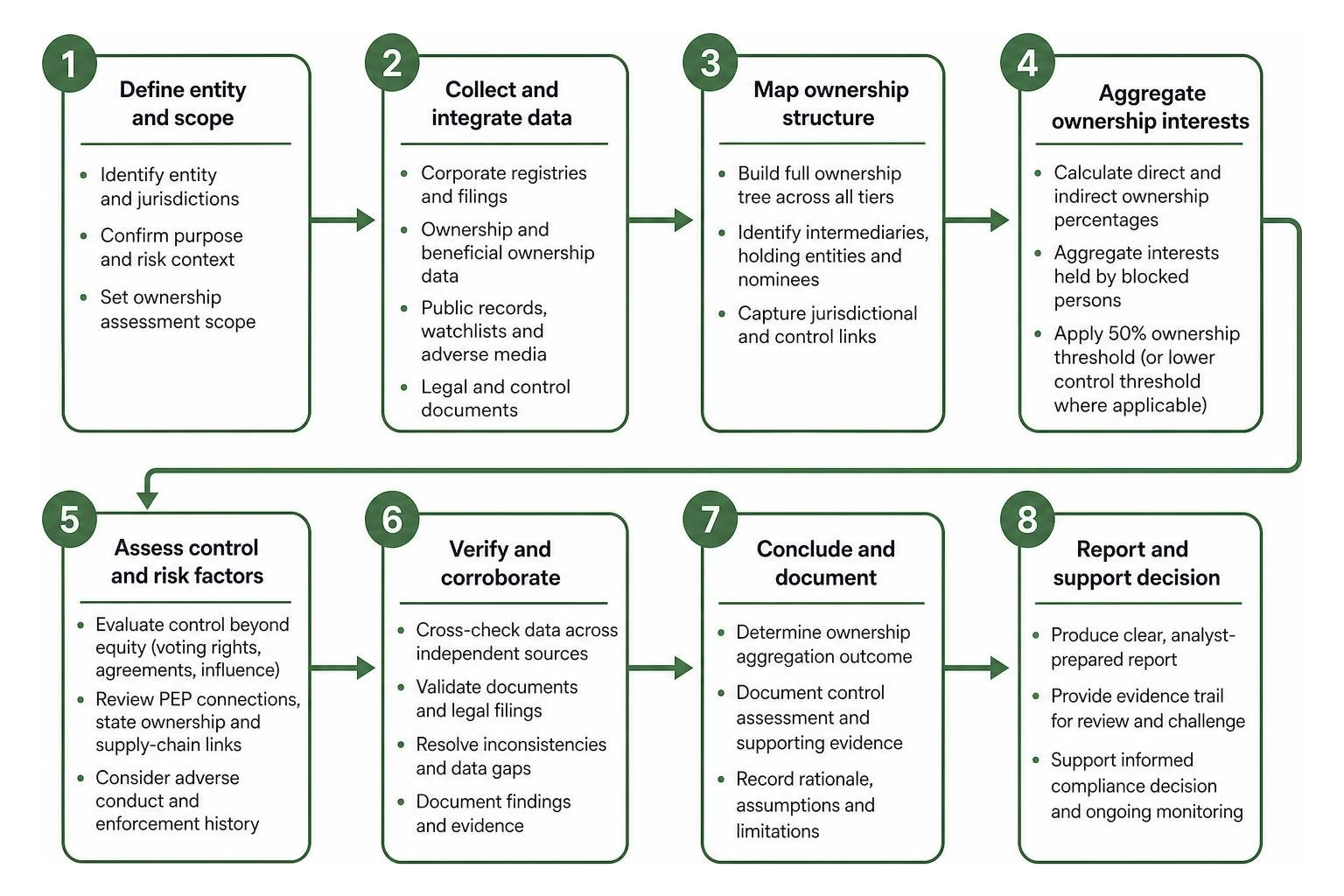
Supply-chain opacity conceals ties to state-linked commercial enterprises, regional military bodies, and high-risk politically exposed persons. Resolving these exposures involves corroborating multilingual primary registry filings, local litigation records, and regulatory enforcement databases. Through comprehensive Corporate Intelligence, institutions aggregate disjointed cross-border records into an intelligible map of institutional control, surfacing foreign sovereign interests and complex political linkages before entering binding joint ventures or vendor agreements.
Core Architecture and Best Practices for Enterprise Risk Data Integration
Integrating large streams of risk information requires an enterprise architecture that transcends static spreadsheets and periodic audits. Supervisory guidance and market practice continue to point to the same weakness: operational systems, procurement records and risk repositories are often maintained separately, which delays risk detection and increases remediation effort.

To establish an auditable risk data foundation, organisations should adopt canonical data models aligned with supervisory standards. The European Central Bank’s supervisory expectations outline the necessity of robust data governance in their Guide on effective risk data aggregation and risk reporting. These principles reinforce the BCBS 239 standard, which requires institutions to maintain complete, auditable data lineage for all risk aggregations. Applying these expectations ensures every data point used in a Third-Party Risk Assessment possesses clear lineage, transparent ownership, and verifiable metadata.
Overcoming Legacy Silos in Third-Party Risk Data Integration
Legacy IT infrastructures frequently separate vendor procurement files, payment histories, compliance monitoring feeds, and cyber assessments across isolated databases. This fragmentation prevents compliance officers from viewing aggregate exposure in real time. Replacing brittle point-to-point connections requires adopting an API-first integration model anchored in unified schemas.
Modern architectures standardise ingestion pipelines through agreed enterprise data dictionaries, controlled taxonomies and consistent schema management. Combining structured supplier files with unstructured adverse intelligence into an enterprise risk lake enables seamless Vendor Compliance Monitoring, eliminating the blind spots caused by disconnected internal departments.
Continuous Monitoring and Event-Driven Pipelines
Relying on annual third-party reviews leaves organisations vulnerable to sudden ownership shifts, sanctions designations, or regulatory enforcements that occur between assessment cycles. Moving to continuous monitoring requires event-driven pipelines powered by Change Data Capture (CDC). Unlike traditional batch loads, CDC streams modified records from underlying data stores, reducing latency materially and preserving a clearer chronology of risk events.
Configuring Real-Time Monitoring Alerts ensures compliance teams respond rapidly when an existing supplier encounters adverse regulatory action, political exposure, or credit deterioration. Furthermore, event-driven data flows dynamically feed into an organisation’s Third-Party Cybersecurity Risk Assessment, adjusting an entity’s composite risk rating when a vulnerability or breach is identified within its external digital ecosystem.
Bridging the Trust Gap: Human Expertise and Scientific Evidence Synthesis
While automated data ingestion accelerates initial screening, algorithmic evaluation alone cannot navigate nuanced legal arrangements, adverse media veracity, or jurisdictional context. A majority of risk executives express greater trust in hybrid human-AI models for risk data analysis than in unverified, fully automated outputs, reflecting broader industry scepticism toward opaque algorithmic decision-making.
High-volume automated screening inevitably yields high false positive rates, which overburden compliance teams and lead to alert fatigue. Conversely, false negatives can introduce unmonitored regulatory risk. A defensible compliance programme requires expert analysts who can contextualise automated findings, evaluate source credibility, and confirm genuine corporate matches.
| Risk Assessment Attribute | Automated Algorithmic Screening | Expert Human Analyst Verification |
|---|---|---|
| Data Processing Latency | Near-instantaneous, high-volume ingestion | Structured review (typically 2 to 5 working days) |
| False Positive Rate | Consistently high; triggered by name similarity | Low; eliminated through targeted corroboration |
| Contextual Nuance | Negligent of local political and legal dynamics | Comprehensive evaluation of local corporate culture |
| Complex UBO Tracking | Limited to explicit mathematical registry links | Identifies de facto control, trusts, and family proxies |
| Regulatory Defensibility | Low; represents an unverified “black box” model | High; delivers fully sourced, auditable intelligence |
| Evidence Synthesis | Simple statistical weighting and rule scoring | Robust causal inference and corroborated validation |
Implementing Hybrid Human-AI Models for Risk Data Integration
The primary value of artificial intelligence in risk data management lies in surface-level noise reduction and early weak-signal detection. Machine learning models can parse millions of unstructured global publications to flag potential regulatory disputes, environmental violations, or legal actions. However, algorithm-derived signals must undergo human validation before translating into operational decisions.
Our approach recognises that automated screening provides initial pointers, but definitive compliance dossiers require human expertise. Detailed methodologies outlined in A Complete Practical Guide to AI Vendor Risk Management demonstrate the importance of assessing external technologies for algorithmic bias, hallucination risks, and data leakage. Reports produced by human analysts ensure every finding is backed by primary source documentation, transforming raw algorithmic data into defensible corporate records.
Adapting Scientific Evidence Integration to Mitigate Assessment Bias
Synthesising disparate risk data streams benefits from established scientific evaluation methodologies. In formal scientific evaluations (Medicine et al., 2017), data interpretation requires separating raw analysis, cross-dataset integration, and final evidence synthesis to establish causal links rather than mere correlation.
Adapting principles such as Bayesian probability inference and the Bradford-Hill causal guidelines allows compliance teams to systematically weigh adverse findings. Analysts evaluate incoming data based on source reliability, temporal consistency, biological or financial plausibility, and corroboration across independent registries. Incorporating a structured weight-of-evidence framework directly into Risk Mapping Scenario Planning Supply Chains prevents subjective biases from skewing supplier risk ratings, ensuring complex holding assessments remain objective and reproducible.
Measuring ROI and Prioritising Emerging Conduct Risks for 2026 and Beyond
Failing to manage third-party conduct can carry severe financial, regulatory and reputational consequences. Recent enforcement and supervisory trends show that major incidents rarely remain confined to one function: sanctions, fraud, cyber, human rights, climate and procurement failures increasingly overlap. As a result, many enterprises are moving from reactive incident remediation towards integrated conduct risk data and cross-functional governance.
Shifting from reactive incident remediation to proactive, unified oversight requires an enterprise-wide risk governance model. Forward-thinking organisations deploy Supply Chain Risk Technology: How AI and Analytics Are Transforming Risk Management to bridge internal data siloes. Consolidating cross-functional risk intelligence protects institutional reputation, preserves commercial relationships, and supports a more defensible response to regulatory scrutiny.
Navigating AI-Related and Climate-Driven Third-Party Exposures
Corporate conduct risks are shifting as enterprises adopt complex algorithmic services and adapt to more demanding environmental and human rights standards. AI vendor exposure may include algorithmic discrimination, intellectual property misuse, opaque model governance and autonomous data breaches. Integrating continuous monitoring of external AI vendors has become an important operational safeguard.
Concurrently, European regulatory mandates, such as the German Supply Chain Due Diligence Act (LkSG) and the EU Corporate Sustainability Due Diligence Directive (CSDDD), subject to transposition and implementation timetables, require greater transparency across environmental and human rights factors. Organisations may also need to capture auditable Scope 3 emissions data and labour compliance records across multiple tiers of suppliers where applicable. Integrating these operational indicators alongside sanctions databases creates a more complete, real-time risk profile for international vendors.
Quantifying Risk Data Value and Defence Defensibility
Proving the return on investment for risk data integration relies on measuring prevented losses, reduced regulatory exposure and operational efficiencies. Traditional point-in-time reviews leave firms exposed to enforcement action, where fines may be accompanied by lasting reputational damage.
| Risk Domain | Reactive, Disconnected Approach | Integrated, Governed Architecture | Measurable Commercial ROI |
|---|---|---|---|
| Sanctions & UBO | Surface-level screening; missed aggregate ownership stakes | Deep UBO identification and multi-tiered aggregation | Avoidance of civil penalties and frozen operating assets |
| Regulatory Compliance | Fragmented spreadsheets; inconsistent audit documentation | Centralised data lineage fulfilling BCBS 239 requirements | Reduced supervisory remediation and audit costs |
| Adverse Media | Overwhelming alert fatigue; reliance on static portals | Expert analyst verification of actionable adverse reporting | Prevention of brand impairment and customer attrition |
| Supply Chain Continuity | Crisis-driven responses to severe vendor insolvencies | Predictive health scoring and continuous supplier monitoring | Minimised operational disruption and rapid supplier onboarding |
A fully integrated data architecture provides an auditable foundation during regulatory inquiries. Demonstrating that vendor assessments rely on robust data lineage, verified beneficial ownership records and documented analyst reviews provides the legal defensibility required to satisfy statutory authorities.
Frequently Asked Questions About Third-Party Risk Data Integration
Why is the 50% rule insufficient when screening third-party vendor risks?
The OFAC 50 percent rule accounts only for aggregate majority equity ownership by blocked individuals. It does not identify minority-held entities where a sanctioned individual exercises direct operational control through executive appointments, side agreements, or family proxies. Furthermore, European Union and UK sanctions regimes evaluate both ownership and effective control independently. Relying solely on a 50 percent numerical threshold leaves organisations vulnerable to complex corporate evasion schemes, adverse conduct, and regulatory penalties.
How does a hybrid human-AI approach improve risk data accuracy?
Automated tools excel at ingesting vast, multijurisdictional datasets and flagging potential anomalies. However, algorithms lack contextual understanding, generating high rates of false positives and occasionally overlooking disguised ownership structures. A hybrid approach uses machine intelligence for initial data filtering, followed by seasoned human analysts who evaluate primary source documents, untangle corporate registries, and eliminate noise. This workflow delivers accurate, auditable, and defensible risk intelligence.
What are the foundational requirements for BCBS 239 compliant risk aggregation?
Compliance with BCBS 239 requires comprehensive data governance, defined data ownership, auditable end-to-end data lineage, and precise metadata management. Organisations must ensure that all critical data elements used in risk reporting can be reconciled back to primary transactional sources. Data pipelines must operate with sufficient accuracy, integrity, and aggregation speed to support decision-making during normal operations and stress scenarios alike.
Conclusion
Managing modern third-party exposure requires moving beyond fragmented, point-in-time checks and superficial screening questions. Modern regulatory frameworks demand continuous oversight of complex ownership networks, global supply chains, and evolving corporate conduct. Effective risk integration combines automated data collection with rigorous, independent verification.
At Rule Ltd, we deliver fixed-price, cost-certain intelligence reports that eliminate the opacity of traditional risk management models. Our screening assessments turn around in two to three working days, while comprehensive enhanced due diligence and corporate intelligence reviews are delivered in approximately five working days, with all pricing agreed before work begins. Our reports are produced entirely by experienced human analysts rather than automated algorithms, providing your leadership team with defensible, case-by-case assessments to protect your organisation against global financial, regulatory, and reputational risk.
To review your counterparty exposures with clarity, explore our full suite of Third-Party Due Diligence solutions.
Sources
National Academies of Sciences, Engineering, and Medicine, Division on Earth and Life Studies, Board on Environmental Studies and Toxicology, Committee on Incorporating 21st Century Science into Risk-Based Evaluations. “Interpretation and Integration of Data and Evidence for Risk-Based Decision-Making.” National Academies Press (US), 2017. NBK424991.
- Guide on effective risk data aggregation and risk reporting (ECB)
- U.S. Department of the Treasury, Office of Foreign Assets Control (OFAC): Guidance on Entities Owned by Persons Whose Property and Interests in Property Are Blocked (50% Rule)
- UK Legislation: Economic Crime and Corporate Transparency Act 2023 (ECCTA 2023)
- Basel Committee on Banking Supervision: Principles for effective risk data aggregation and risk reporting (BCBS 239)
- German Federal Ministry of Labour and Social Affairs: Act on Corporate Due Diligence Obligations in Supply Chains (Lieferkettensorgfaltspflichtengesetz – LkSG)