
Why Continuous Monitoring Services Matter for Real-Time Compliance
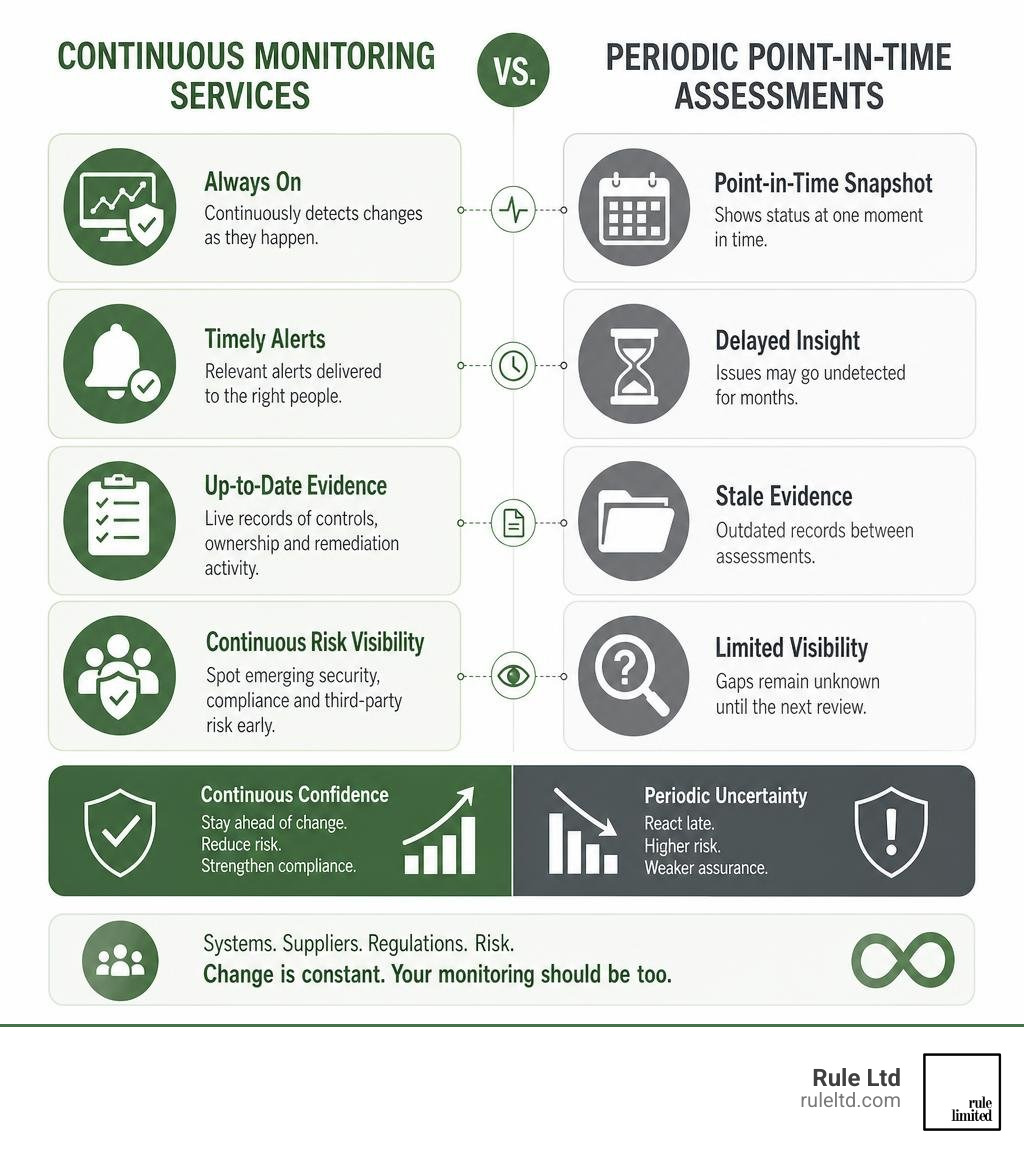
Continuous monitoring services help organisations spot changes in security, compliance and third-party risk between formal reviews. When comparing options, look for services that can:
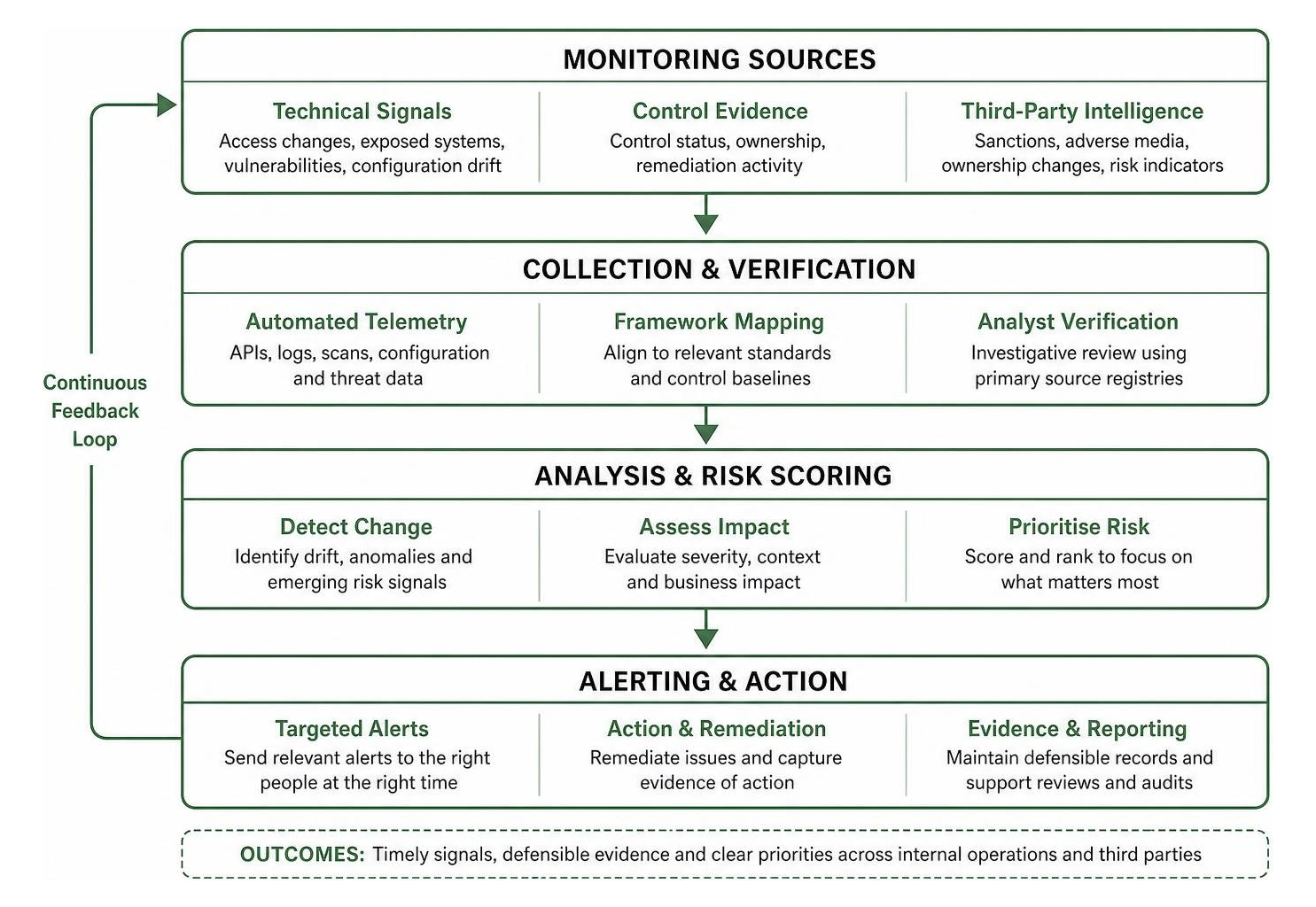
- Monitor technical signals such as access changes, exposed systems, vulnerabilities and configuration drift.
- Track control evidence, ownership and remediation activity against relevant frameworks.
- Identify third-party developments, including sanctions exposure, adverse media, ownership changes and other risk indicators.
- Send relevant alerts to the person who can assess and act on them, rather than creating a stream of unactionable noise.
A periodic audit shows whether a control worked at one moment. Continuous monitoring tests whether it is still working as systems, suppliers, regulations and risk conditions change. It does not remove the need for informed review, especially where ownership, reputation, sanctions or legal exposure require context and judgement. Specific compliance obligations must always be assessed case by case.
For multinational compliance teams, the real question is not whether to monitor continuously. It is whether the service produces timely signals, defensible evidence and clear priorities across both internal operations and the third parties on which the business depends. Corporate intelligence and third-party risk analysis require dedicated human analysts who ensure that risk signals are documented clearly and structured to withstand regulatory scrutiny.
The Fatal Flaw of Point-in-Time Audits in Modern Governance
Annual audits provide a retrospective snapshot of an organisation’s operational state on a single day. In practice, technical configurations shift daily, internal user privileges drift, corporate structures change and international supply chains face sudden geopolitical realignment. Relying solely on periodic assessments exposes enterprises to prolonged compliance drift, where control failures remain invisible for months before discovery during an annual audit preparation cycle.
Modern governance requires real-time posture validation to satisfy standards such as NIST SP 800-137 and ISO/IEC 27001:2022. Perimeter defences erode quickly when software exposures emerge, unmonitored subdomains proliferate or rogue identity permissions expand. Continuous tracking replaces decaying static evidence with active operational telemetry, delivering immediate real-time monitoring alerts that capture drift the moment it occurs. Solutions like Qualys Continuous Security Monitoring Tools & Alerts illustrate how perimeter tracking identifies unexpected external network modifications before external adversaries exploit them.
| Capability Dimension | Technical Security Monitoring | Continuous Controls Monitoring (CCM) | Third-Party Risk Intelligence |
|---|---|---|---|
| Primary Telemetry Focus | Network traffic, endpoints, CVE vulnerabilities, IAM logs | Policy baselines, automated framework mapping, evidence drift | UBO alterations, sanctions, adverse media, legal actions |
| Verification Mechanism | Automated telemetry, SIEM correlation, synthetic queries | Direct API polling against control definitions and IaC | Human analyst investigative verification, primary source registries |
| Regulatory Alignment | PCI DSS 4.0, NIST SP 800-53, Zero Trust Architecture | SOC 2 Type II, ISO 27001:2022, FedRAMP, HIPAA | OFAC 50% Rule, UK Bribery Act, ECCTA 2023, EU Sanctions |
| Operational Impact | Lowers mean-time-to-resolution (MTTR) for technical exploits | Eliminates retrospective manual audit preparation fire drills | Mitigates severe supply chain liability and regulatory penalties |
Evaluating Enterprise Continuous Monitoring Services Across Core Vectors
Establishing effective oversight requires parsing continuous telemetry streams without overwhelming operational teams. As cloud footprints expand across multi-cloud environments, engineering teams frequently encounter alert fatigue and data overload. Deploying continuous compliance monitoring across cloud environments ensures that identity governance, infrastructure drift and vendor compliance monitoring function concurrently rather than as isolated checkpoints.
Platforms such as Continuous monitoring posture as a live signal · Uproot demonstrate the utility of frequent infrastructure polling, running continuous programmatic checks against cloud assets, code repositories and identity platforms to surface state differentials instantly. However, technical posture checks address only internal surface exposures. A mature enterprise strategy pairs automated internal telemetry with external counterparty oversight to maintain an accurate posture across every risk vector.

Architectural Pillars: Security Telemetry vs. Third-Party Governance
Enterprise continuous monitoring requires two synchronised operational pillars: internal technical security telemetry and external third-party governance.
Internal controls capture endpoint events, anomalous IAM escalations and multi-cloud infrastructure drift. External governance tracks counterparties, supply chain integrity and corporate structural modifications. Overlooking supplier ecosystems undermines internal technical safeguards, as highlighted by third-party cyber security risk management imperatives.
Deploying Technical Continuous Monitoring Services for Attack Surface Defence
Technical security monitoring tracks configuration baselines, software dependencies and exposed digital assets. Vulnerability prioritisation requires dynamic risk scoring to isolate severe common vulnerabilities and exposures (CVEs) from low-risk anomalies, directly reducing the organisation’s mean-time-to-resolution.

Continuous attack surface tracking monitors SSL/TLS certificate lifecycles, unauthorised software installations and open ports, identifying exposed cloud storage or forgotten subdomains before malicious actors can exploit them.
Integrating Vendor Continuous Monitoring Services for Defensible Supply Chain Oversight
Vendor continuous monitoring safeguards the organisation against external liabilities that technical logs cannot reveal. Suppliers frequently change corporate directors, alter beneficial ownership or become entangled in adverse litigation between annual reviews. Unmonitored third parties can introduce severe supply chain vulnerabilities, exposing enterprises to regulatory enforcement under global compliance statutes.
Robust sanctions risk management requires automated screening coupled with human-analyst validation to identify complex beneficial ownership layers. Offshore structures often obscure sanctioned entities under the OFAC 50% Rule or UK Office of Financial Sanctions Implementation (OFSI) mandates. In high-risk cross-border engagements, structured third-party risk assessment mechanisms protect organisations against hidden counterparty liabilities.
Our published anonymised case studies illustrate how cross-border corporate intelligence identifies hidden politically exposed persons (PEPs) and opaque ultimate beneficial ownership (UBO) structures before transactions execute. Automated screening flags initial keyword matches, but only thorough analyst investigations confirm whether supply chain partners comply with regulatory requirements or present critical integrity risks.
Regulatory Convergence: Navigating SOC 2, ISO 27001, and Global Mandates
International regulatory frameworks increasingly require continuous, demonstrable control oversight. Maintaining ongoing compliance across SOC 2 Type II, ISO/IEC 27001:2022, NIST CSF 2.0, HIPAA Security Rules and PCI DSS 4.0 requires mapping unified control evidence across multiple frameworks simultaneously. Rather than gathering disparate artefacts for each audit cycle, organisations define controls programmatically to demonstrate adherence continuously across overlapping standards.
Corporate governance extends directly into statutory legal mandates, including the US Foreign Corrupt Practices Act (FCPA), the UK Bribery Act 2010, the UK Economic Crime and Corporate Transparency Act 2023 (ECCTA) and European Union restrictive measures. The failure-to-prevent-fraud offence under ECCTA 2023 places an affirmative obligation on organisations to maintain reasonable, continuous fraud prevention procedures across their operational footprint and commercial relationships. Commercial organisations that fail to monitor supply chain counterparties risk substantial corporate liability if an associated person commits fraud intended to benefit the business.
Cross-border counterparty exposure also demands strict compliance with export controls and sanctions regimes, including the US Uyghur Forced Labor Prevention Act (UFLPA) and the German Supply Chain Due Diligence Act (Lieferkettensorgfaltspflichtengesetz, LkSG). Under these mandates, sporadic supplier questionnaires fail to meet statutory due diligence thresholds. When high-risk jurisdictions, complex corporate ownership or adverse media surface during continuous monitoring, organisations initiate enhanced due diligence to establish a legally defensible audit trail and ensure compliance with global regulatory expectations.
Operational Implementation: Telemetry Triage and Signal Integrity
Deploying continuous monitoring across distributed technical infrastructure and corporate supplier ecosystems introduces significant data volume and operational complexity. Compliance and security operations teams must establish structured signal triage mechanisms to prevent high-volume telemetry from obscuring high-consequence compliance failures.
Signal Ingestion and False-Positive Suppression
Automated monitoring systems frequently generate excessive noise when baseline deviation thresholds are calibrated too narrowly. Operational teams mitigate alert fatigue by correlating operational telemetry with asset criticality and corporate risk exposure. Suppression rules must maintain explicit, audited expiration windows during planned infrastructure maintenance, preventing permanent visibility blind spots. Telemetry feeds from identity providers, continuous integration pipelines and cloud configuration databases require programmatic deduplication against active incident queues to preserve analyst focus.
Dynamic Risk Scoring and Control Verification
Candidate controls for continuous automated verification are those producing structured, machine-readable records. Identity and access reconciliations, multi-factor authentication enforcement states, endpoint encryption configurations, vulnerability patch latency metrics and code repository branch protection rules provide deterministic telemetry suitable for automated testing. Conversely, non-deterministic risks, including counterparty reputational shifts, litigation disclosures and beneficial ownership reorganisations, require structured investigative workflows where automated alerts trigger qualitative analyst review rather than superficial programmatic closure.
Conclusion
Mature enterprise risk management demands continuous operational visibility across internal technical architectures and external supplier networks. Automated systems excel at processing massive telemetry feeds and flagging immediate discrepancies. However, evaluating complex third-party risks—such as beneficial ownership changes, geopolitical exposure, and adverse legal developments—requires qualitative analyst validation.
At Rule Ltd, we deliver corporate intelligence, sanctions screening, and third-party risk analysis through dedicated human analysts, providing defensible, clear assessments rather than unvalidated algorithmic outputs. We quote every engagement on a transparent, fixed-price basis before work begins, offering fast turnaround times of two to three working days for screening reports and approximately five working days for corporate intelligence and enhanced due diligence reviews.
To establish defensible, comprehensive oversight of your external counterparties and ensure ongoing regulatory alignment, partner with us for specialised third-party due diligence support tailored to your enterprise.
Sources
- National Institute of Standards and Technology (NIST) Special Publication 800-137: Information Security Continuous Monitoring (ISCM) for Federal Information Systems and Organizations.
- International Organization for Standardization / International Electrotechnical Commission (ISO/IEC) 27001:2022: Information security, cybersecurity and privacy protection — Information security management systems — Requirements.
- UK Parliament: Economic Crime and Corporate Transparency Act 2023 (ECCTA 2023), Part 5: Fraud and False Accounting Offences.
- UK Parliament: Bribery Act 2010 (c. 23), Section 7: Failure of commercial organisations to prevent bribery.
- US Department of the Treasury, Office of Foreign Assets Control (OFAC): Revised Guidance on Entities Owned by Persons Whose Property and Interests in Property Are Blocked (50% Rule).
- US Department of Justice & US Securities and Exchange Commission: A Resource Guide to the U.S. Foreign Corrupt Practices Act (FCPA).
- European Union: Council Regulation (EU) No 833/2014 and subsequent restrictive measures concerning Russia and sanctions evasion.
- Payment Card Industry Security Standards Council: Payment Card Industry Data Security Standard (PCI DSS) Requirements and Testing Procedures, Version 4.0.