
Aligning Enterprise Risk Management and Compliance Strategy
An effective compliance risk mitigation strategy requires embedding non-negotiable statutory mandates, sanctions controls, and anti-corruption baselines directly into commercial decision-making. Rather than managing compliance as a reactive administrative checklist, an auditable programme combines ongoing regulatory horizon scanning, human-verified counterparty due diligence, independent board escalation, and defensible internal controls to prevent legal breaches, regulatory enforcement, and operational disruption.
Enterprise governance operates across multiple horizons. Enterprise risk management (ERM) evaluates strategic uncertainties, capital allocation, market volatility, and operational resilience to protect and create value. Compliance risk management operates within a bounded, non-negotiable perimeter: the non-discretionary adherence to statutory requirements, supervisory mandates, contractual covenants, and ethical obligations.
When an organisation treats compliance as a siloed checklist rather than an integral pillar of enterprise governance, critical blind spots emerge. Enterprise risk strategies often evaluate risk appetite, accepting calibrated exposures to achieve commercial returns. Compliance risk admits no deliberate appetite for illegality or regulatory breach.
Integrating compliance risk mitigation within broader enterprise governance aligns an organisation’s risk tolerance with hard regulatory baselines.
| Dimension | Enterprise Risk Management (ERM) | Compliance Risk Management (CRM) |
|---|---|---|
| Primary Scope | Strategic, market, credit, operational, and reputational risk across all activities. | Legal duties, regulatory mandates, industry rules, and internal policy frameworks. |
| Core Objective | Optimise risk-adjusted commercial returns while preserving capital and continuity. | Prevent legal breaches, sanctions, criminal liability, regulatory fines, and ethical failure. |
| Risk Appetite | Dynamic and variable; calculated risk-taking is embraced for commercial reward. | Near-zero tolerance for deliberate lawbreaking or systemic non-compliance. |
| Governing Standard | Strategic frameworks (e.g. COSO ERM Framework, ISO 31000). | Supervisory rules, criminal statutes (e.g. UK Bribery Act, FCPA, ECCTA 2023), ISO 37301. |
| Primary Metrics | Value at Risk (VaR), volatility measures, ROI, key risk indicators (KRIs). | Audit findings, regulatory citations, breach logs, due diligence coverage, resolution latency. |
The synthesis of these two disciplines ensures that strategic growth initiatives, such as entering emerging markets, executing cross-border acquisitions, or integrating complex supply chains, are bounded by proactive regulatory screening.
Intersecting Compliance Risk with Operational and Legal Exposure
Compliance risk directly triggers operational disruptions and compounding legal liability. A failure in mandatory transaction monitoring is an operational breakdown; the resulting breach of anti-money laundering regulations is a statutory failure that triggers regulatory enforcement, operational suspension, and substantial financial loss.
When counterparty exposures are left unexamined, standard business operations can lead directly to regulatory violations. Identifying these fault lines requires structured corporate legal due diligence before transactional execution.
A failure to identify that an offshore distributor is owned by a sanctioned person or an unlisted politically exposed person (PEP) directly impairs operational resilience. Internal controls must be designed to withstand rigorous supervisory review, establishing evidential proof of adherence before transactions settle.
Board Oversight and Independent Governance Structures
Supervisory authorities demand evidential proof of an independent, empowered compliance infrastructure. The Federal Reserve Supervisory Guidance on compliance programmes makes clear that compliance officers must operate with structural independence from revenue-generating business units.
An autonomous compliance function requires:
- Direct, unencumbered escalation channels to the board of directors and audit committees.
- Authority to veto commercial engagements, acquisitions, or vendor relationships presenting unmitigated regulatory exposure.
- Remuneration models decoupled from business-line commercial performance to prevent conflicts of interest.
- A clear mandate to foster a culture of integrity, ensuring top-level accountability across all operational divisions.
Core Pillars of an Enterprise Compliance Risk Mitigation Framework
A defensible compliance programme follows an established architecture. Frameworks like ISO 37301 provide benchmarks for auditable compliance management systems. The IMF Compliance Risk Manual reinforces that systematic risk management relies on structured segmentation, targeted treatments, and continuous feedback loops rather than static administrative policies.

Operationalising Compliance Risk Mitigation
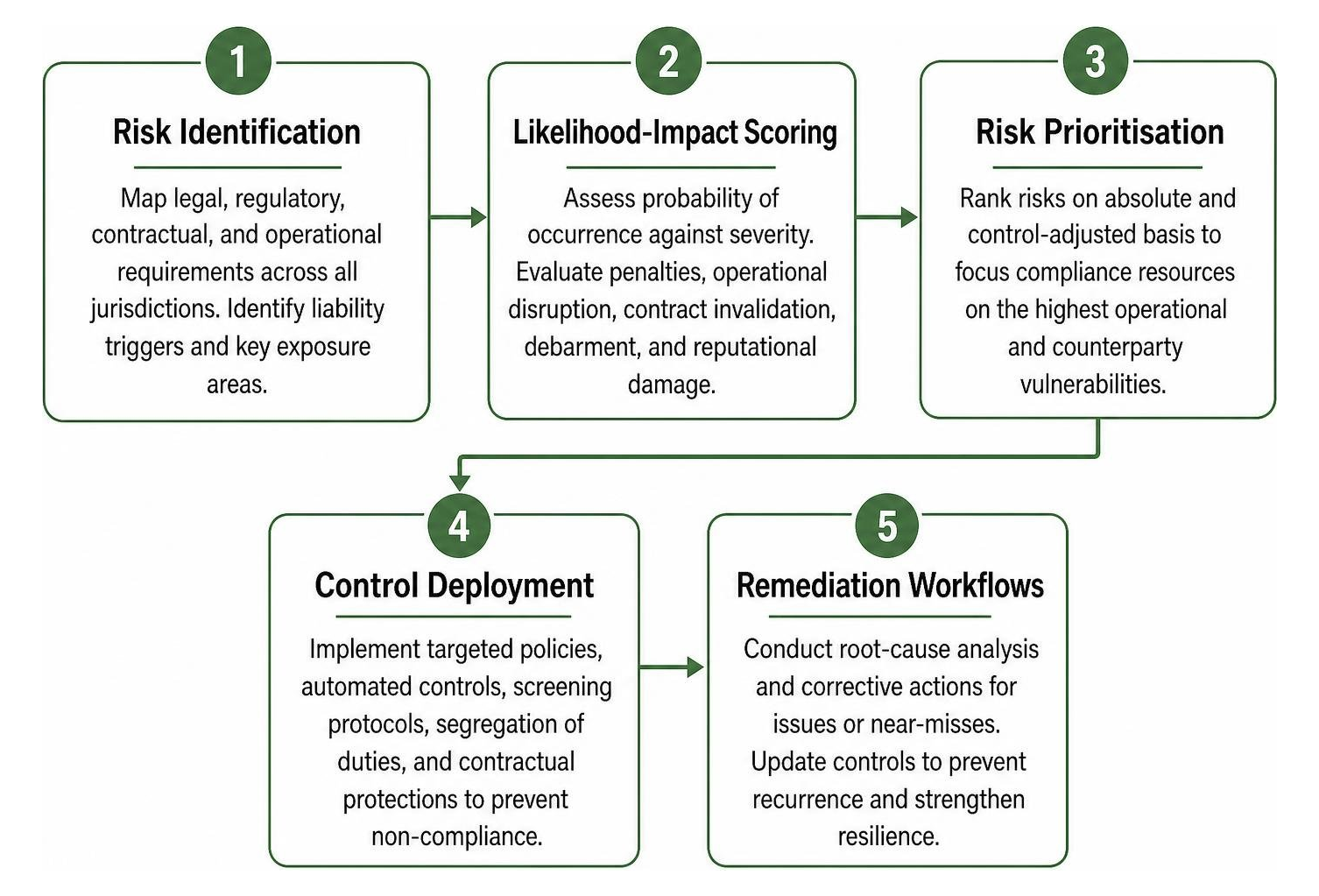
Operational execution breaks down when compliance teams treat regulatory obligations as administrative checklists rather than managing systemic failure modes across complex commercial workflows:
- Jurisdictional Boundary Mismatches: Extraterritorial statutory requirements, including the UK Economic Crime and Corporate Transparency Act 2023 (ECCTA) corporate offence of failure to prevent fraud, trade sanctions, and foreign anti-bribery statutes, apply across entities regardless of local customary business practices. Compliance architecture must account for cross-border liability triggers rather than relying on local subsidiary autonomy.
- Control Degradation and Alert Desensitisation: Static rule engines and uncalibrated transaction screening generate substantial volumes of administrative noise, obscuring genuine red flags. Control effectiveness deteriorates when high false-positive rates divert analyst attention away from sophisticated evasion techniques.
- Inherent Versus Residual Exposure Blind Spots: Quantifying risk without rigorously testing detective controls leads to false assurance. Residual risk profiles must reflect verified control operation, accounting for maximum statutory penalties, contract invalidation, commercial debarment, and operational suspension.
- Remediation Latency and Evidential Deficits: Unresolved audit findings and deferred corrective actions create severe exposure during supervisory reviews. Defensible compliance programmes enforce auditable root-cause remediation workflows that produce contemporaneous evidence of timely corrective action.
Conducting Comprehensive Compliance Risk Assessments
A compliance risk assessment cannot be an annual paper exercise. It requires continuous, dynamic testing across the enterprise threat taxonomy. Compliance teams must map inherent risk profiles against internal control effectiveness to identify unmitigated residual exposures.
Deploying comprehensive corporate risk profiling and reporting enables general counsel and compliance directors to identify regulatory exposure across foreign subsidiaries, joint ventures, and operating units.
When conducting these assessments, compliance professionals should evaluate counterparty structures, regulatory shifts, and operational controls against clear evidential benchmarks.
Culture, Tone from the Top, and Employee Accountability
The most sophisticated compliance policies fail if internal incentives reward non-compliant commercial behaviour. Establishing an ethical culture requires active, visible leadership from the executive committee and board.
Measurable ethical accountability relies on practical mechanisms:
- Secure, independent whistleblower channels that ensure anonymity and strictly prevent retaliation.
- Rigorous conflict of interest screening during executive onboarding, procurement appointments, and commercial negotiations.
- Role-specific training scenarios reflecting real-world compliance risks, moving beyond basic tick-box e-learning modules.
- Formal compensation clawback mechanisms that penalise compliance failures and disincentivise unethical risk-taking.
Managing Vulnerabilities Across Third Parties and Extended Supply Chains
The external perimeter represents the single largest source of compliance vulnerability. Multinational corporations are routinely held legally liable for the conduct of intermediaries, raw material suppliers, offshore joint venture partners, and logistical contractors.
Enforcement under the U.S. Foreign Corrupt Practices Act (FCPA) and the UK Bribery Act 2010 frequently centres on corrupt payments made by third-party intermediaries. Simultaneously, supply chain legislation—including the U.S. Uyghur Forced Labor Prevention Act (UFLPA) and the German Supply Chain Due Diligence Act (Lieferkettensorgfaltspflichtengesetz or LkSG)—mandates rigorous tracing of lower-tier suppliers for human rights and environmental violations.

Modernising Third-Party Compliance Risk Mitigation
Relying on vendor self-certifications and passive questionnaire declarations offers little defence before regulatory bodies. Modern third-party risk mitigation demands independent, evidence-based verification.
Executing an initial third-party risk assessment allows organisations to segment their vendor base by risk tier, establishing proportional due diligence requirements. High-risk relationships require robust contractual safeguards, including:
- Explicit anti-bribery, modern slavery, and trade compliance warranties.
- Absolute rights to conduct independent, unhindered operational audits and inspect corporate books and records.
- Immediate, unilateral termination rights upon the occurrence of a verified compliance breach or sanctions designation.
Navigating Cross-Border Sanctions, PEPs, and Ownership Concealment
Modern corporate ownership structures are often deliberately complex. Sanctioned individuals, corrupt state actors, and illicit networks rarely hold direct, registered ownership of commercial entities. Instead, they operate through shell companies, offshore trusts, nominee arrangements, and complex holding structures designed to evade screening engines.
Compliance programmes must address the enforcement parameters of the Office of Foreign Assets Control (OFAC) 50% Rule and the UK Office of Financial Sanctions Implementation (OFSI) ownership-and-control standards. Under these regimes, an entity is deemed sanctioned if it is owned 50% or more, directly or indirectly, by one or more blocked persons, or if an unlisted sanctioned person exercises ultimate control over the entity.
Automated screening algorithms often fail to detect these indirect ownership links. Establishing compliance requires verifying ultimate beneficial owner checks to pierce opaque corporate layers, alongside rigorous PEP identification and classification to identify potential state exposure and illicit influence.
High-Risk Entities and Deeper Investigative Screening
Standard database screening matches declared corporate names against published blacklists. It does not uncover complex corporate manoeuvres, recent undocumented share transfers, or hidden beneficial interests.
When operating in high-risk jurisdictions, conducting M&A, or engaging agents who interface with foreign government officials, organisations require deeper investigative diligence. Deploying enhanced due diligence for high-risk entities provides the corporate intelligence needed to identify hidden ownership, verify operational legitimacy, surface adverse media in local languages, and protect against severe regulatory enforcement and supply chain disruption.
Deploying Technology, Automation, and Real-Time Surveillance
Modern compliance operations must handle vast volumes of structured and unstructured counterparty data. Enterprise Governance, Risk, and Compliance (GRC) platforms, machine learning models, and automated screening workflows are vital tools for processing this information.
Automation provides substantial operational benefits:
- High-volume, continuous screening of transactions against updated international sanctions lists.
- Natural language processing (NLP) to detect adverse media across global press, regulatory enforcement notices, and local-language registries.
- Anomaly detection algorithms that flag irregular cross-border payments, unusual billing structures, or sudden changes in supplier banking details.
However, over-reliance on purely automated software creates systemic vulnerabilities. Automated systems generate large numbers of false positives, which can lead to compliance analyst fatigue. More critically, automated tools often miss false negatives: sophisticated bad actors who operate behind clean frontmen, obscure ownership records across offshore registries, or alternate corporate spellings.
Effective compliance risk mitigation combines automated data processing with human intelligence. Human analysts provide context, verify beneficial ownership through primary source records, eliminate false positives, and identify complex corporate connections that algorithms overlook.
Continuous Monitoring and Automated Alerting Systems
Periodic, point-in-time due diligence leaves organisations blind to risks that emerge between annual reviews. A compliant vendor onboarded today may undergo an ownership change, face a sanctions designation, or become implicated in a corruption probe tomorrow.
Establishing real-time monitoring alerts ensures immediate notification when risk profiles shift. This capability integrates continuous transaction monitoring, ongoing corporate registry surveillance, and third-party cybersecurity risk controls into an auditable record. When a critical trigger occurs, the organisation can immediately freeze transactions, initiate an internal inquiry, and take defensive action before regulatory scrutiny begins.
Overcoming Implementation Friction and Cultural Resistance
Integrating modern compliance tools often encounters operational friction. Business units may view compliance controls as commercial obstacles that delay deal execution, while compliance teams can become overwhelmed by unprioritised alerts and siloed data systems.
Overcoming these challenges requires:
- Establishing clear service level expectations between compliance and commercial business teams.
- Breaking down data silos by integrating compliance screening directly into ERP, procurement, and CRM platforms.
- Investing in skilled human review to evaluate and triage automated alerts, ensuring commercial teams receive validated, actionable findings rather than unprocessed data dumps.
Measuring Program Effectiveness and Quantifying ROI
To satisfy regulatory authorities, compliance programmes must demonstrate that internal controls are tested, measured, and continuously improved. Demonstrating program effectiveness requires tracking concrete metrics:
Tracking these indicators provides corporate boards with clear visibility into their regulatory posture. Reviewing anonymised due diligence case studies demonstrates how organisations lower their operational compliance costs, minimise false positives, and withstand regulatory scrutiny through structured, evidence-based due diligence workflows.
Frequently Asked Questions About Compliance Risk Mitigation
How should a compliance function distinguish operational loss events from regulatory exposure?
Operational risk and compliance risk frequently converge in practice, but they demand different governance responses. An operational failure, such as a transaction monitoring system outage, becomes a compliance breach when it causes a missed suspicious activity report or a sanctions screening gap. The distinction matters for board reporting: operational risk tolerances may accept residual exposure where continuity costs outweigh mitigation, while compliance risk tolerates no deliberate breach of statutory duties. General counsel should ensure that operational incident logs capture the regulatory consequence of each loss event, not merely the process failure.
What triggers a compliance risk assessment outside the annual cycle?
Material events should trigger immediate reassessment. These include entry into a new jurisdiction, completion of an acquisition, onboarding of a high-risk intermediary, changes to beneficial ownership within a critical supplier, or new enforcement guidance from a relevant supervisory authority. Continuous monitoring should flag these triggers automatically rather than relying on manual escalation.
What are the main consequences of an inadequate compliance mitigation program?
Inadequate compliance risk management exposes organisations to severe statutory penalties, criminal prosecution, civil litigation, loss of operating licences, and international debarment from public procurement. It also creates compounding reputational risk in due diligence, eroding shareholder value, disrupting banking relationships, and causing commercial counterparty flight.
Strategic Imperatives for Modern Compliance Resilience
Effective compliance risk mitigation is a core discipline of modern corporate leadership. It protects enterprise value, maintains market access, and provides the defensible evidence required to satisfy international regulators.
At Rule Ltd, we deliver corporate intelligence, human-led enhanced due diligence, and third-party risk analysis for global enterprises. We provide General Counsel, Chief Compliance Officers, and Risk Committees with the granular intelligence required to make clear, defensible decisions.
Our substantive differentiators include:
- Analyst-Driven Intelligence: Complex corporate risks are analysed by experienced human analysts who eliminate false positives, uncover hidden beneficial ownership, and connect disparate data points.
- Global Reach: Comprehensive research across international jurisdictions and local languages, uncovering risks in offshore and emerging markets.
- Cost and Turnaround Certainty: Fixed-price engagements quoted within one working day, delivering standard screening reports in two to three working days and enhanced due diligence reports in approximately five working days.
To strengthen your risk framework with defensible, intelligence-led intelligence, explore our proactive third-party due diligence solutions.
Disclaimer: This article is provided for informational purposes only and does not constitute formal legal or regulatory compliance advice. Specific legal, regulatory, or investigative matters must be assessed on an individual, case-by-case basis with qualified legal counsel.
Sources
[1] COSO, Enterprise Risk Management—Integrating with Strategy and Performance.
[2] International Monetary Fund, Compliance Risk Management: A Manual for Financial Institutions.
[3] Federal Reserve, Supervisory Guidance on Compliance Risk Management (SR 08-8).
[4] U.S. Foreign Corrupt Practices Act and relevant U.S. Department of Justice guidance.
[5] UK Bribery Act 2010 and relevant UK government guidance.
[6] Uyghur Forced Labor Prevention Act and relevant U.S. government guidance.
[7] German Supply Chain Due Diligence Act (LkSG) and current official guidance.
[8] OFAC, Framework for OFAC Compliance Commitments, including the 50 Percent Rule.
[9] UK Office of Financial Sanctions Implementation (OFSI), current ownership-and-control guidance.
[10] ISO 37301, Compliance Management Systems—Requirements with Guidance for Use.
[11] Economic Crime and Corporate Transparency Act 2023 (ECCTA), UK legislation.
All legal and regulatory sources should be verified for currency as of the publication date in 2026 or later.