
The Main Types of Vendor Risks to Assess in 2026
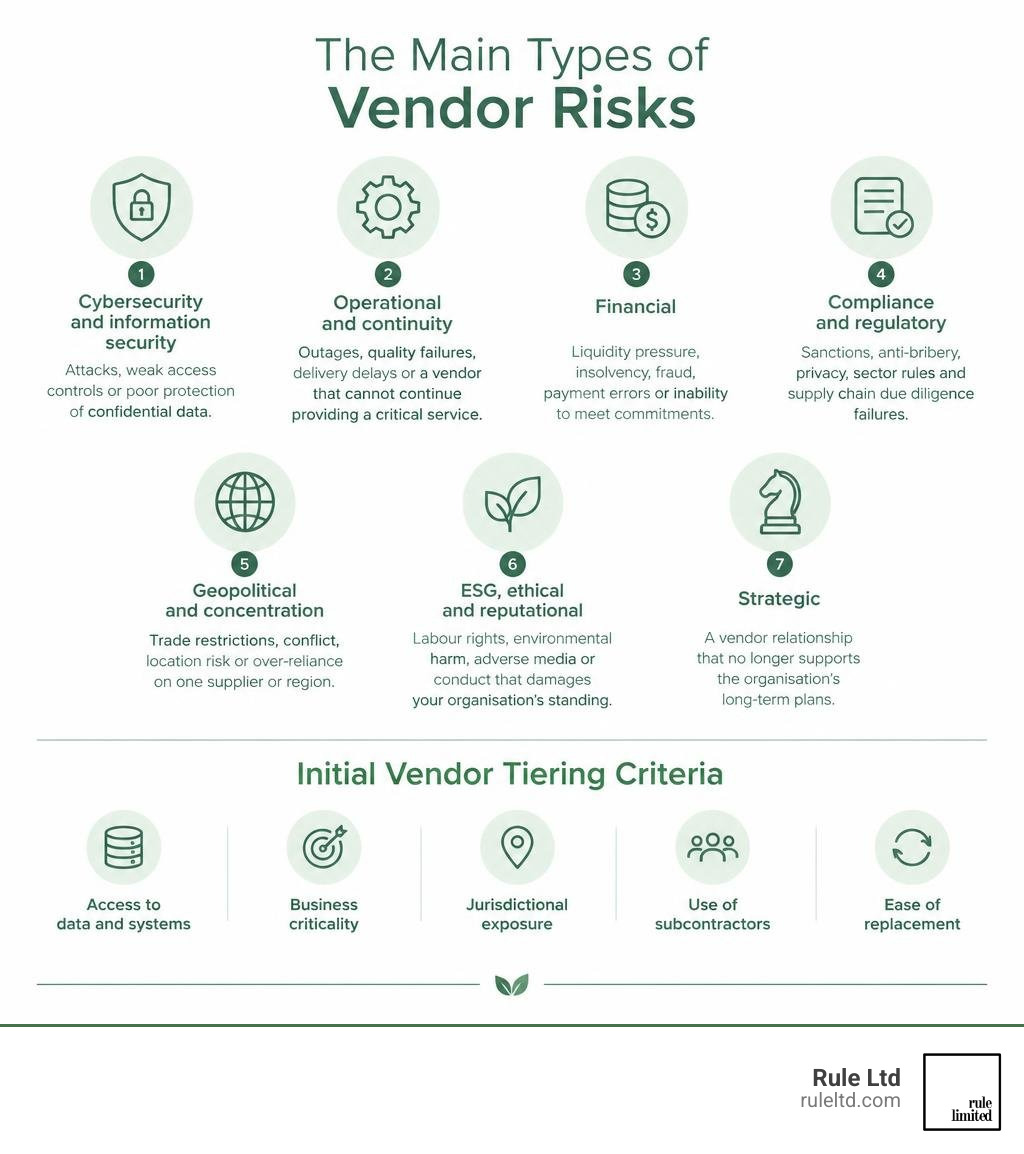
Managing enterprise counterparty exposure requires assessing seven distinct types of vendor risks across the procurement lifecycle:
- Cybersecurity and technical infrastructure: credential vulnerabilities, unpatched software architecture, and system intrusion liabilities.
- Operational and continuity: service delivery disruption, single points of failure, and inadequate disaster recovery runbooks.
- Financial and solvency: counterparty liquidity distress, balance-sheet degradation, and invoicing fiscal leakage.
- Compliance and cross-border regulatory: exposure under statutory regimes including sanctions ownership thresholds, anti-bribery statutes, and data protection mandates.
- Geopolitical and concentration: sovereign intervention, export restrictions, and jurisdictional chokepoints across supply networks.
- ESG, labour standards, and reputational contagion: forced labour exposure, environmental non-compliance, and adverse media exposure.
- Strategic alignment: counterparty structural drift and incompatibility with long-term enterprise governance.
For General Counsel and Chief Compliance Officers, third-party governance cannot remain a routine procurement exercise. Regulatory frameworks such as the EU Digital Operational Resilience Act enforce statutory obligations regarding ICT risk management, while sanctions enforcement and mandatory supply chain due diligence directly govern vendor relationships.
This article is general information, not legal advice. Legal and compliance questions should be assessed case by case, taking account of the relevant contract, facts, jurisdictions and regulatory duties.
Rule Ltd delivers human-led corporate intelligence and investigative due diligence across international jurisdictions, providing senior counsel with audit-ready evidence to evaluate counterparties, ultimate beneficial ownership, and regulatory exposure.
Enterprise Exposure Architecture in Extended Supply Chains

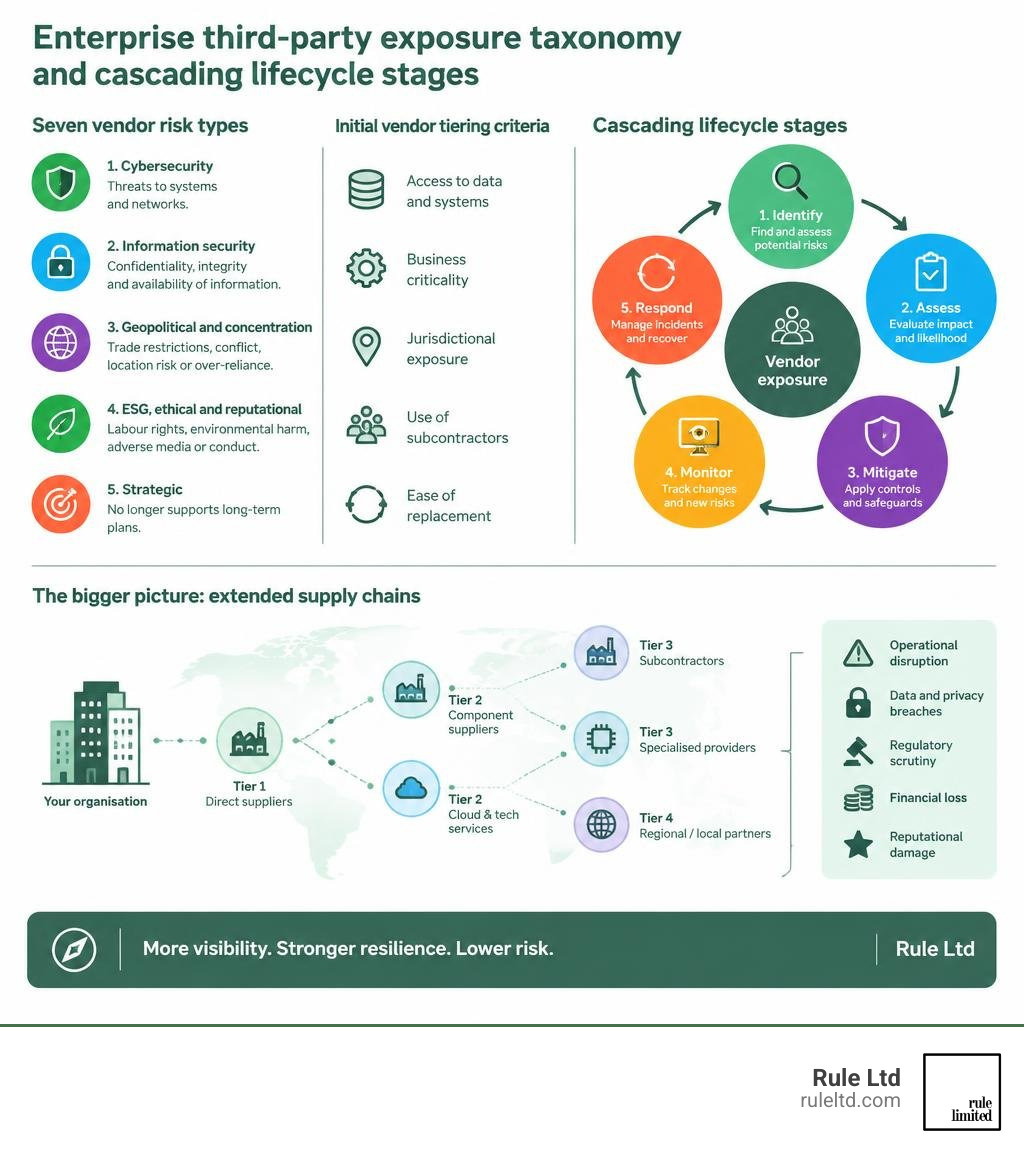
Modern corporate perimeters extend across distributed global supply chains, cloud infrastructure, and specialised professional services. When legal and compliance departments evaluate third-party dependencies, they routinely confront an operational reality where external entities execute core business processes. Operational resilience is no longer defined solely by internal controls; it depends on the security posture, regulatory fidelity, and solvency of entities operating across multiple tiers.
Cross-border enterprise data underscores the severity of this interconnectedness. A clear majority of global organisations experience third-party disruptions annually, with a substantial portion of critical operational halts originating within external service architectures. Widespread supply chain disruptions frequently trace back to systemic failures among external providers rather than internal control breakdowns.
The primary regulatory and operational blind spot lies beyond tier-one counterparties. While direct suppliers are subject to onboarding reviews, critical dependencies often cascade into fourth-party providers, including subcontractors, regional component fabricators, or proprietary software maintainers, where visibility drops dramatically. Without multi-tier intelligence, organisations remain vulnerable to systemic disruptions originating deep within their supply architecture.
Assessing Material Vendor Risk Across Enterprise Portfolios
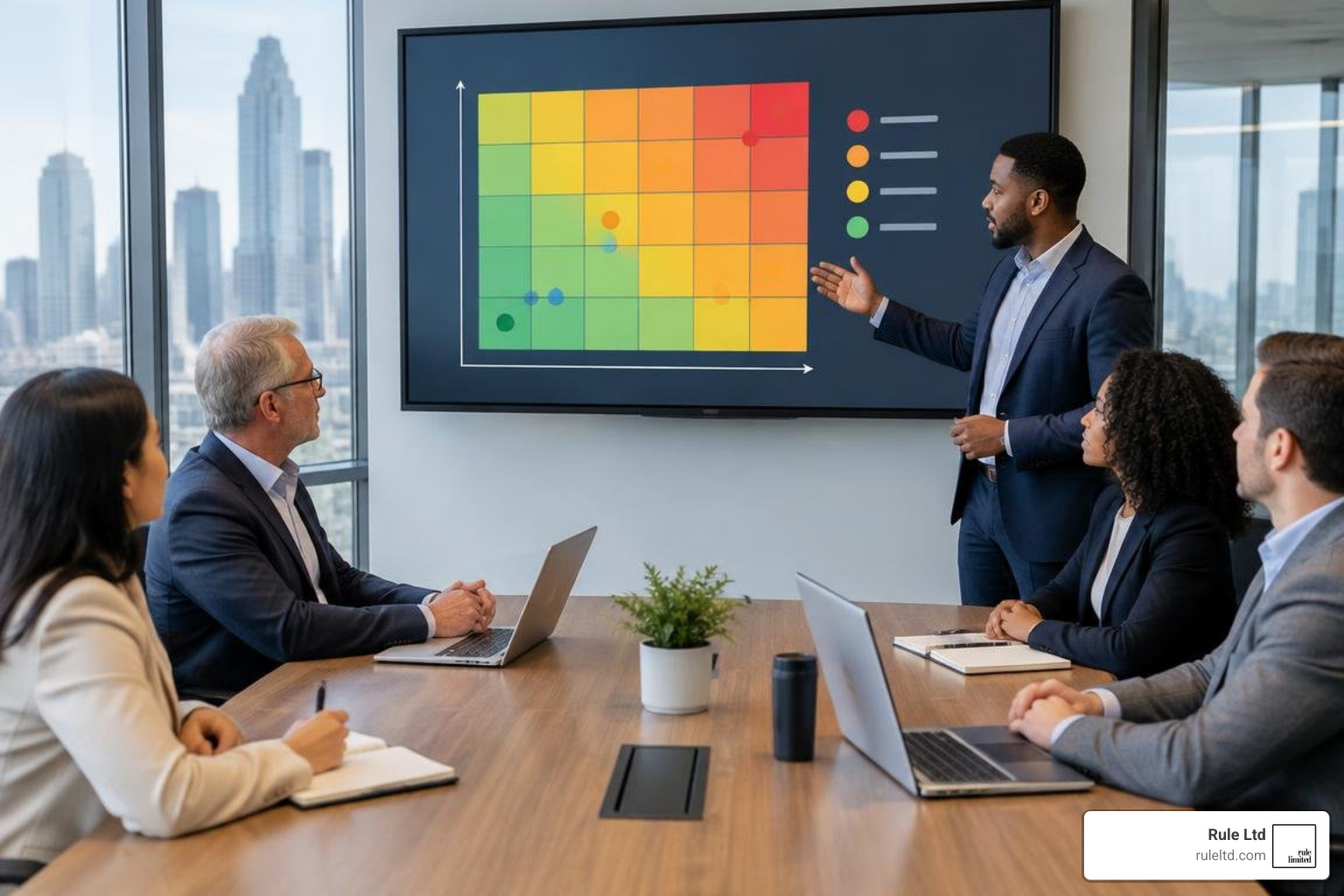
Managing an extensive counterparty portfolio requires an evidential taxonomy that separates nominal exposures from existential threats. Senior leadership cannot review every supplier with equal depth; enterprise risk frameworks must distinguish operational noise from severe compliance liabilities. Analysing vendor risk foundational dynamics enables legal teams to design proportional, defensible review protocols based on verified business impact.
Evaluating exposure demands a disciplined review of operational criticality, data integration, legal jurisdiction, and replacement friction. When conducting an enterprise third-party risk assessment, legal and compliance teams must classify counterparty liabilities into defined exposure domains.
Cybersecurity Versus Information Security Exposures
Enterprise risk assessments frequently conflate technical perimeter vulnerabilities with broader data governance exposure, creating substantial compliance blind spots. Technical assessments must scrutinise external defences against malware deployment, unauthorised access vectors, and credential compromise to prevent vendor cybersecurity breaches.
Concurrently, comprehensive information security oversight requires evidentiary verification of physical document management, internal employee access segregation, hardware sanitisation protocols, and cross-border data sovereignty compliance. A counterparty may exhibit robust perimeter firewalls while maintaining deficient physical access controls or non-compliant data disposal practices. Executing a rigorous third-party cybersecurity risk assessment must therefore be integrated with evidential audits of physical and organisational data governance.
Structural and Operational Types of Vendor Risks
Operational vulnerabilities emerge when counterparty workflow interruptions impact an organisation’s core delivery obligations. Critical risk drivers include unannounced platform migrations, logistics failures, inadequate switchover runbooks, and single-source dependencies. When a critical supplier experiences prolonged downtime, the commissioning firm bears immediate liability for contractual non-performance and downstream customer remediation.
These operational exposures escalate when organisations fail to enforce pre-negotiated service-level agreements and multi-supplier redundancy. Historical supply chain failures demonstrate that the absence of audited contingency architectures and rapid switchover mechanisms converts supplier-level operational distress into enterprise-wide disruption.
Financial Vulnerability and Counterparty Insolvency
Counterparty balance-sheet degradation creates immediate operational risk, including abrupt service abandonment, foreign asset freezes, and the termination of vital software maintenance. Structural deficiencies within accounts payable environments further expose organisations to billing anomalies, payment diversion schemes, and duplicate disbursements.
Procurement oversight requires forensic balance-sheet evaluation to protect operating capital. For example, the U.S. Department of Defense reported that its FY2025 payment recapture audit identified $1.369 billion in overpayments, successfully recovering $1.285 billion. Robust counterparty due diligence must examine cash-flow stability, working capital adequacy, credit downgrade indicators, and transaction verification mechanisms to detect financial insolvency before commercial collapse occurs.
Cross-Jurisdictional Regulatory and Compliance Types of Vendor Risks
Regulatory authorities enforce strict liability for compliance failures introduced through third-party intermediaries. An effective framework for sanctions risk management requires entity screening that pierces opaque, multi-jurisdictional ownership structures.
A frequent compliance failure involves indirect equity aggregation under the OFAC 50% rule and UK OFSI ownership-and-control guidance. If designated persons hold an aggregate interest of 50% or more in an entity, that entity is blocked by operation of law, regardless of whether it is explicitly named on sanctions lists.
Furthermore, anti-corruption enforcement under the UK Bribery Act 2010 and the US Foreign Corrupt Practices Act (FCPA) mandates verifiable ABAC due diligence compliance across commercial agents, distributors, and intermediaries. In financial services, the EU Digital Operational Resilience Act (DORA) imposes rigorous contractual oversight and operational testing requirements on critical ICT vendors. Implementing proactive vendor compliance monitoring ensures that corporate restructurings and ownership changes do not create statutory liabilities.
Geopolitical and Single-Point Concentration Liabilities
Geopolitical friction, trade sanctions, sovereign interventions, and sudden regulatory realignments introduce acute supply uncertainty. Compliance teams must scrutinise critical geopolitical risk red flags, including exposure to capital controls, sovereign asset seizures, and contested jurisdictions.
Geographic concentration risk materialises when independent suppliers rely on identical logistics chokepoints, shared power infrastructure, or concentrated municipal jurisdictions. Deploying specialised vendor risk assessment geopolitical screening uncovers concealed geographic interdependencies, allowing legal teams to mandate operational distribution and cross-regional redundancy.
ESG, Labour Governance, and Reputational Contagion
Supply chain accountability has transitioned from discretionary reporting into enforceable statutory obligations. Regulatory frameworks, including Section 54 of the UK Modern Slavery Act 2015, the US Uyghur Forced Labor Prevention Act (UFLPA), and the German Supply Chain Due Diligence Act (Lieferkettensorgfaltspflichtengesetz – LkSG), establish mandatory due diligence standards across multi-tier networks.
Counterparty labour non-compliance or environmental violations trigger immediate ESG reputational risk, resulting in border import detentions, substantial administrative fines, and severe brand equity erosion. Establishing defensible third-party reputational risk management requires independent, evidence-based investigations into supplier operating records rather than reliance on self-certified corporate codes of conduct.
Cascading Impacts and Multi-Risk Convergence Models
Vendor vulnerabilities rarely operate in isolation. A vulnerability in one domain typically triggers a cascade across operational, financial, legal, and reputational lines. When an initial control failure occurs, the total business impact depends on systemic dependencies and the speed of organisational response.
The following matrix illustrates how primary third-party failures expand into multi-domain enterprise impacts:
| Primary Vendor Incident | Immediate Operational Consequence | Secondary Financial & Compliance Impact | Long-Term Reputational Exposure |
|---|---|---|---|
| Critical SaaS Ransomware Infiltration | Complete access suspension; business process halt | Average data breach cost reaching $4.88 million; potential DORA or GDPR statutory fines | Loss of client trust; public adverse media coverage; equity valuation impact |
| Tier-2 Component Manufacturer Insolvency | Production line stoppage; unfulfilled customer orders | Revenue loss; breach of downstream client contracts; expensive spot-sourcing premiums | Brand perception damage; loss of commercial market share |
| Offshore Subcontractor Labour Violation | Customs border impoundment under UFLPA enforcement | Substantial regulatory penalties under German LkSG; legal defence expenses | Severe consumer boycotts; divestment by institutional ESG funds |
| Intermediary Bribery in Foreign Licensing | Suspension of local operating licences and concessions | Criminal investigation under UK Bribery Act / FCPA; major legal defence costs | Long-term commercial debarment from public tenders |
Understanding risk convergence allows general counsel and chief compliance officers to avoid treating vendor evaluation as a siloed exercise, supporting unified oversight across procurement, legal, and risk teams.
Defensible Risk Treatment: Avoidance, Mitigation, Transfer, and Acceptance
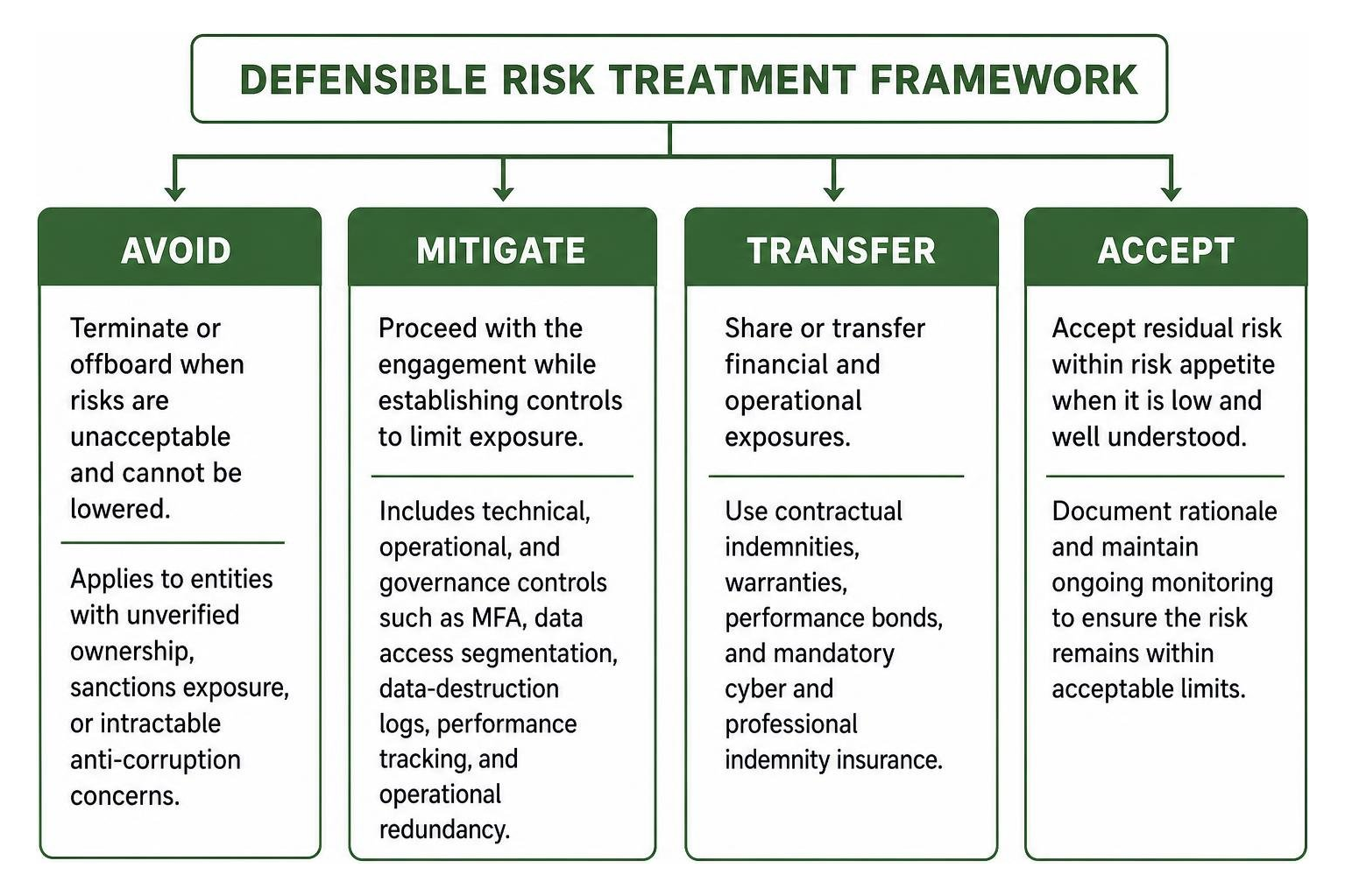
Following comprehensive exposure evaluation, General Counsel and Chief Compliance Officers must establish defensible risk treatment protocols aligned with enterprise risk tolerance, regulatory mandates, and governance standards:
- Risk Avoidance Protocols: Enforced when counterparty screening reveals fatal compliance defects, such as unverified ultimate beneficial ownership, designated entity control under the OFAC 50% rule, or unmitigated anti-corruption red flags. The defensible governance action requires immediate onboarding termination or formal contract offboarding.
- Compensating Control Mitigation: Implemented when proceeding with engagements subject to mandatory technical, legal, and operational safeguards. Defensible controls include audited logical data segregation, mandatory multi-factor authentication, verified media-destruction records, and strict contractual service-level benchmarks.
- Contractual and Financial Transfer: Allocating legal and financial liabilities through comprehensive indemnification provisions, express representations and warranties, performance guarantees, and mandatory cyber and professional liability insurance coverage.
- Documented Executive Risk Acceptance: Formal retention of residual risk within pre-established corporate risk appetite limits. Evidentiary defensibility requires documented executive authorisation, comprehensive risk-benefit analyses, and mandatory periodic audit schedules.
Pre-Contract Due Diligence and Tiered Lifecycle Surveillance
Relying on self-administered questionnaires creates critical compliance blind spots. Standard spreadsheets and self-declarations frequently conceal multi-tiered vulnerabilities, undisclosed changes in ownership, and informal subcontracting arrangements.
Defensible risk management requires deep enhanced due diligence before contract execution. This process demands definitive ultimate beneficial owner verification to pierce opaque multi-jurisdictional holding structures, identify shadow directors, and confirm compliance with sanctions ownership thresholds.
Concurrently, compliance teams must perform exhaustive PEP identification and classification to locate politically exposed persons, evaluate state-owned enterprise affiliations, and uncover hidden conflicts of interest.
Following onboarding, static point-in-time reviews must be supplemented by dynamic surveillance. Establishing real-time monitoring alerts enables organisations to track corporate restructurings, adverse media, litigation filings, and sanctions updates as they occur, ensuring that counterparty risk profiles reflect current operating realities.
Frequently Asked Questions About Vendor Exposure Management
How do enterprise legal teams distinguish cybersecurity from information security in vendor reviews?
Legal and compliance teams evaluate cybersecurity as the technical defence of systems, networks, and digital perimeters against external intrusions, ransomware, and unauthorised access. Information security represents a broader discipline governing the lifecycle confidentiality, integrity, and availability of all data assets. It encompasses physical security, employee access segregation, cross-border data sovereignty, and audited media destruction.
What criteria govern the allocation of vendor risk treatments across critical third parties?
Risk treatment allocations are guided by counterparty criticality tiering, data sensitivity, operational replaceability, and regulatory impact. When risks fall outside defined risk appetite, organisations apply risk avoidance. Where exposures can be managed, they introduce compensating operational controls. Financial risks are addressed via contractual indemnification and insurance coverage, while acceptable residual risks require documented executive authorisation.
How should compliance officers address hidden multi-tier supply chain concentration?
Compliance officers address hidden multi-tier exposure by expanding due diligence beyond tier-one suppliers to map critical fourth-party dependencies, key component fabricators, and regional utilities. Leveraging corporate intelligence, OSINT investigations, and supply chain tracing uncovers hidden single points of failure, enabling firms to mandate multi-sourcing and establish operational redundancy.
Establishing Defensible Third-Party Oversight
Managing third-party risk requires moving beyond administrative questionnaires toward rigorous, evidential due diligence. Relying on superficial self-certifications leaves organisations exposed to regulatory enforcement, operational disruptions, and severe reputational damage. Defensible risk governance demands verified facts, corporate transparency, and continuous intelligence.
Rule Ltd provides human-led corporate intelligence and risk management solutions designed to resolve complex cross-jurisdictional challenges. Our investigative analysts operate across global jurisdictions and languages, delivering detailed, audit-ready evidence that eliminates false positives and identifies hidden liabilities.
We deliver fixed-price, cost-certain reports with guaranteed turnaround times: standard screening reports are completed within two to three working days, while complex enhanced due diligence and corporate intelligence investigations are delivered in approximately five working days.
To review an existing supplier portfolio or assess a critical prospective counterparty, request a structured Third-Party Due Diligence investigation from Rule Ltd.
Footnoted Regulatory Authorities and Standards
- U.S. Department of the Treasury, Office of Foreign Assets Control (OFAC), Revised Guidance on Entities Owned by Persons Whose Property and Interests in Property Are Blocked (the “OFAC 50% Rule”).
- UK Office of Financial Sanctions Implementation (OFSI), Monetary Penalties Guidance and ownership-and-control guidance under the Sanctions and Anti-Money Laundering Act 2018.
- Financial Action Task Force (FATF), International Standards on Combating Money Laundering and the Financing of Terrorism & Proliferation (as updated).
- Regulation (EU) 2022/2554 on digital operational resilience for the financial sector (DORA).
- U.S. Foreign Corrupt Practices Act of 1977, 15 U.S.C. §§ 78dd-1 et seq.
- UK Bribery Act 2010, c. 23.
- UK Modern Slavery Act 2015, s. 54 (Transparency in supply chains).
- Uyghur Forced Labor Prevention Act (UFLPA), Pub. L. No. 117-78, 135 Stat. 1525 (2021).
- German Supply Chain Due Diligence Act (Lieferkettensorgfaltspflichtengesetz – LkSG), BGBl. I 2021, 2959.
- U.S. Department of Defense, FY2025 payment recapture audit reporting.
This article is general information, not legal advice. Legal and compliance questions should be assessed case by case, taking account of the relevant contract, facts, jurisdictions and regulatory duties.