
Start Compliance Risk Mapping With a Clear View of Regulatory Gaps
Compliance risk mapping establishes a defensible evidentiary architecture linking statutory duties, operational activities, and control mechanisms across cross-border operations. Rather than relying on superficial administrative policies, effective programmes trace statutory exposure across complex corporate structures, operating jurisdictions, and third-party networks to pinpoint where operational failure can generate severe statutory liability.
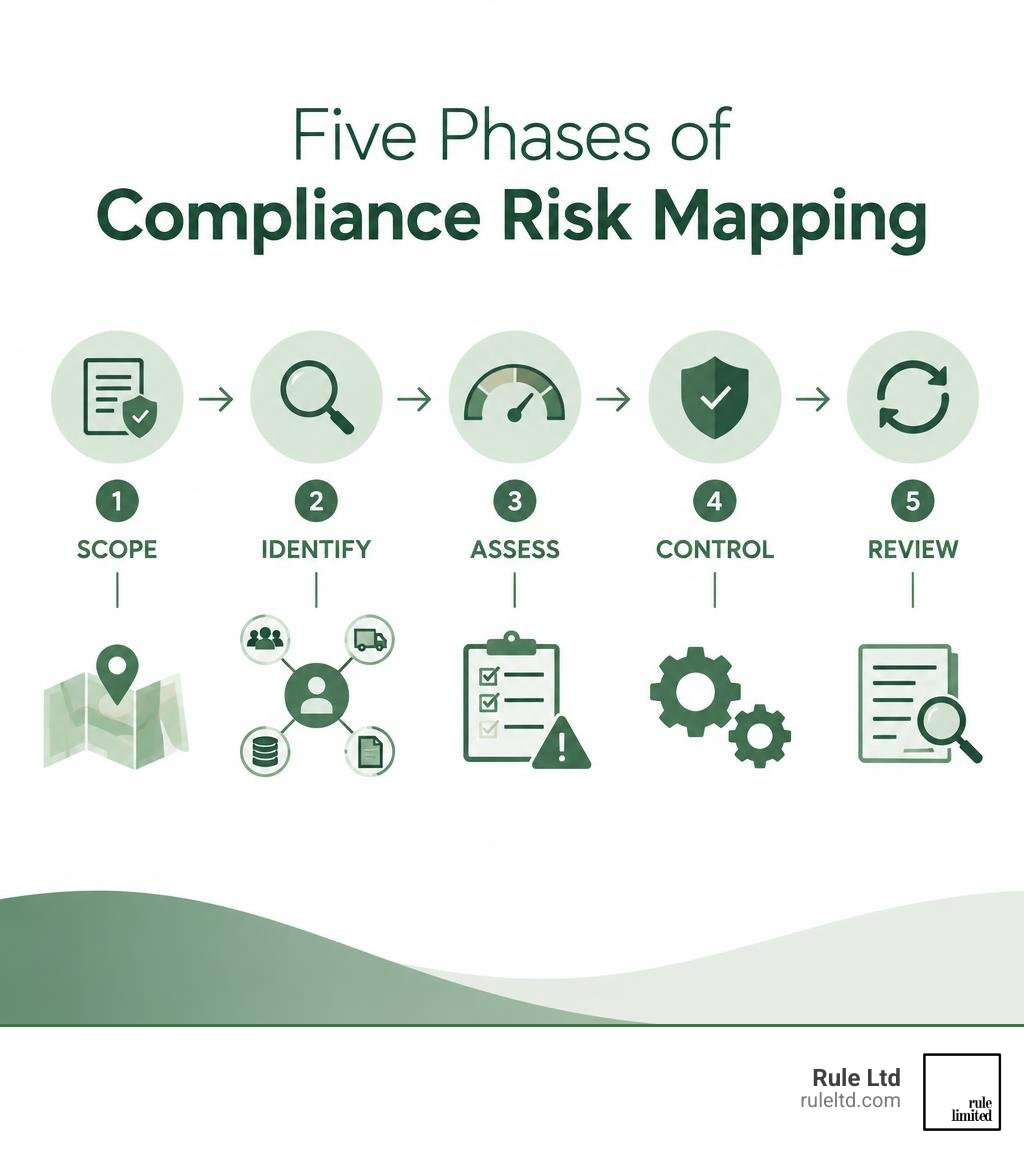
Institutional compliance risk mapping evaluates exposure through five core dimensions:
- Scoping statutory mandates across operating entities and cross-border commercial corridors.
- Pinpointing high-liability operational touchpoints, including intermediaries, distributors, and offshore data transfers.
- Calibrating inherent risk across jurisdictional corruption indices, enforcement trends, and liability velocity.
- Empirically testing control efficacy rather than assuming policy adherence.
- Documenting residual exposure, remediation actions, and oversight triggers within an enterprise risk register.
The resulting risk map provides contemporaneous proof for boards and enforcement authorities that the organisation actively challenges its control framework and remediates material vulnerabilities. Specific compliance conclusions require case-by-case assessment, particularly where obligations vary across jurisdictions or depend on facts that are not visible from internal records alone.
Rule Ltd supports compliance teams in making third-party exposure and ownership concerns clear enough to withstand regulatory scrutiny.
Institutional Risk Architecture and Cross-Border Regulatory Exposure
Constructing a defensible risk architecture requires mapping statutory contact points across operating units to expose operational vulnerabilities before supervisory authorities intervene. Isolated policy reviews fail to capture multi-jurisdictional liabilities that emerge when legal duties interact with commercial pressures.
International standards, including ISO 37301 [1] and the COSO Enterprise Risk Management framework [2], establish that effective governance demands systematic exposure identification. Without an operationalised taxonomy, compliance oversight fragments across business units. Authoritative frameworks such as How To Build A Compliance Risk Assessment: Framework, Template, And Examples demonstrate that establishing defensibility requires evaluating regulatory exposure against practical controls rather than relying on assumed compliance.
Strategic Objectives of Defensible Risk Architecture
The commercial imperative of risk mapping extends beyond passing regulatory audits. It aligns institutional risk appetite with practical capital allocation and investigative priorities. Cross-border commercial enterprises encounter divergent statutory mandates; mapping these boundaries allows compliance leaders to allocate investigative resources where vulnerability is acute. Establishing rigorous corporate due diligence standards ensures that supervisory boards receive factual assurance regarding statutory exposure rather than superficial administrative affirmations.
Core Risk Categories: From Anti-Bribery to Sanctions Exposure
An enterprise risk inventory must encompass distinct, high-liability categories:
- Anti-Bribery and Corruption: Mandates under the US Foreign Corrupt Practices Act (FCPA) [3] and the UK Bribery Act 2010 [4] penalise improper inducements and require adequate prevention procedures.
- Sanctions and Trade Controls: Strict liability regimes administered by the US Department of the Treasury’s Office of Foreign Assets Control (OFAC) [5] and the UK Office of Financial Sanctions Implementation (OFSI) penalise direct and indirect dealings with sanctioned targets. This includes navigating the OFAC 50 Percent Rule and complex corporate structures.
- Anti-Money Laundering (AML) and Counter-Terrorist Financing: Guidelines established by the Financial Action Task Force (FATF) [6] require transparent beneficial ownership verification.
- Data Privacy and Governance: Cross-border frameworks such as the EU General Data Protection Regulation (GDPR) [7] impose statutory penalties for unlawful processing and data transfers.
Where external partnerships touch higher-risk sectors or opaque jurisdictions, integrating robust enhanced due diligence protocols becomes essential to uncover hidden politically exposed persons (PEPs) or state affiliations.
Methodological Rigour in Compliance Risk Quantification

Executing an institutional compliance risk map requires a structured methodology to convert abstract legal statutes into verifiable operational controls. Aligning statutory exposure across operational units mirrors advanced supply chain risk mapping, exposing hidden vulnerabilities within complex procurement, distribution, and cross-border commercial networks.
Regulatory Universe Scoping and Subsidiary Boundary Traps
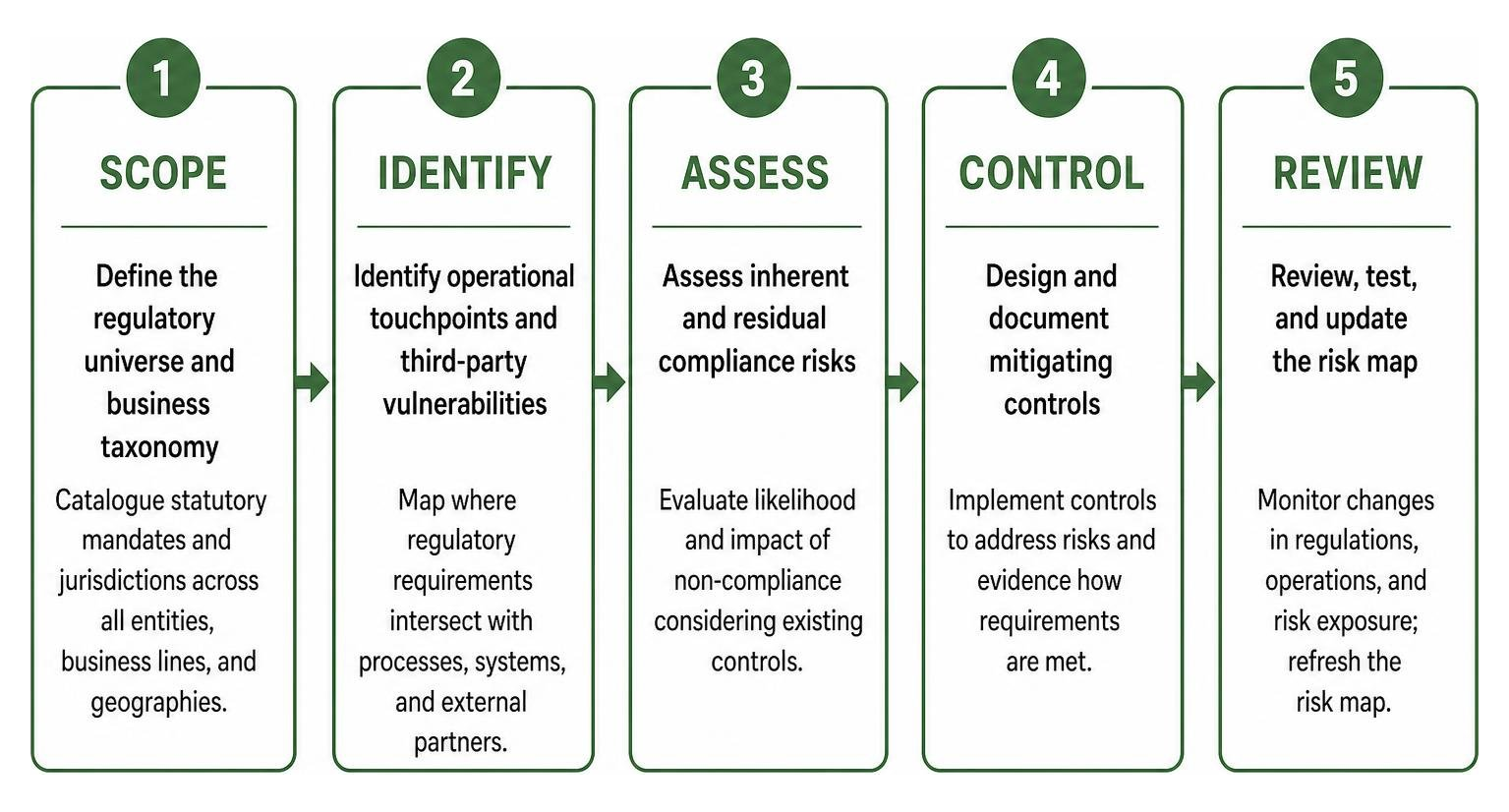
A robust taxonomy catalogues all statutory mandates, licensing parameters, and administrative rules governing every operating subsidiary, business line, and geographic jurisdiction. Compliance teams frequently stumble by constructing this inventory from institutional memory rather than legal registers and primary statutory sources. Incorporating comprehensive corporate due diligence into this foundational stage ensures that newly acquired entities, joint ventures, and off-balance-sheet vehicles are integrated into the governance architecture.
Intermediary Exposure and Transactional Vulnerability Analysis
Legal obligations manifest as operational risk through transactional touchpoints: customs clearances, tender submissions, distributor networks, local agent interactions, and international data sharing. Intermediaries represent an acute exposure point. Organisations must conduct systematic third-party risk assessment workflows to identify vulnerabilities where agents act on the company’s behalf. Evaluating high-risk touchpoints using structured third-party risk checklists isolates intermediaries whose ownership structures or commercial incentives increase non-compliance exposure.
Calibrating Likelihood, Impact, and Liability Velocity
Risk scoring is only useful where it distinguishes genuine enforcement trajectories from generic administrative categorisation. Practitioners should weight likelihood against jurisdictional enforcement patterns and transaction frequency rather than static corruption indices alone, and weight impact against realistic exposure including debarment and operational disruption rather than headline fines. A further, often overlooked, dimension is liability velocity: the speed at which an operational failure escalates into severe regulatory consequence. Sanctions breaches and cyber intrusions carry high velocity and demand pre-agreed containment protocols, whereas some data governance failures allow a longer remediation window before regulatory attention intensifies. Treating all risk categories as equally time-sensitive is a common source of misallocated resource.
Empirical Control Testing and Residual Risk Calculation
Inherent risk scoring reflects raw exposure in the absence of mitigation. To establish true residual risk, compliance teams must evaluate control adequacy across design, implementation, and operational testing, drawing on structures such as those illustrated in the Compliance Risk Assessment Matrix | Free PDF & Word Template.
| Risk ID | Compliance Domain | Inherent Risk (L × I) | Existing Control Mechanism | Control Effectiveness Rating | Residual Risk Score | Priority Tier |
|---|---|---|---|---|---|---|
| CR-01 | OFAC / OFSI Sanctions | 20 (Likelihood: 4, Impact: 5) | Automated screening against watchlists | Partially Effective (30% reduction) | 14.0 | Tier 1 (Critical) |
| CR-02 | UK Bribery Act / Intermediaries | 16 (Likelihood: 4, Impact: 4) | Annual written certifications | Ineffective (10% reduction) | 14.4 | Tier 1 (Critical) |
| CR-03 | EU GDPR Cross-Border Data | 12 (Likelihood: 3, Impact: 4) | Standard Contractual Clauses & audits | Effective (60% reduction) | 4.8 | Tier 3 (Moderate) |
| CR-04 | AML Beneficial Ownership | 15 (Likelihood: 3, Impact: 5) | Baseline corporate registry checks | Ineffective (15% reduction) | 12.75 | Tier 2 (High) |
A control that exists merely as written policy provides negligible mitigation. Only controls validated through active testing, ideally including adversarial or sample-based review, reduce inherent exposure in a manner defensible to enforcement authorities.
Prioritising and Remediating Regulatory Gaps

Plotting residual risk scores on an enterprise heat map isolates systemic vulnerabilities and forces a disciplined choice between treating, terminating, transferring, or formally tolerating each exposure. In practice, this discipline is where many programmes falter: risk owners default to “treat” even where an arrangement sits well outside institutional risk appetite, or they assume contractual indemnities transfer regulatory liability when, in reality, statutory liability generally remains with the regulated entity regardless of private contractual arrangements.
Structuring a Multi-Tier Remediation Plan
Action plans require named accountability, finite execution timeframes, and measurable completion criteria. Applying rigorous vendor due diligence checklists ensures remediation addresses underlying operational root causes, such as unverified sub-contractors or ambiguous beneficial owners, rather than applying superficial administrative fixes. Where a remediation plan tolerates residual exposure, that decision should be documented with the same rigour as a treatment plan, since regulators scrutinise unexplained tolerance decisions as closely as untreated gaps.
Balancing Technology with Human Investigative Analysis
Automated governance tools provide valuable screening capabilities and regulatory change tracking across vast data volumes. However, software algorithms often generate false-positive fatigue and miss nuanced exposure indicators, such as circular corporate holdings, informal political relationships, and indirect sanctions evasion.
Our approach at Rule Ltd balances automated technology with deep qualitative investigation. Our reports are produced by experienced human analysts rather than automated algorithms, delivering defensible corporate intelligence that withstands regulatory scrutiny. When higher-risk transactions or suspicious intermediaries are identified during risk mapping, deploying specialised corporate intelligence investigations reveals critical on-the-ground facts that software cannot detect. We provide fixed-price, cost-certain reports with fast turnaround times; routine screening reports are delivered in two to three working days, while corporate intelligence and enhanced due diligence reviews are completed in approximately five working days, with pricing quoted prior to commencing work.
Governance, Review Cadence, and Avoiding Common Pitfalls
Under the US Department of Justice Evaluation of Corporate Compliance Programmes [8], regulatory authorities evaluate whether compliance management systems are dynamic and well-resourced. A static assessment conducted once and shelved fails regulatory standards of reasonable diligence.
Maintaining Dynamic Compliance Risk Mapping Programmes
Institutional risk registers require systematic updating cadences:
- Periodic Comprehensive Review: A full re-evaluation conducted annually across all operating units.
- Material Event Triggers: Immediate mapping revisions following mergers and acquisitions, expansion into unfamiliar jurisdictions, product launches, or notable corporate restructuring.
- Regulatory Change Triggers: Updates initiated when supervisory bodies introduce new statutory obligations.
Integrating continuous risk management insights into regular board reporting ensures that executive committees and non-executive directors maintain visibility over evolving operational liabilities.
Critical Pitfalls to Avoid in Risk Assessment
- Building Inventories from Memory: Omitting obscure subsidiaries, supply chain tiers, or local administrative rules.
- Confusing Policy with Operational Effectiveness: Assuming that a code of conduct guarantees compliance without empirical testing.
- Unchallenged Self-Assessments: Allowing operating units to score their own risk profiles without independent compliance review.
- Isolating Findings from Monitoring: Failing to link identified gaps directly to internal audit programmes and investigative workflows.
Practitioner Considerations in Compliance Risk Mapping Governance
Calibrating review cadence against enforcement velocity
Annual comprehensive review remains a baseline expectation, but sophisticated programmes calibrate additional review triggers to enforcement velocity within specific domains. Sanctions and export control exposure warrants near-continuous monitoring given the pace at which designations and licence conditions change, whereas data governance risk may tolerate a longer review interval absent a material incident. Off-cycle reviews should be triggered by cross-border mergers, entry into higher-risk emerging markets, material supply chain restructuring, or statutory amendments in operating jurisdictions.
Ownership and accountability across the three lines of defence
Effective risk mapping depends on tension between business unit leaders, who understand practical operational workflows, and independent compliance and internal audit functions, who must challenge self-reported risk scores rather than accept them uncritically. The Chief Compliance Officer and General Counsel typically direct the exercise, but findings should reach the Board Audit Committee in a form that distinguishes inherent exposure from residual exposure and clearly flags where control testing has not yet validated a stated mitigation.
Evidential value under regulatory scrutiny
A thoroughly documented, regularly tested risk map provides contemporaneous evidence that an organisation systematically identifies, scores, and remediates its legal vulnerabilities, which is a factor enforcement authorities weigh when assessing the adequacy of a compliance programme. The evidential weight of that documentation depends on demonstrating genuine control testing rather than static self-certification, and on showing that tolerance decisions were made deliberately rather than by omission. Specific compliance conclusions still require case-by-case assessment, particularly where statutory obligations diverge across jurisdictions.
Conclusion
Systematic compliance risk mapping transforms complex statutory burdens into defensible, prioritised operational controls. By linking real-world touchpoints to validated safeguards, organisations protect their commercial standing and navigate international markets with confidence. When addressing complex counterparty exposures, opaque ownership structures, or high-risk jurisdictions, our analyst-led third-party due diligence solutions deliver the evidence-based clarity required to satisfy international regulators. Specific compliance matters require case-by-case assessment to ensure proportional, defensible outcomes.
Sources and Footnotes
[1] International Organization for Standardization, ISO 37301:2021, Compliance management systems — Requirements with guidance for use.
[2] Committee of Sponsoring Organizations of the Treadway Commission, Enterprise Risk Management—Integrating with Strategy and Performance.
[3] U.S. Department of Justice and U.S. Securities and Exchange Commission, A Resource Guide to the U.S. Foreign Corrupt Practices Act, current edition.
[4] UK Bribery Act 2010, legislation.gov.uk.
[5] U.S. Department of the Treasury, Office of Foreign Assets Control, Sanctions Programs and Information.
[6] Financial Action Task Force, The FATF Recommendations: International Standards on Combating Money Laundering and the Financing of Terrorism & Proliferation.
[7] Regulation (EU) 2016/679, General Data Protection Regulation, EUR-Lex.
[8] U.S. Department of Justice, Criminal Division, Evaluation of Corporate Compliance Programs.
[9] Rule Ltd, “What Is Corporate Due Diligence and When Do You Need It?” https://ruleltd.com/what-is-corporate-due-diligence-and-when-do-you-need-it/
[10] Risk Publishing, “How To Build A Compliance Risk Assessment: Framework, Template, And Examples.” https://riskpublishing.com/how-to-build-a-compliance-risk-assessment-frame/
[11] Rule Ltd, “Enhanced Due Diligence.” https://ruleltd.com/enhanced-due-diligence/
[12] Rule Ltd, “Risk Mapping, Scenario Planning and Supply Chains.” https://ruleltd.com/risk-mapping-scenario-planning-supply-chains/
[13] Rule Ltd, “Corporate Due Diligence.” https://ruleltd.com/corporate-due-diligence/
[14] Rule Ltd, “Third-Party Risk Assessment.” https://ruleltd.com/third-party-risk-assessment/
[15] Rule Ltd, “Third-Party Risk Assessment Checklist.” https://ruleltd.com/third-party-risk-assessment-checklist/
[16] Ezel AI, “Compliance Risk Assessment Matrix | Free PDF & Word Template.” https://ezel.ai/templates/compliance-risk-assessment-matrix
[17] Rule Ltd, “Corporate Due Diligence Checklist for Vendors and Partners.” https://ruleltd.com/corporate-due-diligence-checklist-for-vendors-and-partners/
[18] Rule Ltd, “Corporate Intelligence Investigation Services.” https://ruleltd.com/corporate-intelligence-investigation-services/
[19] Rule Ltd, “Risk Management Insights.” https://ruleltd.com/category/articles/risk-management/
[20] Rule Ltd, “Third-Party Due Diligence Solutions.” https://ruleltd.com/third-party-due-diligence/