
The Shifting Architecture of Cross-Border Regulatory Enforcement Actions
Multinational corporations operate under overlapping enforcement regimes where single control failures trigger parallel proceedings across multiple authorities. Coordinated investigations between the United States Department of Justice (DOJ), the UK Serious Fraud Office (SFO), European authorities such as France’s Parquet National Financier (PNF), and Asian regulators including Singapore’s Corrupt Practices Investigation Bureau (CPIB) and Hong Kong’s Securities and Futures Commission (SFC) represent established cross-border practice. Extraterritorial statutory reach, mutual legal assistance treaties, and multilateral information sharing have removed the operational jurisdictional barriers that multinational groups once relied upon.
Consumer protection, antitrust, and market conduct regulators also pursue high-value cross-border actions targeting commercial deception and pricing structures. For instance, the Federal Trade Commission (FTC), alongside state attorneys general, secured a historic $225 million settlement from multilevel marketing operator Amway over deceptive business practices and earnings representations. Cross-border enforcement extends beyond core financial crime to encompass systemic governance misrepresentations within global supply chains and commercial operational models.
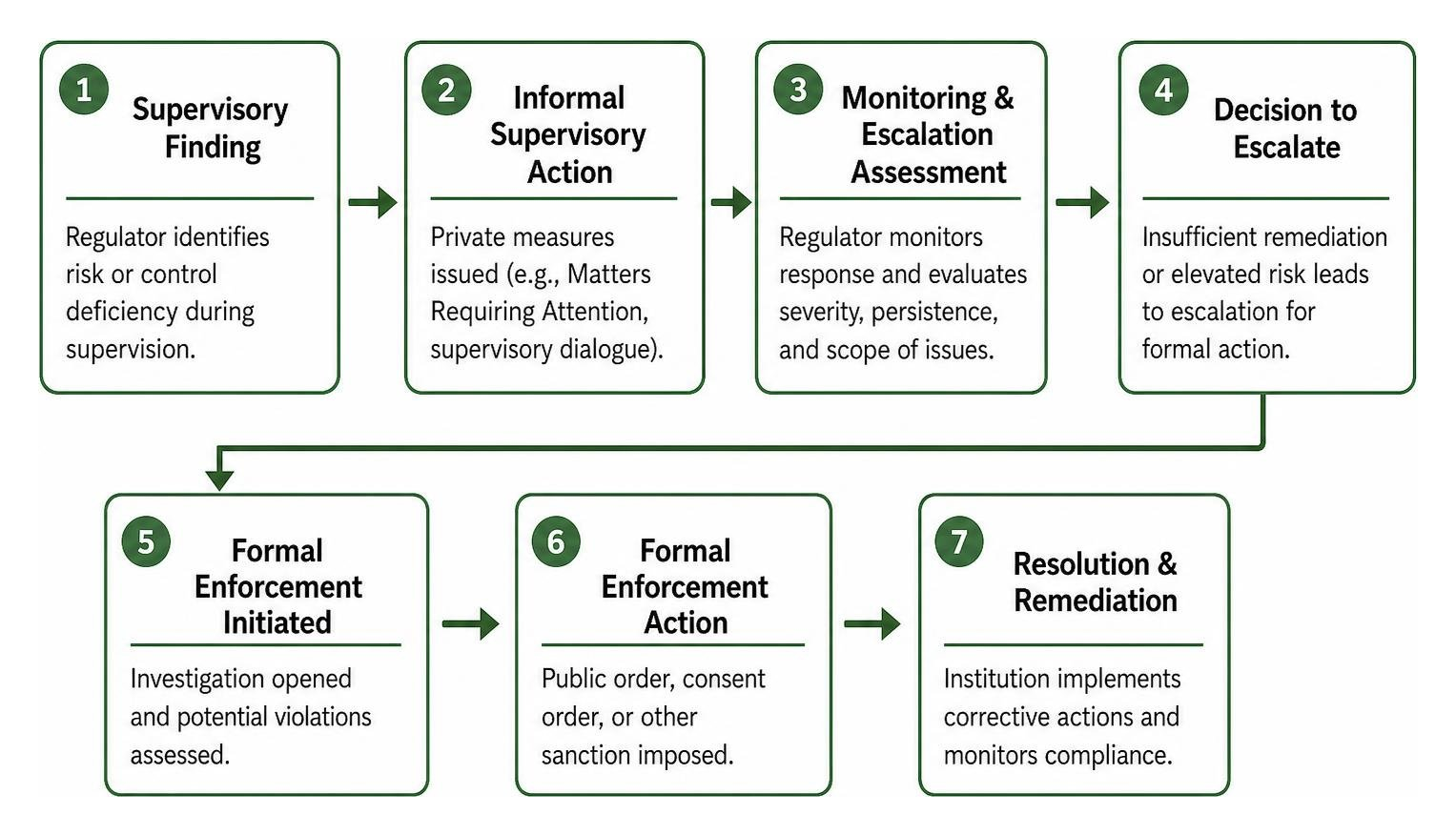
Supervisory Deliberation Versus Formal Sanctions Under Bank Regulators
Within banking and prudential regulation, distinguishing between private supervisory measures and formal enforcement actions shapes corporate risk profiles. Prudential authorities such as the Federal Reserve, the European Central Bank (ECB) Single Supervisory Mechanism, and the UK Prudential Regulation Authority (PRA) rely heavily on confidential supervisory mechanisms, including formal supervisory decisions, operational requirements, and private remediation notices, prior to or alongside escalating to public civil money penalties or statutory orders.
This reliance on private supervisory dialogue can obscure systemic governance lapses from counterparties and the broader market. When institutions and commercial counterparties transact with opaque third parties, standard supervisory dialogue without public transparency can delay necessary risk remediation. Senior legal leaders managing regulated exposures must conduct rigorous enhanced due diligence for high-risk entities rather than assuming clean public supervisory records indicate an absence of underlying operational vulnerabilities.
How Multi-Jurisdictional Exposure Amplifies Corporate Due Diligence Failures
A single compliance vulnerability within a local subsidiary or commercial intermediary can cross borders swiftly, creating multi-jurisdictional liabilities. In healthcare and public procurement, corporate integrity failures frequently result in massive cross-agency False Claims Act settlements. For example, Abbott agreed to pay over $384 million to settle allegations related to contaminated infant formula after manufacturing facilities concealed unsanitary production conditions, structural water ingress, and microbial risks.
In the United Kingdom, statutory standards for corporate liability shifted under the Economic Crime and Corporate Transparency Act 2023 (ECCTA 2023), specifically the corporate failure-to-prevent-fraud offence in force from 2025. Under this regime, large commercial organisations face direct criminal liability if an associated person commits a specified fraud offence intending to benefit the business, unless the enterprise proves it had reasonable prevention procedures in place. Mitigating these systemic vulnerabilities across European, Asian, and Anglo-American operations requires human-led investigative depth and thorough corporate due diligence that validates operational reality rather than relying on checklist certifications.
Third-Party Networks and Supply Chain Liability in 2026

Modern enforcement frameworks hold parent companies accountable for third-party conduct, commercial intermediaries, and extended supply chains under specific statutory mechanisms. In Germany, the Supply Chain Due Diligence Act (Lieferkettensorgfaltspflichtengesetz, or LkSG), enforced by the Federal Office for Economic Affairs and Export Control (BAFA), establishes human rights and environmental due diligence duties across an enterprise’s own operations and its direct suppliers, extending to indirect suppliers when substantiated knowledge of potential violations arises. In contrast, the United States Uyghur Forced Labor Prevention Act (UFLPA) operates through an evidentiary rebuttable presumption, where goods mined, produced, or manufactured wholly or in part in the Xinjiang Uyghur Autonomous Region are presumed inadmissible at customs unless clear and convincing evidence demonstrates the absence of forced labour.
Across the Asia-Pacific region, statutory bodies enforce rigorous third-party oversight: the Monetary Authority of Singapore (MAS) mandates detailed counterparty and intermediary scrutiny under its anti-money laundering notices, while Hong Kong’s Independent Commission Against Corruption (ICAC) enforces the Prevention of Bribery Ordinance and the Securities and Futures Commission (SFC) enforces intermediary conduct rules under the Securities and Futures Ordinance. In this demanding regulatory environment, basic database screening fails to uncover deliberate evasion tactics. Layered corporate structures, offshore vehicles, and nominee arrangements frequently conceal prohibited affiliations, state links, or illicit sourcing channels.
Unmasking Ultimate Beneficial Ownership and Sanctions Exposure
Sanctions enforcement requires continuous visibility into complex ownership chains. The U.S. Department of the Treasury’s Office of Foreign Assets Control (OFAC) enforces its 50 Percent Rule, which automatically blocks entities owned 50 percent or more in aggregate by one or more blocked persons. In the European Union, Council Regulation (EU) No 833/2014 and the EU Best Practices for the effective implementation of restrictive measures assess both ownership (holding 50 percent or more of proprietary rights) and control (the qualitative power to exercise decisive influence over corporate decision-making), enforced at member-state level by national competent authorities such as Germany’s Bundesbank and BAFA, France’s Direction Générale du Trésor (DGTrésor), and the Netherlands’ Central Import and Export Office (CDIU).
The UK Office of Financial Sanctions Implementation (OFSI) similarly applies an ownership and control test under the Russia (Sanctions) (EU Exit) Regulations 2019. Relying strictly on public registers, such as the UK Companies House Persons with Significant Control (PSC) register, introduces major compliance gaps because self-reported filings remain vulnerable to nominee arrangements and complex offshore holding vehicles. Compliance teams must navigate these exposure traps by identifying the 50 percent rule and other OFAC compliance program pitfalls through detailed, human-led beneficial ownership investigations across free-zone and offshore jurisdictions.
Defending Against Vendor Misconduct in Regulatory Enforcement Actions
Vendor misconduct creates joint exposure under anti-corruption statutes, competition laws, and market conduct regulations. When a commercial partner or intermediary platform misrepresents terms or conceals fee structures, the resulting regulatory enforcement actions can disrupt entire commercial networks. This risk is clearly illustrated in a major federal and state antitrust complaint concerning hidden platform fees, where the FTC and twenty state attorneys general allege an undisclosed surcharge scheme extracted over $20 billion from advertising customers.
Establishing defensible vendor oversight requires ongoing corporate intelligence. Enterprises must implement independent verification mechanisms and defensible third-party due diligence to ensure external partners, service providers, and channel intermediaries comply with contractual terms and statutory standards.
Establishing Defensible Evidentiary Standards for Corporate Compliance

When facing an enforcement investigation, the outcome depends on the quality of an organisation’s contemporaneous evidentiary record. Regulators do not grant credit for compliance programmes that exist solely on paper. General Counsel and Chief Compliance Officers must present clear, auditable evidence showing that risk assessments were conducted prior to commercial engagement, that red flags were investigated, and that decisions were made on verified facts. This standard requires addressing systemic reputational risk in due diligence before entering high-risk commercial transactions.
Rule Ltd supports compliance leaders by providing defensible, human-analysed corporate intelligence and due diligence reports. Rule’s investigative analysts reduce false positives, connect complex findings across jurisdictions, and establish clear audit trails. Offering multilingual, multi-jurisdictional, one-stop coverage and faster, more cost-certain delivery than large incumbents, our reports are delivered under fixed prices quoted before work begins, delivering screening profiles within two to three working days and corporate intelligence or enhanced due diligence within approximately five working days.
Remediation Strategies and Early Disclosure Protocols
When an organisation uncovers internal misconduct or a third-party compliance breach, prompt remediation is critical for mitigating statutory penalties. The DOJ Corporate Enforcement and Voluntary Self-Disclosure Policy provides defined pathways for potential declination or reduced financial penalties when an enterprise voluntarily self-discloses, fully cooperates, and demonstrates timely, comprehensive remediation. Similarly, FinCEN explicitly considers voluntary disclosure and effective root-cause remediation as substantial mitigating factors under its Statement on Enforcement of the Bank Secrecy Act.
Remediation requires concrete operational reforms: terminating non-compliant intermediaries, replacing compromised executives, upgrading automated transaction controls, and conducting retrospective reviews of legacy files. Examining documented compliance case studies demonstrates that regulators assess not only the remediation plan, but the independence and rigour of the investigation that produced it.
Mitigating Reputational Fallout from Regulatory Enforcement Actions
The commercial damage from formal regulatory enforcement often exceeds the financial penalties. Public enforcement actions can trigger stock devaluations, debasement from public procurement tenders, debt covenant defaults, and severe customer churn. Managing these risks requires clear coordination between the board of directors, internal legal teams, compliance executives, and commercial leadership.
By proactively identifying major corporate reputation risks and ways to mitigate them, corporate leaders can protect the enterprise from severe market fallout and show stakeholders that risks are actively governed and remediated.
Navigating Multi-Jurisdictional Evidentiary Thresholds and Enforcement Defences
Supervisory Dialogue Versus Formal Enforcement Exposure
Navigating multi-jurisdictional enforcement requires distinguishing between confidential supervisory findings and formal public sanctions. While informal supervisory measures allow financial institutions and regulated entities to address governance or risk deficits confidentially, formal regulatory enforcement actions, such as public consent orders, cease-and-desist directives, civil money penalties, or formal settlements, create public records that can trigger cross-border regulatory interest and civil claims. Even when resolved without an admission of liability or formal adjudication of statutory non-compliance, public consent orders establish factual narratives that counterparties and overseas regulators scrutinise closely.
Senior legal teams must evaluate these actions within a wider cross-border framework. Regulators in one jurisdiction frequently use admissions, factual recitations, or operational remediation plans agreed in another forum to initiate secondary enquiries under domestic bribery, fraud, or market abuse statutes.
Distinguishing Statutory Defence Standards Across UK, US, and Asian Frameworks
Evidentiary requirements differ substantially across major enforcement jurisdictions, requiring compliance leaders to avoid applying unified assumptions to distinct statutory defences. In the United Kingdom, corporate liability for third-party conduct under Section 7 of the Bribery Act 2010 requires proving “adequate procedures”, whereas corporate liability under Section 199 of the Economic Crime and Corporate Transparency Act 2023 (ECCTA 2023) requires proving “reasonable prevention procedures”. While both defences demand documented risk assessment and governance, the specific procedural thresholds and statutory guidance reflect distinct legal tests.
In the United States, prosecutors evaluating corporate exposure under the Foreign Corrupt Practices Act (FCPA) and general federal statutes assess whether an enterprise’s compliance programme is well designed, adequately resourced, and effective in practice, rather than applying a strict statutory defence. In European Union member states, proving compliance under sanctions frameworks and supply-chain due diligence laws requires verifiable audit trails demonstrating ownership-and-control analyses and active risk management. Across Asian financial centres, authorities such as Singapore’s Monetary Authority of Singapore (MAS) and Hong Kong’s Securities and Futures Commission (SFC) evaluate compliance against strict regulatory notices and codes of conduct, requiring clear documentary verification of beneficial ownership and intermediary oversight.
Conclusion
Managing cross-border regulatory exposure requires operational discipline, verified intelligence, and a clear evidential record of all third-party relationships. As regulatory agencies across the United States, United Kingdom, European Union, and Asia strengthen coordinated enforcement, multinational enterprises cannot rely on automated screening or passive certifications. Defensible compliance demands verified beneficial ownership, early identification of operational red flags, and comprehensive risk assessments across all jurisdictions.
Rule Ltd provides global enterprises with defensible intelligence, multilingual investigative depth, and cost-certain compliance insights. For senior legal and compliance leaders seeking to protect their organisations against cross-border enforcement, our analysts deliver the evidential clarity required to make critical commercial decisions. Protect your organisation against cross-border exposure by exploring our Third-Party Due Diligence Solutions today.
Disclaimer: This article does not constitute legal advice. Specific legal, regulatory, or compliance matters must be evaluated on a case-by-case basis under the applicable governing laws.
Sources
- U.S. Department of Justice, Evaluation of Corporate Compliance Programs (updated March 2023) and Corporate Enforcement and Voluntary Self-Disclosure Policy.
- U.S. Department of the Treasury, Office of Foreign Assets Control, Revised Guidance on Entities Owned by Persons Whose Property and Interests in Property Are Blocked (50% Rule Guidance), 31 C.F.R. § 501.
- UK Office of Financial Sanctions Implementation, General Guidance for Financial Sanctions Related to Russia, Ownership and Control Provisions.
- Council of the European Union, EU Best Practices for the Effective Implementation of Restrictive Measures (Document 10572/22) and Council Regulation (EU) No 833/2014.
- UK Economic Crime and Corporate Transparency Act 2023 (ECCTA 2023), s. 199 (Failure to Prevent Fraud).
- UK Bribery Act 2010, s. 7, and UK Ministry of Justice, The Bribery Act 2010: Guidance about procedures which relevant commercial organisations can put into place.
- German Supply Chain Due Diligence Act (Gesetz über die unternehmerischen Sorgfaltspflichten in Lieferketten – LkSG), Federal Office for Economic Affairs and Export Control (BAFA) Guidance.
- U.S. Customs and Border Protection, Operational Guidance for Importers: Uyghur Forced Labor Prevention Act (UFLPA), Rebuttable Presumption Standards.
- Monetary Authority of Singapore (MAS), Notice 626 on Prevention of Money Laundering and Countering the Financing of Terrorism and Guidelines on Individual Accountability and Conduct.
- Hong Kong Securities and Futures Commission (SFC), Code of Conduct for Persons Licensed by or Registered with the Securities and Futures Commission, and Hong Kong Independent Commission Against Corruption (ICAC), Prevention of Bribery Ordinance (Cap. 201).
- U.S. Department of Justice, Office of Public Affairs, Abbott Agrees to Pay Over $384M to Settle Allegations Related to Contaminated Infant Formula (Press Release No. 24-914, 2024).
- U.S. Federal Trade Commission, FTC Takes Action Against Multilevel Marketing Operator Amway for Deceptive Business Practices (Docket No. C-4792, September 2026).
- Financial Crimes Enforcement Network (FinCEN), Financial Crimes Enforcement Network (FinCEN) Statement on Enforcement of the Bank Secrecy Act (Mitigating Factors and Voluntary Disclosure Framework).