
CSDDD Compliance Cannot Be Proven by Unverified Supplier Questionnaires
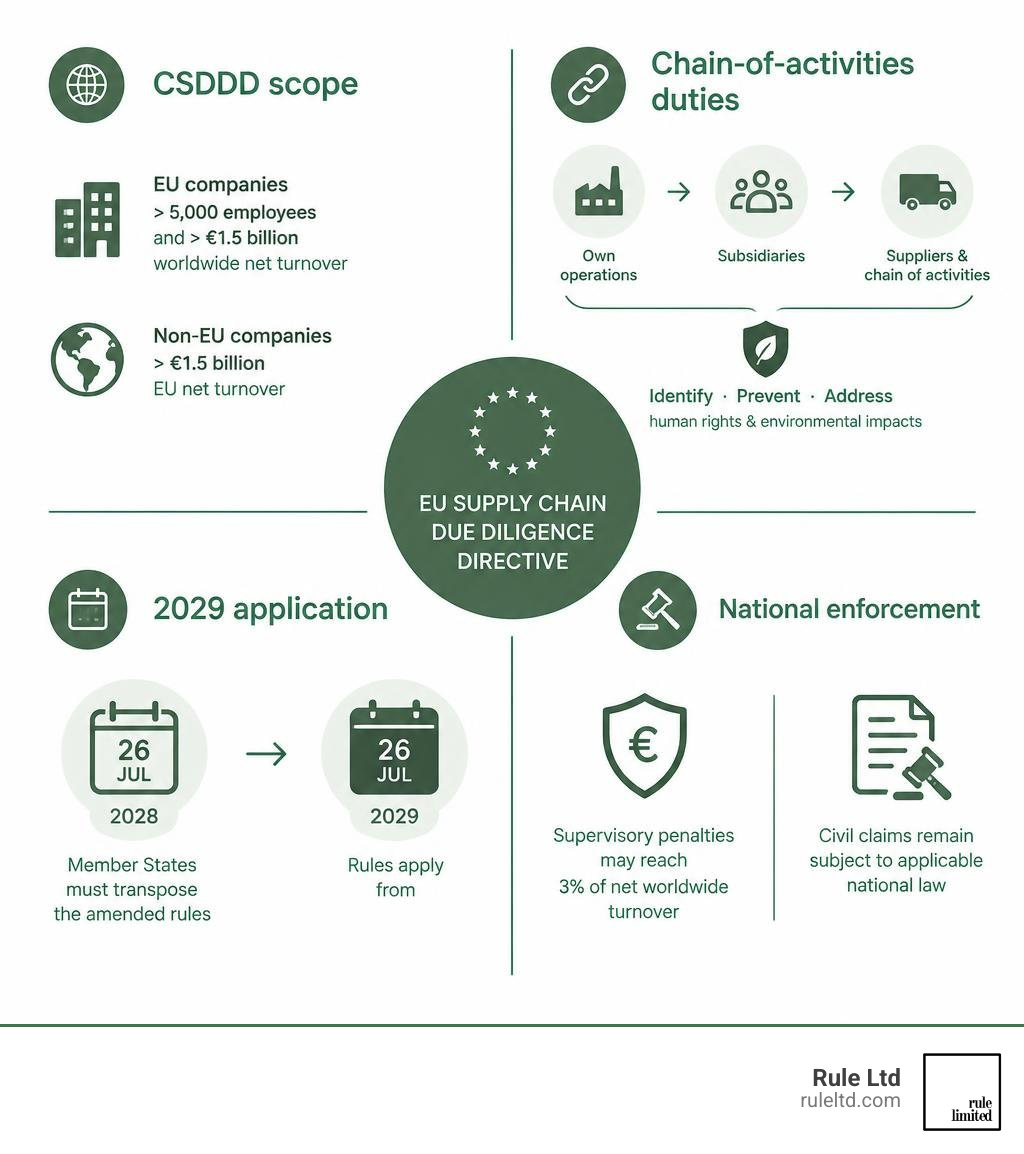
As of 2026, corporate governance across Europe and international trade corridors faces a fundamental shift under Directive (EU) 2024/1760 (the Corporate Sustainability Due Diligence Directive, or CSDDD) [1], as amended by subsequent Omnibus simplification measures [2]. The directive establishes a mandatory conduct obligation for in-scope enterprises to identify, prevent, mitigate, and remediate adverse human rights and environmental impacts throughout their operations, subsidiaries, and defined chain of activities. Under the recalibrated thresholds, the regime applies directly to EU companies with more than 5,000 employees and over €1.5 billion in worldwide net turnover. For non-EU entities, scope is governed exclusively by market presence: generating more than €1.5 billion in net turnover within the EU single market triggers direct obligations, irrespective of employee headcount [1, 2]. Member States must transpose the directive by 26 July 2028, with application commencing on 26 July 2029 [1].
These thresholds carry direct operational consequences for UK and multinational corporate groups selling into the single market or sourcing through European supply networks. Supervisory authorities are empowered to levy severe administrative penalties, with maximum pecuniary fines scaled up to at least 5% of net worldwide turnover [1]; civil liability remains rooted in national law [2], subject to directive-level procedural standards. While Germany’s LkSG imposes distinct corporate diligence obligations without a statutory civil liability cause of action [4], the UK Modern Slavery Act enforces transparency reporting rather than a mandatory conduct duty [5]. Sourcing teams and General Counsel cannot satisfy regulatory standards through self-certified supplier forms alone. Establishing a defensible position requires verified beneficial ownership, sanctions and control checks, and corroborated adverse media analysis. Structured third-party due diligence provides the evidentiary record necessary to withstand regulatory and legal challenge. This analysis reflects statutory frameworks as of 2026 and does not constitute formal legal advice; specific compliance exposures must be assessed case by case.
Statutory Scope, Timelines, and Liability Under Directive (EU) 2024/1760
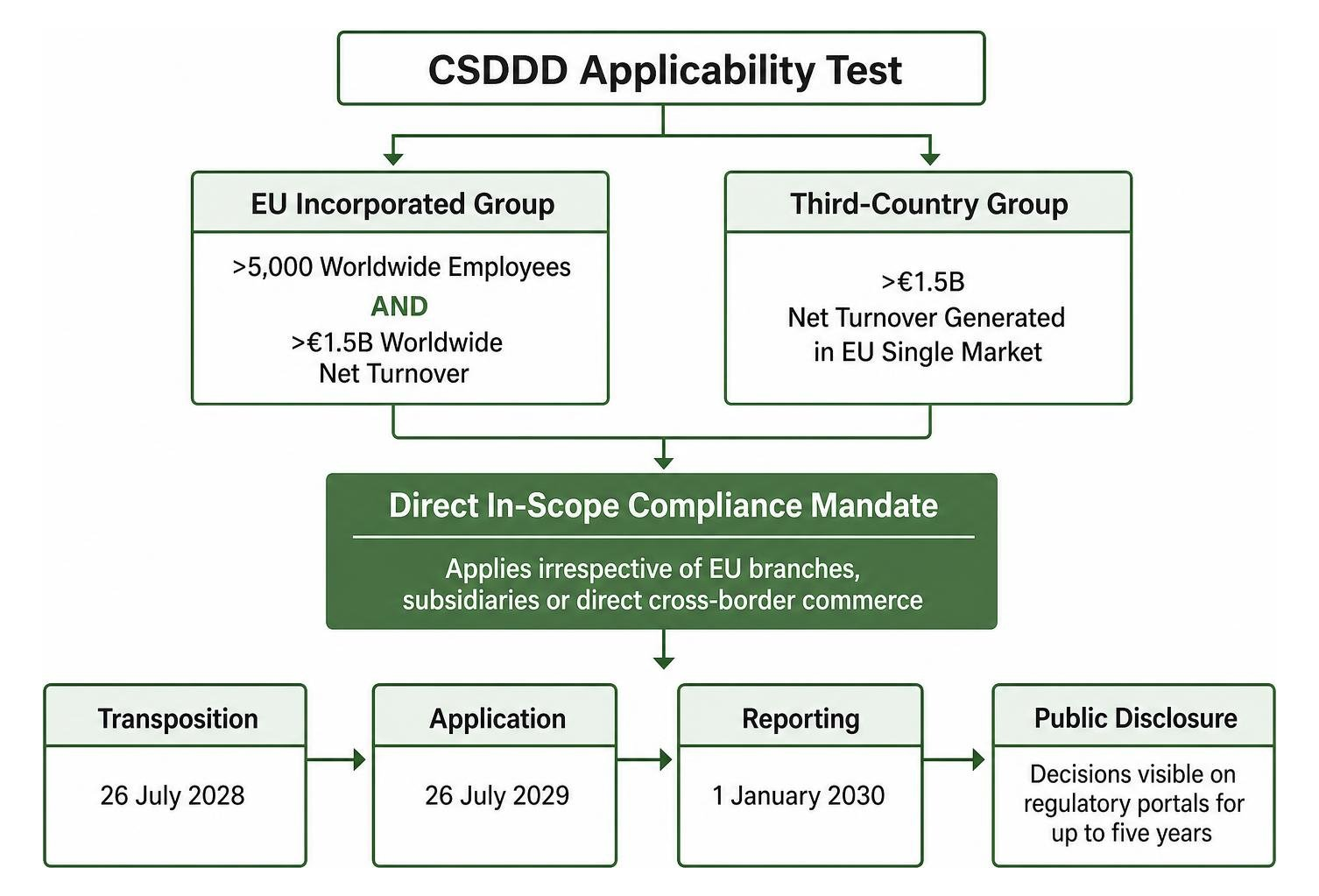
The evolution of EU corporate accountability reached statutory maturity through Directive (EU) 2024/1760 (CSDDD) [1], as refined under Directive (EU) 2026/470 [2]. The political compromise streamlined previous multi-phase thresholds into a single baseline. Direct European application targets undertakings with more than 5,000 employees and net worldwide turnover exceeding €1.5 billion [1, 2]. Member States are required to complete national transposition by 26 July 2028, with obligations taking legal effect from 26 July 2029 [1, 2]. While the statutory entry into force date of 26 July 2029 is settled at Union level, specific enforcement mechanics and procedural rules remain subject to national transposing legislation across individual Member States.
For non-EU enterprises, the directive operates on net turnover generated within the European Union exceeding €1.5 billion, excluding headcount considerations [1, 2]. Consequently, foreign parent companies with substantial direct sales or established European distribution hubs face direct statutory liability. Under the Omnibus simplification framework [2], reporting obligations under Article 16 were streamlined to eliminate duplicative filings; undertakings already subject to reporting under CSRD (Directive 2013/34/EU) satisfy transparency requirements through their consolidated sustainability statements rather than preparing an uncoordinated standalone CSDDD report [1, 2].
Beyond entities meeting headline thresholds, out-of-scope suppliers do not face direct statutory duties under the directive. In practice, however, in-scope buyers cascade verification and compliance requirements into supply agreements and procurement codes to mitigate their own regulatory exposure and ESG reputational risk.
Administrative Sanctions and the Civil Liability Framework
CSDDD establishes a dual enforcement structure combining administrative supervision with civil liability. Under Article 27, Member States must empower national supervisory authorities to impose administrative penalties, requiring that the maximum statutory fine available under national law is set at not less than 5% of the undertaking’s net worldwide turnover in the financial year preceding the fining decision [1]. Regulators may also publish infringement decisions, generating severe commercial repercussions.
Civil liability under CSDDD is integrated into Member State tort frameworks rather than established as an autonomous EU tort [1]. Under Article 29, Member States must provide rules governing civil liability where an undertaking intentionally or negligently fails to comply with prevention and remediation duties, causing damage to a natural or legal person [1]. The directive outlines core procedural safeguards, including a minimum five-year limitation period and provisions enabling civil society organisations and trade unions to bring representative actions [1]. The 2026 Omnibus simplification measures [2] preserved this national tort integration while harmonising cross-regime definitions, meaning substantive disclosure rules, evidentiary thresholds, and causation standards remain governed by national transposing statutes.
Conduct vs Disclosure: Interoperability with LkSG, CSRD, and UK Sourcing
A critical distinction for compliance executives is separating corporate reporting from operational conduct. The Corporate Sustainability Reporting Directive (CSRD) [3] mandates public disclosure under double materiality standards. Conversely, CSDDD obliges organisations to identify, prevent, mitigate, and remediate adverse impacts across their chain of activities [1].
| Regulatory Mandate | Nature of Obligation | Scope Thresholds | Supply Chain Coverage | Maximum Statutory Penalties |
|---|---|---|---|---|
| EU CSDDD (Directive 2024/1760 as amended) [1, 2] | Mandatory conduct, prevention, and remediation duty | >5,000 employees and >€1.5B worldwide turnover (EU) / >€1.5B EU turnover (Non-EU) | Chain of activities: direct business partners, and indirect partners where substantiated risks arise | National statutory maximum fine must be set at not less than 5% of net worldwide turnover; national civil liability |
| EU CSRD (Directive 2022/2464) [3] | Public sustainability reporting and assurance | Large undertakings meeting balance sheet and revenue metrics under national law | Entire upstream and downstream value chain (reporting materiality) | Administrative penalties and director sanctions under national transposition |
| German LkSG [4] | Human rights and environmental due diligence duty | ≥1,000 employees in Germany | Direct suppliers (Tier 1); indirect suppliers upon substantiated knowledge | Fines up to 2% of average global annual turnover for large entities; public procurement exclusions |
| UK Modern Slavery Act (Section 54) [5] | Annual transparency and disclosure duty | Commercial organisations with total turnover ≥£36M carrying on business in the UK | Global commercial operations and supply chains | Court injunctions; no direct turnover-based pecuniary fine |
The interaction with Germany’s Lieferkettensorgfaltspflichtengesetz (LkSG) requires precise legal distinction. As of 2026, the LkSG remains fully in force for companies with at least 1,000 employees in Germany, mandating risk management primarily across Tier 1 direct suppliers and extending to indirect suppliers only upon substantiated knowledge of violations [4]. Unlike CSDDD, Section 11 of the LkSG explicitly excludes a statutory civil liability cause of action for breach of diligence duties [4]. Germany must align its domestic framework with CSDDD by the July 2028 transposition deadline, which will expand civil liability exposure and recalibrate company thresholds for the 2029 application date.
Implications for UK Groups: Selling and Sourcing
For UK-headquartered groups, CSDDD exerts pressure across two distinct commercial channels:
- Selling into the EU: UK groups generating over €1.5 billion in net EU turnover fall directly within statutory scope, requiring formal board-approved diligence policies, operational prevention plans, and full alignment with EU supervisory standards [1, 2].
- Sourcing through the EU: UK entities acting as suppliers to in-scope European buyers, or UK businesses sourcing components through EU distributors, face commercial pass-through demands. While not directly regulated by the directive, these suppliers must provide contractual representations and verifiable proof of upstream compliance to satisfy buyer risk audits.
While Section 54 of the UK Modern Slavery Act 2015 remains strictly an annual disclosure duty without mandatory operational conduct standards [5], UK groups engaged with EU counterparties must demonstrate substantive operational compliance. Implementing rigorous supply chain transparency practices enables cross-border groups to meet overlapping UK and EU obligations efficiently.
Interoperability with Trade Sanctions and Forced Labour Regimes
CSDDD intersects directly with asset-level trade enforcement, including Regulation (EU) 2024/3015 on prohibiting products made with forced labour [6] and the US Uyghur Forced Labor Prevention Act (UFLPA) [7]. While CSDDD assesses corporate conduct, forced labour rules empower customs authorities to detain, seize, and ban goods at the border. An enforcement action under trade bans creates immediate evidentiary exposure under CSDDD. When procuring from complex operating environments, deploying enhanced due diligence across tier-one partners and raw material origins is essential to defend against both border detentions and regulatory inquiries.
Evidentiary Defensibility: Beyond Self-Assessments to Multi-Tier Intelligence

A critical failure mode in corporate compliance is over-reliance on supplier self-assessment questionnaires (SAQs) and off-the-shelf audits. Under CSDDD, an unverified supplier declaration does not constitute an appropriate measure if adverse human rights or environmental indicators were discoverable through public or corporate records [1]. While routine diligence focuses on direct business partners and downstream transport or storage, indirect partners must be investigated whenever plausible risk signals, whistleblowing reports, or sector-level adverse indicators emerge [1].
Regulators and courts evaluate whether an organisation took reasonable, risk-based measures. Defensible compliance requires contextualised intelligence rather than unvalidated data aggregation. Deploying structured third-party risk assessment workflows allows General Counsel to test evidence before onboarding critical suppliers.
When evaluating high-risk geographies, human-led intelligence that reviews corporate filings, local registries, and adverse media in native languages is vital. Countering volatile operating conditions requires continuous risk mapping and scenario planning rather than periodic administrative questionnaires.
Uncovering Beneficial Ownership and Sanctions Control
Supply chain integrity is inseparable from international sanctions and financial crime enforcement. Hidden ownership structures frequently conceal blocked entities or politically exposed persons (PEPs).
Under the US OFAC 50 Percent Rule and UK OFSI ownership-and-control guidance, an entity is restricted if owned 50% or more by sanctioned persons, or controlled by them through informal mechanisms [8]. In the UK, the Economic Crime and Corporate Transparency Act 2023 (ECCTA) [9] has expanded corporate criminal liability and reformed Companies House verification, heightening scrutiny on opaque domestic and offshore holding structures.
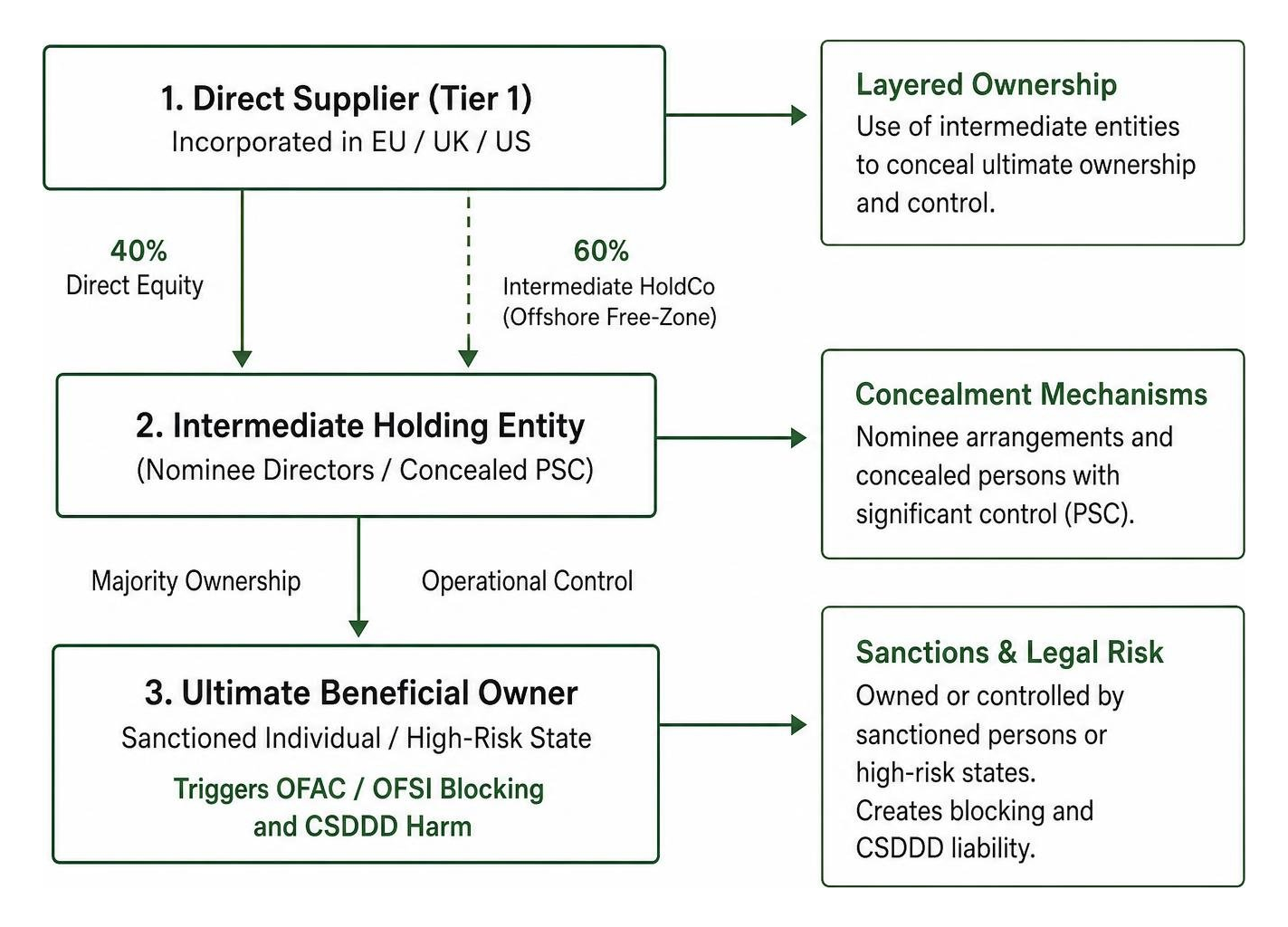
A direct supplier may maintain compliant surface operations while routing revenue through intermediate entities to sanctioned individuals or restricted jurisdictions. Sourcing teams relying on basic vendor screening risk severe legal penalties and trade embargoes. Conducting geopolitical risk assessment paired with forensic corporate intelligence ensures beneficial ownership networks are comprehensively analysed.
Boardroom Governance: Structuring Verifiable Chain-of-Custody Protocols

Navigating CSDDD demands an integrated governance framework aligned with the OECD Due Diligence Guidance for Responsible Business Conduct [1]. For General Counsel and Chief Compliance Officers, diligence cannot be treated as an annual policy exercise or an isolated procurement checklist. Board oversight requires active integration of adverse impact assessments into enterprise risk registers, executive remuneration metrics, and supplier contractual architectures.
Establishing defensibility requires an unbroken chain of custody across third-party evaluations. Contractual warranties and representations are necessary but legally insufficient if a buyer fails to investigate credible adverse indicators. Legal teams must ensure that risk identification triggers proportionate operational responses, such as targeted supplier capacity building, modified purchasing terms, and verified corrective action plans.
Furthermore, grievance mechanisms mandated under Article 14 must provide functioning intake and escalation protocols capable of handling reports from trade unions and affected communities. To withstand regulatory inquiries and potential civil claims, compliance teams must ensure all corporate due diligence findings and mitigation decisions are compiled into timestamped, tamper-evident investigation records.
Disclaimer: This analysis is provided for informational purposes only and does not constitute formal legal advice. Evolving statutory obligations under EU and national legal frameworks must be evaluated on a case-by-case basis.
Board-Level Questions on CSDDD Exposure
Which UK and non-EU companies fall directly within scope of CSDDD?
Non-EU companies fall directly within scope if they generate more than €1.5 billion in net turnover within the European Union [1, 2]. Headcount is not considered for non-EU undertakings. Parent entities must evaluate consolidated group operations, as aggregated EU revenues across subsidiaries can draw the holding entity into direct statutory scope.
How do administrative penalties and national civil liability interact under the directive?
National supervisory authorities enforce administrative compliance, and Member States are mandated to set maximum administrative fines at no less than 5% of the undertaking’s net worldwide turnover [1]. Civil liability operates independently through Member State national tort laws, requiring a minimum five-year limitation period and representative action mechanisms for affected parties claiming damages caused by failures to prevent or mitigate adverse impacts [1, 2].
Does CSDDD diligence apply only to direct (Tier 1) suppliers?
While routine diligence primarily focuses on direct business partners across upstream and select downstream operations, indirect business partners remain within scope when plausible risk signals, sector-level concerns, or substantiated complaints indicate adverse impacts [1]. Over-relying on superficial Tier 1 self-declarations fails regulatory defensibility standards when deeper supply chain risks were discoverable.
What Records Should Be Retained to Defend Due Diligence Decisions?
Organisations should retain a dated, auditable record of risk assessments, supplier screening, beneficial ownership and sanctions checks, adverse-media reviews, escalation decisions, contractual remediation steps, and evidence supporting the proportionality of each response. The record should show not only what was identified, but why the organisation considered its prevention, mitigation, or remediation measures appropriate in the circumstances. A completed questionnaire without underlying corroboration is unlikely to provide a defensible evidential trail.
Why Can CSRD Disclosures Create Additional CSDDD Exposure?
CSRD disclosures do not create CSDDD liability automatically. However, published sustainability statements can make an organisation’s stated risk assessments, policies, and material impacts available for comparison with its operational diligence record. Inconsistencies between disclosed commitments and documented supplier controls may increase scrutiny from regulators, claimants, investors, and counterparties. Legal and compliance teams should therefore ensure that reported value-chain risks are reconciled with the evidence retained for CSDDD decision-making.
Strategic Value Chain Integrity as Balance Sheet Protection
Under Directive (EU) 2024/1760, supply chain diligence has transitioned into a core balance sheet risk. With administrative penalties linked to global turnover and civil liability exposures adjudicated in national courts, superficial vendor questionnaires leave organisations vulnerable to enforcement action.
Rule Ltd delivers human-led corporate intelligence, third-party risk analysis, and enhanced due diligence that enable General Counsel and Chief Compliance Officers to make defensible decisions. Our experienced investigative analysts reduce false positives, unpack complex multi-jurisdictional ownership structures, and verify operational integrity across international supply networks.
We provide cost-certain, fixed-price engagements quoted within one working day before work commences. Routine screening reports are delivered within two to three working days, while corporate intelligence and enhanced due diligence investigations are completed in approximately five working days.
To secure your global sourcing footprint and build verifiable evidentiary defences, commission an independent third-party risk assessment or speak with our investigative team about your due diligence requirements today.
Sources
- Directive (EU) 2024/1760 of the European Parliament and of the Council of 13 June 2024 on corporate sustainability due diligence, Official Journal of the European Union, EUR-Lex.
- Directive (EU) 2026/470 regarding corporate sustainability reporting and due diligence simplification measures, Official Journal of the European Union, EUR-Lex.
- Directive (EU) 2022/2464 of the European Parliament and of the Council of 14 December 2022 amending Regulation (EU) No 537/2014, Directive 2004/109/EC, Directive 2006/43/EC and Directive 2013/34/EU, as regards corporate sustainability reporting (CSRD), EUR-Lex.
- German Supply Chain Due Diligence Act (Lieferkettensorgfaltspflichtengesetz – LkSG), Federal Law Gazette, Gesetze im Internet.
- UK Modern Slavery Act 2015, Section 54 (Transparency in supply chains etc.), legislation.gov.uk.
- Regulation (EU) 2024/3015 on prohibiting products made with forced labour on the Union market, EUR-Lex.
- Uyghur Forced Labor Prevention Act (Public Law 117-78), US Customs and Border Protection.
- US Department of the Treasury, Office of Foreign Assets Control (OFAC), Revised Guidance on Entities Owned by Persons Whose Property and Interests in Property are Blocked (50 Percent Rule); HM Treasury, Office of Financial Sanctions Implementation (OFSI), General Guidance for Financial Sanctions: Ownership and Control.
- UK Economic Crime and Corporate Transparency Act 2023 (ECCTA), legislation.gov.uk; Companies House Guidance on the Register of Persons with Significant Control (PSC).