
Unverified Public Record Searches Create False Certainty in Third-Party Due Diligence
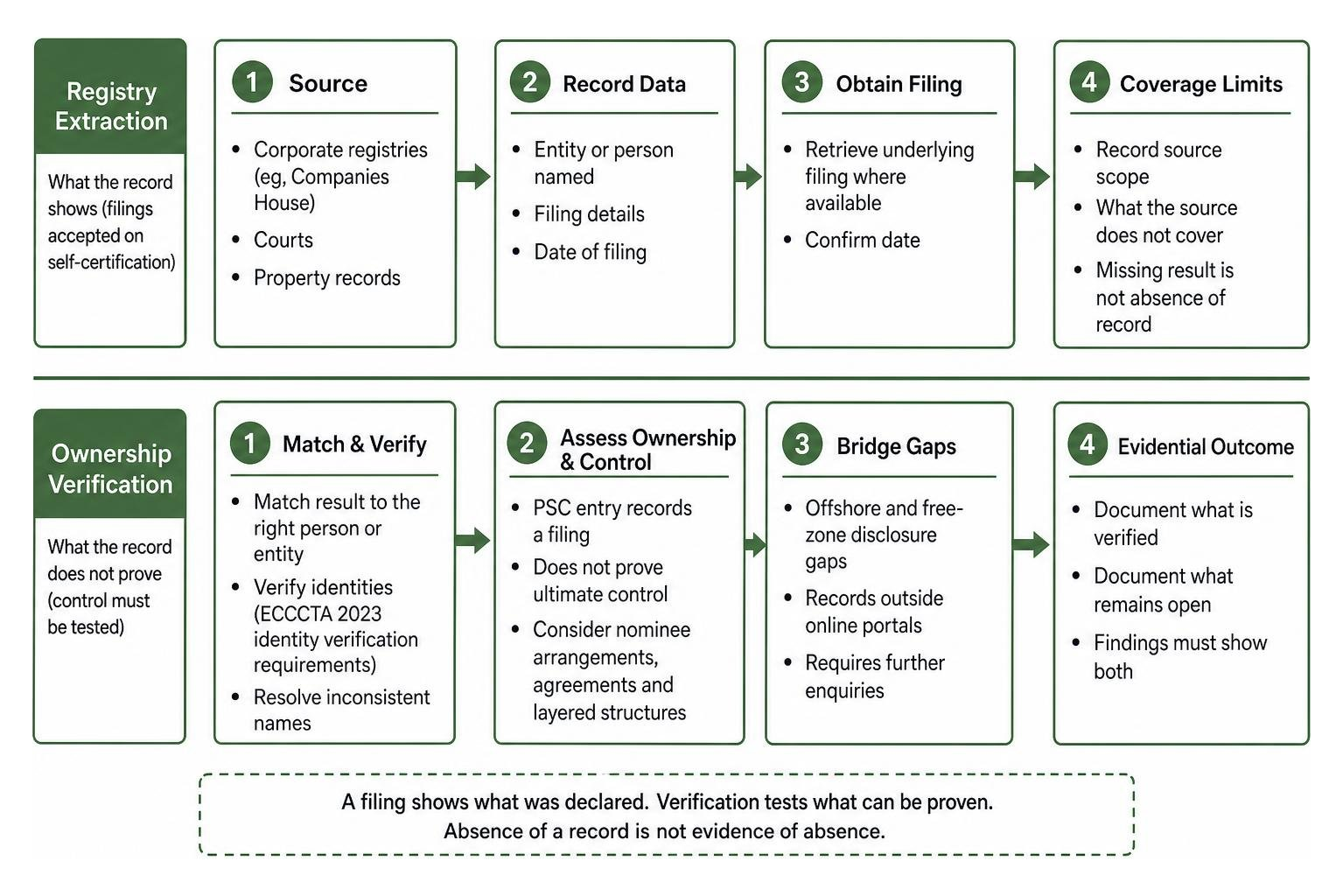
For deep public record searches, start with the question you need to resolve, not a name search. Check the relevant corporate registries, courts and property records in each jurisdiction. Then match each result to the right person or entity, confirm its date and obtain the underlying filing where possible. Record what each source does not cover. A missing court result, for example, is not proof that no case exists.
The harder calls concern ownership and control. A Companies House person with significant control (PSC) entry records a filing; it does not, by itself, settle who ultimately controls a company . Identity verification under the Economic Crime and Corporate Transparency Act 2023 changes who must verify their identity, but should not be treated as verification of every ownership claim. Offshore disclosure gaps, inconsistent names and records held outside online portals may require further enquiries.
This article is not legal advice. Specific legal and compliance matters require assessment case by case.

Explore more about public record searches:
Corporate Registry Distortions: From Unverified Filings to Beneficial Ownership Gaps
Corporate registries serve as statutory repositories rather than investigative authorities. In most jurisdictions, registrars accept company formations and officer appointments on a self-certified basis. Relying solely on official register extracts to identify ownership structures creates severe compliance exposures, particularly when assessing counterparty risk under anti-money laundering and international sanctions regulations.
An automated search that extracts a declared shareholder or director does not resolve beneficial ownership. When undertaking an ultimate beneficial owner check, compliance counsel must account for nominee directors, unrecorded shareholder agreements, and layered corporate vehicles designed to mask operational control. In high-risk cross-border arrangements, a clean registry extract often conceals sanctioned individuals or politically exposed persons (PEPs) holding informal proxy control.
This statutory blind spot carries serious legal consequences. Under OFAC regulations and UK OFSI ownership-and-control guidance , an entity is blocked if aggregate ownership by sanctioned parties reaches or exceeds 50 percent, or if an unsanctioned entity is controlled by a designated person. Regulatory enforcement actions routinely penalise compliance teams that accepted self-declared registry data without investigating indirect control paths. Overlooking these structures illustrates the core risks analysed in our review of the 50% rule and sanctions compliance.
The Limits of Statutory Disclosure in Offshore and Free-Zone Jurisdictions
Offshore jurisdictions and commercial free zones introduce structural statutory opacity. In jurisdictions such as the British Virgin Islands, Cayman Islands, Seychelles, and various free-trade zones across the Middle East, corporate registries frequently disclose only the registered agent and company status. Detailed shareholder registers, articles of association, and board minutes remain shielded from public inspection.
In these environments, counterparties often deploy circular shareholding structures, discretionary trusts, or foundation layers to sever the documentary link between operating assets and ultimate beneficiaries. A standard registry extraction will return a valid certificate of good standing while revealing nothing about the true ownership chain. Detecting an obscured owner requires tracing cross-border holding companies through multi-jurisdictional filings, identifying anomalies similar to a beneficial ownership red flag where paper entities exist purely to shield controlling interests.
ECCTA Verification Realities and Ongoing Registry Vulnerabilities
The implementation of the Economic Crime and Corporate Transparency Act 2023 (ECCTA) granted the Registrar of Companies in the United Kingdom expanded powers to query suspicious filings, remove fraudulent entries, and mandate identity verification through a phased rollout across new and existing registered company directors and Persons with Significant Control (PSCs) .
While ECCTA marks a material shift in regulatory enforcement, statutory registers remain vulnerable during multi-year transition windows and retrospective cleanup operations. Identity verification establishes that a director or PSC is a real person whose identity documents have been authenticated. It does not verify whether that individual is acting as an undisclosed nominee, exercising independent management authority, or serving as a synthetic front for third-party interests. Compliance officers cannot treat an authenticated identity as an endorsement of lawful corporate conduct.
The Structural Evidentiary Blind Spots in Public Records
Commercial aggregators ingest billions of records from thousands of distinct sources. While aggregators market instantaneous access to corporate records, court filings, and property documents, their data models prioritise breadth over evidential veracity. Automated ingest pipelines suffer from secondary indexing latency, data truncation, and OCR ingestion errors that produce false negatives.
Relying entirely on database aggregators when conducting corporate due diligence introduces substantial liability. If an aggregator misindexes a court docket, fails to capture a newly filed writ, or omits a subsidiary filing due to non-standard naming conventions, a counterparty can pass desktop screening while carrying active insolvency or fraud litigation.
| Due Diligence Parameter | Statutory Public Record Aggregator | Multi-Source Verified Corporate Intelligence |
|---|---|---|
| Data Provenance | Secondary ingest; aggregated bulk indexes | Certified primary source filings; direct court dockets |
| Ownership Resolution | Static self-certified registry extracts | Multilingual corporate mapping; indirect control analysis |
| Litigation Scope | Indexed electronic databases only | Electronic dockets, physical courthouses, municipal filings |
| Adverse Media | Automated keyword scrapes; high false positives | Context-validated human analysis; local press reviews |
| Evidentiary Standard | Indicative information | Defensible legal documentation suitable for boards |
The Illusion of Completeness in Digitised Public Records
Digitised repositories create a false sense of comprehensive coverage. In many jurisdictions, historical records prior to specific cut-off dates, localised municipal disputes, and specialised tribunals remain non-digitised. A search engine query across commercial aggregators will yield zero results for a target, not because the counterparty is unencumbered, but because the relevant proceedings are archived in physical courthouse folios.
Furthermore, bulk data aggregators frequently merge records belonging to separate entities with similar names, creating noise while obscuring high-risk filings. When dealing with complex counterparties, compliance teams must follow structured investigative protocols, aligning with enhanced due diligence high-risk screening steps to verify source documents directly against original filing authorities.
Publicly Accessible Records Versus Verified Due-Diligence Evidence
Public records represent raw administrative claims. Verified due diligence evidence represents authenticated, contextualised intelligence capable of withstanding scrutiny by regulatory bodies and statutory auditors.
Relying on raw public files exposes organisations to statutory enforcement under frameworks like the UK Bribery Act 2010 and the US Foreign Corrupt Practices Act (FCPA) . Regulators evaluating an organisation’s compliance defence examine whether the company took reasonable, documented steps to verify the operational reality and reputational integrity of its partners, rather than conducting check-the-box electronic searches.
Court Records: UK Sources and Cross-Border Limits
A court-record review should begin with the limits of the available source, not the assumption that an online search is comprehensive. In England and Wales, Find Case Law makes judgments and selected decisions accessible, but it is not a complete, searchable record of every claim, order, filing, hearing, or settlement. Reporting restrictions, procedural rules, retention practices, and the fact that many matters never produce a published judgment can leave material gaps.

For UK insolvency indicators, available court material should be considered alongside statutory notices in The Gazette and the relevant Insolvency Service registers. These sources can evidence formal steps such as insolvency appointments or notices, but they do not establish the full commercial, litigation, or ownership position of a counterparty. A defensible review records both the repositories searched and the records that could not be verified.
Coverage Varies by Jurisdiction
The position becomes more fragmented outside the United Kingdom. The European Union has no single court-record repository: access, publication practices, language, and personal-data restrictions remain national or regional. In the United States, PACER covers federal proceedings but not the separate state and local court systems where many commercial disputes are heard. Offshore jurisdictions may publish only limited corporate or insolvency information, while court files and beneficial-ownership evidence can require local retrieval or professional enquiries.
For cross-border counterparties, the relevant question is not whether a database returns a clean result, but whether the search scope was capable of detecting the risk in the first place. Rule Ltd’s corporate intelligence services combine source-level review with jurisdiction-specific enquiries where the public record is incomplete.
Name Matching, Transliteration, and Entity Disambiguation Pitfalls
Entity resolution is one of the highest failure points in cross-border public record investigations. Automated matching algorithms frequently fail when processing non-Latin scripts, phonetic variations, patronymic naming conventions, and corporate homonyms.
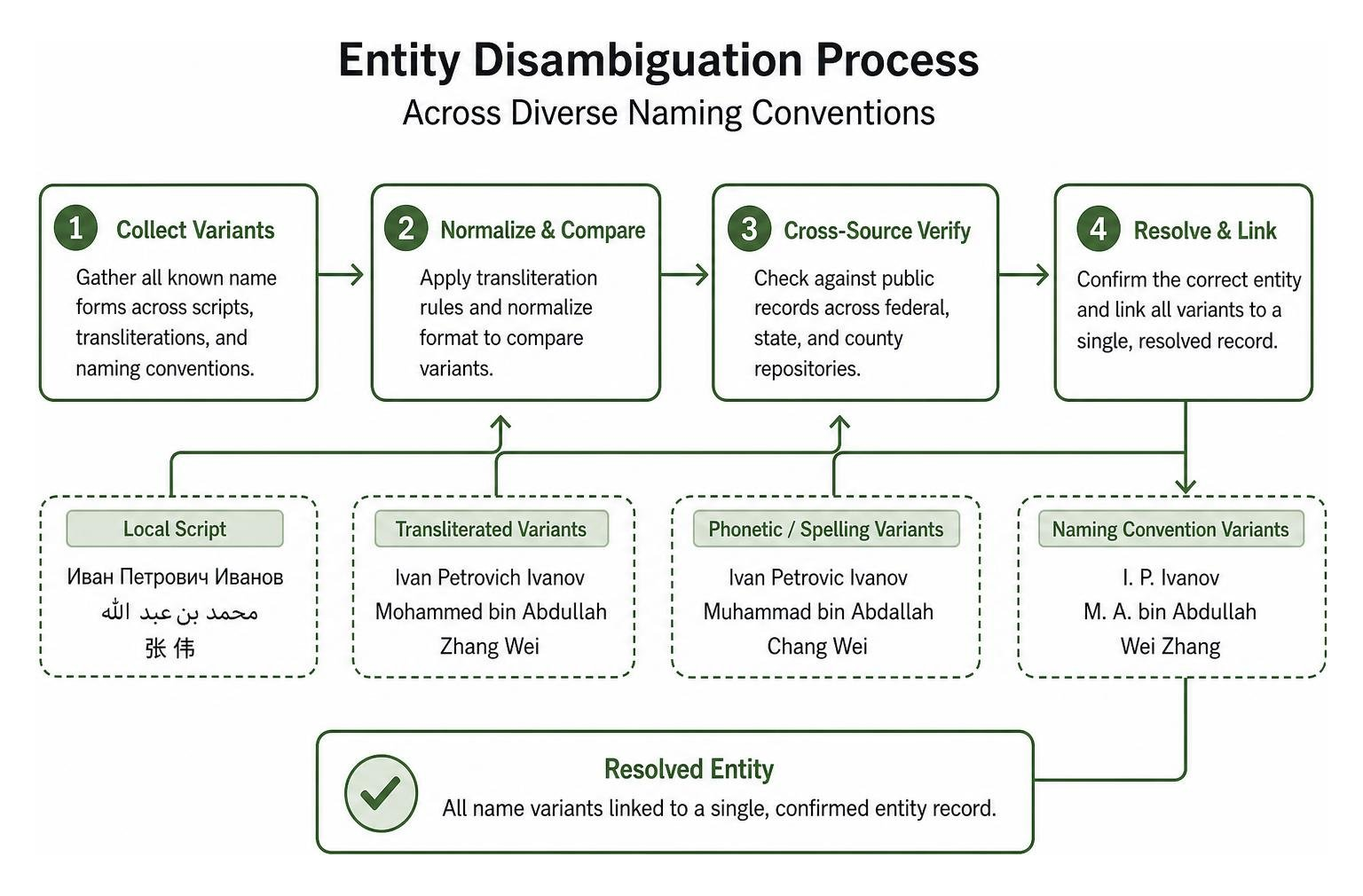
Investigators must apply precise linguistic rules and jurisdictional expertise to resolve counterparty identities, as outlined in our review of counterparty due diligence terms.
Cross-Border Script Inconsistencies and Transliteration Anomalies
When names are transliterated from Cyrillic, Arabic, Simplified Chinese, or other scripts into the Latin alphabet, multiple valid English spellings emerge. An automated sanctions screening engine running a strict search for a specific Latin spelling will miss identical individuals recorded under alternative transliteration standards:
- Pinyin vs Wade-Giles: Chinese corporate filings and individual names vary significantly across Mainland China, Taiwan, and Hong Kong records.
- Arabic Naming Structures: Variations in prefixes (Al-, El-), patronymics (bin, ibn), and transliterated vowels create dozens of spelling permutations for a single individual.
- Cyrillic Romanisation: Inconsistent transliteration of Slavic surnames across European court registries frequently allows designated individuals to evade algorithmic screening.
Failing to search all transliteration variants can lead an organisation to onboard an entity subject to OFAC, EU, or UK sanctions, creating immediate enforcement exposure.
Managing Common Surnames and Corporate Shell Homonyms
Phonetic algorithms such as Soundex or standard string-distance metrics often generate high volumes of false positives when querying common surnames, causing analyst fatigue. Conversely, strict search parameters miss counterparties operating under subtle corporate name variations.
Sophisticated bad actors deliberately incorporate legal entities with names identical or nearly identical to well-known multinational companies in offshore jurisdictions or separate state registries. These entity clones or fraudulent branch structures pass high-level desktop screening by exploiting search engine ambiguity. Resolving these entities requires manual cross-referencing of incorporation dates, registered agent addresses, and corporate identifiers during third-party due diligence.
Evidentiary Defensibility: Human Intelligence vs Unverified Records
Regulatory compliance demands evidential defensibility. Under enforcement frameworks governed by the US Department of Justice, the UK Serious Fraud Office, and international FATF standards , organisations must prove they executed rigorous due diligence before executing high-value transactions.

Desktop public record searches establish only what is recorded on paper. Human-led corporate intelligence establishes operational facts.
When Desktop Public Record Searches Demand Field Corroboration
Desktop searches reach their limit when public records conflict with ground realities. A corporate registry extract may list an operational entity with millions in paid-up capital, while physical inspection reveals a dormant site, a shared letterbox address, or a vacant warehouse.
Field corroboration becomes necessary when verifying high-risk vendors, prospective joint-venture partners, or supply-chain integrity:
- Site Verifications: Confirming whether commercial premises, manufacturing plants, or registered offices actually exist and maintain legitimate operations.
- Physical Archival Retrievals: Inspecting non-digitised court dockets, municipal files, and land deeds directly at local registries.
- Human Source Enquiries: Engaging with local industry peers, former executives, and sector specialists to evaluate counterparty integrity and beneficial ownership, leveraging specialist corporate intelligence services.
Constructing a Defensible Evidentiary Due-Diligence File
A defensible compliance audit trail requires a structured investigative methodology. General Counsel and Chief Compliance Officers must maintain records that demonstrate thorough investigative standards:
- Primary Filing Collection: Obtain certified copies of original corporate charters, court judgments, and land deeds rather than aggregator summaries.
- Contemporaneous Evidentiary Logging: Maintain audit-proof records documenting the search parameters, spelling variations, registries queried, and dates accessed.
- Cross-Source Corroboration: Corroborate all material public record findings against independent regulatory disclosures, litigation records, and field findings.
- Clear Disclosure of Limitations: Formally record what records were inaccessible or unverified due to statutory constraints, establishing an honest evidentiary baseline.
Decision Points for General Counsel and Chief Compliance Officers
Why Statutory Public Record Searches May Be Insufficient for Complex Cross-Border Due Diligence
Statutory searches frequently fail in cross-border engagements because corporate registries accept self-certified disclosures, offshore jurisdictions conceal shareholder identities, and automated matching algorithms miss transliterated names. Desktop searches cannot uncover informal proxy relationships, offshore trusts, or unrecorded regulatory disputes.
How Court-Record Coverage Differs Across UK, EU, US, and Offshore Jurisdictions
In the United Kingdom, accessible judgments, insolvency notices and register entries provide useful evidence but do not amount to a complete court record. Coverage in the European Union remains national or regional; US federal systems do not capture state and local matters; and offshore jurisdictions may publish only limited corporate or insolvency information. A defensible review records both the sources searched and the material that could not be verified.
What Distinguishes Unverified Public Record Results from Human-Led Open-Source Intelligence
Unverified public record queries yield raw, isolated documents prone to OCR errors, false positives, and statutory latency. Human-led intelligence applies contextual entity resolution, cross-checks multi-jurisdictional filings, reviews local non-digitised archives, and conducts field enquiries to produce defensible findings.
Conclusion
Public records form the baseline of corporate investigations, but unverified registry data cannot establish commercial reality. For General Counsel and Chief Compliance Officers, treating unverified registry extracts as definitive proof exposes enterprises to severe legal, financial, and regulatory penalties.
At Rule Ltd, we deliver corporate intelligence and due-diligence services designed to provide defensible evidence for cross-border transactions and compliance programmes. Our reports are authored by expert human analysts who resolve transliteration anomalies, identify hidden beneficial owners, and bridge jurisdictional data gaps across international territories.
We deliver fixed-price, cost-certain reports with fast turnaround times, providing screening reports within two to three working days and enhanced corporate intelligence reports in approximately five working days, with fixed fees confirmed before work begins.
To safeguard your organisation with verified intelligence, explore our comprehensive corporate intelligence capabilities.
Footnoted Legal & Statutory Sources
This article does not constitute legal advice. Specific legal and compliance matters require assessment case by case.