
Foreign vs Domestic PEPs: Why the Institution’s Jurisdiction Decides the Classification
For politically exposed persons, the key classification question is where the reporting institution operates relative to the country that entrusted the person with public office. A UK cabinet minister is a domestic PEP for a UK bank but a foreign PEP for a French bank. A French politician living in London remains a foreign PEP for a UK bank. Residence and passport do not settle the question.
The distinction changes the response. FATF Recommendation 12 calls for enhanced measures for foreign PEPs in all cases. Domestic PEPs and senior officials of international organisations are assessed on a risk basis, with enhanced measures where the relationship is higher risk. From 10 January 2024, the UK rules require firms to treat domestic PEPs as lower risk than non-domestic PEPs unless other risk factors apply. The FCA’s July 2024 review examined how firms were implementing those requirements. Classification is a starting point, not a verdict on the person; each decision still needs a case-specific assessment.
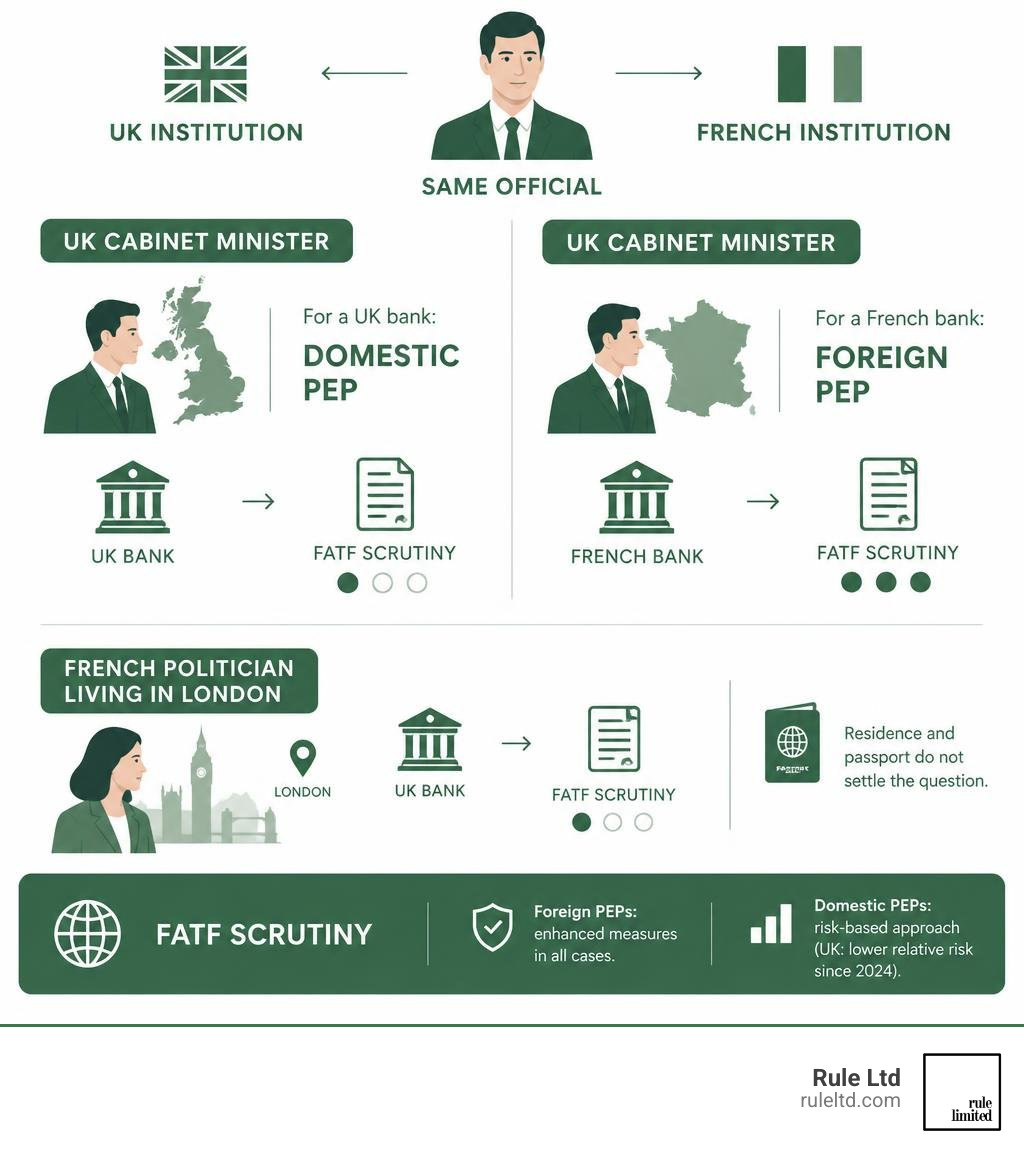
Foreign vs Domestic Politically Exposed Persons: The Jurisdictional Anchor

A fundamental misconception in compliance operations is that political exposure attaches permanently to an individual as an absolute, portable status. In practice, regulatory classification depends on a jurisdictional anchor: the relationship between the country authorising the prominent public function and the physical, legal seat of the regulated entity processing the transaction.
Financial institutions and obliged entities often conflate geographic residency, citizenship, and regulatory nexus. Robust PEP identification and classification requires untangling where an official’s authority originates from where an entity encounters them. The Financial Action Task Force (FATF) standards establish clear divisions based on cross-border authority exposure, preventing institutions from applying a flat, unworkable standard across disparate operational footprints.
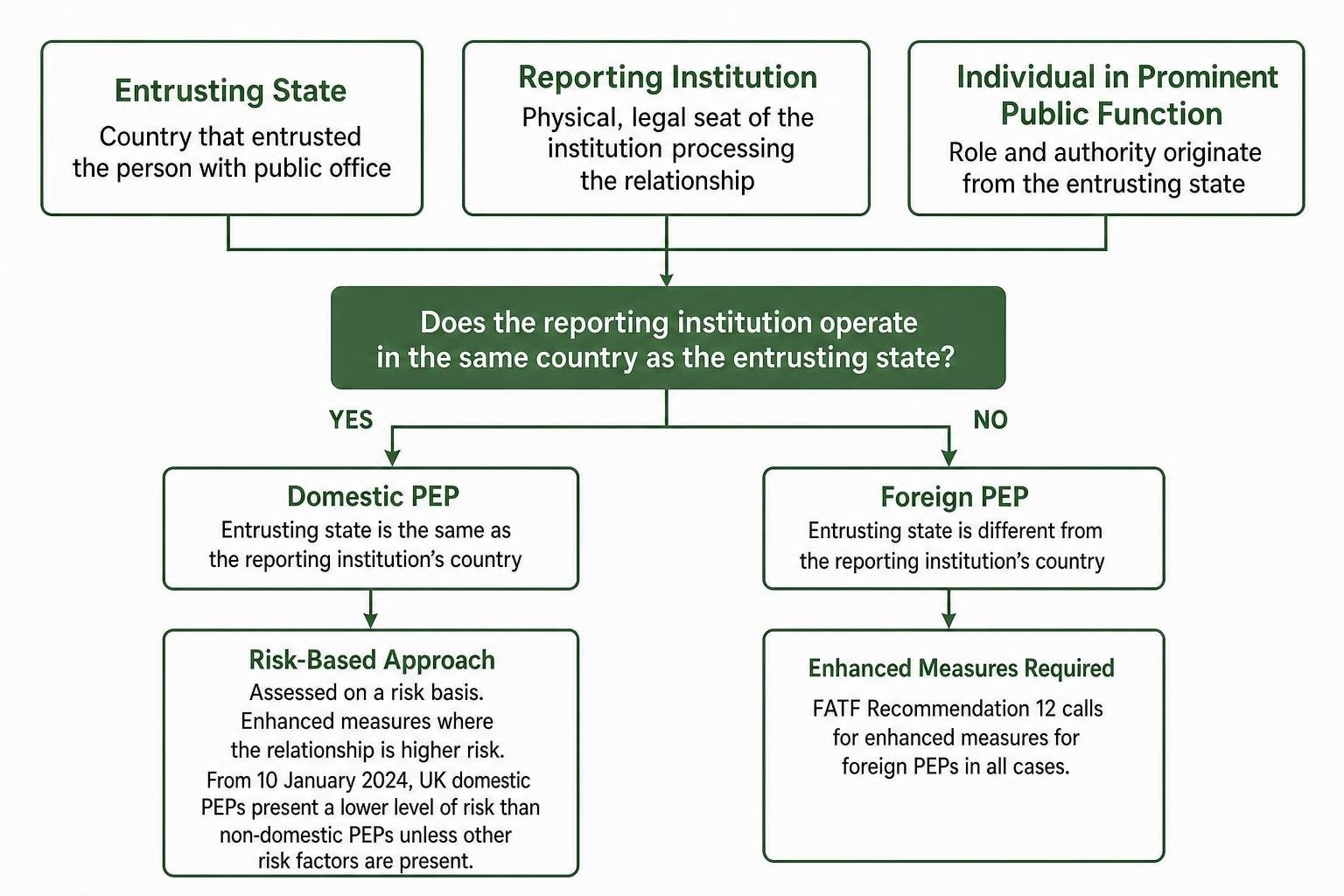
How the Reporting Institution Decides PEP Classification
When assessing an individual holding prominent office, the compliance officer must evaluate the regulatory nexus of the specific entity entering the business relationship. The table below illustrates how institutional geography dictates statutory classification under FATF standards:
| Individual Profile | Reporting Institution Location | Resulting Classification | Mandatory Baseline Scrutiny |
|---|---|---|---|
| UK Cabinet Minister | United Kingdom (e.g. Barclays UK) | Domestic PEP | Risk-based due diligence; lower initial baseline |
| UK Cabinet Minister | France (e.g. BNP Paribas Paris) | Foreign PEP | Mandatory Enhanced Due Diligence (EDD) |
| French Deputy Mayor (Paris) | France (e.g. Crédit Agricole) | Domestic PEP | Risk-based due diligence |
| French Deputy Mayor (Living in London) | United Kingdom (e.g. HSBC UK) | Foreign PEP | Mandatory Enhanced Due Diligence (EDD) |
| Senior Official, United Nations | Any Jurisdiction | International Organisation PEP | Risk-based due diligence |
As demonstrated, citizenship and physical domicile do not dictate status. If a senior foreign political figure resides in London and opens an account with a UK-regulated bank, that individual remains a foreign PEP because the UK government did not entrust them with their public mandate. Conversely, multinational banking groups face split obligations: a corporate customer holding domestic status at a London branch immediately triggers foreign PEP obligations when serviced by a subsidiary in Frankfurt or Singapore.
Regulatory Obligations for Foreign Politically Exposed Persons
FATF Recommendation 12 mandates that obliged entities apply specific preventive measures to all foreign PEPs, regardless of the individual transaction size. These measures include:
- Obtaining senior management approval prior to establishing or continuing business relationships.
- Taking reasonable measures to establish the source of wealth and source of funds.
- Conducting enhanced, continuous monitoring of the business relationship.
These obligations are preventive rather than punitive. However, failure to maintain appropriate scrutiny exposes firms to severe enforcement actions. In historical enforcement cases, such as the Abacha affair, where billions were siphoned through international financial centres, Swiss authorities investigated nearly 60 banks and froze over USD 645 million due to systemic due diligence failures. In the European Union, compliance teams must align onboarding controls with statutory publications such as the EU PEP list regulations, which catalogue prominent national functions across all member states.
Risk-Based Due Diligence for Domestic Officials and International Bodies

Unlike the prescriptive rules governing foreign figures, FATF standards permit a risk-based approach for domestic officials and senior executives of international organisations. Obliged entities must examine contextual factors, including the individual’s role, spending authority, procurement oversight, and regional corruption indicators, before applying enhanced controls. This balanced methodology integrates directly with broader anti-bribery and corruption compliance programmes.
Tiered Scrutiny and the UK’s 2024 Domestic PEP Rule Change
A critical development took effect on 10 January 2024, when the Money Laundering and Terrorist Financing (Amendment) Regulations 2023 amended the UK Money Laundering Regulations. The amendment requires UK-regulated firms to treat domestic PEPs, and their family members and known close associates, as lower risk than non-domestic PEPs unless other risk factors are present. The FCA’s July 2024 review examined firms’ implementation of this change.
This change was intended to reduce disproportionate treatment of domestic PEPs while preserving firms’ obligation to assess other relevant risk factors. Firms may calibrate measures accordingly and escalate to comprehensive enhanced due diligence for high-risk entities when specific risk indicators emerge, such as involvement in high-value state contracts or unexplained asset accumulations.
Other jurisdictions maintain rigorous, published standards defining domestic prominence. For instance, Nordic authorities publish explicit position inventories, such as the statutory positions of prominent public function maintained by the Central Bank of Iceland, cataloguing exact judicial, legislative, and military tiers subject to domestic monitoring.
Relatives and Close Associates of Politically Exposed Persons
Corrupt actors rarely move illicit funds solely under their legal names. Consequently, international standards extend scrutiny to Relatives and Close Associates (RCAs). This category encompasses:
- Family Members: Spouses, civil partners, children, their spouses, and parents.
- Known Close Associates: Individuals with joint beneficial ownership of legal entities, contractual ties, or close business relationships with a prominent figure.
Navigating RCA exposure requires precise evidentiary analysis. Regulatory frameworks, including Swiss AML definitions under Article 2a, provide detailed guidance on identifying persons linked socially, professionally, or through ownership structures to public figures.
Under UK regulations, while the primary domestic official retains PEP status for at least 12 months after stepping down from office, obligations concerning their family members and close associates cease immediately once the official leaves their prominent post, absent independent risk factors. In Switzerland, domestic exposure follows a strict 18-month statutory de-escalation period before normal due diligence duties resume.
Establishing Source of Wealth and Detecting Opaque Ownership Structures
The primary operational challenge in managing exposure involves verifying source of wealth (SoW) and source of funds (SoF). Verifying SoW requires substantive, corroborating documentation demonstrating how an individual acquired their total cumulative net worth, rather than simply confirming the origin of a specific transactional deposit.
Public registry disclosures often mask true economic control. When dealing with state-owned enterprise (SOE) executives or senior procurement ministers, basic database searches fail to expose commercial interests concealed behind holding layers. Conducting a thorough ultimate beneficial owner check is essential to pierce corporate veils and establish verifiable asset provenance.
Unmasking Beneficial Ownership Behind Shell Companies
The Panama Papers leak underscored how easily high-ranking officials conceal capital through offshore jurisdictions, exposing over 140 public figures from 50 countries operating secret corporate vehicles. Illicit networks routinely structure corporate holdings below statutory transparency thresholds, such as the standard 25% equity ownership mark, to evade automated screening triggers.
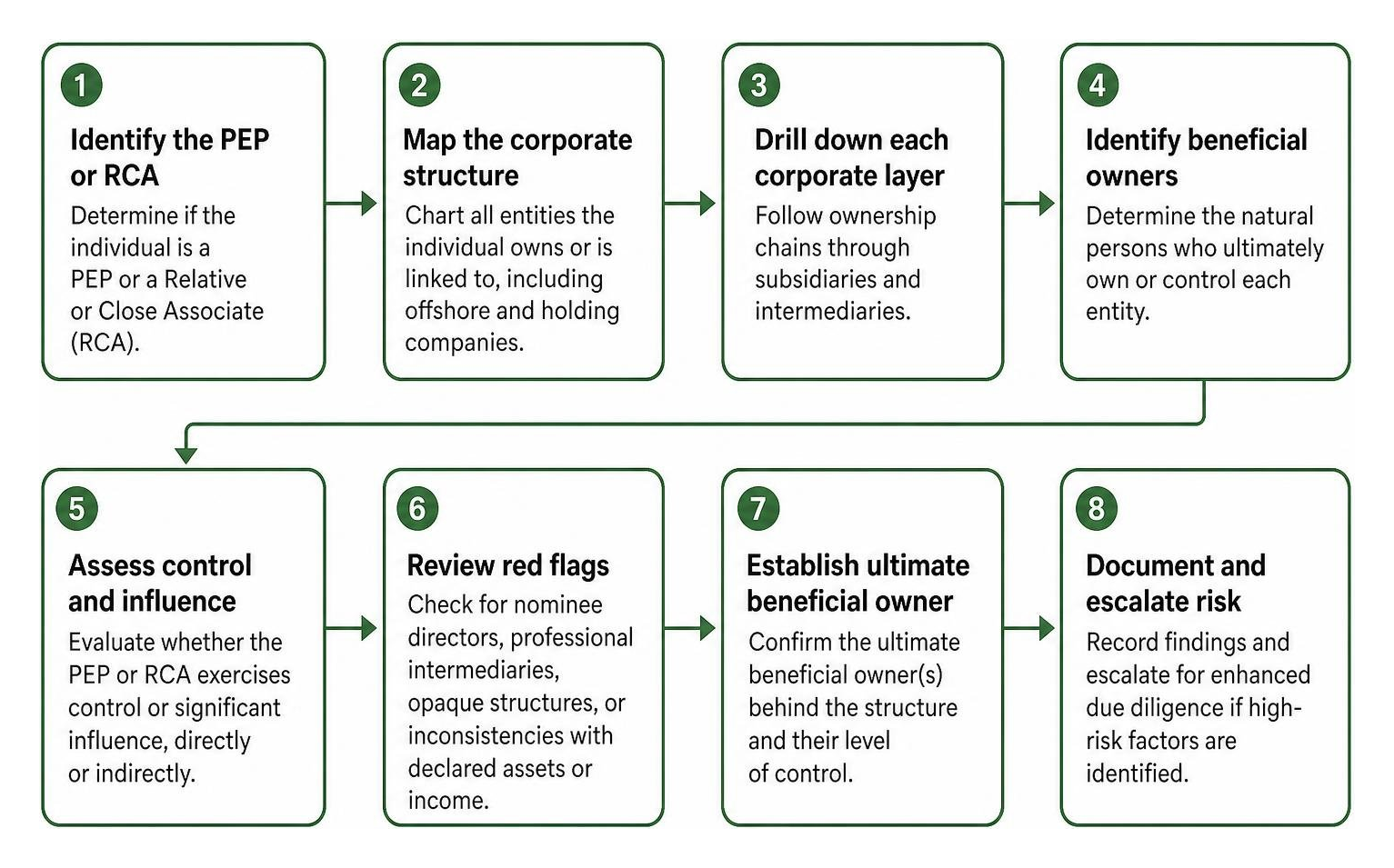
Compliance teams must actively identify beneficial ownership red flags, such as:
- Corporate structures spanning multiple secrecy jurisdictions with no evident commercial rationale.
- Nominee directors, professional intermediaries, or family members listed as sole shareholders while the official exercises informal control.
- Inconsistencies between public asset filings, official government salaries, and the operating scale of associated private entities.
Red Flags in Asset Declarations and Cross-Border Transfers
Major global scandals illustrate how public corruption manifests across corporate networks. The 1MDB scandal involved the siphoning of billions from a sovereign wealth fund using international banks, falsified joint ventures, and shell vehicles. Similarly, in Latin America, registries identified between 2,200 and 3,000 active PEPs in Chile alone during initial mapping initiatives, demonstrating the vast volume of individuals requiring ongoing corporate intelligence reviews.
Key red-flag indicators that require immediate corporate intelligence escalation include:
- Cross-border wire transfers originating from state-backed commercial counterparties into private accounts.
- Rapid, high-volume real estate acquisitions conducted through layered limited liability companies.
- Substantial divergence between an official’s published civil service remuneration and verifiable commercial asset holdings.
- Use of corporate vehicles registered in jurisdictions lacking public ultimate beneficial ownership registers.
Frequently Asked Questions About PEP Compliance
What distinguishes a foreign PEP from a domestic PEP under FATF rules?
The classification depends on the relationship between the country that entrusted the public function and the reporting institution’s operating jurisdiction. An individual holding office in Country A is a domestic PEP for institutions inside Country A, but is classified as a foreign PEP by institutions operating in Country B, regardless of citizenship or physical residence. Foreign PEPs trigger mandatory Enhanced Due Diligence under FATF Recommendation 12, whereas domestic PEPs are subject to a risk-based approach.
Does PEP status expire immediately after leaving public office?
No. International standards apply a risk-based period after an official steps down. In the UK, statutory guidance under the MLRs requires EDD considerations to continue for at least 12 months after leaving office. In Switzerland, domestic status formally transitions after an 18-month cooling-off period. However, FATF guidance recommends assessing former senior officials based on their enduring informal influence, control over state resources, and ongoing links to public procurement.
How are family members and close associates evaluated during onboarding?
Family members and known close associates (RCAs) inherit the risk profile of the primary official because corrupt actors frequently route illicit assets through relatives or business partners. When onboarding an RCA, institutions must identify joint beneficial ownership arrangements, verify source of wealth, and determine whether intermediary corporate entities are being utilised to mask the primary official’s economic interest.
Why is database screening alone insufficient for PEP risk management?
Commercial watchlist databases rely on static public profiles and structured registry data, which often miss indirect associations, layered holding companies, and subtle ownership thresholds below 25%. Sole reliance on automated list-matching generates high false-positive rates while failing to contextualise regional corruption risks, unlisted close associates, or discrepancies in public asset declarations.
Conclusion
Managing exposure to prominent public officials requires moving past superficial database matching toward rigorous, context-driven analysis. The distinction between foreign and domestic classifications highlights that political exposure is never absolute; it is an evolving regulatory calculation anchored to institutional geography, local statutory frameworks, and demonstrable risk.
Rule Ltd provides independent third-party risk management and corporate intelligence services to help global enterprises verify exposure, resolve complex ownership structures, and validate source of wealth. Using human analysts to cut through false positives and evaluate multi-jurisdictional registry records, our reports provide cost certainty with transparent fixed pricing quoted before work begins. Routine screening reports are delivered in two to three working days, while comprehensive corporate intelligence and enhanced due diligence investigations are completed in approximately five working days.
To ensure your third-party onboarding processes remain compliant, defensible, and aligned with international standards, commission a bespoke third-party risk assessment with our corporate intelligence team.
Footnoted Sources & Authorities Relied On
- Financial Action Task Force (FATF): FATF Guidance on Politically Exposed Persons (Recommendations 12 and 22), June 2013 (incorporating consolidated international AML/CFT standards).
- UK Government / HM Treasury: The Money Laundering and Terrorist Financing (Amendment) Regulations 2023, which took effect on 10 January 2024 and amended the Money Laundering Regulations’ treatment of domestic PEPs.
- Financial Conduct Authority: Treatment of politically exposed persons, July 2024 multi-firm review of how firms applied the revised domestic-PEP requirements.
- European Parliament and Council: Directive (EU) 2015/849 (4th AMLD) and Directive (EU) 2018/843 (5th AMLD), including Member State compilations of prominent public functions.
- Swiss Federal Assembly: Federal Act on Combating Money Laundering and Terrorist Financing (Anti-Money Laundering Act, AMLA), Art. 2a Definitions (Foreign and Domestic PEPs, International Organisations, and 18-month de-classification rules).
- Central Bank of Iceland: Positions that are considered to be prominent public functions, published under Act No. 140/2018 and updated under Regulation No. 1420/2020.
Notice: This article is published for informational and risk-management purposes only and does not constitute formal legal advice. Regulatory determinations regarding politically exposed persons must be evaluated on a case-by-case basis in alignment with applicable jurisdictional statutes.