
Section 7 Corporate Exposure Turns on Evidential Reality, Not Policy Documentation
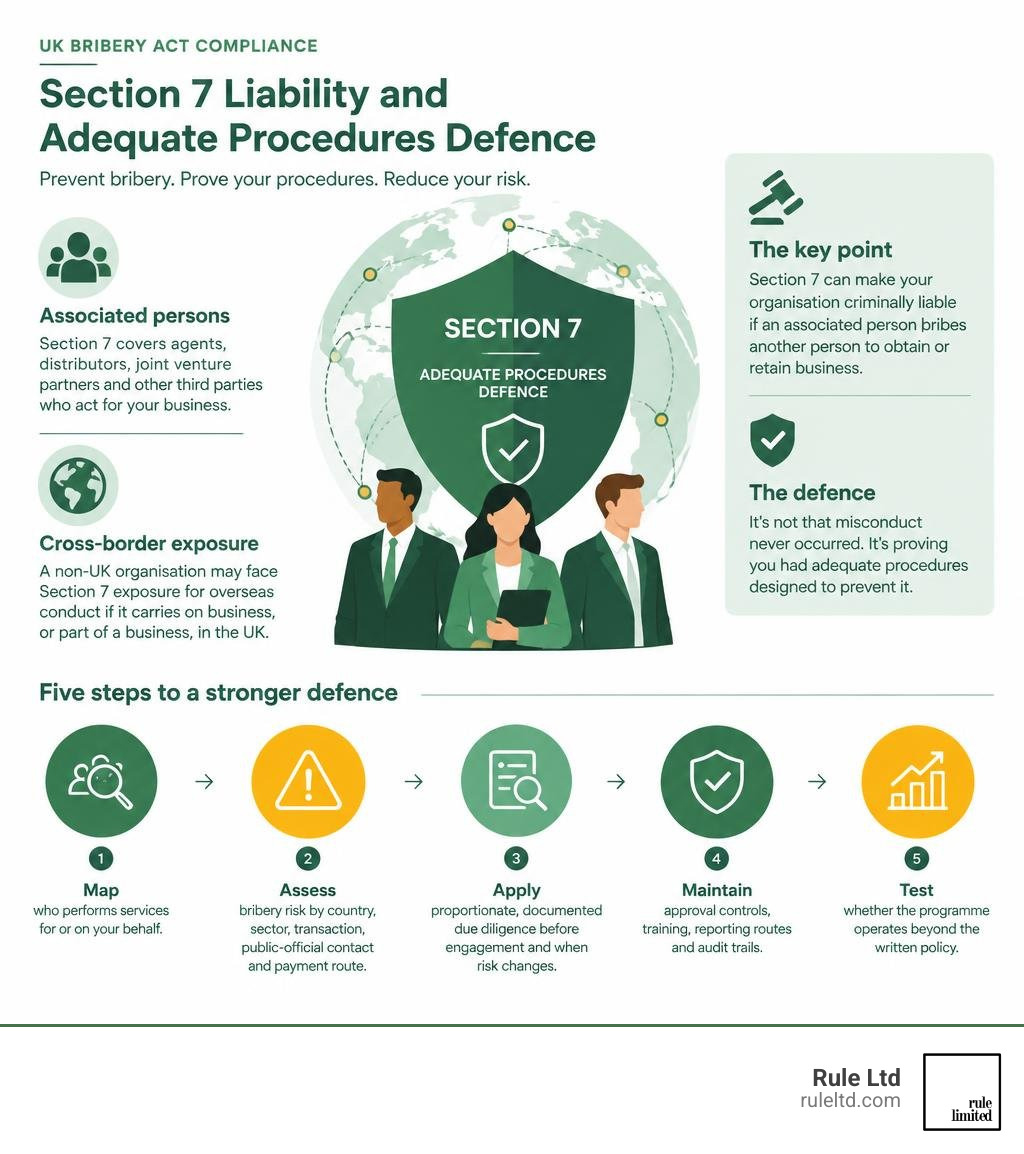
Defensible Section 7 compliance requires proving operational control over intermediaries in practice, rather than relying on paper governance. For General Counsel and Chief Compliance Officers managing cross-border commercial networks, establishing the statutory adequate procedures defence under the Bribery Act 2010 requires contemporaneous evidence across five operational priorities:
- Evidenced mapping of every intermediary performing services for or on behalf of the commercial organisation.
- Dynamic risk stratification calibrated to regional corruption indices, sector exposure, public-official interactions, and compensation models.
- Contemporaneous pre-engagement due diligence and event-driven reassessments.
- Audited approval records demonstrating how red flags were investigated, escalated, and resolved.
- Active operational testing proving compliance oversight operates independently of commercial pressures.
Under Section 7, corporate criminal liability turns on whether an associated person acted with intent to obtain or retain business or a business advantage. The sole statutory defence requires proving on the balance of probabilities that the organisation maintained adequate procedures designed to prevent it.
Enforcement authorities evaluate operations through an extraterritorial lens. Any commercial entity carrying on a business or part of a business in the UK faces prosecution for conduct occurring overseas. Defensibility depends on whether contemporaneous records demonstrate why an intermediary was engaged, what controls were applied, and how the business intervened when facts changed.
The Serious Fraud Office tests whether anti-corruption controls were actively resourced, monitored, and enforced during material transactions. This scrutiny converges with broader corporate crime mandates, including failure-to-prevent-fraud under the Economic Crime and Corporate Transparency Act 2023, requiring coherent corporate crime prevention governance.
This analysis constitutes general information, not legal advice. Corporate criminal exposure and procedure adequacy must be determined on the specific facts of each case.
Cross-border anti-corruption controls must also synchronise with trade compliance protocols, integrating an OFAC sanctions list search within an enterprise-wide sanctions compliance programme to mitigate concurrent regulatory liabilities.
Evidentiary Realities of Section 7: Associated-Person Exposure and Burden of Proof
Corporate criminal exposure under Section 7 of the Bribery Act 2010 establishes strict liability once prosecutors demonstrate that an associated person paid a bribe to secure or retain business. Defensibility shifts entirely to whether the commercial organisation can discharge its legal burden of proving adequate procedures.
Under Section 8, associated-person status is determined by factual function rather than formal corporate designation. Contractual disclaimers stating that a third party acts as an independent contractor carry negligible weight if operational realities show that a local distributor, customs broker, freight forwarder, or commercial consultant advanced the commercial interests or managed regulatory touchpoints of the principal.
When evaluating corporate cases under the Code for Crown Prosecutors, the Serious Fraud Office examines whether compliance procedures operated effectively in practice. Official The Bribery Act 2010 – Guidance establishes that adequacy depends on evidentiary depth, commercial proportionality, and substantiated responses to anomalies.
Operationalising Adequate Procedures Under SFO Scrutiny
Establishing an adequate procedures defence under Section 9 requires organisations to prove that controls were active, resourced, and systematically enforced at the material time of the misconduct. As analysed in our assessment of ABAC due diligence compliance, an isolated rogue act does not automatically invalidate a defence, but systematic failures to detect obvious red flags, audit high-risk relationships, or enforce contractual rights will defeat it.
Intermediary Risk Typologies: Structural Failure Modes
Third-party intermediaries remain the primary corporate exposure point under Section 7.

Executing defensible third-party due diligence requires addressing structural vulnerabilities across counterparty categories:
- Sales Agents and Finders: Success fees and variable commission structures create direct financial incentives to fund corrupt payments.
- Customs and Logistics Agents: High-volume interactions with border and port officials generate chronic exposure to demands for unlawful payments.
- Joint Venture Operating Partners: Split operational control without direct compliance oversight creates blind spots in high-risk markets.
- Permitting and Government Intermediaries: Entities engaged specifically to secure municipal or ministerial licences carry inherent corruption risk.
Where intermediaries operate in opaque jurisdictions or interact with public bodies, deploying enhanced due diligence for high risk entities creates the contemporaneous evidentiary record required to defend commercial engagements.
Operational Controls vs Paper Governance: Mitigating Core ABAC Failure Modes
Enforcement proceedings consistently expose the gap between formal policy drafting and practical control execution.
| Operational Control | Defective Compliance Posture | Defensible Evidential Standard |
|---|---|---|
| Risk Assessment | Static annual enterprise questionnaires stored without review. | Event-driven profiling triggered by jurisdiction entry, high-risk contracts, or ownership shifts. |
| Third-Party Diligence | Automated name screening without beneficial ownership verification. | Deep-dive UBO verification, PEP mapping, and source-of-funds analysis in local language. |
| Governance Oversight | Unmonitored policy attestations signed during onboarding. | Documented escalation pathways, compliance veto authority, and audited budget allocation. |
| Intermediary Controls | Boilerplate anti-bribery representations without audit verification. | Documented commercial justification, milestone-linked payments, and active audit enforcement. |
| Training & Awareness | Generic completion tracking for non-targeted e-learning modules. | Scenario-based training tailored to commercial, procurement, and supply chain personnel. |
| Monitoring & Audit | Financial reviews limited to balance-sheet reconciliation. | Targeted transaction testing, data anomaly analysis, and periodic investigative refreshes. |
Robust anti-corruption programmes integrate rigorous reputation risk assessment to evaluate counterparties’ actual market conduct and regulatory track records.
Beneficial Ownership Transparency and PEP Exposure
Concealed beneficial ownership structures in offshore jurisdictions frequently hide corrupt affiliations with foreign public officials. Executing an ultimate beneficial owner check is critical before onboarding intermediaries in high-risk jurisdictions.

Defensible corporate vetting requires investigating specific structural risks:
- Politically Exposed Persons (PEPs): Advanced PEP identification and classification to identify indirect familial or commercial links to government decision-makers.
- Nominee and Proxy Arrangements: Detecting informal nominee arrangements designed to obscure true beneficial control, as detailed in our analysis of beneficial ownership red flags from corporate intelligence.
- Offshore Intermediary Networks: Screening entities operating through jurisdictions with restrictive public registries.
- State-Owned Enterprise Overlaps: Uncovering undisclosed commercial intersections with state entities.
High-Risk Touchpoints: Hospitality Thresholds and Facilitation Extortion
Operational controls must address critical legal boundaries under UK law:
- Corporate Hospitality and Promotional Spend: Hospitality is lawful when reasonable, proportionate, and demonstrably connected to legitimate commercial presentation. Controls must enforce clear financial thresholds, pre-approval workflows, and documented business cases. Deploying conflict of interest screening prevents commercial gifts from compromising procurement integrity.
- Facilitation Payments: The Bribery Act provides no statutory exemption for facilitation payments. These non-discretionary payments are illegal under Sections 1 and 6. The only legal defence available to individuals is the common-law defence of duress where life or limb is threatened. Organisations must enforce strict payment prohibitions combined with mandatory incident escalation protocols.
Architectural Flaws in Modern UK Bribery Act Compliance Programmes
Corporate compliance failures rarely stem from an absence of policies. They arise from structural flaws in programme execution, resource allocation, and third-party supervision.
Addressing the core third party risk assessment failures that leave vendor exposure unverified requires eliminating specific structural defects:
- Static Point-in-Time Onboarding: Screening an intermediary exclusively during initial procurement leaves the business blind to subsequent ownership changes, new PEP appointments, or emerging adverse media. Active vendor compliance monitoring provides operational continuity.
- False-Positive Saturation: Over-reliance on generic database filters generates excessive unvalidated alerts, causing compliance teams to overlook genuine corruption risks.
- Siloed Risk Management: Separating anti-bribery due diligence from trade sanctions, fraud prevention, and ESG governance blinds organisations to systemic counterparty vulnerabilities.
- Unenforced Audit Rights: Including comprehensive anti-corruption audit provisions in contracts but never exercising them in high-risk relationships undermines corporate defensibility during SFO scrutiny.
Investigative Intelligence and Substantive Due-Diligence Capabilities
Modern risk management requires integrating human intelligence alongside automated screening to maintain an audit-ready compliance posture. Deploying real time monitoring alerts allows corporate legal teams to detect counterparty risk profile shifts instantly.
When anomalous transactions or adverse disclosures emerge, deploying professional corporate intelligence investigation services provides the factual clarity necessary to decide whether to remediate, suspend, or terminate an intermediary relationship.
At Rule Ltd, our investigative reports are prepared by experienced human analysts who reduce false positives, resolve data anomalies, and connect complex information across disparate sources. We provide defensible reporting alongside multilingual, multi-jurisdictional one-stop coverage across opaque emerging markets.
Compared with large incumbents that rely on bureaucratic workflows and opaque hourly consulting models, Rule Ltd provides faster, more cost-certain delivery. We quote fixed fees before work commences, delivering standard screening reports in two to three working days and comprehensive corporate intelligence or enhanced due diligence reports in approximately five working days.
Cross-Border Jurisdictional Overlap and Multi-Agency Enforcement
Multinational enterprises navigate concurrent enforcement actions by the UK SFO, the US Department of Justice (DOJ), the US Securities and Exchange Commission (SEC), and European authorities.
Navigating overlapping enforcement requires understanding critical legal distinctions:
- Extraterritorial Reach: The Bribery Act applies to conduct committed anywhere in the world by UK citizens, UK residents, and UK-incorporated bodies, as well as foreign commercial organisations that carry on a business, or part of a business, in any part of the United Kingdom.
- Public vs Commercial Bribery: While the FCPA focuses primarily on foreign public officials, the UK Bribery Act criminalises both public (Section 6) and purely commercial, business-to-business bribery (Sections 1 and 2).
- Strict Liability Standard: Section 7 does not require proof of corporate knowledge, wilful blindness, or involvement by senior management. The mere act of bribery by an associated person for the company’s benefit establishes corporate criminal liability, subject only to the adequate procedures defence.
- Sanctions and ABAC Convergence: Corrupt intermediaries frequently intersect with illicit finance networks, making proactive sanctions risk management an essential pillar of comprehensive anti-bribery governance.
Evidential Judgements, Jurisdictional Traps, and Defensible Positions
Assessing Ambiguous Associated-Person Status in Subsidiary Networks
An overseas subsidiary or affiliate qualifies as an associated person under Section 8 whenever factual circumstances demonstrate that it performs services for or on behalf of the parent entity. Corporate separateness provides no shield if the foreign operating entity negotiates concessions, secures municipal permits, or wins regional contracts that deliver commercial advantage or revenue to the UK parent. Establishing defensibility requires parent-level compliance governance to maintain documented oversight over the subsidiary’s high-risk commercial intermediaries and public-sector touchpoints.
Managing Incomplete Ownership Evidence and Opaque Corporate Vehicles
Where an intermediary operates through multi-layered holding structures, offshore secrecy jurisdictions, or informal nominee arrangements, an inability to identify the ultimate beneficial owner constitutes a primary risk finding rather than a routine administrative gap. In enforcement proceedings, proceeding with an engagement despite unverified beneficial ownership undermines an adequate procedures defence. Defensible governance requires commissioning independent corporate intelligence to identify controlling minds, evaluate PEP connections, and document specific risk mitigations before commercial onboarding.
Evidentiary Thresholds Under SFO Compliance Scrutiny
Under SFO evaluation standards, procedure adequacy depends on four evidential dimensions:
- Authority and Independence: Compliance personnel must possess formal authority to halt suspicious disbursements, veto high-risk counterparties, and report directly to the board audit committee without commercial override.
- Proportionate Scrutiny: Investigative due diligence must demonstrate deeper scrutiny on counterparties operating in high-risk jurisdictions, complex corporate structures, and public-facing touchpoints.
- Remediation Discipline: Concrete documentation proving that audit findings, whistleblowing disclosures, and control anomalies were independently investigated and remediated.
- Contemporaneous Audit Trails: Audited records establishing that counterparty risks were identified, evaluated, mitigated, and approved prior to entering commercial commitments.
Documenting Extortion Demands and Preserving Duress Defences
Because the Bribery Act provides no exception for administrative facilitation payments, informal disbursements made under coercive pressure create severe criminal exposure. The common-law defence of duress applies only where personnel face imminent threats of physical harm or death. To preserve corporate defensibility, legal counsel must ensure that any incident is recorded immediately with contemporaneous witness logs, escalated through formal legal channels, and evaluated for voluntary self-disclosure.
Conclusion: Structuring Defensible Anti-Corruption Governance
Achieving durable anti-corruption governance requires General Counsel, Chief Compliance Officers, and audit committees to move beyond passive tick-box controls. Defensible Section 7 risk management requires an active operational architecture built on dynamic risk profiling, verified beneficial ownership intelligence, and rigorous supervision of third-party intermediaries.
When regulatory authorities examine corporate conduct, defensibility rests entirely on contemporaneous evidence showing why a third party was engaged, how risks were mitigated, and how the organisation validated partner integrity.
Rule Ltd equips global enterprises with the investigative intelligence and third-party vetting necessary to withstand strict regulatory scrutiny. Learn more about operationalising defensible third-party governance through our dedicated Third Party Due Diligence practice.
Sources
- Bribery Act 2010
- Ministry of Justice, The Bribery Act 2010 – Guidance
- Serious Fraud Office, Evaluating a Corporate Compliance Programme Guidance
- Economic Crime and Corporate Transparency Act 2023
- Financial Action Task Force (FATF) Guidance on Beneficial Ownership
- UK Ministry of Justice, Bribery Act 2010 Quick Start Guide