
Regulatory Evolution: Navigating OCC Third-Party Relationships from 2023 to 2026
Managing OCC third-party relationships requires a bank to plan, conduct due diligence, negotiate contracts, monitor performance, and prepare for termination across the full lifecycle of each arrangement. Supervisory expectations focus on whether oversight is tailored to the specific operational, financial, and compliance risk posed by the counterparty, rather than on completing a standard checklist. The board and senior management remain accountable for approving risk appetite, governance policies, and the most significant third-party engagements.
The supervisory landscape governing bank arrangements with external entities has transformed substantially. In June 2023, the Office of the Comptroller of the Currency (OCC), the Federal Reserve Board, and the Federal Deposit Insurance Corporation (FDIC) issued the joint Interagency Guidance on Third-Party Relationships via OCC Bulletin 2023-17, Federal Reserve SR 23-4, and FDIC FIL-29-2023. This replaced earlier individual agency releases, including OCC Bulletin 2013-29, establishing a unified lifecycle for managing risk across all banking partnerships.
On 11 September 2026, the OCC, Federal Reserve Board, FDIC, and National Credit Union Administration (NCUA) announced proposed interagency third party risk management guidance, with the Federal Register notice published on 15 September 2026. Published on 15 September 2026 at 91 FR 58536, the proposal is identified as OCC Docket ID OCC-2026-0793 and NCUA Docket No. NCUA-2026-1684. It is not final, and comments are due by 16 November 2026. The June 2023 guidance remains the operative framework for the federal banking agencies unless and until final guidance replaces it. NCUA was not a party to the June 2023 guidance, which was issued through OCC Bulletin 2023-17, Federal Reserve SR 23-4, and FDIC FIL-29-2023.
| Dimension | June 2023 Interagency Guidance | September 2026 Proposed Guidance |
|---|---|---|
| Status | Current framework for OCC, Federal Reserve, and FDIC supervised banking organisations | Proposed guidance, published at 91 FR 58536; comments due 16 November 2026 |
| Participating Agencies | OCC, Federal Reserve Board, and FDIC; NCUA was not a party | OCC, Federal Reserve Board, FDIC, and NCUA |
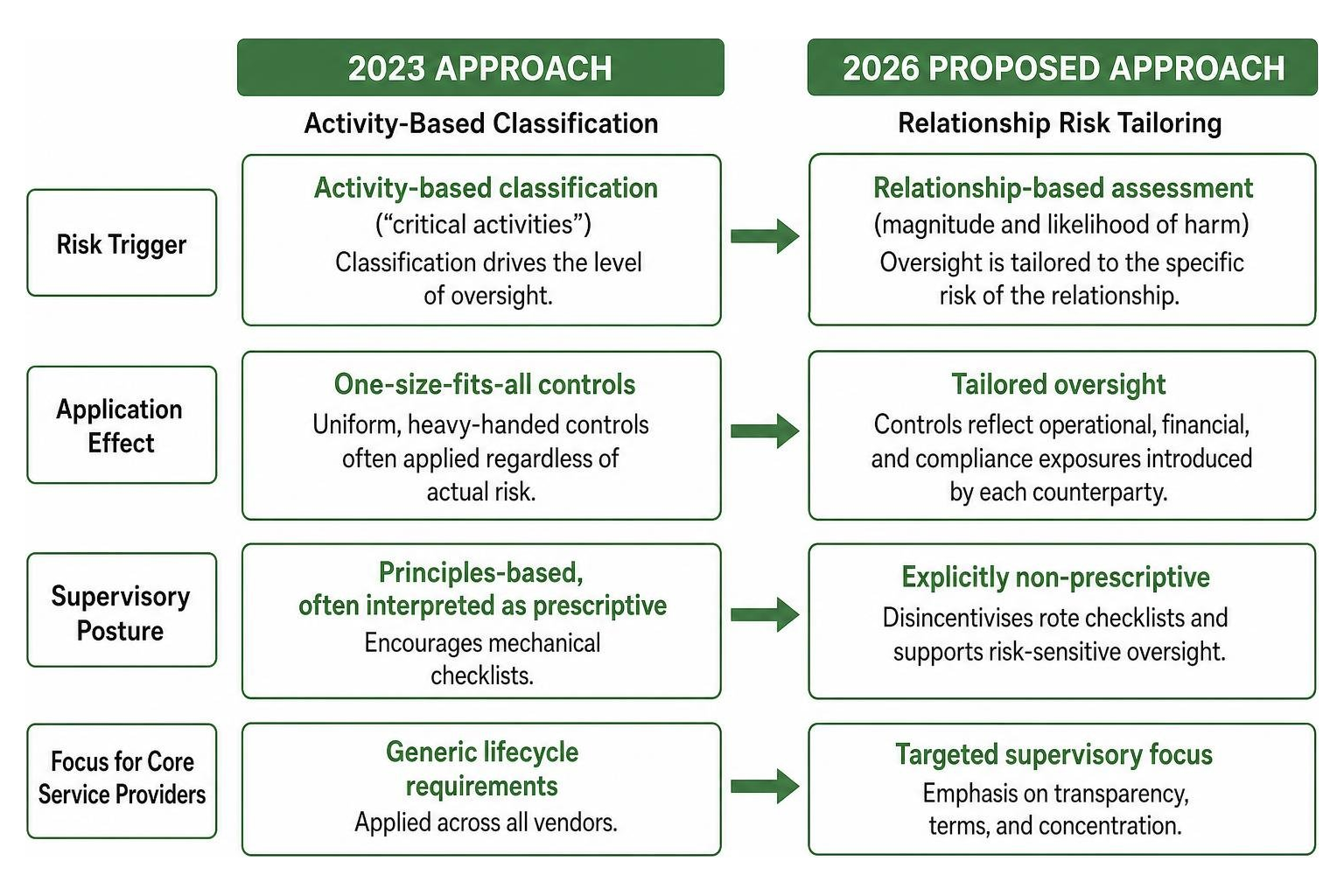
| Risk Approach | Lifecycle based, risk based oversight proportionate to the relationship | Tailoring based on the reasonably assessed risk of each relationship, the institution’s risk appetite, and available resources |
| Community Banks and Core Providers | Principles apply proportionately to size, complexity, and risk | Continues to emphasise tailoring to institutional size, complexity, risk profile, and the nature of the relationship |
| Supervisory Effect | Non-binding supervisory guidance used in examination and risk assessment | Proposed non-binding guidance; the agencies plan to rescind and replace existing guidance only if finalised |
Key Shifts in Supervisory Focus for OCC Third-Party Relationships
Under the 2023 framework, an institution must calibrate third party controls to the nature of each arrangement and to its own operating profile. The September 2026 draft would retain that risk sensitive approach while directing attention to the relationship’s reasonably assessed risk, the institution’s stated appetite and tolerances, and the resources available for oversight. It also brings NCUA into the proposed joint framework, although NCUA did not join the 2023 guidance.
The May 2024 community bank guide is a voluntary implementation resource, not a replacement for the June 2023 guidance. It provides examples and considerations for each stage of the lifecycle; a Federal Reserve-hosted copy of the community bank guide is also available. A later July 2024 joint statement on deposit arrangements delivered through third parties similarly restated existing expectations and identified risk-management practices; it did not create new supervisory expectations.
Verified Later Supervisory Developments
The May 2024 community bank guide gave institutions a practical resource for applying the June 2023 principles across planning, due diligence, contracting, monitoring, and termination. It states that use of the guide is voluntary and depends on the bank’s size, complexity, risk profile, and the relationship concerned.
In July 2024, the OCC, Federal Reserve, and FDIC issued a joint statement on third-party deposit arrangements and requested information on bank-fintech arrangements. The statement highlighted potential safety and soundness, compliance, and consumer risks, while confirming that it did not establish new supervisory expectations.
Recent enforcement actions illustrate the evidential standard expected in higher risk third party arrangements. Axiom Bank’s OCC formal agreement, dated 3 October 2024 (AA-SO-2024-83), addressed BSA/AML deficiencies. Its third party risk management article covered prepaid card and merchant processing partnerships. The OCC terminated the agreement on 29 April 2026. Rule’s regulatory enforcement actions analysis provides wider context on the supervisory themes these cases raise.
The State Exchange Bank consent order, FDIC-24-0035b, was issued jointly with the Oklahoma State Banking Department on 8 July 2024. It addressed due diligence and monitoring for third parties performing AML/CFT functions and was terminated on 29 June 2026.
On 14 June 2024, the Federal Reserve and Arkansas State Bank Department issued a consent cease and desist order against Evolve Bank & Trust over AML, risk management, and consumer compliance deficiencies in its fintech partnerships. The order required prior approval before the bank entered new fintech partnerships. The OCC’s Blue Ridge Bank consent order, AA-ENF-2023-68, was dated 24 January 2024 and publicly released on 15 February 2024. It addressed BSA/AML deficiencies and oversight of fintech partners and sub-partners, including an OCC non-objection requirement before new fintech partnerships. The OCC terminated that order on 13 November 2025.
How to Execute the OCC Third-Party Risk Management Lifecycle
Executing a defensible third-party risk management programme requires integrating risk analysis throughout the five stages of the supervisory lifecycle: planning, due diligence, contract negotiation, ongoing monitoring, and termination contingency.
- Planning: Define the strategic purpose, assess operational dependencies, identify regulatory requirements, and establish the risk appetite for the arrangement.
- Due Diligence: Conduct a comprehensive counterparty assessment that scales with the risk profile, examining financial health, legal exposure, operational resilience, and beneficial ownership.
- Contract Negotiation: Embed clear service level agreements, specific audit rights, data ownership rules, dispute procedures, and mandatory notification triggers.
- Ongoing Monitoring: Execute continuous vendor compliance monitoring, tracking key risk indicators, financial stability, operational performance, and adverse legal filings.
- Termination and Exit: Establish transition strategies, data retrieval or destruction protocols, and contingency procedures to mitigate disruption upon contract conclusion.
Effective execution depends on conducting an initial third-party risk assessment to ensure resources focus on relationships posing material risk.
Structuring Due Diligence for High-Risk OCC Third-Party Relationships
High-risk counterparties require rigorous vetting prior to contract execution. Due diligence must evaluate whether the entity has the financial capacity, operational resilience, and compliance infrastructure necessary to deliver the contracted services.
A structured framework includes:
- Corporate Structure and Governance: Verifying legal registration, parent-subsidiary relationships, and governing board composition.
- Financial Viability: Analysing audited financial statements, solvency metrics, debt arrangements, and overall balance sheet health.
- Regulatory and Legal Integrity: Checking litigation records, supervisory enforcement actions, and compliance histories across all operating jurisdictions.
- Subcontractor Exposure: Identifying critical fourth-party dependencies and assessing the counterparty’s own vendor management standards.
Institutions should refer to established methods for enhanced due diligence for high-risk entities and broader corporate due diligence standards to ensure documentation meets regulatory expectations.
Moving Beyond Database Checks with Human-Led Investigative Due Diligence
Automated screening and electronic databases often fail to uncover hidden risks in complex corporate structures. Automated searches generate high volumes of false positives while missing obscured ownership networks, circular holding entities, and recently filed foreign litigation.
Investigative due diligence deployed by human analysts resolves these limitations by examining primary corporate registries, physical court records, and local-language intelligence. This analytical depth is essential for executing an accurate ultimate beneficial owner check to establish true ownership-and-control structures under the OFAC 50% rule or OFSI equivalents.

A thorough investigation also ensures reliable PEP identification and classification, differentiating legitimate business figures from politically exposed persons operating through intermediaries. Identifying these factors produces defensible findings in a due diligence report that give General Counsel and Chief Compliance Officers actionable intelligence.
Tailoring Risk Governance for Community Banks and BaaS Models
Community banks and institutions operating Banking-as-a-Service (BaaS) arrangements face distinct challenges. While community banks often depend on a few dominant core service providers, BaaS sponsor banks manage high volumes of customer transactions distributed across fintech partners.

Proportionality allows smaller institutions to structure their oversight around actual institutional risk rather than bureaucratic processes. Risk governance requires establishing measurable key compliance risk indicators and maintaining formal documentation when senior management and the board accept residual risk.
Managing Fintech and Core Provider Dependencies
Fintech and core provider relationships concentrate operational, compliance, and legal exposures. Institutions must ensure contracts secure robust audit access, operational transparency, and defined contingency plans.
Ongoing oversight cannot rely on annual reviews alone. Instead, organisations should use structured continuous monitoring services to monitor material changes in a partner’s financial health, legal standing, or regulatory compliance throughout the relationship. This monitoring should be supported by human-led analysis of corporate records, litigation filings, and ownership changes rather than automated database alerts alone.
Frequently Asked Questions about OCC Third-Party Guidance
How would the September 2026 proposal affect oversight for community banks if finalised?
If adopted, the draft would formalise a more explicit link between the intensity of oversight, the risk posed by the particular relationship, and the institution’s documented risk appetite. Until final guidance takes effect, the 2023 interagency framework continues to govern the federal banking agencies’ supervisory expectations. The May 2024 community-bank implementation resource remains voluntary and does not supersede that framework.
What is the deadline for comments on the September 2026 proposal?
Public comments on the proposed guidance are due by 16 November 2026. The proposal was announced on 11 September 2026 and published on 15 September 2026 at 91 FR 58536. The Federal Register notice identifies OCC Docket ID OCC-2026-0793, Federal Reserve Docket No. OP-1881, and NCUA Docket No. NCUA-2026-1684.
When is board approval mandated under OCC third-party standards?
Board approval is expected for third-party arrangements that involve critical activities or present significant legal, operational, or financial exposure. The board remains accountable for approving risk governance policies, establishing risk tolerances, and reviewing due diligence and contract terms for the institution’s highest-risk relationships.
Conclusion
Managing third-party relationships under OCC expectations requires moving beyond superficial database checks to establish defensible counterparty transparency. Rule Ltd delivers human-led investigative intelligence that cuts through complex corporate structures, uncovers hidden beneficial ownership, and identifies legal exposures across worldwide jurisdictions. Our senior analysts provide fixed-price, cost-certain reports with fast turnaround times: screening reports are delivered in two to three working days, while enhanced due diligence and corporate intelligence reviews are completed in approximately five working days, with every engagement quoted before work begins.
To ensure your third-party programme meets supervisory expectations, explore our Third-Party Due Diligence services.
This article does not constitute legal advice; specific third-party arrangements and supervisory obligations must be assessed on a case-by-case basis.
Sources Relied On
- OCC, Federal Reserve Board and FDIC, “Interagency Guidance on Third-Party Relationships: Risk Management” (6 June 2023).
- OCC Bulletin 2024-11: Third-Party Relationships for Community Banks (3 May 2024).
- OCC, Federal Reserve Board and FDIC, “Agencies Remind Banks of Potential Risks Associated with Third-Party Deposit Arrangements and Request Additional Information on Bank-Fintech Arrangements” (25 July 2024).
- OCC, Federal Reserve Board, FDIC and NCUA, “Agencies Seek Comment on Proposed Third-Party Risk Management Guidance and Issue Statement on Community Bank Engagement with Core Service Providers” (11 September 2026).
- OCC, Federal Reserve Board, FDIC and NCUA, “Proposed Third-Party Risk Management Guidance” (15 September 2026, 91 FR 58536).
- OCC, “Proposed Third-Party Risk Management Guidance,” public-comment notice.
- OCC, “Formal Agreement with Axiom Bank, N.A.” (3 October 2024, AA-SO-2024-83), and termination order (29 April 2026, AA-SO-2026-26).
- FDIC and Oklahoma State Banking Department, “Consent Order: The State Exchange Bank” (8 July 2024, FDIC-24-0035b).
- Federal Reserve Board and Arkansas State Bank Department, “Cease and Desist Order: Evolve Bancorp, Inc. and Evolve Bank & Trust” (14 June 2024).
- OCC, “Consent Order: Blue Ridge Bank, N.A.” (AA-ENF-2023-68).