
Withdrawn SEC Outsourcing Proposals Do Not Absolve Counterparty Liability
SEC vendor due diligence must focus on the legal, financial, and structural integrity risks an external counterparty introduces, rather than relying on standard self-attestation questionnaires. For vendors and intermediaries that influence an adviser’s investment mandates, valuation processes, or regulatory compliance, firms must verify corporate ownership and ultimate control, screen counterparties for cross-border sanctions and adverse regulatory findings, assess anti-bribery and conflict risks, and maintain documented resolutions for every identified red flag. While the SEC formally withdrew its proposed rule on outsourcing by investment advisers [8], that withdrawal does not relieve firms of existing compliance and supervisory duties under federal securities laws [1].
Automated screening tools frequently flag false positives or fail to penetrate multi-tiered offshore holding structures. Defensible third-party due diligence must establish the true identity of controllers, verify corporate standing across primary registers, and evaluate the evidential weight of adverse findings before an engagement is executed.
Rule Ltd’s approach to SEC vendor due diligence centres on independent corporate intelligence, unravelling beneficial ownership, cross-border sanctions exposure, and executive integrity to provide compliance leaders with defensible, analyst-verified findings.
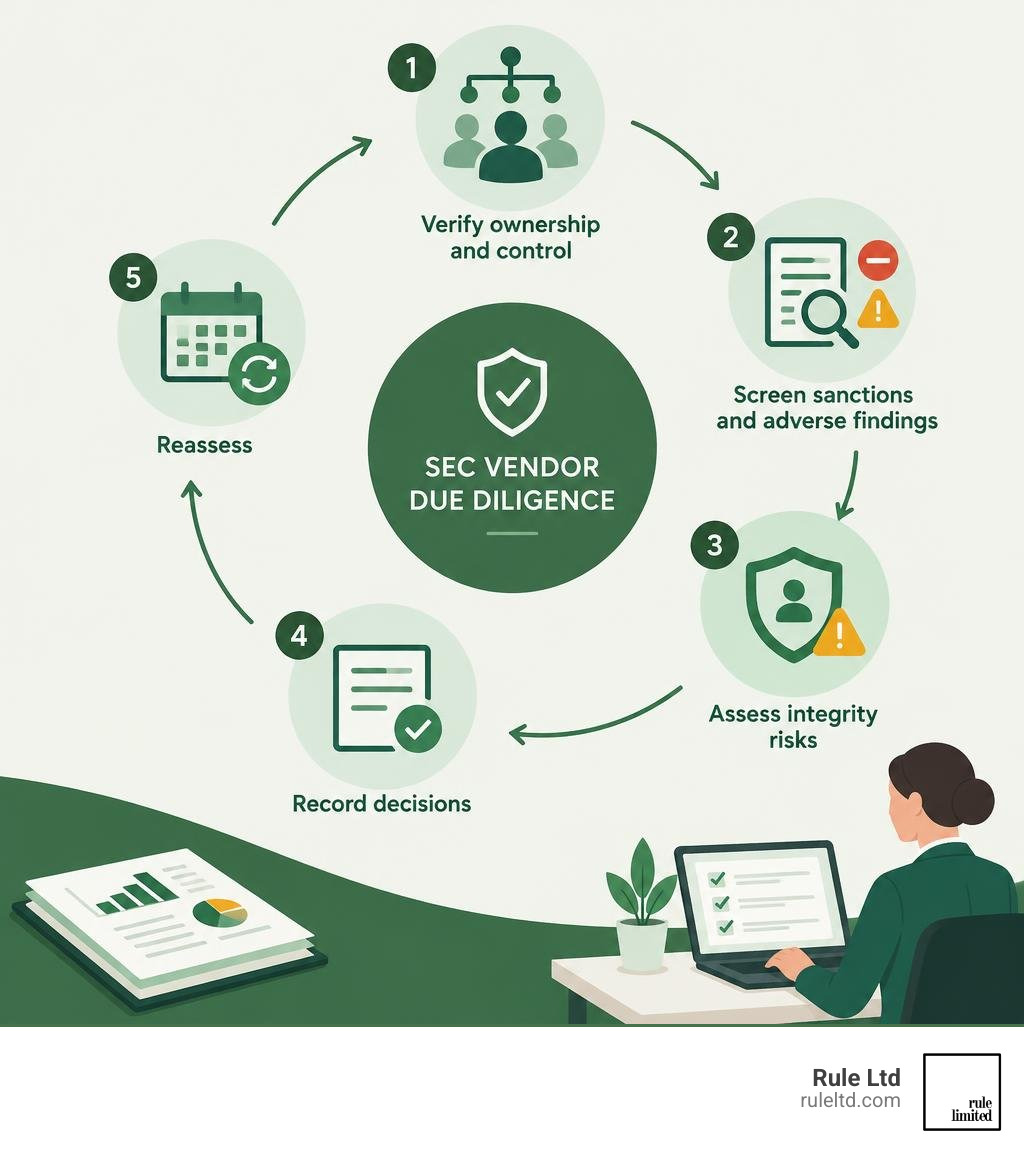
Fiduciary Accountability and Counterparty Due Diligence
Registered investment advisers routinely delegate operational functions to external intermediaries, valuation agents, sub-advisers, and fund administrators. However, delegating critical operations does not delegate fiduciary liability.
Under the Investment Advisers Act of 1940, registered advisers retain an unwaivable fiduciary duty to act in their clients’ best interests [1]. When an adviser engages a third party to perform functions integral to its advisory mandate, regulatory scrutiny falls squarely on the registered entity. Failures or misconduct by external service providers are treated by examiners as internal supervision and compliance failures under Rule 206(4)-7 [1].
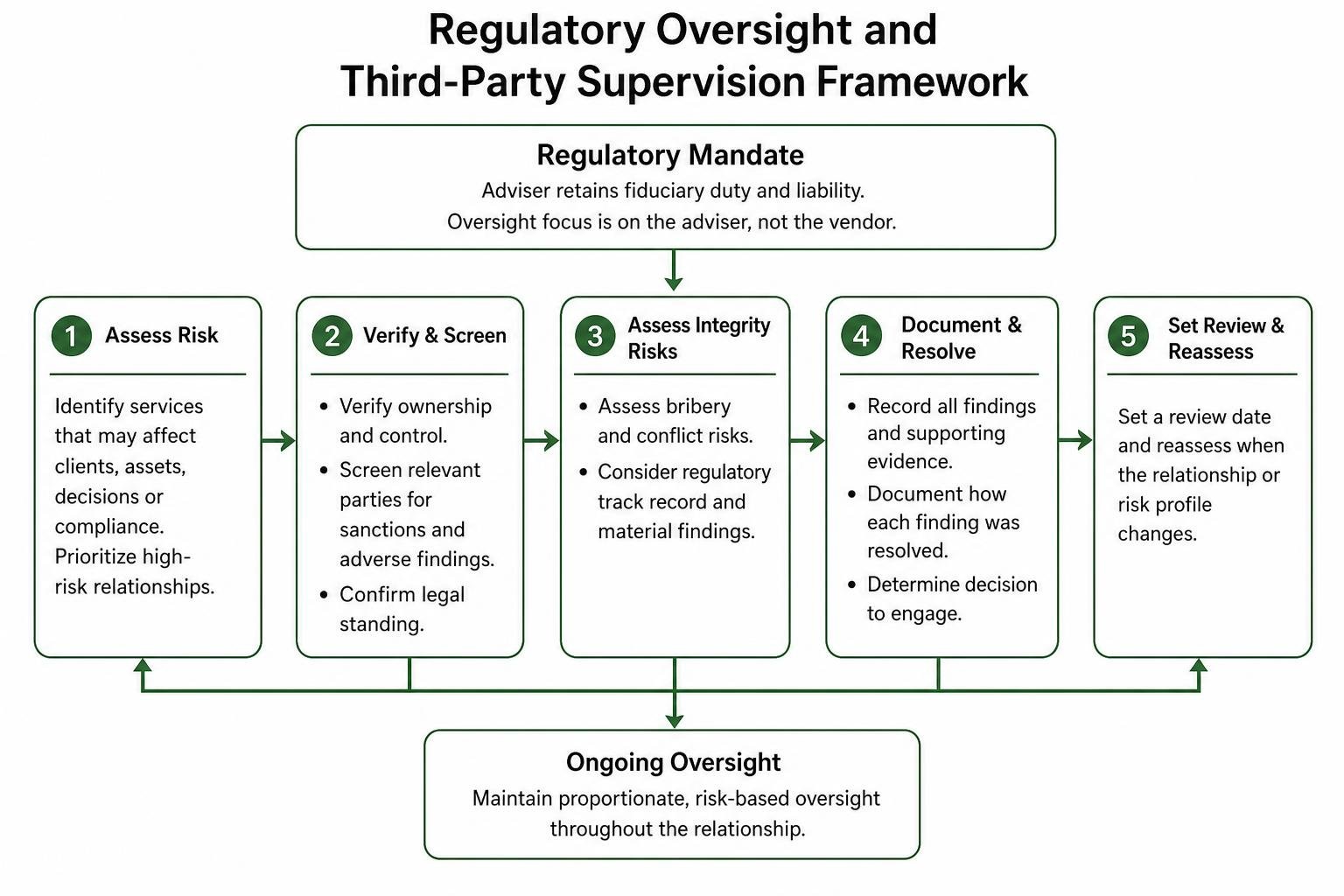
Advisers must establish defensible corporate due diligence standards that evaluate corporate transparency, legal standing, and regulatory disciplinary track records across their entire intermediary network.
Materiality Thresholds and Fiduciary Scope
A defensible third-party oversight framework distinguishes commoditised service providers from high-risk counterparties whose failure directly impacts regulatory standing or client assets. High-risk relationships encompass entities that influence investment decisions, pricing, trade execution, or compliance reporting.
When evaluating high-risk counterparties, compliance teams executing a third-party risk assessment must focus on structural integrity:
- Verifying the counterparty’s corporate registration, legal standing, and operating licences across all active jurisdictions
- Uncovering corporate ownership hierarchies to ensure no hidden counterparties, politically exposed persons, or sanctioned entities exercise control
- Confirming that key principals possess verified professional qualifications and clean regulatory records
- Assessing undisclosed commercial conflicts between the vendor’s ownership and the adviser’s client mandates
Regulatory Examination Priorities and Evidential Standards
The SEC Division of Examinations continues to focus on third-party oversight across examination cycles, reaffirming supervisory scrutiny in its 2026 examination priorities [2]. Examiners assess whether advisers maintain robust supervisory controls, retain verifiable due diligence audit trails under the Books and Records Rule (Rule 204-2), and independently verify vendor representations [1].
Deficiency findings frequently highlight advisers that rely on generic questionnaire certifications without corroborating corporate claims. When an adviser engages an external service provider without independently reviewing its regulatory track record and beneficial ownership, examiners view that lapse as a failure of supervisory controls.
Investigative Corporate Due Diligence Versus Automated Screening

A defensible vendor oversight programme requires evidence-based corporate intelligence rather than automated check-box compliance. Automated databases and portal questionnaires frequently generate unvetted false positives while missing hidden risks such as offshore shell ownership or indirect regulatory sanctions.
| Diligence Category | Automated Basic Screening | Investigative Corporate Due Diligence |
|---|---|---|
| Ownership Verification | Relies on self-declared vendor portal inputs | Primary registry unravelling to identify ultimate beneficial owners |
| Sanctions Assessment | Direct name matching against consolidated lists | Multi-layered ownership aggregation and OFAC 50% rule analysis |
| Reputational Risk | Automated keyword scrapes yielding high false positives | Analyst-verified adverse media across local-language primary sources |
| Disciplinary History | Limited to public federal court filings | Comprehensive review of domestic, cross-border, and offshore tribunals |
| Integrity Review | Binary pass/fail algorithms | Deep-dive integrity profiling on key executives and beneficial owners |
Conducting rigorous third-party due diligence requires compliance teams to retrieve primary corporate filings, cross-examine commercial registers, and corroborate findings across multiple legal jurisdictions.
Critical Failure Modes in Vendor Due Diligence Programmes
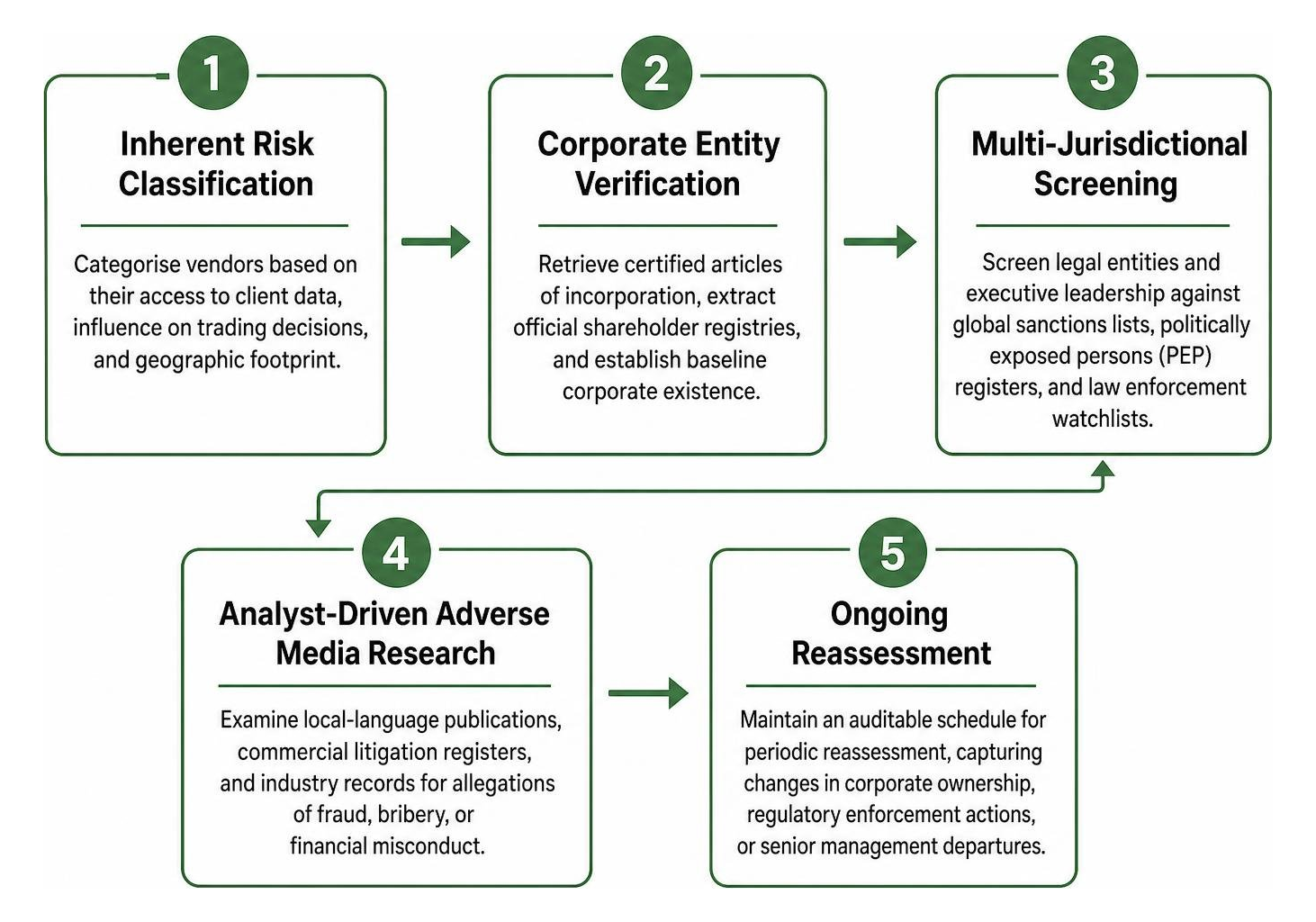
Compliance failures rarely arise from a complete absence of diligence; they stem from structural blind spots within standard onboarding procedures:
- Over-Reliance on Self-Attestation: Accepting vendor-completed questionnaires without retrieving independent company registry filings or verifying share capital.
- Superficial Sanctions Screening: Screening only the immediate contracting entity while ignoring intermediate holding companies and individual controllers.
- English-Language Bias: Missing local litigation, regulatory reprimands, or adverse press by relying solely on English-language database aggregators.
- Static Onboarding Files: Treating due diligence as a one-time onboarding exercise rather than implementing vendor compliance monitoring to capture ownership transfers, management changes, or regulatory enforcement actions.
Verifying Counterparty Track Records and Governance
Evaluating an external provider requires assessing its corporate governance, solvency, and regulatory discipline. Compliance officers must look beyond commercial assertions to determine whether the counterparty has been subject to confidential regulatory censures, civil fraud claims, or structural ownership disputes.
Conducting background checks and key personnel vetting services on the vendor’s directors, partners, and key compliance executives ensures that the individuals steering the organisation possess unblemished regulatory histories. Verifying professional track records through official regulatory registers and court filings protects the adviser from partnering with rogue operators or unstable counterparties.
Managing High-Risk Counterparties: Beneficial Ownership and Sanctions Exposure

One of the most complex areas of vendor due diligence involves unravelling multi-tiered ownership structures. Complex offshore holding companies, nominee director arrangements, and trust vehicles frequently obscure who owns and controls external vendors and intermediaries.
Failing to identify who stands behind a corporate vendor exposes registered entities to severe regulatory enforcement, particularly under cross-border sanctions regimes. Compliance teams must conduct an independent ultimate beneficial owner check to establish true ownership percentages and verify controlling interests.
Applying SEC Vendor Due Diligence to Cross-Border Intermediaries
When registered investment advisers engage offshore intermediaries, fund administrators, or foreign brokers, jurisdictional transparency diminishes significantly. Intermediaries registered in secrecy jurisdictions or free-trade zones present elevated compliance risks.
Effective vendor evaluation requires conducting a geopolitical risk assessment and digital due diligence to identify whether corporate structures involve state-owned enterprises, politically exposed persons, or jurisdictions subject to international monitoring by bodies such as the Financial Action Task Force [6].
Sanctions Screening and OFAC Compliance Pitfalls
Sanctions compliance extends beyond screening an immediate entity name against the Office of Foreign Assets Control (OFAC) Specially Designated Nationals (SDN) list. Under the OFAC 50% Rule, any entity owned in the aggregate, directly or indirectly, 50 percent or more by one or more blocked persons is considered sanctioned, regardless of whether the entity itself is named on a sanctions list [3].
Similar strict standards apply under the UK Office of Financial Sanctions Implementation (OFSI) ownership-and-control guidance [4] and European Union sanctions regulations [7]. Navigating the 50% rule and other OFAC compliance program pitfalls requires calculating aggregated shareholdings across multi-layered holding companies. Human analysts must trace parent entities through each intermediate holding layer to verify that no blocked individuals hold minority stakes that sum to a controlling or 50 percent interest.
Anti-Bribery, FCPA, and Books and Records Integrity
Registered investment advisers and their affiliates frequently fall under the jurisdiction of the Foreign Corrupt Practices Act (FCPA)—whether as domestic concerns, SEC reporting issuers, or agents acting on their behalf—which prohibits corrupt payments to foreign public officials to obtain or retain business [5]. In financial services, third-party introducers, local placement agents, and foreign operating consultants represent primary sources of anti-corruption liability.
Intermediaries operating in high-risk markets must be thoroughly vetted to ensure they do not channel improper benefits to government officials or sovereign wealth fund managers. This process requires identifying politically exposed persons through PEP identification and classification to uncover hidden family or commercial ties between vendor executives and state decision-makers.
Bribery and Corruption Red Flags in Third-Party Networks
Advisers should train compliance teams to spot structural red flags during vendor onboarding and ongoing review:
- Vague consulting or introducer mandates with success-fee arrangements disproportionate to commercial market rates
- Requests for commission payments to third-party bank accounts located in offshore secrecy jurisdictions
- Corporate structures that incorporate nominee shareholders or lack verifiable commercial premises
- Intermediaries introduced at the explicit request of foreign government officials or state-linked investment executives
Following a practical guide to ABAC due diligence compliance enables advisers to uncover uncommercial fee arrangements, verify legitimate business capability, and document defensible anti-bribery reviews.
Recordkeeping Obligations and Subcontractor Transparency
Under Rule 204-2 of the Investment Advisers Act (the Books and Records Rule), registered advisers must maintain orderly, accessible records that substantiate operational integrity and compliance oversight [1]. When an adviser relies on an external vendor to store or maintain required regulatory books and records, examiners expect the firm to retain immediate, unhindered access to those materials.
Advisers must also manage fourth-party risk, which arises when contracted vendors subcontract operational tasks to downstream entities. If a primary service provider delegates trade reconciliation, client records processing, or pricing calculations to an unvetted offshore subcontractor, the adviser’s risk exposure multiplies. Engaging corporate intelligence investigation services ensures visibility into the entire vendor delivery chain, confirming that subcontractors meet equivalent governance and regulatory standards.
Strategic Considerations for Compliance Leaders
Strict-Liability Exposure from Beneficial Ownership Opacity
Opaque corporate structures conceal whether a third party is owned or controlled by sanctioned entities, politically exposed persons, or commercial counterparties with undisclosed conflicts of interest. Under strict-liability regimes such as OFAC sanctions [3] and OFSI regulations [4], lack of knowledge is not a defence against unlawful dealings. Without human-led corporate intelligence to trace ultimate beneficial owners through offshore holding layers, firms face substantial enforcement penalties and reputational damage.
Rule 204-2 Evidential Thresholds and Audit Readiness
Under Rule 204-2 [1], investment advisers must retain complete due diligence files, including primary corporate registry filings, sanctions screening audit trails, PEP assessments, adverse media reviews, and written escalation memos for at least five years (the first two years in an easily accessible place). Examiners expect documentation detailing not just the screening results, but the precise rationale and evidence used to clear any adverse findings before onboarding.
Dynamic Triggers Versus Static Periodic Reviews
A defensible oversight framework pairs initial pre-contract corporate intelligence with continuous event-driven monitoring [2]. Rather than relying on annual questionnaires, compliance teams establish triggers for re-investigation upon material events, including changes in shareholding, executive departures, corporate restructuring, or cross-border regulatory enforcement.
Conclusion
Building a defensible third-party oversight framework requires investment advisers to move beyond superficial compliance questionnaires and automated screening software. When regulatory examiners evaluate a firm’s supervisory controls, they expect clear, verifiable documentation demonstrating that critical service providers have been independently investigated and cleared of ownership risks, sanctions exposure, and anti-corruption vulnerabilities.
Rule Ltd provides objective corporate intelligence and integrity due diligence for global enterprises, investment funds, and compliance leaders. Our human analysts cut through false positives, unravel complex cross-border ownership structures, and deliver defensible intelligence across worldwide jurisdictions.
We deliver fixed-price, cost-certain screening reports within two to three working days, and bespoke enhanced due diligence investigations in approximately five working days, with fixed pricing confirmed before work begins. Ensure your firm’s vendor management framework satisfies the highest regulatory standards by requesting comprehensive third-party due diligence from our specialist analysts.
Footnotes and Regulatory Authorities
- Investment Advisers Act of 1940, 15 U.S.C. § 80b-1 et seq., including Rule 206(4)-7 (Compliance Procedures and Practices) and Rule 204-2 (Books and Records Rule).
- U.S. Securities and Exchange Commission, Division of Examinations, 2026 Examination Priorities: Investment Advisers (Supervisory Oversight and Compliance with Rule 206(4)-7).
- U.S. Department of the Treasury, Office of Foreign Assets Control (OFAC), Specially Designated Nationals and Blocked Persons List; Revised Guidance on Entities Owned by Persons Whose Property and Interests in Property Are Blocked (50% Rule).
- UK HM Treasury, Office of Financial Sanctions Implementation (OFSI), General Guidance on Financial Sanctions: Ownership and Control.
- Foreign Corrupt Practices Act of 1977 (FCPA), 15 U.S.C. §§ 78dd-1 et seq.
- Financial Action Task Force (FATF), High-Risk Jurisdictions Subject to a Call for Action and Jurisdictions under Increased Monitoring.
- Council Regulation (EU) No 269/2014 and European Commission Consolidated Guidance on Restrictive Measures: Ownership and Control Criteria.
- U.S. Securities and Exchange Commission, Regulatory Flexibility Act Agenda (Withdrawal of Proposed Outsourcing by Investment Advisers Rule, Release No. IA-6176).
This article is provided for general informational purposes only and does not constitute legal advice. Specific matters must be assessed case by case by qualified counsel.