
Why a minority stake can still create sanctions exposure
Sanctioned minority shareholders do not automatically make a company subject to an asset freeze. Under OFAC rules, however, separate blocked holdings are combined: if they reach 50% of the company, the company is blocked. Below that threshold, the sanctioned shareholder’s own interest remains blocked, including dividends owed to them. EU rules also require an assessment of control, not just share percentages
The immediate question is therefore not simply whether a shareholder can be bought out. It is who owns and controls the shares, what payments are due, and whether a proposed transfer needs regulatory authorisation. A forced sale may be valid under company law yet still breach an asset freeze.
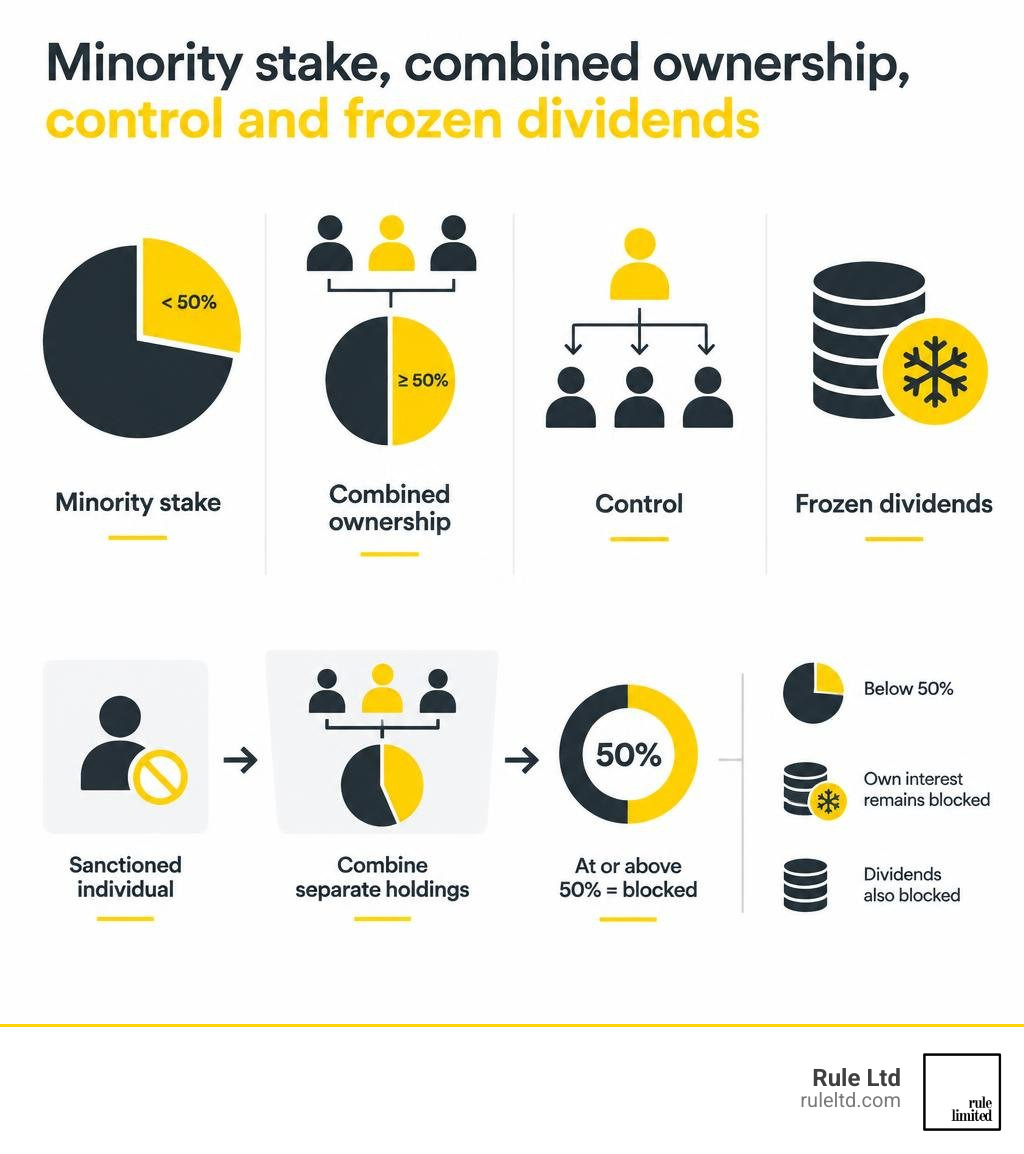
Regulatory Exposure: Navigating the 50 Percent Rule and Sanctioned Minority Shareholders
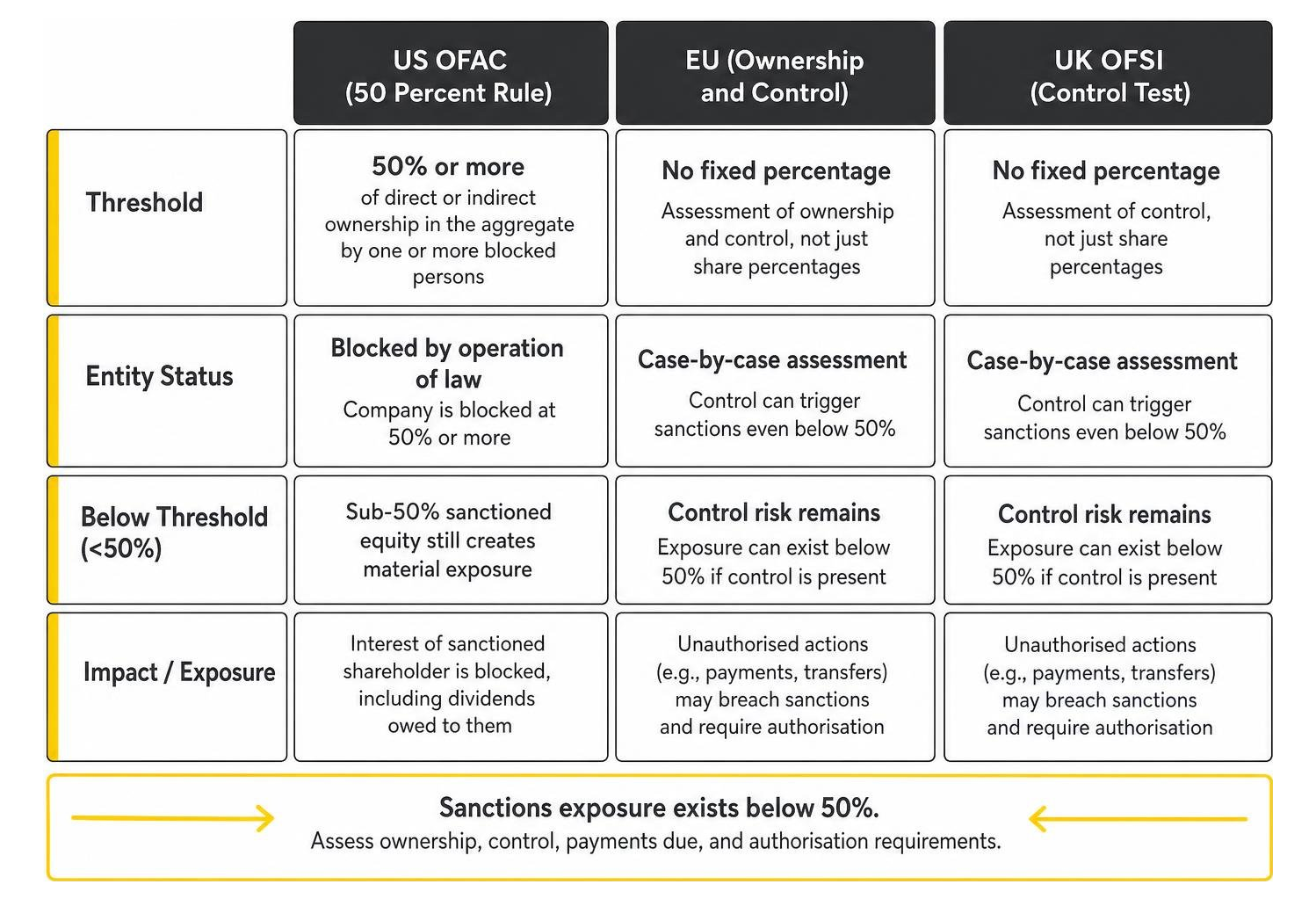
When an enterprise identifies a designated person on its capitalisation table, corporate counsel must distinguish between the asset freeze applied to the individual’s specific property and the legal status of the operating entity itself. Regulatory authorities enforce strict liability regimes across international borders, meaning that operational missteps—such as facilitating an unauthorised corporate restructuring or distributing equity value—create severe civil and criminal liability.
A robust framework for sanctions risk management requires compliance teams to look past surface equity figures. Under published OFAC FAQ guidance on the 50 Percent Rule, an entity whose direct or indirect ownership is held 50 percent or more in the aggregate by one or more blocked persons is blocked by operation of law. However, retaining sub-50 percent sanctioned equity still creates material exposure. Financial institutions routinely freeze clearing lines, counterparties terminate commercial contracts under standard sanctions clauses, and institutional investors demand immediate remedies to prevent reputational contagion.
Dissecting the 50 Percent Rule: US OFAC, EU, and UK OFSI Thresholds
The legal standards governing ownership thresholds diverge across key Western and Asian trade hubs. Understanding these mechanical differences is vital for legal counsel managing international corporate groups.
| Jurisdiction | Statutory Ownership Threshold | Aggregation of Unrelated Blocked Parties | Separate De Facto Control Test |
|---|---|---|---|
| United States (OFAC) | 50.0% or greater (direct or indirect) | Mandatory across all programmes | No automatic blocking by control alone (designation risk remains) |
| European Union (EU) | 50.0% or greater (proprietary rights) | Mandatory under Commission FAQs | Yes (independent basis for asset freeze) |
| United Kingdom (OFSI) | Greater than 50.0% (50.001%+) | No (unless joint arrangement exists) | Yes (independent basis under Regulation 7) |
Under US Treasury regulations, indirect ownership cascades down tiered corporate holdings only through intermediate entities that are themselves 50 percent or more blocked. If a sanctioned individual owns 50 percent of HoldCo A, and HoldCo A owns 40 percent of OpCo B, OpCo B is treated as 40 percent blocked. However, if the sanctioned party owns only 49 percent of HoldCo A, none of HoldCo A’s downstream equity in OpCo B is attributed to the blocked person under US ownership mechanics.
Conversely, the European Union enforces an independent control standard alongside ownership. According to European Commission guidance on ownership and control, an operating entity is subject to an indirect asset freeze if a designated party holds dominant influence, possesses the right to appoint the majority of management, or guarantees the entity’s commercial liabilities, even when their nominal equity is well below 50 percent.
The UK Office of Financial Sanctions Implementation (OFSI) applies a threshold of strictly greater than 50 percent (>50.001%) for ownership, while maintaining rigorous control tests under Regulation 7 of the Russia (Sanctions) (EU Exit) Regulations 2019.
Aggregation Traps and Control Tests in Sub-50 Percent Holdings
Aggregation represents one of the most common regulatory failure modes in corporate governance. If two designated persons each hold a 25 percent minority stake in an operating business, OFAC combines those holdings to reach the 50 percent threshold, instantly blocking the operating entity. This applies even if the individuals are designated under entirely different sanctions regimes (for example, combining counter-narcotics and regional conflict designations).
Recent administrative interpretations have increased cross-border complexity. Modern analysis of Russia sanctions and minority share aggregation demonstrates that European Union authorities have aligned their enforcement expectations with US standards by aggregating minority holdings across listed persons in non-listed companies.
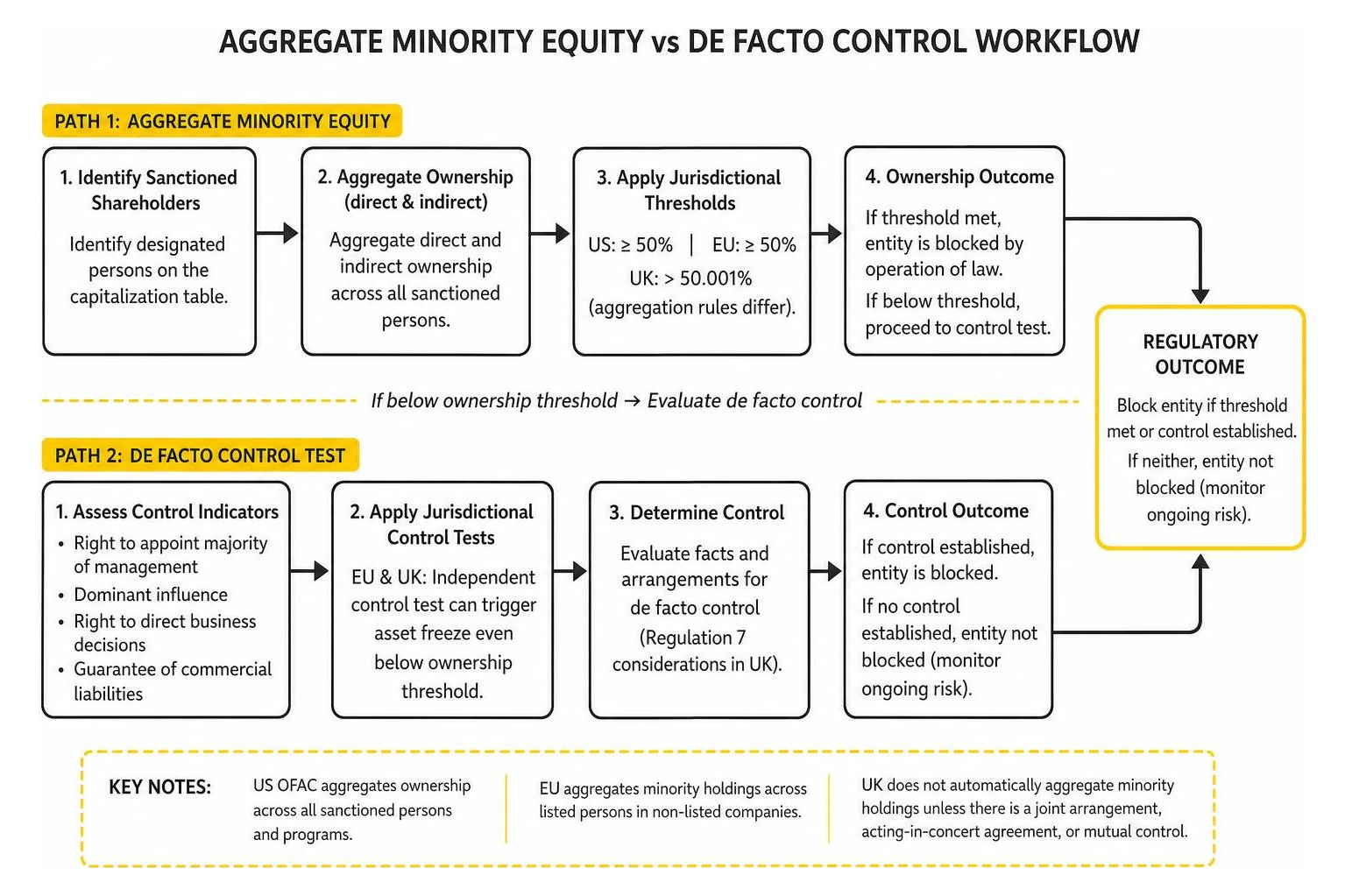
In contrast, UK OFSI does not automatically combine minority shareholdings owned by distinct designated persons unless there is demonstrable evidence of a joint arrangement, acting-in-concert agreement, or mutual control. However, corporate compliance officers cannot treat the absence of aggregation in the UK as a safe harbour. Sophisticated screening workflows must apply advanced corporate fraud detection protocols to uncover whether disguised voting pacts or proxy agreements establish de facto control over the enterprise.
Legal Mechanisms for Divestment, Freeze-Outs, and Forced Buy-Outs

When corporate boards discover sanctioned minority shareholders on their capitalisation table, management often seeks to eliminate the designated party through statutory squeeze-outs or forced redemptions. However, corporate restructuring in a sanctions environment operates at the intersection of domestic company law and international asset freeze prohibitions.
Executing any equity transfer involving a designated person constitutes dealing in frozen funds or property. Therefore, executing a buy-out without specific statutory authority or formal regulatory licences breaches international trade restrictions. Conducting rigorous corporate due diligence before initiating restructuring ensures that all statutory steps are legally defensible and fully compliant with competent authorities.
Corporate Buy-Out Mechanisms and Legal Squeeze-Outs of Sanctioned Minority Shareholders
Boards attempting to exercise drag-along rights or compulsory acquisition clauses under shareholder agreements must navigate distinct regulatory hurdles:
- Licensing and Prior Authorisation: Under UK, EU, and US frameworks, executing a forced share transfer requires an explicit specific licence from OFSI, the relevant EU National Competent Authority, or OFAC before the share register is altered.
- Segregation of Consideration: As outlined in OFAC guidance on sub-50 percent minority holdings, consideration payable for redeemed shares cannot be transmitted directly or indirectly to the designated person. Funds must be deposited into a blocked, interest-bearing escrow account at an authorised domestic financial institution.
- Sterilisation of Governance Rights: Prior to obtaining divestment licences, the company must amend governance protocols to ensure the sanctioned shareholder cannot exercise voting rights, access non-public operational data, or participate in shareholder resolutions.
Reverse Stock Splits, Fractional Share Redemptions, and Fair Value Litigation
One mechanism utilised under certain corporate law jurisdictions to divest disruptive or sanctioned minority owners is the reverse stock split paired with mandatory fractional share redemption.
Under this corporate action, a board approves a high-ratio reverse stock split (for example, 100:1 or 500:1) deliberately calibrated to reduce the targeted minority holding to a fraction of a single share. Corporate statutes generally authorise the company to cancel fractional shares and redeem them for cash rather than issuing fractional share certificates.
This structural mechanism presents distinct legal advantages and operational traps:
- Standing Deprivation: Once the fractional share is redeemed, the divested holder loses continuous shareholder status, which eliminates their legal standing to maintain derivative lawsuits or bring fiduciary oppression claims against management.
- Appraisal Litigation and Fair Value: The divested shareholder’s sole remaining statutory remedy is typically restricted to exercising dissenter’s rights to challenge the valuation. In appraisal litigation, courts mandate payment of statutory “fair value” rather than “fair market value.” Crucially, fair value calculations legally prohibit the application of minority discounts or lack-of-marketability discounts.
- Asset Freeze Interception: While the corporate mechanism validly cancels the shares under company law, transferring the redemption cash directly to the designated party violates financial sanctions. The proceeds must be redirected to a blocked account under regulatory oversight.
Cross-Border Divergence: Statutory Squeeze-Outs in Guernsey, the UK, and the EU
Cross-border jurisdictions provide distinct statutory squeeze-out paths, each carrying specific sanctions compliance requirements:
- Guernsey: Under the Companies (Guernsey) Law, 2008 (Part XVIII), a bidder acquiring 90 percent of the target shares can serve a compulsory acquisition notice on remaining minority holders. When squeezing out a sanctioned shareholder, the company must ensure the statutory transfer forms and consideration are handled strictly in accordance with Guernsey Financial Services Commission (GFSC) sanctions licences.
- United Kingdom: Under Part 28 of the Companies Act 2006 (sections 974–991), a 90 percent bidder can compulsorily acquire dissenting equity. If the minority owner is an asset-frozen person under the Russia Regulations, the consideration must be held on statutory trust in a blocked account, and registration of the transfer requires prior OFSI clearance.
- European Union: EU Member States enforce cross-border mergers and takeovers under transposed European Company Law Directives. However, National Competent Authorities evaluate post-designation share cancellations strictly to verify that transactions are not sham transfers designed to facilitate capital flight or circumvent asset freezes.
Enhanced Due Diligence and Tracing Complex Minority Structures
Identifying minority sanctions exposure requires investigative methodologies that extend beyond automated database screening. Designated individuals rarely hold equity directly in commercial enterprises; instead, they deploy multi-tiered holding companies, offshore trusts, nominee arrangements, and immediate family members to conceal their beneficial ownership.
Uncovering these obfuscated structures demands corporate intelligence investigation services that combine public register audits with human-analyst inquiries to identify hidden equity paths and disguised de facto control.
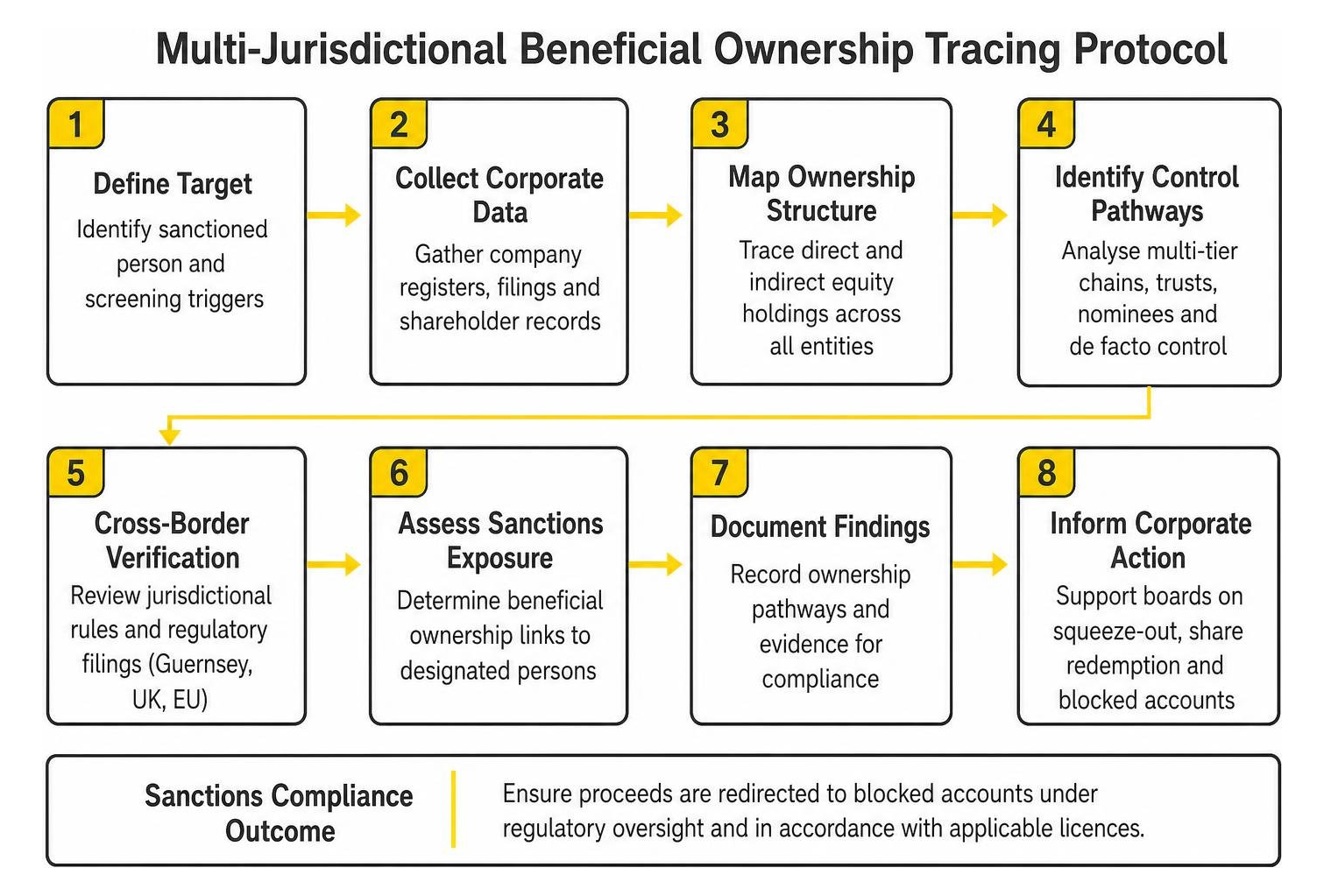
Asset Freezes, Blocked Accounts, and Governance Deadlock with Sanctioned Minority Shareholders
When a minority shareholder is designated under financial sanctions, the company faces immediate operational hurdles:
- Banking Disruption: Commercial banks will routinely freeze company operating accounts if international screening algorithms detect a designated person on the share register, halting ordinary payroll and supplier disbursements.
- Dividend Quarantine: Boards must immediately quarantine and segregate all declared dividends, profit shares, or debt repayments owed to the designated party, transferring them into isolated blocked suspense accounts.
- Governance Sterilisation: The company must ensure that quorum requirements under the Articles of Association do not cause operational paralysis. If the sanctioned shareholder refuses or is legally barred from voting, articles may require amendment to bypass blocked equity in non-sanctioned voting procedures.
Addressing these structural risks begins with detecting a beneficial ownership red flag from a routine corporate intelligence check before regulatory scrutiny or banking interventions occur.
Multijurisdictional Investigation Protocols for Obfuscated Cap Tables
Tracing complex corporate structures requires structured human-analyst review across multiple investigative dimensions:
- Multi-Tiered Registry Tracing: Conducting a rigorous ultimate beneficial owner check through primary corporate registries in key offshore jurisdictions, such as Cyprus, the British Virgin Islands, the Cayman Islands, the United Arab Emirates, and Singapore.
- Identifying Post-Designation Dilution: Tracking share transfers executed immediately before or following sanctions designations. Designated individuals frequently transfer equity down to 49.9 percent or shift shares to spouses, adult children, or corporate directors to evade 50 percent thresholds while retaining operational control.
- Evaluating Control Proxies: Reviewing side letters, shareholder voting agreements, and board appointment rights through enhanced due diligence to establish whether a minority shareholder exercises dominant influence over strategic decisions.
Frequently Asked Questions about Sanctioned Minority Shareholders
Can a company pay dividends to a minority shareholder who is designated under financial sanctions?
No. Paying dividends or disbursing commercial profits directly to a designated person is prohibited under US, UK, and EU sanctions regimes. Declared dividends attributable to frozen shares qualify as economic resources and must be held in segregated, interest-bearing blocked accounts at authorised domestic financial institutions. Companies cannot release these funds without an explicit specific licence from the relevant sanctions authority (such as OFAC or OFSI).
How do dissenter rights and fair value challenges apply when squeezing out a sanctioned party?
When a company executes a statutory squeeze-out or fractional share redemption against a sanctioned minority shareholder, the shareholder retains statutory dissenter’s rights to challenge the transaction’s valuation in court.
Judicial appraisal actions evaluate “fair value,” which legally excludes minority and lack-of-marketability discounts. While the court may determine a higher valuation, any additional payment ordered by the court remains subject to international asset freezes and must be paid directly into a blocked escrow account rather than distributed to the designated person.
Does UK OFSI aggregate minority stakes held by different sanctioned persons?
Under the UK Russia (Sanctions) (EU Exit) Regulations 2019, OFSI does not automatically combine the separate minority holdings of distinct designated persons to meet the greater than 50 percent ownership threshold.
However, aggregation applies under UK law if the shares are subject to a joint arrangement, if there is a formal voting agreement between the parties, or if one designated person exercises operational control over the rights of another. Furthermore, the entity remains subject to financial sanctions if any individual designated person exercises de facto control under Regulation 7.
Conclusion
Managing the legal and commercial risks associated with sanctioned minority shareholders requires balancing corporate law procedures with cross-border sanctions compliance. While a minority holding under 50 percent may not automatically freeze an entire operating business, aggregation rules, European control standards, banking friction, and reputational exposure demand rigorous governance safeguards.
Corporate boards, General Counsel, and Chief Compliance Officers must look beyond simple capitalisation table percentages. Defensible risk management requires identifying beneficial ownership, sterilising illicit governance control, isolating frozen economic streams, and obtaining appropriate regulatory licences before executing structural divestments.
Rule Ltd provides comprehensive third-party due diligence, enhanced due diligence, and corporate intelligence investigation services to help global enterprises identify hidden beneficial owners, manage complex shareholding structures, and maintain international regulatory compliance. Contact Rule Ltd to arrange a confidential discussion regarding your organisation’s third-party risk management and corporate governance requirements.