
Why Is Supplier Risk a Finding Rather Than a Forecast?
Predictive risk models often present supplier vulnerability as a probabilistic forecast. Algorithms generate abstract risk scores based on industry indices, geographic averages, or historical failure rates. For General Counsel and Chief Compliance Officers, however, probabilistic scores carry little weight when regulators demand evidential proof. A risk heat map cannot defend an organisation during an enforcement enquiry. Defensible risk management treats supplier vulnerability as an empirical finding: verified through primary records, authenticated ownership chains, and demonstrable integrity assessments.
Global supply networks are exposed to severe structural and integrity vulnerabilities. These exposures rarely stem from unforeseen disruptions; they originate from deliberately obscured corporate structures, undisclosed sub-tier intermediaries, and systemic non-compliance across lower supplier tiers. Superficial onboarding checks and self-disclosure questionnaires routinely miss these risks, creating unverified exposure across Tier-2 and Tier-3 vendors.
International regulatory frameworks have shifted from voluntary due diligence recommendations to strict statutory liability for supply network failures. Compliance leaders must navigate stringent enforcement mandates across jurisdictions:
- The UK Economic Crime and Corporate Transparency Act 2023 (ECCTA): Introduces a corporate offence for failure to prevent fraud, placing strict liability on organisations that fail to maintain reasonable fraud prevention procedures across their associated persons and supply chains.
- The German Supply Chain Due Diligence Act (Lieferkettensorgfaltspflichtengesetz or LkSG): Mandates continuous human rights and environmental risk management across direct suppliers and requires immediate risk analysis of indirect suppliers upon obtaining substantiated knowledge of violations.
- The US Uyghur Forced Labor Prevention Act (UFLPA): Establishes a rebuttable presumption that goods mined, produced, or manufactured wholly or in part in the Xinjiang Uyghur Autonomous Region violate Section 307 of the Tariff Act of 1930, requiring granular supply chain traceability down to raw material origins.
- OFAC and OFSI Ownership-and-Control Guidance: The US Office of Foreign Assets Control (OFAC) 50% Rule automatically blocks entities owned 50 percent or more in the aggregate by sanctioned parties, while the UK Office of Financial Sanctions Implementation (OFSI) applies sanctions where an entity is owned directly or indirectly over 50 percent or controlled by a designated person.
Relying on high-level vendor representations without verifying the underlying corporate fabric leaves multinationals vulnerable to sudden enforcement actions, heavy financial penalties, and reputational damage. Defensible compliance requires robust tools to identify vulnerabilities in global supplier networks that transform raw data leads into verified, objective findings.
What Are the Critical Hidden Vulnerabilities in Global Supplier Networks?
Structural legal and integrity vulnerabilities in global supply networks usually remain concealed beneath routine commercial transactions. Establishing effective oversight requires following supply chain transparency practices rather than settling for unverified supplier declarations.
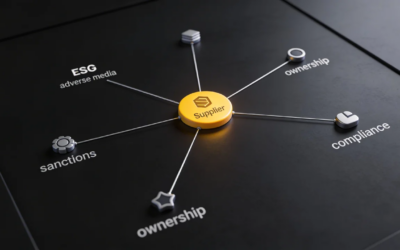
When organisations evaluate vendor networks, the most severe exposures emerge from hidden ownership chains, trade restrictions, and deliberate entity structuring.
Hidden Nominee Structures and Politically Exposed Persons (PEPs)
A significant integrity vulnerability is the presence of hidden ultimate beneficial owners (UBOs) obscured behind nominee directors, offshore holding companies, or complex trust instruments. High-risk actors and Politically Exposed Persons (PEPs) routinely employ proxy shareholders to conceal their commercial interests.
Uncovering undeclared political exposure is essential under international anti-corruption legislation, including the UK Bribery Act 2010 and the US Foreign Corrupt Practices Act (FCPA). When a state official holds an undisclosed financial interest in a supplier, routine contract payments can be treated as corrupt transactions. Conducting a rigorous ultimate beneficial owner check is critical to establish the natural persons who direct the enterprise and receive dividend flows.
Sanctions Evasion and Front Companies
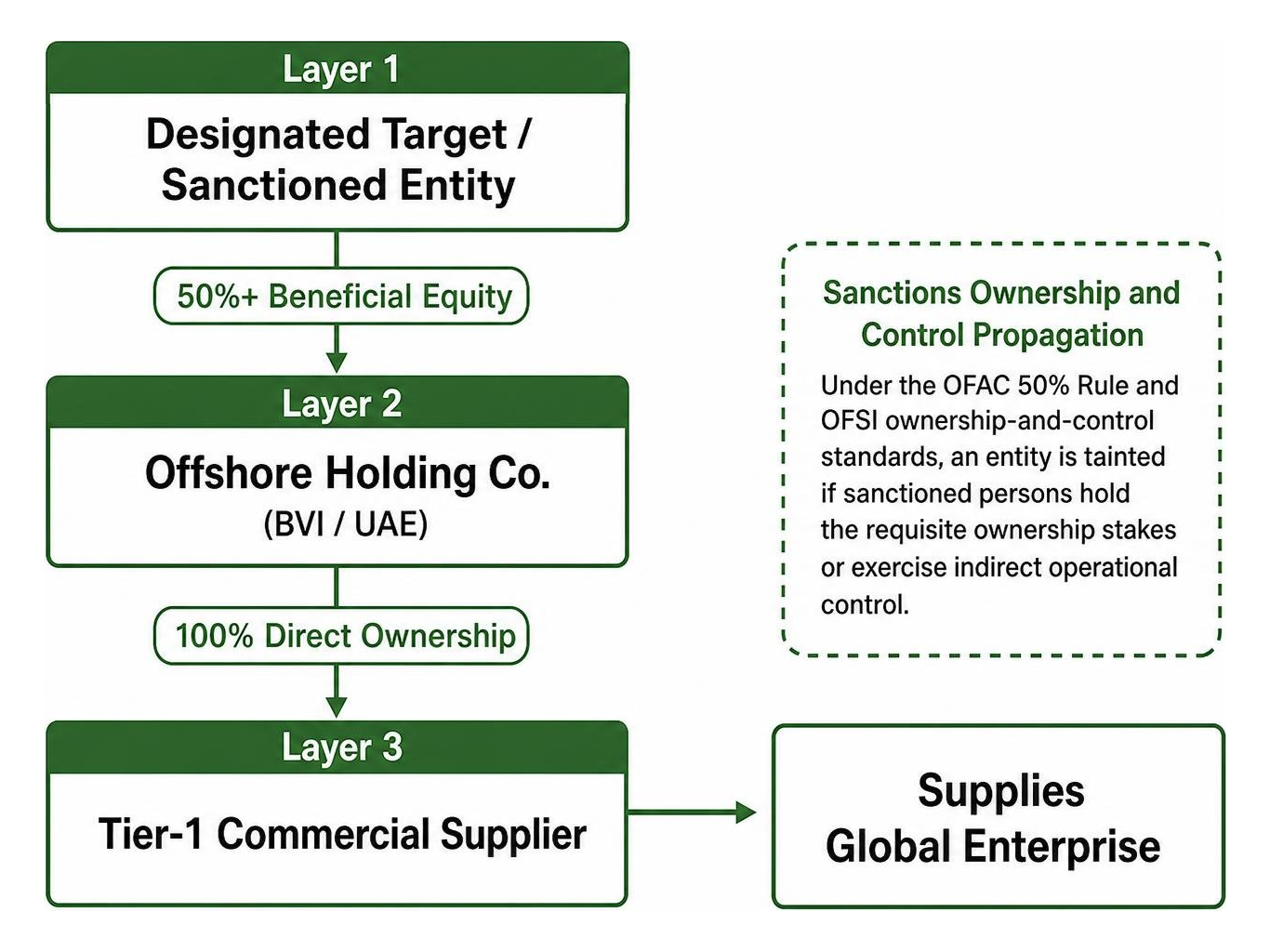
Designated individuals and state-linked entities often circumvent international restrictions by using intermediary front entities and complex corporate layers. Under both the OFAC 50% Rule and OFSI ownership-and-control standards, an entity is tainted if sanctioned persons hold requisite ownership stakes or exercise indirect operational control.
Without proactive sanctions risk management, companies risk contracting with entities that appear benign on primary watchlists but are legally blocked through aggregate offshore shareholdings.
Trade Evasion, Transshipment, and Regional Concentration Vulnerabilities
Global supply operations are heavily exposed to illicit transshipment schemes designed to disguise true product provenance. Goods originating from embargoed territories or regions implicated in modern slavery are frequently rerouted through intermediate trading hubs, where shipping documentation and certificates of origin are falsified.
Furthermore, supply networks often harbour severe structural vulnerabilities caused by single-source dependencies and geographic concentration in politically volatile territories. Analysing the top 13 geopolitical risks in supply chain environments helps identify these exposures. In particular, managing the China dilemma through supplier diversification strategy requires balancing cost considerations against statutory compliance under import restrictions like the UFLPA.
Academic research using the Analytic Hierarchy Process (AHP) indicates that structural network complexity is the primary contributor to vulnerability, with critical supplier dependency (global weight 0.220) and supplier geographic location (global weight 0.110) representing the most significant vulnerability factors (Sharma et al., 2021).
Which Tools and Data Sources Are Used to Uncover Supplier Vulnerabilities?

Deploying effective tools to identify vulnerabilities in global supplier networks requires aggregating multiple external data sources. No single registry or screening platform provides complete visibility into extended supplier tiers. Compliance teams rely on five core categories of investigative tools and data sources to surface risk leads.
1. Corporate Registry and Beneficial Ownership Databases
Official corporate registers, commercial gazettes, and statutory filings are the starting point for establishing legal entity standing. These include resources such as the UK Companies House People with Significant Control (PSC) register, European national business registers, and offshore registry filings.
These repositories help verify:
- Date of incorporation, registered capital, and corporate status
- Historical shareholder and directorship changes
- Multi-tier corporate shareholding structures
- Registered office addresses and commercial operational footprints
However, official registers vary in reliability across jurisdictions. Many offshore domiciles and secrecy jurisdictions restrict public access to beneficial ownership records, requiring targeted research across corporate filings in connected jurisdictions.
2. Sanctions, PEP, and Watchlist Screening Databases
Automated watchlist engines aggregate global screening feeds from enforcement agencies, including OFAC’s Specially Designated Nationals (SDN) List, the UK OFSI Consolidated List, the EU Consolidated Financial Sanctions List, and global law enforcement databases. Executing an OFAC sanctions list search to verify entity compliance status ensures immediate screening against designated entities.
The primary limitation of automated watchlist tools is their inability to calculate indirect aggregate ownership or identify dynamic control relationships where an unlisted entity is managed by a sanctioned proxy.
3. Shipping Manifests, Bills of Lading, and Customs Trade Data
Trade intelligence platforms compile customs declarations, bills of lading, and shipping manifests from national customs authorities and maritime databases. This data allows compliance teams to:
- Trace physical material provenance from origin to destination
- Identify the actual manufacturing entities and freight forwarders handling cargo
- Discover undisclosed sub-tier subcontractors operating in restricted regions
- Detect transshipment patterns where cargo is routed through intermediate ports to alter export documentation
4. Multilingual Adverse Media, Litigation, and Regulatory Records
Comprehensive risk identification requires interrogating localised court records, commercial arbitration databases, regulatory enforcement notices, and local media archives in the primary language of the supplier’s home jurisdiction. Local-language adverse media routinely exposes labour violations, executive fraud, bribery investigations, and environmental enforcement actions months before such matters appear in international English-language news feeds.
5. On-the-Ground Enquiries and Discreet Source Verification
When public registries and trade records are deliberately manipulated or unavailable in closed jurisdictions, on-the-ground enquiries provide the ground-truth verification that desktop tools cannot achieve. In-country field checks confirm whether a supplier’s declared manufacturing plant actually exists, assess active workforce operations, and discreetly interview informed industry sources to establish operational control and undisclosed beneficial ownership.
How Do Automated Screening Tools Compare with Human-Led Corporate Intelligence?
Automated screening is an efficient lead-generation engine. It can rapidly cross-reference tens of thousands of supplier names against published watchlists, domestic business registers, and global media aggregators. However, algorithmic screening cannot verify complex corporate reality or interpret nuanced legal structures.
Automated tools frequently generate two critical operational failures:
- False Positives: Algorithms flag common names, shared corporate addresses, and minor administrative discrepancies, overwhelming compliance teams with noise.
- False Comfort: Databases miss sophisticated obfuscation techniques, including nominee director arrangements, complex offshore trusts, and indirect UBO holdings that sit just below standard algorithmic thresholds.
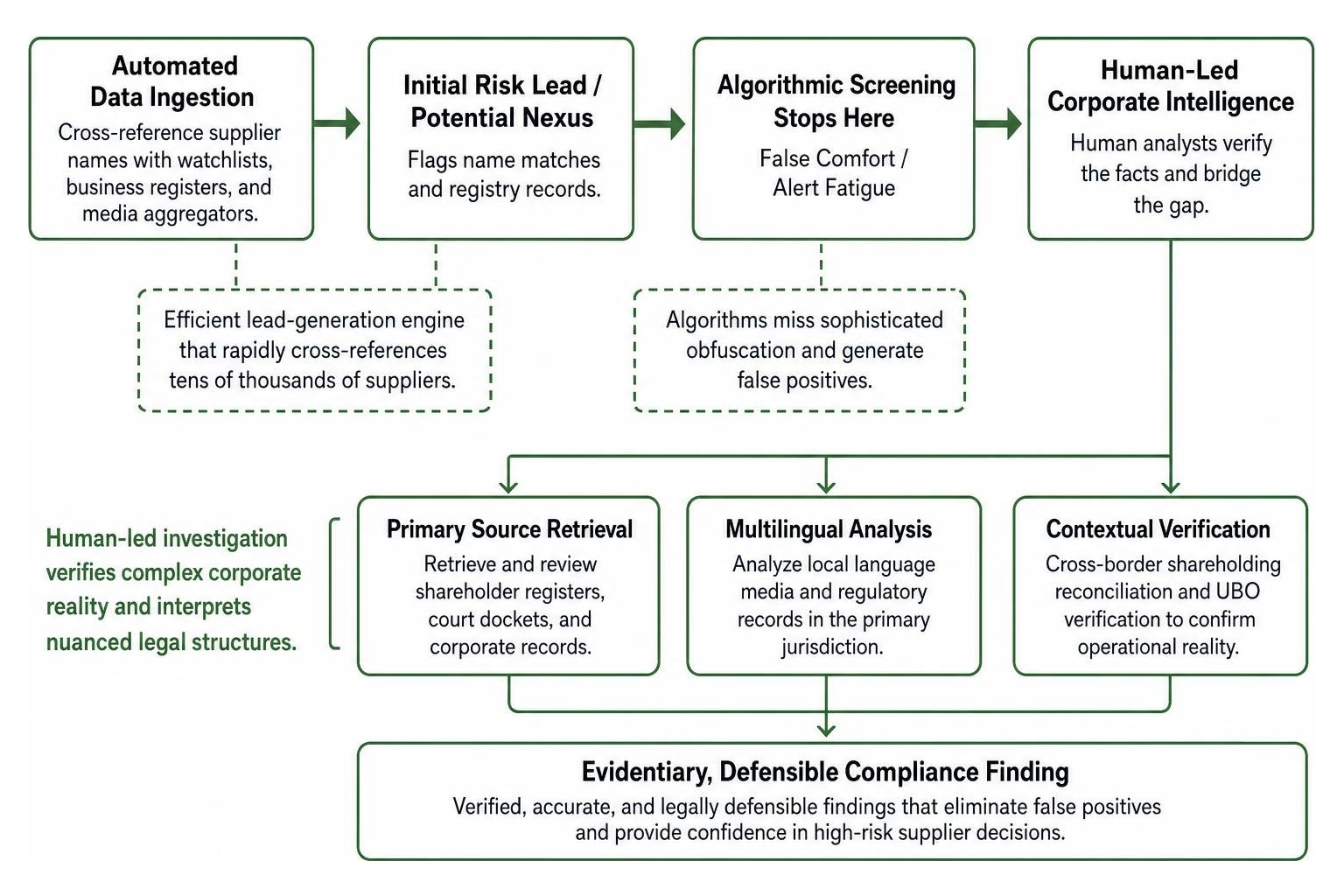
Human corporate intelligence bridges this gap. While automated data sources identify initial leads, human analysts verify the facts. Investigative analysis interrogates primary source records, translates local-language filings, evaluates corporate registries across multiple jurisdictions, conducts on-the-ground enquiries, and confirms physical operational reality.
Rule Ltd functions as an investigative partner to General Counsel and Chief Compliance Officers, delivering human analyst-led investigations that eliminate false positives and provide legally defensible findings. Multinationals use strategic supplier intelligence and enhanced due diligence to verify high-risk entities before finalising critical commercial engagements.
| Dimension | Automated Screening Platforms | Commercial Trade Databases | On-the-Ground Enquiries | Human Analyst-Led Corporate Intelligence |
|---|---|---|---|---|
| Primary Function | High-volume watchlist and PEP lead generation | Physical logistics and customs manifest tracking | Physical facility verification and human source checks | In-depth verification and UBO structural analysis |
| False-Positive Handling | High noise; requires manual compliance triage | Moderate; requires cross-referencing with shipping agents | Low; directly observes physical site and local standing | Eliminated through contextual multi-source analysis |
| Evidentiary Depth | Superficial; limited to public data feeds | Operational; limited to declared trade manifests | Empirical; confirms real-world footprint and active capacity | Deep; synthesises primary registry, dockets, and field facts |
| Board & Regulatory Defensibility | Low; demonstrates automated process, not verification | Moderate; demonstrates supply chain tracking | High; provides direct factual evidence of operations | High; provides defensible, audited investigative findings |
| Turnaround Certainty | Instantaneous to real-time batching | Instantaneous to real-time querying | 3 to 7 working days depending on location | Fixed turnaround (2–3 days screening; ~5 days EDD) |
Verifiable Case Evidence: Uncovering Sub-Tier Evasion in Practice
An anonymised case study published on ruleltd.com demonstrates the operational gap between database screening and human-led verification in practice. A European industrial manufacturer screened a prospective Tier-1 solar components vendor registered in Southeast Asia. Initial database queries returned no adverse media, no direct sanctions matches, and an active business registration.
However, enhanced corporate intelligence and customs manifest interrogation established that the vendor had been incorporated recently with nominal paid-up capital. Further cross-border corporate filing reviews and discreet on-the-ground enquiries confirmed that the local premises functioned as an administrative transshipment depot devoid of manufacturing equipment. Shipping records demonstrated that sub-assemblies were sourced directly from an entity subject to US UFLPA enforcement actions. Human-led corporate intelligence prevented the client from executing a contract that would have resulted in customs detention and regulatory penalties.
Human Investigation as the Verification Standard
When screening tools flag a potential risk or when high-value contracts involve opaque jurisdictions, organizations conduct enhanced due diligence high-risk screening steps. Human analysts examine registry records, cross-border corporate filings, on-the-ground operational indicators, and civil litigation dockets to confirm ownership lines. This structured approach to third-party due diligence ensures compliance teams make decisions on verified findings rather than unverified alerts.
How Can General Counsel and Compliance Leaders Implement Defensible Due Diligence?
Building a resilient, defensible supplier network requires moving from passive annual audits to an active, tiered due diligence framework. General Counsel and Chief Compliance Officers can implement a structured model to identify and resolve vulnerabilities across global vendor networks:
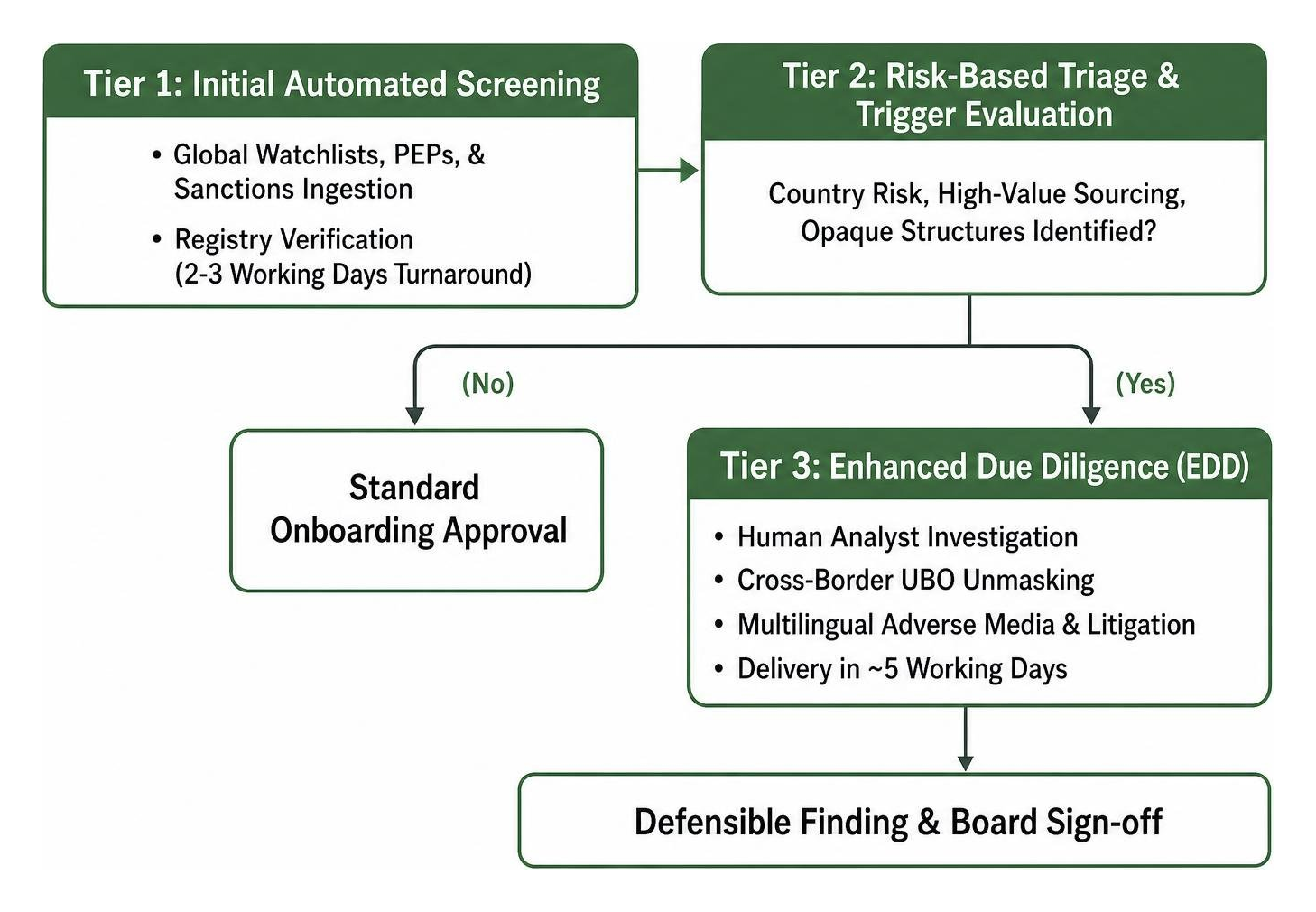
- Establish Clear Risk Triggers: Maintain automated screening for baseline vendor onboarding while establishing clear escalation triggers for enhanced investigation. Mandatory investigative triggers should include sourcing from high-risk jurisdictions, private corporate ownership in secrecy domiciles, single-source dependency, or unverified changes in UBO structures. Tracking key compliance risk indicators helps teams spot these warning signs early.
- Incorporate Enforceable Contractual Safeguards: Commercial contracts must contain explicit clauses mandating full UBO transparency, immediate notification of ownership changes, sub-tier vendor disclosure, and unfettered audit rights across all supplier tiers.
- Deploy Targeted Mitigation Strategies: When vulnerabilities are discovered, compliance teams should execute structured compliance risk mitigation strategies, such as requiring intermediate holding restructuring, placing funds in escrow, or executing phased supplier diversification.
- Utilise Fixed-Price, Cost-Certain Investigative Support: Compliance teams avoid the unpredictable hourly fees of traditional advisory firms by utilising Rule Ltd’s fixed-price investigative support. Initial screening reports are delivered in two to three working days, while comprehensive enhanced due diligence and corporate intelligence investigations turn around in approximately five working days, with fixed quotes provided within one working day before work commences.
Multinationals can evaluate their current supplier portfolio exposure using Rule Ltd’s third-party risk assessment process to identify unverified vendor relationships.
Disclaimer: The information provided in this article is for educational and informational purposes only and does not constitute formal legal advice. Compliance requirements, sanctions enforcement, and corporate liability must be evaluated on a case-by-case basis under the guidance of qualified legal counsel.
What Are Frequently Asked Questions About Supplier Network Vulnerabilities?
Why is automated screening insufficient for uncovering sub-tier supplier risks?
Automated screening tools rely on static databases and declared records. They cannot trace undisclosed subcontracting arrangements, investigate informal relationships, or penetrate multi-layered holding entities in jurisdictions where corporate ownership records are restricted. When sub-tier suppliers deliberately conceal their identities to bypass export controls or import bans, automated processes lack the investigative capability to uncover the underlying network.
How does human corporate intelligence establish true ultimate beneficial ownership?
Human corporate intelligence analysts cross-reference primary company registry filings, historical gazette notices, notarised share transfers, and court dockets across multiple jurisdictions. When public records are restricted, analysts examine local-language trade filings, regulatory submissions, and discreet inquiries to trace the flow of control and capital, establishing the natural persons who own or direct the entity.
What legal frameworks make identifying supplier vulnerabilities mandatory for multinationals?
Multinational enterprises are subject to statutory compliance regimes that enforce strict supply chain liability. These include:
- The US Uyghur Forced Labor Prevention Act (UFLPA) and Section 307 of the Tariff Act
- The UK Economic Crime and Corporate Transparency Act 2023 (ECCTA)
- The German Supply Chain Due Diligence Act (LkSG)
- The UK Bribery Act 2010 and the US Foreign Corrupt Practices Act (FCPA)
- OFAC and OFSI economic sanctions regulations and ownership-and-control guidance
Conclusion
Identifying vulnerabilities in global supplier networks is an ongoing discipline of evidential verification rather than an exercise in statistical forecasting. As regulatory authorities expand enforcement across international supply chains, organizations that rely on high-level questionnaires and automated database checks face substantial legal exposure.
By pairing automated data aggregation with human-led corporate intelligence, General Counsel and Chief Compliance Officers can uncover hidden UBOs, detect trade evasion schemes, eliminate false positives, and establish defensible compliance standards that withstand regulatory scrutiny.
Sources Relied Upon
- Financial Action Task Force (FATF). Guidance on Transparency and Beneficial Ownership (Recommendation 24 & 25).
- HM Treasury, Office of Financial Sanctions Implementation (OFSI). Financial Sanctions: General Guidance on Ownership and Control.
- UK Government. Economic Crime and Corporate Transparency Act 2023 (ECCTA). UK Public General Acts, c. 56.
- UK Ministry of Justice. The Bribery Act 2010: Guidance about procedures which relevant commercial organisations can put into place.
- US Customs and Border Protection (CBP). Uyghur Forced Labor Prevention Act (UFLPA) Operational Guidance for Importers.
- US Department of Justice & US Securities and Exchange Commission. A U.S. Foreign Corrupt Practices Act resource (Second Edition).
- US Department of the Treasury, Office of Foreign Assets Control (OFAC). Revised Guidance on Entities Owned by Persons Whose Property and Interests in Property Are Blocked (50% Rule).
- Federal Ministry of Labour and Social Affairs (Germany). Act on Corporate Due Diligence Obligations in Supply Chains (Lieferkettensorgfaltspflichtengesetz – LkSG). Sharma SK, Srivastava PR, Kumar A, Jindal A, Gupta S. “Supply chain vulnerability assessment for manufacturing industry..” Annals of operations research, 2021. PMCID PMC8196930.