
When high-risk findings justify outsourcing enhanced due diligence
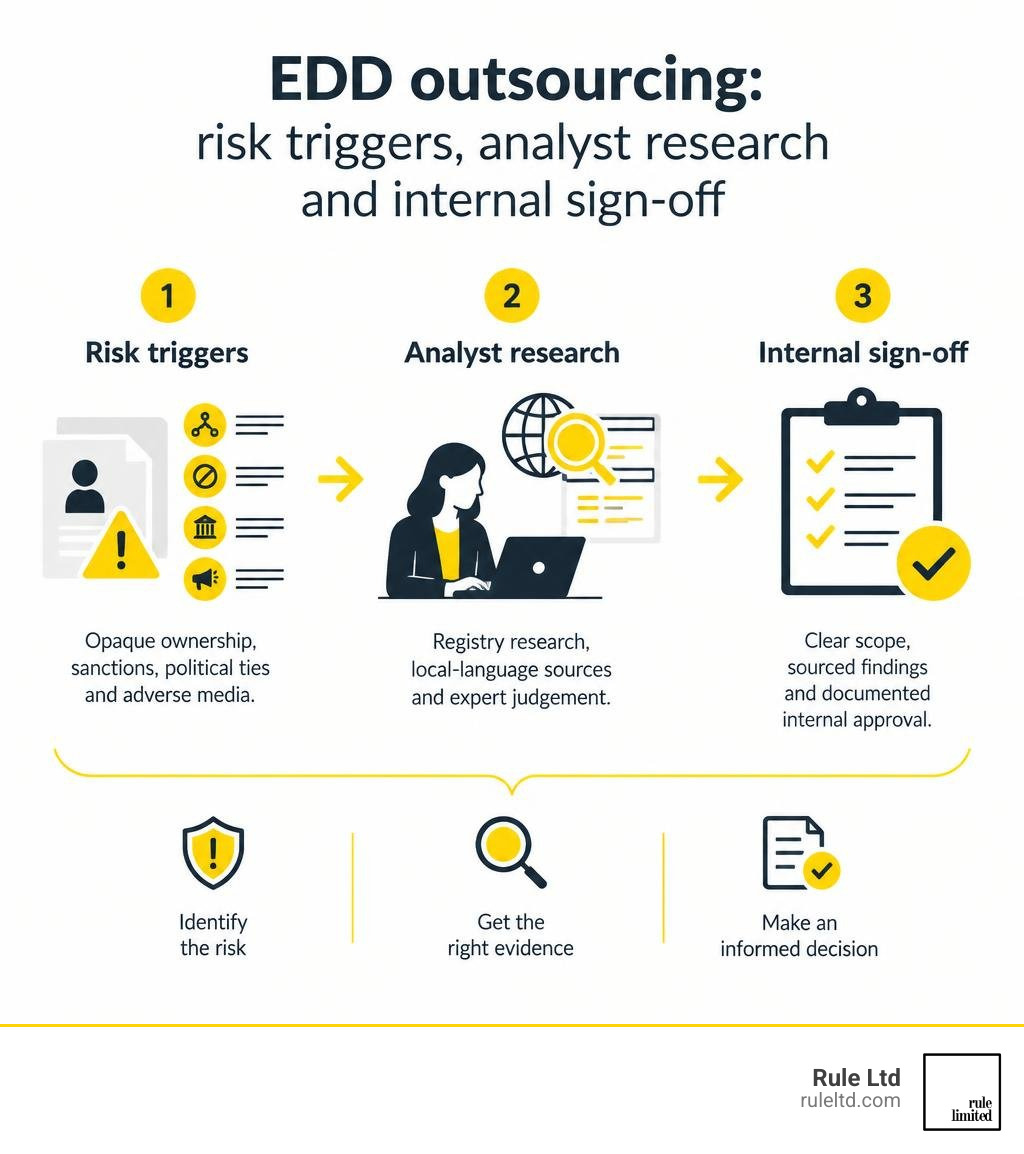
Outsourcing enhanced due diligence is most useful when a high-risk third party needs evidence the internal team cannot gather or assess efficiently. Opaque ownership, possible sanctions control, political ties and serious adverse media may call for registry research, local-language sources and an analyst’s judgement. The external investigator can establish and test the facts; the organisation must still decide whether to proceed.
The distinction matters when an initial third-party risk assessment or screening result is inconclusive. An adverse-media match may concern someone else, while a clean database result may conceal a nominee or an undisclosed owner. Integrating expert-led third-party due diligence and deeper corporate due diligence allows teams to scope investigations around the decision at stake, require primary sources for material findings, and retain a clear internal sign-off. For FCA-regulated firms, outsourcing does not remove the firm’s responsibility for oversight.
Critical Risk Indicators Triggering Enhanced Scrutiny
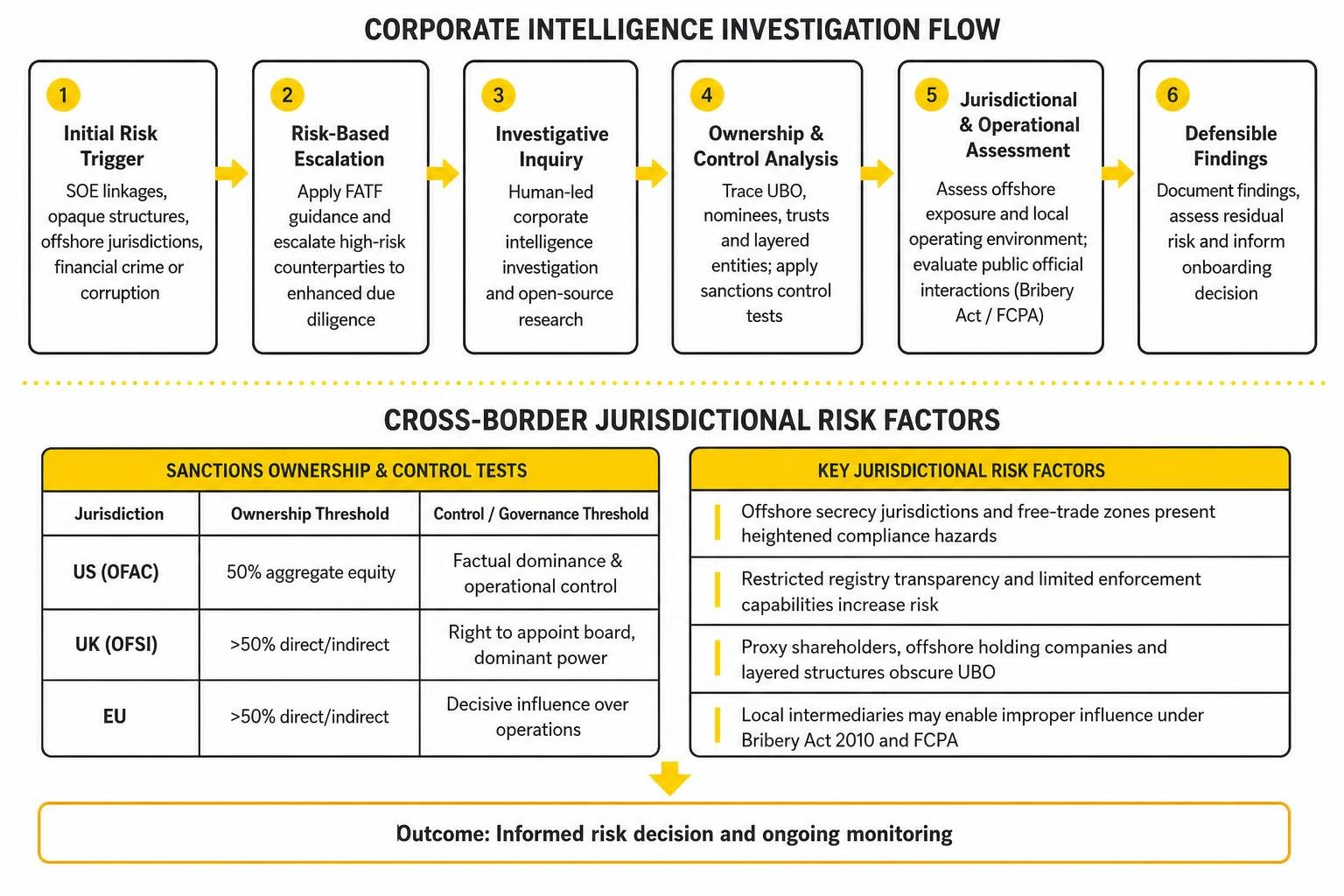
Standard screening mechanisms routinely fail when applied to complex counterparties. Automated databases index structured lists, yet material legal exposure often emerges from unindexed records, corporate restructurings, or informal commercial associations. Regulators expect firms to apply a rigorous risk-based approach under Financial Action Task Force (FATF) guidance, escalating counterparties that present elevated compliance risks to rigorous investigative scrutiny.
Conducting Enhanced Due Diligence for High-Risk Entities becomes essential when initial onboarding flags specific material concerns. These include state-owned enterprise (SOE) linkages, opaque intermediary structures, operations within offshore secrecy jurisdictions, and severe allegations of financial crime or corruption. Implementing a structured Corporate Due Diligence Checklist for Vendors and Partners establishes standard baseline parameters, but complex counterparties require human-led investigative depth to establish defensible findings.
Opaque Ownership Structures, Nominees, and Sanctions Control
Determining ultimate beneficial ownership (UBO) is rarely straightforward in high-risk jurisdictions. Corporate structures frequently incorporate circular shareholding arrangements, discretionary trusts, and professional nominee directors to obscure the identity of controlling individuals.
Under the US Office of Foreign Assets Control (OFAC) 50 Percent Rule, any entity owned 50 percent or more in the aggregate by one or more blocked persons is automatically blocked. Similarly, the European Union and the UK Office of Financial Sanctions Implementation (OFSI) apply strict control tests: an entity is subject to asset freezes if a designated person exercises direct or indirect control over its operational decisions, irrespective of nominal equity percentages.
In the UK, the Economic Crime and Corporate Transparency Act 2023 (ECCTA) has introduced expanded powers for Companies House to query, challenge, and reject suspicious filings on the Persons with Significant Control (PSC) register. Despite these measures, bad actors continue to use proxy shareholders, offshore holding companies, and layered intermediate entities. Following systematic Enhanced Due Diligence High-Risk Screening Steps in Practice allows investigators to trace legal ownership back to natural persons and identify unlisted controlling interests.
Jurisdictional Exposure and Local Operating Environments
Jurisdictional risk extends beyond standard FATF grey and black lists. Counterparties registered in, or routing transactions through, offshore secrecy centres or free-trade zones present heightened compliance hazards due to restricted registry transparency and limited enforcement capabilities.
Cross-border joint ventures, distribution agreements, and local agent arrangements often involve interactions with foreign public officials. These commercial relationships require careful analysis under the UK Bribery Act 2010 and the US Foreign Corrupt Practices Act (FCPA). Applying A Practical Guide to ABAC Due Diligence Compliance helps risk leads identify whether local intermediaries possess legitimate technical capabilities or exist primarily to facilitate improper influence.
Strategic Considerations When Outsourcing Enhanced Due Diligence
Managing enhanced due diligence entirely in-house poses significant operational and financial challenges for enterprise compliance teams. Complex cross-border casework requires specialised investigative tradecraft, multi-language document retrieval capabilities, and access to localised public records that standard database subscriptions do not provide.

When internal resources become constrained, commissioning specialist Enhanced Due Diligence investigations ensures that complex files receive deep-dive analysis without pulling senior compliance officers away from strategic supervisory duties.
Cost and Capacity Drivers for Outsourcing Enhanced Due Diligence
Compliance officers frequently face severe capacity constraints during periodic review cycles and seasonal onboarding surges. Hand-built enhanced due diligence reviews demand extensive analytical hours. Gathering records, parsing foreign-language filings, comparing declared versus actual commercial profiles, and drafting defensible risk memorandums takes substantial time per file.
Conducting a thorough third-party risk assessment allows organisations to reserve internal capacity for core governance, while allocating complex, time-intensive investigative files to external specialists. Outsourcing the investigative research enables enterprises to manage variable volume surges effectively without inflating permanent overhead costs or creating compliance backlogs.
Overcoming Multi-Jurisdictional Evidential and Language Barriers
Investigating cross-border counterparties requires native-language research and direct access to primary corporate and legal registries. Automated translation tools frequently miss crucial legal nuances, regional political associations, and local litigation histories.
Specialist corporate intelligence analysts review native-language adverse media, examine unindexed regional court archives, and interpret regulatory enforcement filings in context. Combining desktop corporate intelligence with contextual reputation risk assessment reveals historical disputes, regulatory censures, and integrity red flags that automated English-language screening cannot surface.
In-House Diligence vs Outsourced Investigations
Deciding between in-house reviews and specialised external investigations requires understanding the operational capabilities and limitations of each approach.
| Dimension | In-House Diligence Review | Specialist Outsourced EDD Investigation |
|---|---|---|
| Primary Scope | Internal account records, basic screening databases, self-declarations | Primary registry retrieval, native-language media, UBO tracing, litigation records |
| Language Coverage | Typically limited to operational languages of in-house staff | Broad multilingual coverage across primary local jurisdictions |
| UBO Unwrapping | Standard corporate registry checks and declared shareholder forms | Multi-layered offshore unwrapping, trust analysis, nominee identification |
| Evidentiary Depth | Database snapshot matches and questionnaire responses | Source-cited investigative dossier with verified primary documents |
| Regulatory Role | Policy ownership, transaction oversight, final risk decision | Factual discovery, intelligence synthesis, objective risk analysis |
Understanding what third-party due diligence involves helps firms establish clear boundaries between high-volume baseline screening and deep, analyst-led investigations.
Limits of Screening-Only Reviews
Automated screening tools are designed for initial list-matching against sanctions, PEP, and global enforcement databases. However, public search engines and standard commercial aggregators index only a fraction of the open web and local municipal archives.
Automated alerts often lead to false-positive fatigue, consuming analytical hours on name-match disambiguation. Conversely, false negatives occur when adverse litigation, regulatory censures, or commercial disputes reside in unindexed regional registries. To evaluate reputational risk in due diligence effectively, organisations require human-led investigative analysis that evaluates contextual source credibility rather than relying solely on automated keyword scores.
Managing Regulatory Liability When Outsourcing Enhanced Due Diligence
A critical regulatory principle across major jurisdictions is that legal compliance accountability cannot be outsourced. Under the UK Financial Conduct Authority (FCA) Senior Managers and Certification Regime (SM&CR), FinCEN guidelines, and AUSTRAC rules, the regulated entity retains absolute legal responsibility for its compliance decisions.
When engaging external specialists for third-party due diligence, the operational execution of research is delegated, but the final risk determination must remain in-house. Compliance officers and Money Laundering Reporting Officers (MLROs) must independently evaluate external findings against internal risk appetites before executing final sign-offs.
Establishing Governance and Quality Control for External Investigations
Maintaining audit-readiness requires robust governance over all external investigative engagements. Regulators expect firms to enforce strict evidentiary standards and maintain full transparency over how external findings are collected and verified.

A comprehensive EDD Report Preparation workflow guarantees that external reports deliver objective, factual intelligence rather than subjective commentary.
Defining Scope, SLAs, and RACI Decision Boundaries
Effective outsourcing engagements require clearly defined scopes of work, service level agreements (SLAs), and structured RACI (Responsible, Accountable, Consulted, Informed) frameworks.
Reviewing The Key Findings in a Due Diligence Report against pre-agreed terms of reference ensures that the intelligence collected directly addresses the transaction or counterparty risk at hand.
Ensuring Evidential Traceability and Audit Defensibility
Audit defensibility requires every factual statement in an investigative file to be backed by verifiable, primary documentation. Regulatory examiners will reject unsupported assertions or opaque summaries.
Adhering to an Enhanced Due Diligence Checklist Process ensures that each file incorporates:
- Official corporate registry extracts verifying current incorporation status, registered capital, and directorships.
- Clear multi-level ownership charts documenting equity and voting control down to natural persons or public bodies.
- Unredacted civil, criminal, and regulatory litigation records where legally accessible.
- Contextualised adverse media summaries citing original publications and verifying source credibility.
- Fully documented audit trails establishing when searches were executed and by whom.
Frequently Asked Questions about Outsourced Enhanced Due Diligence
Can a regulated firm outsource its legal AML and anti-corruption liability?
No. Legal liability and regulatory accountability remain strictly with the regulated firm and its designated senior managers. Regulators such as the FCA, FinCEN, and AUSTRAC permit the delegation of operational investigative tasks, but require internal compliance leads to review the external findings and execute the final risk determination.
What specific triggers require moving from standard CDD to outsourced EDD?
Triggers include identifying connections to Politically Exposed Persons (PEPs), complex multi-jurisdictional holding structures, entities registered in secrecy havens or free-trade zones, unverified beneficial owners, material adverse media, or transactions involving state-owned enterprises in high-risk jurisdictions.
How do outsourced investigators resolve beneficial ownership in opaque jurisdictions?
Specialist investigators retrieve primary filings from regional and offshore corporate registries, examine historical shareholder records, analyse cross-border directorship networks, cross-reference local regulatory filings, and review native-language public records to unravel nominee arrangements and establish legal and operational control.
Conclusion
Managing high-risk third-party relationships demands rigorous investigative tradecraft, multi-jurisdictional capabilities, and absolute evidential defensibility. While standard automated screening tools serve an essential role in baseline monitoring, complex counterparties with layered corporate structures, foreign official links, or adverse regulatory histories require specialist human-analyst scrutiny.
Outsourcing enhanced due diligence enables compliance leaders to access expert investigative intelligence and scale operational capacity without compromising regulatory standards. Rule Ltd provides expert-led corporate intelligence and enhanced due diligence services designed to deliver clear, verifiable evidence for informed governance and risk decision-making.
To discuss your organisation’s high-risk counterparty requirements or review an upcoming complex file, contact our senior analyst team for a confidential discussion.
Primary Sources and Regulatory Authorities Relied Upon
- Financial Action Task Force (FATF) – Guidance on the Risk-Based Approach for High-Risk Jurisdictions and Politically Exposed Persons (PEPs).
- US Department of the Treasury, Office of Foreign Assets Control (OFAC) – Revised Guidance on Entities Owned by Persons Whose Property and Interests in Property are Blocked (50 Percent Rule).
- UK Office of Financial Sanctions Implementation (OFSI) – Enforcement and Compliance Guidance: Ownership and Control Thresholds.
- UK Economic Crime and Corporate Transparency Act 2023 (ECCTA) – Expanded Registrar Powers, Identity Verification, and Reform of the Persons with Significant Control (PSC) Register.
- UK Bribery Act 2010 (c. 23) & US Foreign Corrupt Practices Act (FCPA, 15 U.S.C. § 78dd-1) – Standards for Intermediary and Third-Party Anti-Bribery Due Diligence.
- UK Financial Conduct Authority (FCA) – Senior Management Arrangements, Systems and Controls sourcebook (SYSC 8: Outsourcing) and Senior Managers and Certification Regime (SM&CR).