
A Defensible Due Diligence File Must Show How the Decision Was Reached
A defensible due diligence file records more than completed checks. It shows the scope of the enquiry, the primary records used to verify material findings, the gaps that remained, and who accepted the risk before the decision was made. Each significant conclusion should be traceable to evidence available at that time.
A clean share register, for example, does not settle who exercises control. Where ownership remains unclear, the file should distinguish verified facts from inference and explain why further enquiry was or was not proportionate. That record can be tested later without relying on the memory of the person who approved the transaction.
Rule Ltd assesses a defensible due diligence file by whether another reviewer can follow the evidence, the limits of the enquiry and the judgement made. This article is for informational purposes only and does not constitute legal advice. Specific compliance matters should be assessed case by case.
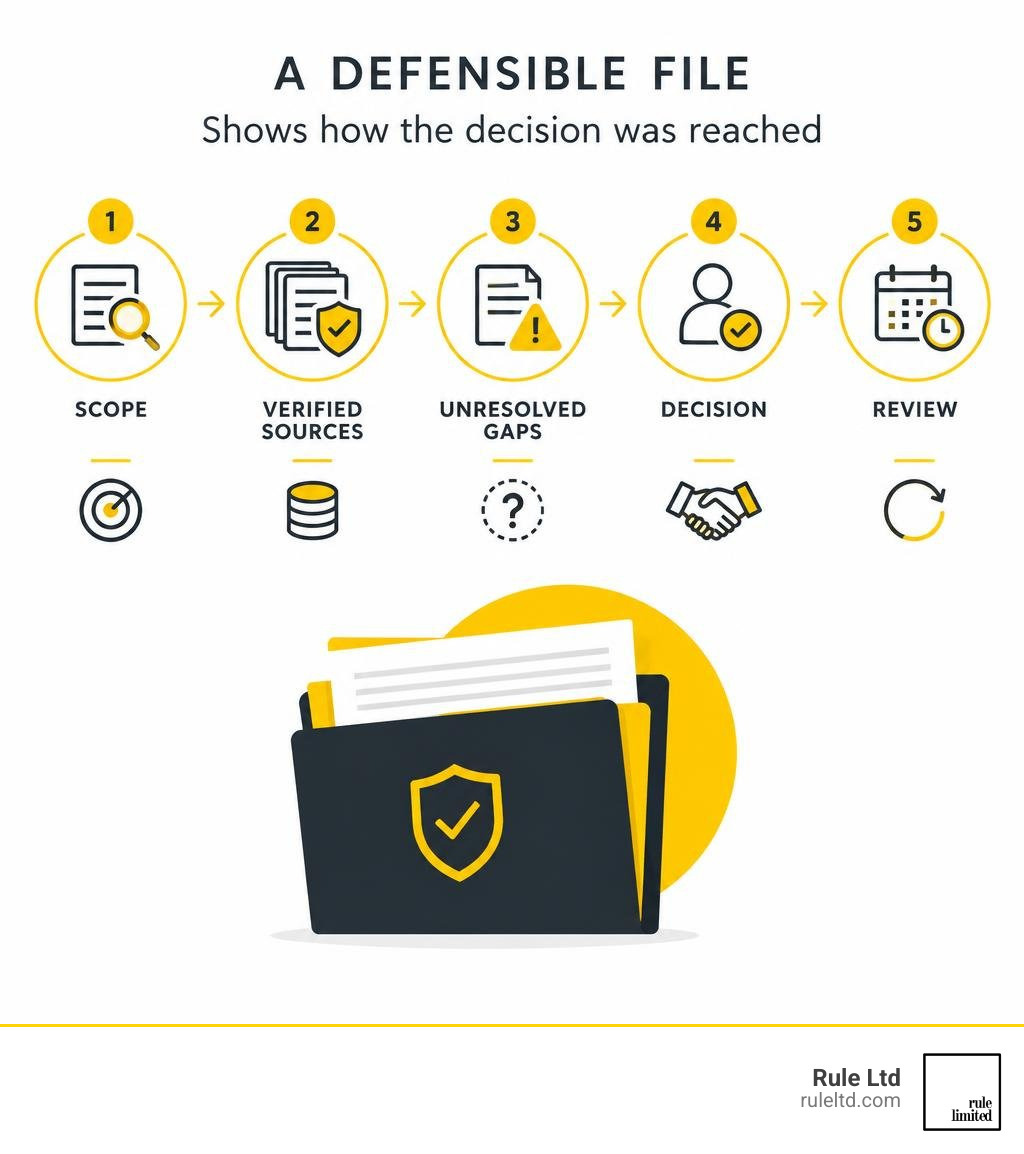
Quick look at defensible due diligence file:
The Anatomy of Box-Ticking: Why Standard Vetting Fails Enforcement Scrutiny

Enforcement actions across major jurisdictions demonstrate a consistent failure mode: organisations confuse process completion with evidential defensibility. When regulatory authorities examine a compliance file, they do not merely verify that a checklist was completed or that a commercial database returned zero immediate hits. They evaluate whether the underlying inquiry was substantive, objective, and capable of addressing the specific legal and operational risks of the transaction.
Superficial screening routinely founders upon confirmation bias. Automated watchlist matching or target-supplied representations create a false sense of security while leaving fundamental liabilities unexamined. Under modern corporate criminal liability frameworks, including the UK Economic Crime and Corporate Transparency Act 2023 (ECCTA 2023) failure-to-prevent-fraud offence, Section 7 of the UK Bribery Act 2010, and U.S. Foreign Corrupt Practices Act (FCPA) enforcement principles, commercial organisations face strict liability standards where the only statutory defence is establishing that “reasonable prevention procedures” were actively enforced.
| Dimension | Superficial Checklist Screening | Defensible Investigative Due Diligence |
|---|---|---|
| Information Origin | Target self-disclosures and aggregated portal exports | Independent public records, primary registries, and official dockets |
| Verification Depth | Binary match confirmation (name matching against lists) | Corroborative analysis across corporate filings, litigation, and gazettes |
| Ownership Analysis | Direct, legal shareholding records (Level 1 cap table) | Unmasking indirect control, nominee arrangements, and aggregate stakes |
| Gap Management | Missing data ignored or treated as zero risk | Formally recorded in limitation memoranda with alternative mitigations |
| Evidentiary Standard | Ephemeral, dynamic links and unarchived database hits | Tamper-evident, timestamped primary records with full audit provenance |
| Statutory Defence | Vulnerable to claims of wilful blindness or negligence | Substantive proof of reasonable precautions and proportionate inquiry |
A compliance record that relies entirely on an unverified questionnaire fails to satisfy evidential burdens when an illicit transaction emerges. Regulators evaluate what the organisation knew, what it reasonably ought to have known, and whether its inquiries were proportionate to the risk profile.
Evidentiary Standards That Separate a Defensible Due Diligence File from Checklist Compliance
A defensible file rests on an evidential threshold capable of withstanding adversarial testing in court or during regulatory investigations. This requires moving beyond high-level summaries to secure primary, verifiable documentation. Every factual proposition must be supported by an identifiable, retrievable primary record, whether drawn from official corporate registries, court dockets, regulatory enforcement archives, or gazettes.
Where public records present ambiguities, corporate intelligence investigations deploy human-source inquiries and jurisdictional analysis to establish ground truth. Crucially, defensibility requires contemporaneous record-keeping. Post-event rationalisations assembled after an enforcement notice or subpoena arrives carry little weight. The file must demonstrate what facts were known, what analytical inferences were drawn, and why specific lines of inquiry were pursued or concluded at the time the decision was made.
Documenting Non-Responsive Counterparties and Scope Constraints
During high-stakes commercial transactions, deal teams frequently encounter counterparties that refuse to complete standard questionnaires, withhold corporate documentation, or operate in opaque jurisdictions. In transactional environments, standard checklists such as transactional legal due diligence request schedules establish baseline expectations, yet non-responsive counterparties remain a common friction point.
A common compliance error is permitting commercial momentum to bypass these data gaps without documentation. A defensible file handles non-responsiveness through structured limitation memoranda. When a counterparty declines to disclose required records, the file must formally record:
- The exact scope limitation and the commercial justification asserted by the counterparty;
- The alternative primary sources independently reviewed to test the omitted data points;
- The compensatory controls, enhanced contractual warranties, or ongoing monitoring measures instituted to offset the gap;
- Formal risk acceptance signed off by independent compliance or legal functions, insulated from deal-origination commercial pressures.
Documenting limitations transforms an apparent vulnerability into clear evidence of informed risk awareness and deliberate governance.
Core Pillars of a Defensible Due Diligence File Under Regulatory Scrutiny
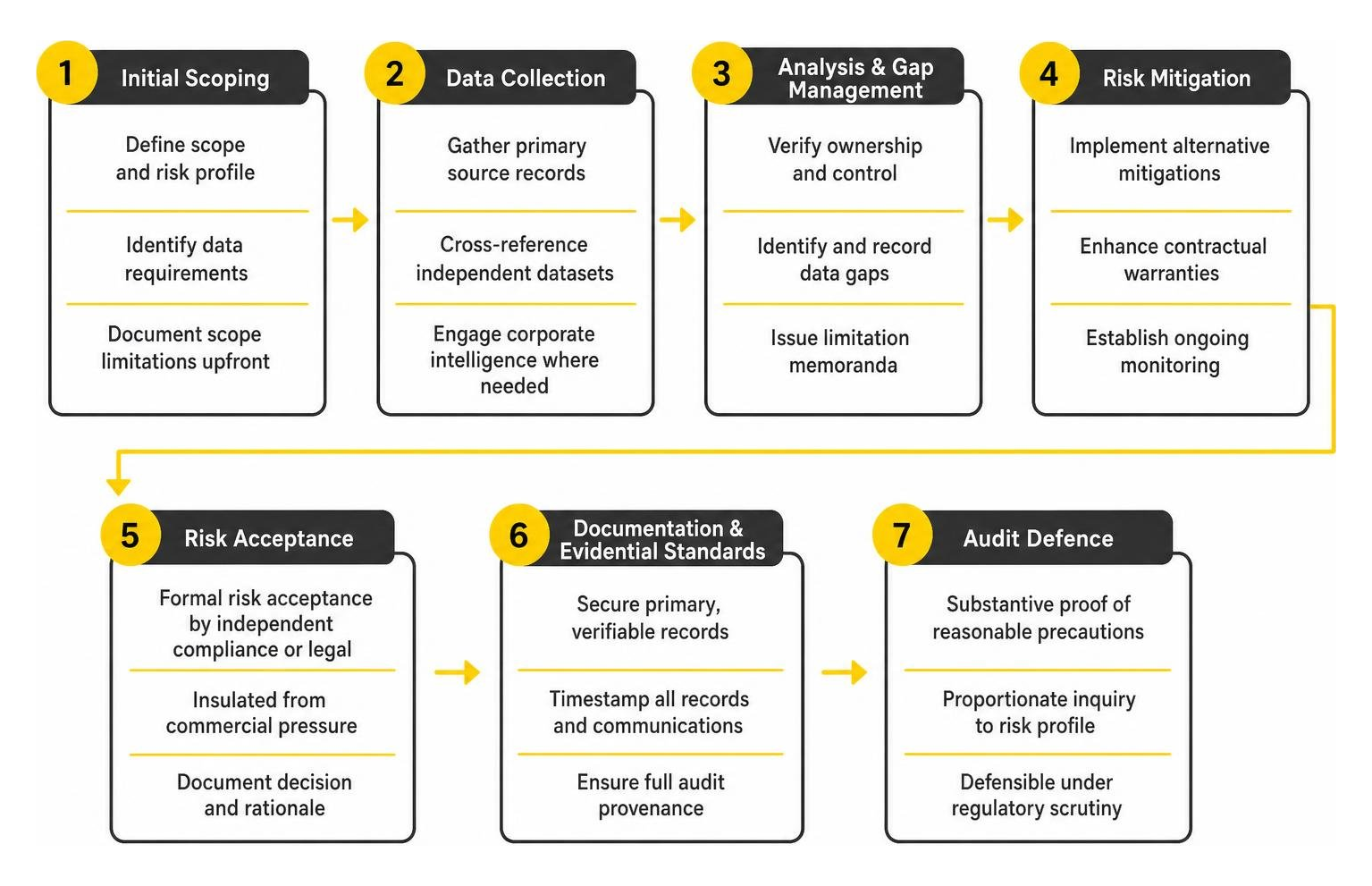
Constructing an audit-ready file requires systematic evidentiary triangulation. Analysts must cross-reference independent data sets to verify corporate claims before entering into contractual commitments. A comprehensive framework for what is third party due diligence relies on primary source verification across multiple distinct pillars:
- Primary Corporate Registration: Direct registry filings, articles of association, shareholder logs, and gazette notices;
- Litigation and Regulatory Dockets: Comprehensive local and national court archives, insolvency records, and regulatory enforcement databases;
- Integrity and Reputational Context: Adverse media analysis across local-language sources, public procurement registries, and political exposure indices;
- Governance Structure: Clear verification of executive appointments, board oversight records, and signatory authorities.
Sourcing Provenance and Distinguishing Facts from Inferences
A critical flaw in standard compliance summaries is the conflation of raw fact, reported allegation, and analytical inference. In a defensible file, these categories must remain distinct to preserve evidentiary integrity and prevent uncorroborated assertions from tainting commercial decisions.
- Factual Assertions: Supported by direct citations to primary government, legal, or corporate records (e.g., official registration extracts, signed balance sheets, or entered judicial judgments).
- Reported Allegations: Explicitly contextualised with the source’s identity, date, publication venue, and potential commercial or political bias (e.g., investigative press reports or competitor litigation pleadings).
- Analyst Inferences: Clearly identified deductions based on patterns of verified facts, explicitly labelled to show the logical bridge between evidence and conclusion.
Every material finding must maintain a retrievable citation, preserving metadata, retrieval timestamps, and repository references to ensure audit reproducibility.
Contemporaneous Audit Trails and Point-in-Time Verification
Regulatory ecosystems and corporate registries are dynamic. Company directors change, share capital structures alter, and international sanctions lists update continuously. Recent years have seen a sustained increase in new international sanctions designations, with the pace of change accelerating across major regimes. This makes counterparty risk profiles evolve quickly.
A point-in-time snapshot becomes stale quickly. To defend past decisions before bodies like the UK Office of Financial Sanctions Implementation (OFSI) or the U.S. Office of Foreign Assets Control (OFAC), an organisation must prove the exact state of information at the precise moment capital was committed. Integrating continuous monitoring alongside dated archival captures protects against “registry drift,” proving that the institution acted with appropriate care based on all available contemporaneous evidence.
Ownership, Control, and Sanctions: Evidentiary Gaps Beyond the Share Register
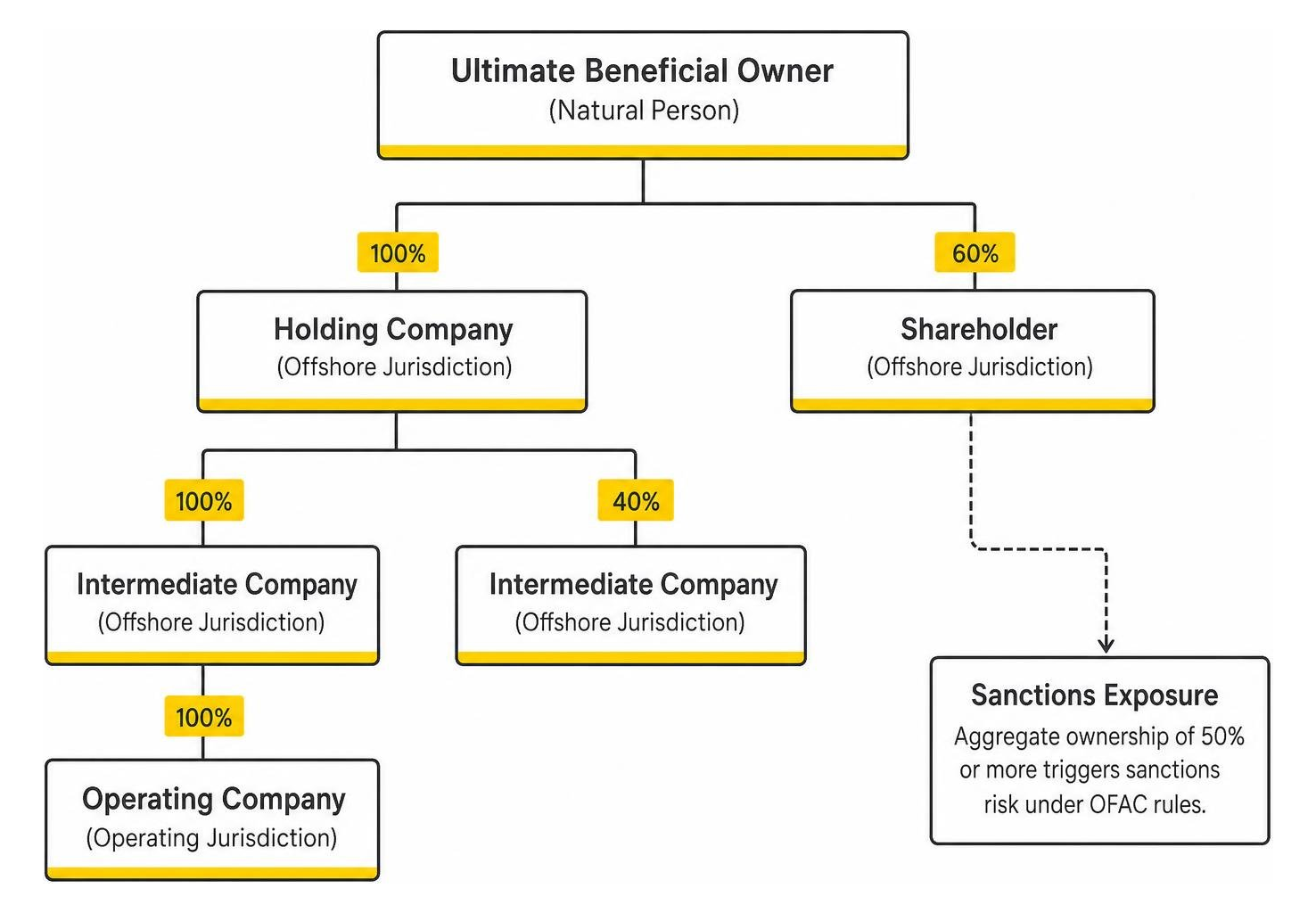
Verifying legal ownership is merely the baseline of counterparty vetting; it does not settle who exercises actual operational control or extracts ultimate economic benefit. Complex corporate structures spanning offshore secrecy jurisdictions, free-trade zones, and multi-layered trusts frequently obscure the real decision-makers behind clean legal facades.
Navigating the 50 Percent Rule and Aggregate Sanctions Exposure
Sanctions compliance is enforced on a strict-liability basis across key jurisdictions. Under OFAC regulations, any entity owned 50% or more in the aggregate by one or more blocked persons is automatically blocked, regardless of whether the entity itself appears on the Specially Designated Nationals (SDN) list. Conversely, UK OFSI and EU regulations introduce distinct control tests alongside ownership thresholds, where an entity may be subject to asset freezes if a designated person exercises direct or indirect dominant influence over corporate decision-making, even with a minority equity stake.
Navigating the 50 percent rule and OFAC compliance pitfalls requires aggregating fractional shares across offshore holding companies, holding entities, and investment funds. A defensible file must document the mathematical aggregation and legal ownership layers down to the individual beneficial owners, ensuring compliance across overlapping US, UK, and EU sanctions regimes.
Unmasking Informal Control and Nominee Shareholding
Opaque ownership structures often utilise nominees, family members, or commercial proxies to circumvent regulatory scrutiny. When identifying beneficial ownership, relying strictly on public registries such as the UK Companies House Persons with Significant Control (PSC) register is insufficient, as unverified filings may mask undisclosed trusts, powers of attorney, or side letters.
In situations involving unverifiable ultimate beneficial ownership, identifying the gap is a critical finding rather than a procedural failure. Practical beneficial ownership red flags include sudden equity transfers to spouses or long-standing administrative staff immediately preceding sanctions rollouts, opaque nominee services in secrecy havens, or individuals holding extensive directorships without corresponding commercial expertise. A defensible file documents these behavioural indicators and subjects them to qualitative analysis to determine true operational control.
Investigative Methodologies: Constructing Work Product That Withstands Judicial Challenge

A defensible work product is an evidentiary asset designed to withstand scrutiny from prosecutors, regulatory examiners, joint-venture partners, or arbitral tribunals. Constructing this work product requires combining public-record retrieval with rigorous corporate intelligence and open-source intelligence (OSINT) methodologies.
Assembling and Preserving a Defensible Due Diligence File for Cross-Border Enforcement
To ensure long-term integrity, compliance files should follow structured taxonomies aligned with standard corporate data room structures and established transactional due diligence indexes. An institutional due diligence file must maintain a clean, indexed digital architecture:
- Executive Summary & Risk Rating: Scoping parameters, core findings, Red-Amber-Green (RAG) risk scoring, and governance sign-offs;
- Entity Profiling & Primary Registration: Certified corporate extracts, formation charters, historical filings, and cross-border branch registrations;
- Beneficial Ownership & Control Mapping: Unbroken cap table structures, trust documentation, nominee reviews, and sanctions aggregation calculations;
- Integrity, Litigation & Regulatory Record: Official court docket searches, bankruptcy proceedings, administrative enforcement actions, and sector debarment lists;
- Human Rights, Labour & Operational Sourcing: Verification of supply chain integrity, workforce standards, and environmental compliance records;
- Evidential Annexures & Search Logs: Time-stamped primary registry printouts, adverse media clips, database query histories, and signed limitation memoranda.
Where elevated risks, political exposure, or cross-border complexities are present, deploying comprehensive enhanced due diligence ensures every material risk is rigorously substantiated and catalogued.
Rejection Rationale and Documenting Negative Assurance
A significant deficiency in corporate diligence governance is the failure to document non-selected or rejected counterparties. In competitive tender processes or commercial selections, files frequently preserve evidence only for the winning counterparty, creating an impression of retrospective justification.
To establish true institutional defensibility, the file must record the qualitative scoring, comparative analysis, and documented rationale for rejecting alternative counterparties. Capturing this decision trail demonstrates that the selection process was objective, free from commercial bias, and grounded in verifiable risk criteria.
Proportionality, Governance, and Human Rights: Aligning the File with Global Standards
Defensible compliance must reflect international standards of proportionality and human rights due diligence. The UN Guiding Principles on Business and Human Rights (UNGPs) establish a three-part operational framework:
- Identify and Assess: Proactively uncovering adverse human rights and supply chain risks;
- Prevent and Mitigate: Establishing contractual and operational safeguards to remediate exposure;
- Account and Report: Maintaining auditable records tracking the efficacy of mitigation measures.
These principles are codified in mandatory supply chain due diligence legislation worldwide, including the German Supply Chain Due Diligence Act (Lieferkettensorgfaltspflichtengesetz – LkSG), the EU Corporate Sustainability Due Diligence Directive (CSDDD), Section 54 of the UK Modern Slavery Act 2015, and U.S. Uyghur Forced Labor Prevention Act (UFLPA) enforcement frameworks.
Documenting Proportionate Measures and Materiality Thresholds
Proportionality requires that the depth of investigation matches the jurisdictional, operational, and commercial risk of the engagement. A routine domestic supplier operating in a low-risk environment does not warrant the exhaustive multi-jurisdictional intelligence required for an intermediary in a high-risk jurisdiction.
Compliance teams must define explicit materiality thresholds in their files, supported by structured risk matrices. Reviewing established due diligence case studies helps compliance officers calibrate these thresholds against real-world enforcement precedents, ensuring resources are directed effectively without creating audit vulnerabilities.
Perpetual Governance: Moving from Point-in-Time Vetting to Continuous Defensibility
A completed diligence file should never remain static. Modern governance frameworks treat due diligence as an ongoing lifecycle rather than a one-time onboarding hurdle. Periodic file refreshes must be scheduled based on the counterparty’s risk profile, with automated trigger events prompting immediate re-evaluation:
- Material corporate restructuring, mergers, or changes in legal ownership;
- Appointment of new executive directors, board members, or authorised signatories;
- Emergence of adverse media allegations regarding financial crime, bribery, or human rights abuses;
- New entries on international sanctions, export control, or PEP watchlists.
Establishing continuous oversight ensures the diligence file remains fully defensible throughout the entire commercial relationship.
Frequently Asked Questions about Defensible Due Diligence Files
What distinguishes a defensible due diligence file from a standard compliance check?
A standard compliance check generally relies on automated database screening, self-reported counterparty questionnaires, and high-level legal register reviews. A defensible due diligence file provides an auditable evidentiary record built upon primary public sources, independent corporate intelligence, explicit distinction between facts and inferences, and documented governance rationales that prove reasonable precautions were exercised.
How should compliance teams document counterparties that refuse to provide requested records?
When a counterparty refuses to disclose information, the file must contain a formal limitation memorandum. This document outlines the specific data omitted, the commercial reason provided, the alternative primary sources investigated independently, the compensatory contractual or operational controls introduced, and formal risk acceptance signed off by senior compliance leadership.
How long must an enterprise retain a completed due diligence file to maintain defensibility?
Retention periods must align with applicable statutory limitation periods, regulatory enforcement lookbacks, and the duration of the commercial relationship. While statutory baselines often span three to seven years, retaining complete due diligence files, source annexures, and decision logs for the entire lifespan of the counterparty engagement—plus the applicable statutory limitation period following contract termination—provides the strongest evidential defence against cross-border enforcement scrutiny.
Assessing Your Compliance Record Defensibility
Constructing an audit-ready, defensible due diligence file requires specialised investigative depth, primary source verification, and nuanced jurisdictional analysis. Rule Ltd supports global enterprises by providing human-analyst led third-party due diligence, enhanced due diligence, and corporate intelligence services across complex international jurisdictions.
To discuss your organisation’s diligence requirements or examine how our analyst-led reporting supports your compliance governance, request a custom EDD report quotation to consult confidentially with our team.
This article is for informational purposes only and does not constitute legal advice. Specific compliance matters should be assessed case by case.
Primary Sources and Regulatory Authorities Relied Upon
- Financial Action Task Force (FATF), International Standards on Combating Money Laundering and the Financing of Terrorism & Proliferation (February 2025 Recommendations), available at: https://www.fatf-gafi.org/content/dam/fatf-gafi/recommendations/Feburary%202025%20FATF%20Recommendations.pdf
- UK Economic Crime and Corporate Transparency Act 2023 (ECCTA 2023), failure-to-prevent-fraud offence.
- UK Bribery Act 2010, Section 7 (failure of commercial organisations to prevent bribery).
- U.S. Foreign Corrupt Practices Act (FCPA), 15 U.S.C. §§ 78dd-1 et seq.
- U.S. Office of Foreign Assets Control (OFAC), 50 Percent Rule guidance, 31 C.F.R. Part 560 and related sanctions regulations.
- UK Office of Financial Sanctions Implementation (OFSI), UK sanctions guidance on ownership and control.
- EU sanctions regulations, including Council Regulation (EU) No 269/2014 and related control tests.
- UK Companies House, Persons with Significant Control (PSC) register requirements under the Companies Act 2006.
- UK Modern Slavery Act 2015, Section 54 (transparency in supply chains).
- German Supply Chain Due Diligence Act (Lieferkettensorgfaltspflichtengesetz – LkSG).
- EU Corporate Sustainability Due Diligence Directive (CSDDD), Directive (EU) 2024/1760.
- U.S. Uyghur Forced Labor Prevention Act (UFLPA), Pub. L. No. 117-78.
- UN Guiding Principles on Business and Human Rights (UNGPs), endorsed by the UN Human Rights Council in 2011.