
An unverifiable UBO is an evidential finding
An unverifiable UBO is a material due diligence finding: the available evidence does not establish who ultimately owns or controls a third party. A self-declaration collects a claim; a matching registry entry does not, on its own, prove the underlying control. The question is who ultimately owns or controls the business, not simply whose name appears in a record
The finding should state which links in the ownership chain remain unproven, what evidence was tested and whether the unresolved risk permits the relationship to proceed. Nominee arrangements, trusts and gaps between national registers may call for investigation within enhanced due diligence. An inability to verify should not be presented as a clean result.
From a legal and compliance perspective, the limit of the evidence must be clear enough for a decision-maker to act on. That means distinguishing between a declared owner and a verified controller, and recording the difference in terms that withstand regulatory scrutiny.
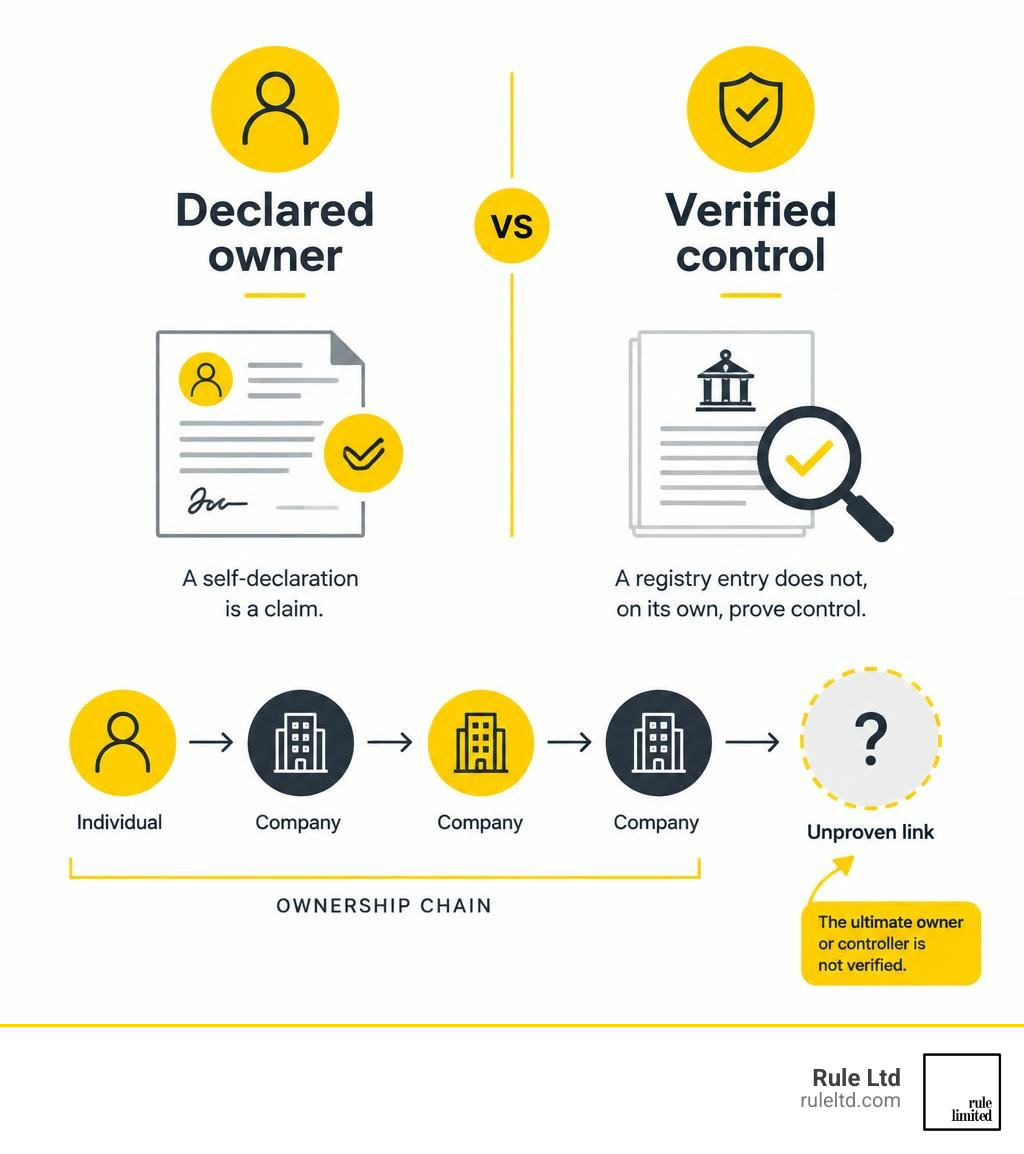
The UBO Verification Gap: Why Self-Declarations and Public Registries Fail
Corporate onboarding across global supply chains frequently breaks down at the point where data collection is mistaken for independent verification. Relying on vendor-provided beneficial ownership forms introduces substantial compliance risk. A self-declaration is merely an assertion of legal standing, whereas anti-money laundering frameworks, including Financial Action Task Force (FATF) Recommendation 24, require obliged entities to obtain adequate, accurate, and up-to-date beneficial ownership data that has been independently corroborated.

In practice, cross-referencing onboarding declarations against external, independent datasets reveals immediate discrepancies. In routine reviews, roughly 18% of corporate applications demonstrate material differences between self-declared ownership percentages and primary corporate records. For organisations conducting standard third-party due diligence, relying solely on basic public registers creates an untenable evidential gap.
Under the UK Economic Crime and Corporate Transparency Act 2023 (ECCTA 2023), statutory bodies like Companies House have received expanded powers to verify corporate filings and query suspicious submissions. However, the legacy Persons of Significant Control (PSC) register has historically contained unvetted filings. An entry in a statutory commercial register demonstrates only that an entity submitted a record; it does not confirm that the declared natural person exercises genuine economic ownership or ultimate operational control.
Passive Depositories and Cross-Border Registry Inconsistencies
Many national business registers function strictly as document depositories rather than investigative verification authorities. They receive corporate filings without testing the accuracy of the underlying equity distribution, validating whether identification documents are authentic, or confirming whether intermediate holding entities are legitimate trading firms.
This dynamic becomes complicated during cross-border corporate due diligence. While the European Union’s Anti-Money Laundering Regulation (AMLR) framework harmonises beneficial ownership rules across member states towards 2027, cross-border corporate unwrapping encounters structural friction. Registries in jurisdictions such as Switzerland, Singapore, the United Arab Emirates, and offshore dependencies operate under varying disclosure mandates. The lack of standardisation between central registers creates data blind spots, allowing bad actors to exploit reporting discrepancies across borders.
Point-of-Submission Vulnerabilities and Nominee Fronts
A verified submission does not guarantee a verified owner. The technical specifications outlined in international point-of-submission verification standards show that data intake systems often confirm format conformance, such as verifying that share allocations do not exceed 100%, without proving identity veracity.
Nominee shareholders, synthetic corporate vehicles, and strawman directors are frequently supported by legitimate, government-issued identity documents. A front person can submit genuine documentation, pass intake verification checks, and obscure the real controlling principal behind side agreements, powers of attorney, or unrecorded trust deeds. Compliance teams relying solely on identity checks will miss these hidden controllers. Effective corporate fraud detection requires assessing substantive control rather than nominal registry entries.
Structural Obfuscation: Core Drivers of an Unverifiable UBO
An ultimate beneficial owner becomes unverifiable when corporate layering, legal arrangements, or jurisdictional barriers prevent tracing ownership down to a natural person. The table below outlines the primary mechanisms used to obscure beneficial ownership:
| Obfuscation Mechanism | Structural Modality | Evidential Challenge for Due Diligence |
|---|---|---|
| Nominee Shareholder Pacts | Legal title held by third parties via private side letters | Register reflects legitimate individuals with no operational control |
| Discretionary Trusts | Separation of legal title (trustee) from economic benefit (beneficiaries) | Beneficiaries are contingent and excluded from public shareholder registries |
| Circular Ownership Chains | Cross-holdings between entities that cycle equity back into parent entities | Mathematical ownership formulas yield indefinite control loops |
| Offshore Tiering | Intermediary holding companies incorporated in secrecy jurisdictions | Opaque registers return no shareholder or voting right distributions |
| Equity Dilution Below 25% | Deliberate fragmentation of voting rights among connected associates | Individuals bypass statutory identification thresholds while acting in concert |
Establishing true ownership requires executing a thorough ultimate beneficial owner check that analyses underlying governance agreements and capital flows.
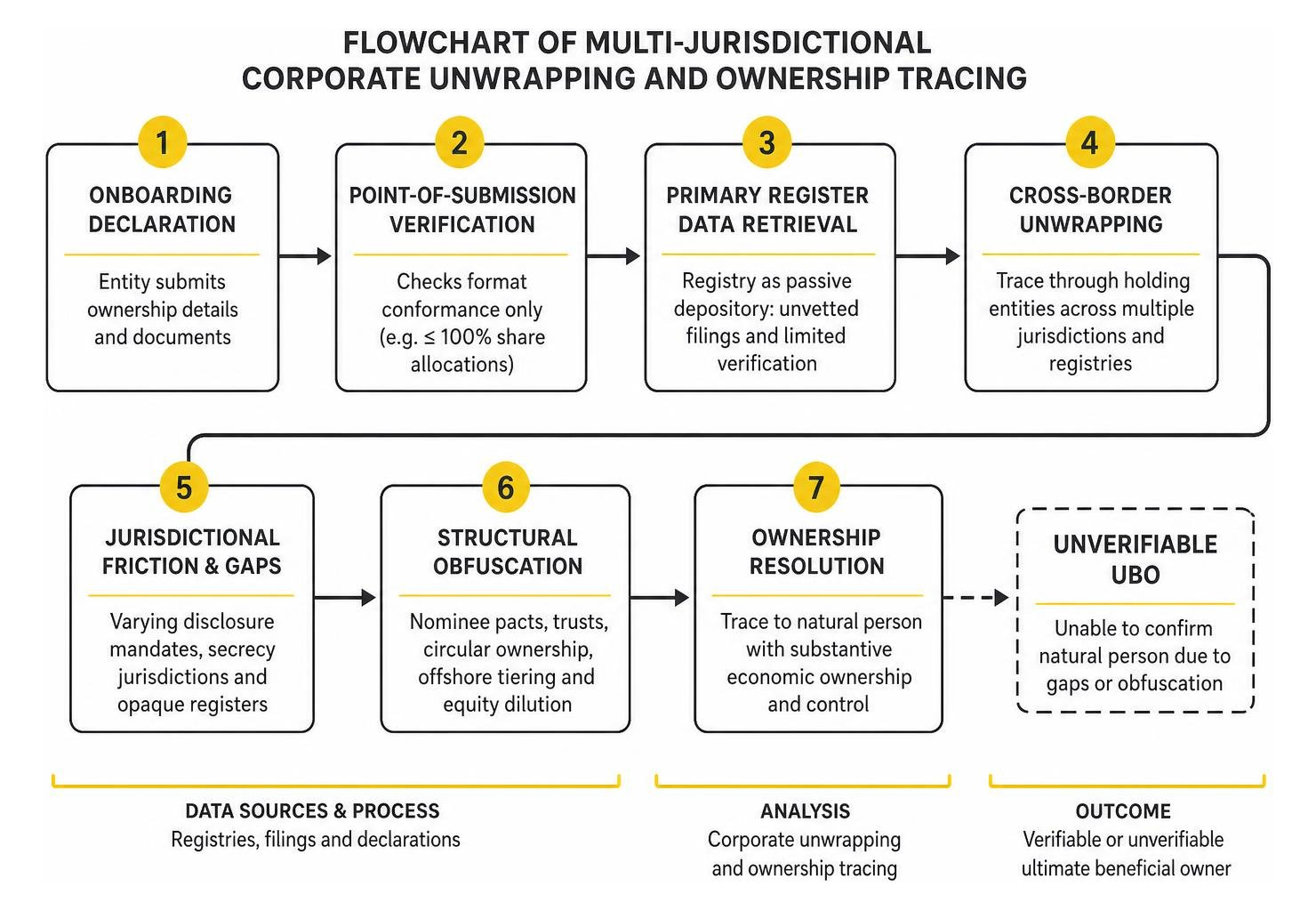
Offshore Layering, Private Trusts, and Jurisdictional Secrecy
Opaque corporate arrangements frequently exploit jurisdictions where public registry disclosure is limited or legally restricted. When corporate unwrapping reaches a shell entity in a non-transparent jurisdiction, automated data retrieval fails, returning unresolvable records or blank shareholder registers.
In discretionary trust structures, the divergence between legal title and economic control creates significant opacity. The trustees manage corporate assets for undefined or contingent classes of beneficiaries, while an undisclosed protector may hold power of veto over distributions. Identifying a true natural person requires reviewing trust deeds, letters of wishes, and related constitutional documents through enhanced due diligence for high-risk entities.
Deliberate Concealment and Sanctions Evasion Techniques
Sophisticated counterparties design ownership structures to evade regulatory detection. A common tactic is equity fragmentation: distributing ownership among several family members, trusted business associates, or parallel offshore entities so that no single individual crosses the standard 25% statutory reporting threshold.
Under strict regimes, such as the EU framework that applies a 15% threshold for designated higher-risk sectors, or the aggregate 50% Rule enforced by the US Office of Foreign Assets Control (OFAC), equity fragmentation exposes organisations to severe sanctions risk. Under OFAC regulations, if one or more blocked persons collectively hold a 50% or greater aggregate stake in an entity, that entity is automatically blocked, regardless of whether it is explicitly named on a sanctions list. Robust sanctions risk management requires investigating past the nominal register to identify hidden collective control and avoid known OFAC compliance pitfalls.
Regulatory Liability and Legal Fallbacks in High-Risk Onboarding
Failing to verify beneficial ownership exposes organisations to substantial regulatory penalties, strict liability sanctions violations, and commercial loss. In the United Kingdom, investment fraud and corporate misappropriation schemes accounted for 47% of total financial claim values, up from 39% the previous year, despite representing only 7.1% of reported incidents. These losses often stem from opaque corporate structures that conceal the individuals managing enterprise funds, highlighting the importance of evaluating reputational risk in due diligence.
The Senior Managing Official Fallback and Its Legal Hazards
When standard ownership unwrapping fails, compliance programmes frequently turn to the statutory fallback provision: designating a Senior Managing Official (SMO) as the pseudo-UBO. Under Article 30 of the EU Anti-Money Laundering Directive (AMLD) and equivalent global regulations, an organisation may record an executive director or managing officer as the UBO only after exhausting all investigative means without uncovering a qualifying natural person.
Relying on the SMO fallback is not a risk-free procedural bypass. Regulators scrutinise whether an organisation genuinely exhausted all reasonable avenues of enquiry before resorting to this provision. If an SMO is recorded without documentation demonstrating the steps taken to unmask the true beneficial owner, the organisation risks enforcement action for inadequate customer due diligence. Documenting this process provides the defensible evidence required by key compliance risk indicators.
Discrepancy Reporting and Escalation When Dealing with an Unverifiable UBO
Regulatory frameworks are placing direct reporting duties on obliged entities. Under Regulation 30A of the UK Money Laundering Regulations 2017 and updated European enforcement mandates, firms must formally report material discrepancies between public registry entries and the ownership information discovered during customer due diligence.
In international jurisdictions, administrative reporting requirements have become increasingly strict. For example, in Ukraine, where primary financial monitoring entities encounter unresolvable ownership structures, state registrars can place formal inaccuracy markers on the public register, freeze corporate filings, or remove the entity’s registration entirely. Discovering an unresolvable corporate structure should immediately trigger internal escalation, following established procedures for resolving beneficial ownership red flags.
Evidential Standards: Closing the Verification Gap with Investigative EDD
Resolving an unverifiable UBO requires shifting from passive data collection to proactive, investigative enhanced due diligence. When corporate structures span opaque jurisdictions or employ nominee arrangements, automated registry aggregation must be supplemented with in-depth human analysis.

A comprehensive investigation evaluates primary constitutional records, unrecorded shareholder agreements, and original formation documentation, applying structured enhanced due diligence high-risk screening steps to confirm the chain of control.
Cross-Border Corporate Intelligence and Human Analysis
Investigative corporate intelligence pairs open-source intelligence with local jurisdictional retrieval. Human analysts review local language litigation filings, regulatory disclosures, corporate balance sheets, and real estate registers to identify who directs company strategy, signs commercial agreements, and receives enterprise profits.
This analysis identifies undisclosed relationships, such as family connections, political affiliations, and cross-guarantees between nominal shareholders and hidden controlling principals. It establishes an evidential bridge where public company registers end.
Treating the Unverifiable UBO as Actionable Intelligence
When corporate ownership cannot be established following an exhaustive investigation, that finding must be treated as actionable intelligence. An unverifiable beneficial owner is a concrete evidential conclusion that provides decision-makers with the clarity needed to determine whether to restrict commercial exposure, implement contractual controls, or decline the relationship entirely.
For general counsel and compliance leaders managing these situations, our unverifiable UBO survival guide provides structured escalation frameworks, supported by practical scenarios documented in our due diligence case studies.
Frequently Asked Questions About Beneficial Ownership Verification
What is the legally defensible procedure when a UBO cannot be verified?
A legally defensible procedure requires documenting every investigative step taken to trace the corporate ownership chain. Compliance files must record registry searches, corporate document requests, cross-border entity analyses, and customer communications.
If ownership remains unverified and the institution decides to apply the Senior Managing Official fallback, the compliance file must contain a clear, documented rationale explaining why identifying the natural owner was impossible, confirming that no suspicion of money laundering exists, and securing senior management sign-off.
Why is self-declared beneficial ownership insufficient for regulatory compliance?
Self-declared beneficial ownership captures only what an entity chooses to report. It fails to expose undisclosed nominee agreements, unrecorded trust deeds, side letters, or circular equity structures designed to obscure control.
Regulatory bodies such as the FATF and national enforcement agencies require independent corroboration using primary documents, official registers, and corporate intelligence. Sole reliance on self-declarations leaves organisations vulnerable to regulatory fines and enforcement action.
How does an unverifiable UBO create strict liability sanctions risk?
Sanctions enforcement regimes, including OFAC, OFSI, and the European Union, operate primarily on a strict liability basis. Ignorance of an underlying beneficial owner’s sanctions status is not a legal defence.
Under aggregate ownership rules, such as OFAC’s 50% Rule, an unverified ownership stake held by a blocked person exposes the transaction to immediate asset freezes and enforcement action. Operating with an unverifiable UBO prevents an organisation from confirming whether its counterparties are controlled by designated persons.
Conclusion
Managing third-party risk requires moving beyond superficial onboarding checklists to establish clear evidentiary standards. An unverifiable UBO is not a process failure; it is an actionable investigative finding that highlights the structural limits of available corporate data.
Rule Ltd delivers human-analyst third-party due diligence, enhanced due diligence, and corporate intelligence to give compliance leaders and general counsel clear visibility into complex, cross-border corporate structures.
To evaluate complex ownership structures within your supply chain or counterparties, contact Rule Ltd for a confidential discussion with our investigative team.
Primary Sources Relied Upon
- Financial Action Task Force (FATF) – Recommendation 24: Transparency and Beneficial Ownership of Legal Persons.
- UK Parliament – Economic Crime and Corporate Transparency Act 2023 (ECCTA 2023).
- UK Statutory Instruments – The Money Laundering, Terrorist Financing and Transfer of Funds (Information on the Payer) Regulations 2017 (SI 2017/692), Regulation 30A.
- European Parliament and Council – Directive (EU) 2015/849 and Regulation (EU) 2024/1624 (EU Anti-Money Laundering Framework / AMLR, Article 30).
- US Department of the Treasury, Office of Foreign Assets Control (OFAC) – Revised Guidance on Entities Owned by Persons Whose Property and Interests in Property Are Blocked (50% Rule).
- Open Ownership – Verification of Beneficial Ownership Data: Verification at the Point of Submission Standards.