
Third-Party Risk Management Process: Where Risk Tiering Fails Without Verified Ownership
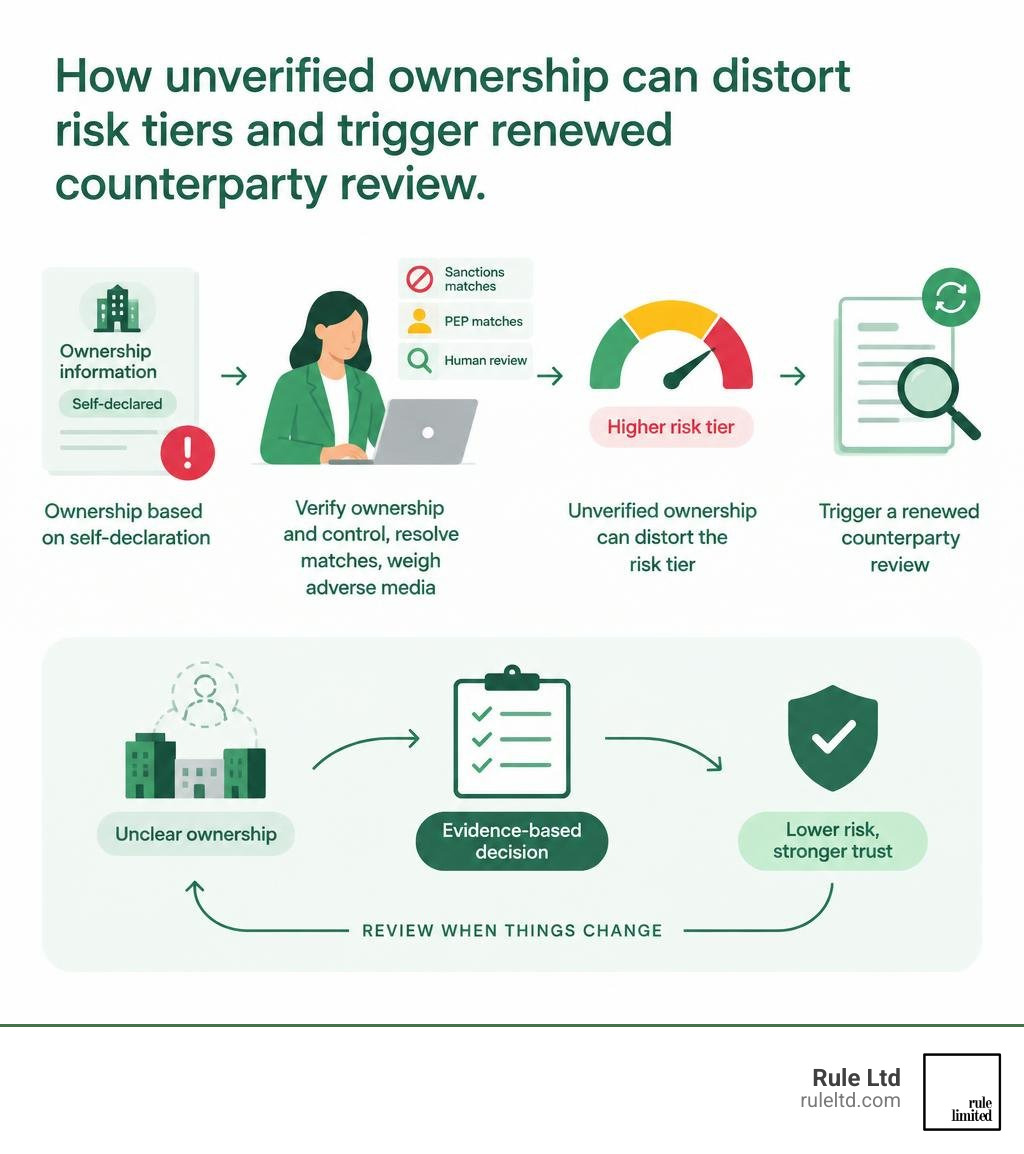
The third-party risk management process can misclassify a counterparty when its risk tier rests on self-declared ownership. Before approving a relationship, compliance teams should verify who owns and controls the entity, resolve sanctions and politically exposed person matches through human review, and weigh adverse media against reliable records. A change in ownership, leadership, or jurisdiction should prompt a fresh assessment rather than waiting for a scheduled review.
The issue is not whether a questionnaire has been completed. It is whether the evidence supports the decision to proceed. Comprehensive third-party due diligence should leave a clear record of what was verified, what remains uncertain, and who accepted the residual risk.
Judy Lee is the founder and chief executive of Rule Ltd and previously held senior legal and compliance roles, including General Counsel and Head of Legal Services EMEA at Integreon. Her work on the third-party risk management process focuses on opaque ownership, sanctions exposure, and findings that can withstand scrutiny.
Structural Flaws in the Traditional Third-Party Risk Management Process
Most institutional governance models sort counterparties into inherent risk categories based on prospective spend, commodity type, or geographical operational footprint. When these categories rely entirely on self-administered intake forms, critical legal and reputational exposures remain obscured.
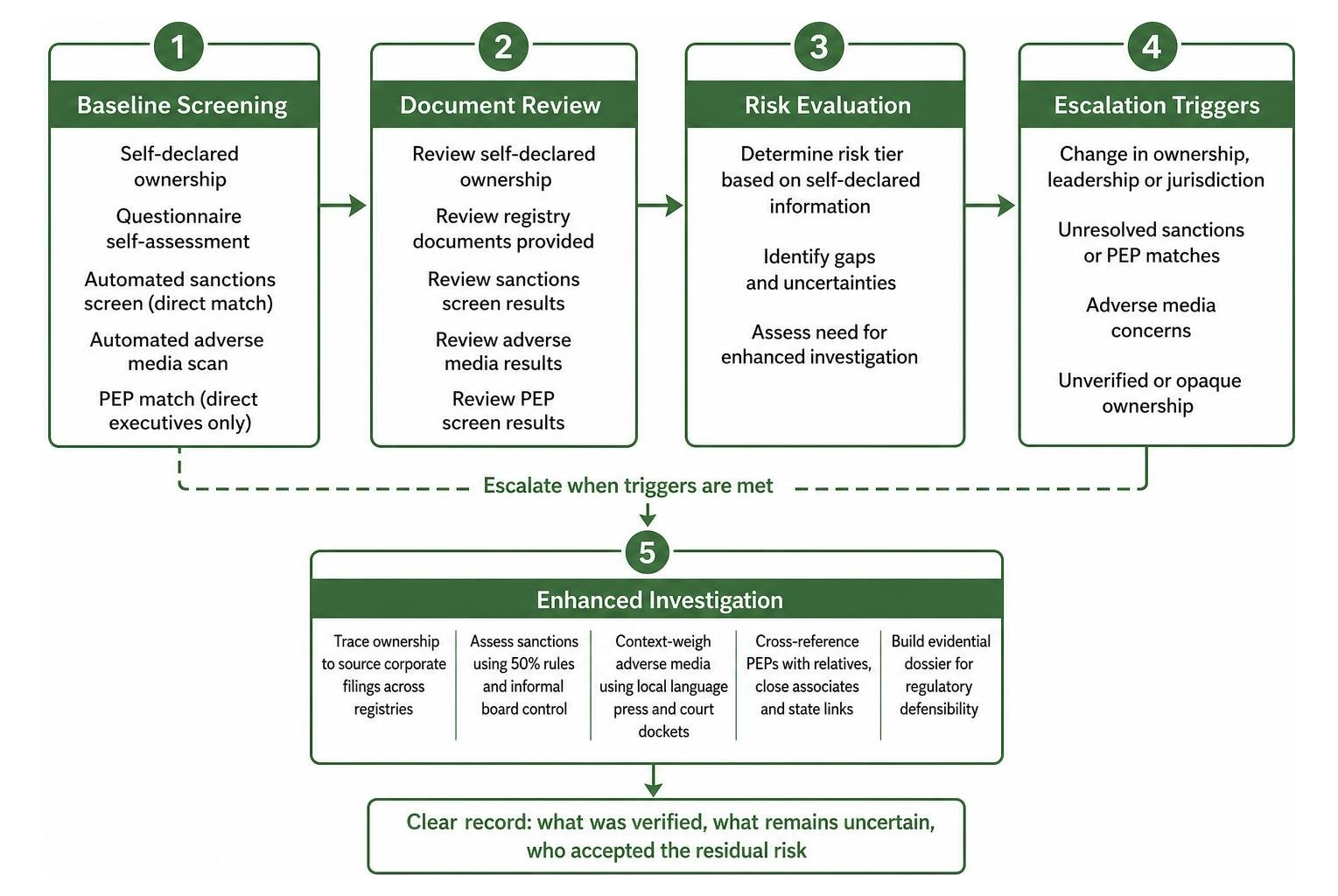
| Evaluation Dimension | Questionnaire Self-Assessment | Analyst-Verified Investigation |
|---|---|---|
| Ownership Verification | Relies on self-declared disclosures | Traced to source corporate filings across registries |
| Sanctions & Control | Screens direct named entity only | Assesses aggregate 50% rules and informal board control |
| Adverse Media | Automated keyword aggregations | Context-weighed local language press and court dockets |
| PEP Exposure | Matches direct executive names | Cross-references relatives, close associates, and state links |
| Regulatory Defensibility | Checkbox compliance record | Evidential dossier resilient to enforcement scrutiny |
When an enterprise assumes that a supplier operating in an apparently low-risk industry carries minimal exposure, it risks bypassing the rigorous scrutiny required for complex corporate structures. Executing a substantive third-party risk assessment requires validating public records, official gazettes, and registry filings rather than accepting unverified vendor claims.
Why Self-Declared Data Undermines the Third-Party Risk Management Process
Standard onboarding forms introduce structural bias. Counterparties frequently omit intermediary holding companies, multi-layered trusts, or circular shareholdings that obscure the identity of the true controllers.
Supervisory bodies, including the Basel Committee on Banking Supervision and US prudential regulators, highlight that institutional responsibility cannot be delegated or validated purely through vendor assertions [1]. Without independent registry analysis and thorough third-party due diligence, compliance teams risk approving counterparties whose actual controllers sit on international restriction lists.
Evidential Verification Gaps Across Cross-Border Free Zones
Offshore jurisdictions and commercial free zones across Europe, the Middle East, and Asia frequently permit bearer shares, corporate directors, or undisclosed beneficial owners. Relying on basic documentation in these regions allows nominee directors to mask high-risk controlling figures.
Recent cross-border enforcement actions over the past 24 months—such as coordinated OFAC and OFSI designations targeting transnational electronics, maritime, and procurement networks operating through free-zone entities across the UAE, Hong Kong, and Turkey [2]—demonstrate that secondary trading hubs often conceal majority stakes held by designated individuals through trust deeds and power-of-attorney mandates. Conducting a rigorous ultimate beneficial owner check requires cross-border document retrieval, review of original incorporation deeds, and analysis of share capital distribution to pierce nominee arrangements.
Regulatory Exposure: Sanctions, Ownership Control, and Failure to Prevent Fraud
Enforcement agencies assess liability based on economic reality and direct or indirect control rather than formal transactional appearance. Under the Office of Foreign Assets Control (OFAC) 50% Rule and parallel guidance from the UK Office of Financial Sanctions Implementation (OFSI) and the European Commission, an entity is blocked if one or more sanctioned persons own 50 percent or more in the aggregate.
Navigating sanctions risk management requires compliance teams to look beyond direct equity stakes to evaluate voting control, informal dominion, and debt instruments, avoiding the common pitfalls detailed in the 50% rule guidance. Recent OFSI ownership and control determinations under the Russia regime underline that operational influence alone can trigger full asset-freeze restrictions even when direct shareholdings remain beneath 50 percent [3].
Under the UK Economic Crime and Corporate Transparency Act 2023 (ECCTA), large organisations face direct corporate criminal liability if an “associated person”—including a supplier or intermediary—commits fraud intended to benefit the business, unless the organisation can demonstrate reasonable fraud prevention procedures [4].
Establishing Evidential Rigour in the Third-Party Risk Management Process
Automated screening engines generate high volumes of false positives, pairing innocent suppliers with sanctioned entities or politically exposed persons (PEPs) due to similar transliterations or naming conventions. Conversely, basic fuzzy-matching algorithms often miss sanctioned entities when corporate names are slightly modified or registered in non-Latin scripts.
An analyst-led review cuts through noise by cross-referencing dates of birth, corporate filings, and commercial registers. Distinguishing genuine exposure requires detailed PEP identification and classification, alongside targeted enhanced due diligence when red flags appear.
Weighed Adverse Media and Regulatory Enforcement Realities
Unfiltered automated media screening often collects unsubstantiated blog posts, duplicate syndication, or irrelevant litigation while missing local-language investigative reporting and court records.
Evaluating reputational risk in due diligence requires evaluating the legal source material, assessing the credibility of local press, and checking official enforcement gazettes. This approach aligns with global regulatory standards, including FDIC Third-Party Risk Guidance [5], ensuring decisions are grounded in verified fact.
Dynamic Governance: Material Triggers for Ongoing Vendor Review

Third-party risk management is not a point-in-time exercise. A compliant counterparty can quickly introduce severe legal, financial, or regulatory liability following corporate restructuring, executive turnover, or changes in jurisdictional footprint.
Relying solely on fixed calendar intervals leaves organisations blind to interim risk shifts. Material changes should prompt targeted review using structured intelligence and continuous compliance monitoring.
Corporate Restructuring and Jurisdictional Pivot Triggers
Material triggers that require immediate re-assessment include:
- Beneficial Ownership Changes: Shifts in shareholding that introduce new natural persons, trusts, or offshore holding vehicles.
- Board and Executive Reconstitution: Appointments of directors with undisclosed political connections or active directorships in restricted jurisdictions.
- Cross-Border Re-domiciliation: Moving operations or legal entities into jurisdictions known for sanctions evasion, as outlined in detailed examinations of geopolitical risk red flags.
- Mergers and Acquisitions: Upstream acquisitions that alter group control or introduce shared operational dependencies.
Supply Chain Integrity and Modern Slavery Enforcement
Regulatory mandates such as the German Supply Chain Due Diligence Act (Lieferkettensorgfaltspflichtengesetz – LkSG), the US Uyghur Forced Labor Prevention Act (UFLPA), and Section 54 of the UK Modern Slavery Act 2015 require demonstrable supply chain transparency. Over the past 24 months, enforcement agencies have actively scrutinised sub-tier exposure: the US Forced Labor Enforcement Task Force (FLETF) expanded the UFLPA Entity List across automotive, aluminium, electronics, and agricultural suppliers, leading US Customs and Border Protection (CBP) to detain commercial imports lacking verified chain-of-custody documentation [6], while Germany’s Federal Office for Economic Affairs and Export Control (BAFA) initiated formal administrative control procedures against major retail and automotive enterprises to audit risk management reports and supply-chain mapping under the LkSG [7].
When mapping extended supply networks, compliance teams must establish traceability through verified supplier risk evaluation to detect intermediary shells, unverified sub-tier suppliers, or sourcing operations in restricted regions.
Frequently Asked Questions about Third-Party Risk Management
How do false positives undermine vendor screening efficiency?
Automated name-matching tools rely on broad fuzzy logic, generating numerous false alerts for common names across international databases. When compliance teams spend critical hours reviewing false positives, they face alert fatigue. This operational backlog increases the risk that genuine sanctions matches, political exposure, or material adverse findings remain unreviewed. Human analyst adjudication resolves ambiguous alerts against official corporate records before findings enter the risk register.
When should corporate restructuring trigger immediate re-screening?
Any material shift in an entity’s legal or operational structure should trigger immediate re-screening rather than waiting for an annual review cycle. Key triggers include changes in direct or beneficial ownership crossing statutory control thresholds, the appointment of new directors or key executives, transfers of assets to offshore vehicles, or corporate re-domiciliation to high-risk jurisdictions.
How does ECCTA 2023 alter third-party fraud liability for global groups?
Under the UK Economic Crime and Corporate Transparency Act 2023, a corporate entity can be held criminally liable if an “associated person”—which expressly includes third-party suppliers, agents, and subsidiaries—commits fraud intending to benefit the commercial organisation directly or indirectly. The only statutory defence is proving that the organisation had “reasonable prevention procedures” in place at the time of the offence, making unverified self-assessment questionnaires legally indefensible.
What is the difference between inherent and residual risk in third-party assessments?
Inherent risk represents the raw, unmitigated exposure a third party poses based on its operating sector, jurisdictional base, nature of services, and commercial value before evaluating internal controls. Residual risk is the remaining exposure after completing independent due diligence, verifying beneficial ownership, confirming regulatory compliance, and establishing enforceable contractual safeguards.
Conclusion

A resilient governance framework requires moving beyond checkbox onboarding. Protecting an enterprise against regulatory enforcement, operational disruption, and reputational damage requires an evidence-based approach that verifies beneficial ownership, confirms control structures, and assesses adverse intelligence across global jurisdictions.
Rule Ltd provides human analyst-led corporate intelligence, sanctions vetting, and third-party due diligence for global enterprises facing complex counterparty exposures. Operating with worldwide language and jurisdictional reach, Rule Ltd delivers fixed-price screening reports within two to three working days, and comprehensive enhanced due diligence dossiers in approximately five working days, with fixed quotes provided within one working day before work begins.
This article does not constitute legal advice. Specific matters require case-by-case assessment by qualified counsel.
Sources Relied Upon
- Basel Committee on Banking Supervision, Guidelines: Principles for the Sound Management of Third-Party Risk, Bank for International Settlements (2024).
- US Department of the Treasury (OFAC) & UK Office of Financial Sanctions Implementation (OFSI), Targeting Transnational Procurement Networks and Intermediaries in Third Jurisdictions, Joint Sanctions Notices (2024–2025).
- UK Office of Financial Sanctions Implementation (OFSI), Ownership and Control: Public Guidance and Director Disqualification Determinations, HM Treasury (2024).
- UK Parliament, Economic Crime and Corporate Transparency Act 2023, Part 5: Failure to Prevent Fraud (c. 56).
- Federal Deposit Insurance Corporation, Board of Governors of the Federal Reserve System, and Office of the Comptroller of the Currency, Interagency Guidance on Third-Party Relationships: Risk Management (FIL-29-2023 / FIL-08-2024).
- US Department of Homeland Security, Uyghur Forced Labor Prevention Act (UFLPA) Entity List Updates, Forced Labor Enforcement Task Force (2024–2025).
- German Federal Office for Economic Affairs and Export Control (BAFA), Administrative Control and Enforcement Reports under the Supply Chain Due Diligence Act (LkSG) (2024).