
Evidential Standards and Governance Defensibility in Third-Party Due Diligence
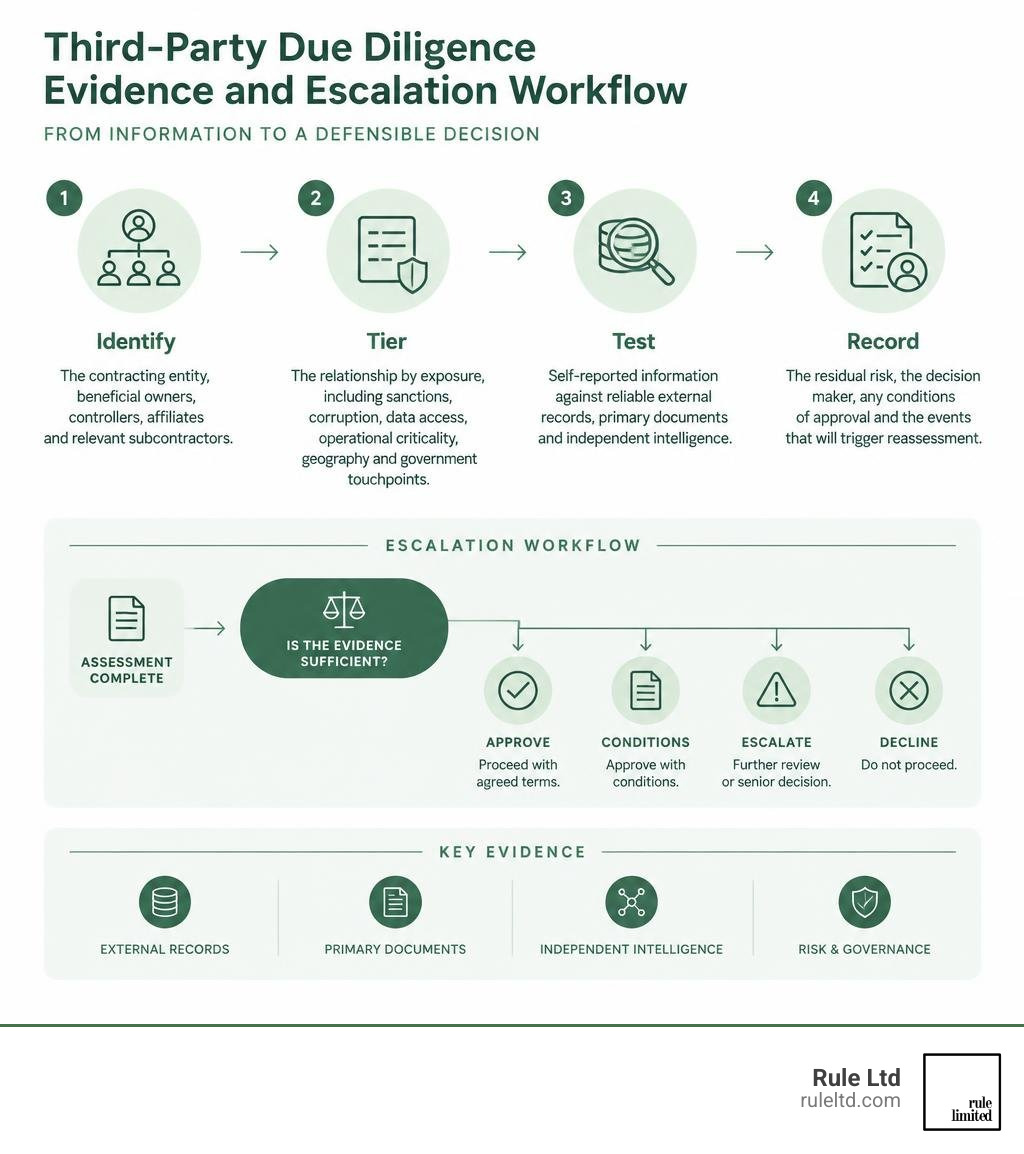
A defensible third-party due diligence process is fundamentally an evidentiary burden rather than an administrative intake workflow. For General Counsel and Chief Compliance Officers, regulatory scrutiny turns on whether the underlying investigative record supports a reasoned, documented decision to proceed, decline, or accept a defined residual risk.
Treating intake forms as established fact creates severe legal exposure where corporate ownership is opaque, where an entity is subject to indirect sanctions control, or where an intermediary interfaces with foreign public officials. Formal shareholding alone rarely settles the analysis under OFAC’s 50 Percent Rule or UK sanctions regimes. Similarly, establishing adequate procedures under section 7 of the UK Bribery Act 2010 requires verifiable evidence of counterparty integrity and proportionality regarding associated persons
Cross-border enforcement frameworks increasingly penalise static, uncorroborated assessments. Mandates such as DORA enforce direct oversight over ICT vendor concentrations, while NIS2 establishes management accountability for supply-chain cybersecurity controls across covered entities Navigating these demands requires testing self-reported declarations against primary multilingual records, independent corporate intelligence, and verifiable operational data. This article provides general analysis, not legal advice. Specific compliance matters must be assessed case by case against applicable facts and law.
Rule Ltd provides third-party due diligence, corporate intelligence and enhanced investigations for General Counsel and Chief Compliance Officers worldwide. Its reports are prepared by human analysts who review primary multilingual records, pierce multi-tiered corporate structures, reduce false-positive fatigue and connect disparate risk indicators across international jurisdictions.
Evidential Failure Modes in the Standard Third-Party Due Diligence Process
Compliance teams frequently experience questionnaire fatigue, accompanied by a structural reliance on unverified self-attestations. Standard assessment portals collect self-serving assertions from vendors, resulting in substantial informational gaps. When an organisation treats intake declarations as established fact, it fails to meet the standard required by regulatory authorities and courts evaluating compliance programmes.
Empirical industry findings consistently demonstrate that legal and compliance leaders frequently discover critical vendor exposures only after standard onboarding workflows conclude, with late-discovered risks routinely driving material operational or regulatory disruption. Standard intake declarations are structurally incapable of identifying obscured corporate linkages, informal control arrangements, or indirect state ownership.
This self-attestation reliability deficit is compounded by rapid point-in-time assessment decay. A static assessment completed during onboarding deteriorates as corporate structures shift, leadership rotates, regulatory watchlists expand, and operational dependencies evolve. Examining common third-party risk assessment failures that leave vendor exposure unverified demonstrates that static files routinely obscure developing sanctions exposure, litigation risk, and solvency decay. Defensible compliance demands moving beyond administrative checklist completion to independent, corroborative evidence gathering.
Piercing Ownership Opacity and Sanctions Control Structures
Establishing legal entity ownership requires more than pulling corporate registry snapshots. High-risk entities routinely deploy tiered holding companies, trust arrangements, nominee directorships, and offshore structures situated in opaque jurisdictions to conceal ultimate controlling minds.

Under the United States Department of the Treasury’s Office of Foreign Assets Control (OFAC) regulations, any entity owned 50 percent or more in the aggregate by one or more blocked persons is automatically blocked by operation of law, regardless of whether the entity is named on the Specially Designated Nationals (SDN) list [1]. Navigating the 50 percent rule and OFAC compliance pitfalls requires aggregating fractional holdings across complex chains of subsidiaries.
In parallel, the UK Office of Financial Sanctions Implementation (OFSI) and European Union authorities apply separate ownership and control tests [2]. Under UK and EU frameworks, an entity is subject to asset freezes if a designated person holds more than 50 percent of the proprietary rights or possesses the practical ability to direct the entity’s corporate affairs, appoint board majorities, or control corporate assets through informal arrangements.
Relying on basic filings such as the UK Companies House People with Significant Control (PSC) register without independent corroboration leaves organisations exposed to unverified filings [5]. Following the implementation of the Economic Crime and Corporate Transparency Act 2023 (ECCTA), regulatory scrutiny over corporate opacity has intensified [6]. A defensible ultimate beneficial owner check must pierce multi-layered structures, identifying beneficial owners down to natural persons and verifying that sanctioned individuals or disguised state actors exercise neither direct ownership nor indirect control.
Managing Intermediary Corruption and Foreign Public Official Exposure
Intermediaries, distributors, customs brokers, and commercial sales agents represent primary liability vectors under international anti-bribery statutes. Cross-border enforcement patterns by the U.S. Department of Justice and SEC under the Foreign Corrupt Practices Act (FCPA) consistently demonstrate that third-party intermediaries account for the overwhelming majority of international bribery enforcement actions [4].
Under section 7 of the UK Bribery Act 2010, commercial organisations face corporate liability for failing to prevent bribery committed by an “associated person” acting on their behalf, unless the enterprise can establish that it put in place adequate procedures [3]. General Counsel must structure reviews to identify anomalous commercial arrangements, as outlined in our analysis of anti-bribery and corruption compliance due diligence.
High-risk indicators include:
- Compensation arrangements disjointed from local market rates, such as success fees, retainer premiums, or commissions exceeding standard market baselines.
- Vague contractual deliverables described as “consulting support,” “expediting services,” or “government liaison advisory.”
- Requests for offshore routing of payments, split invoicing, or remuneration routed to third-party bank accounts in unrelated jurisdictions.
- Intermediaries maintaining direct familial, commercial, or structural ties to foreign public officials, including state-owned enterprise (SOE) executives.
Meeting evidential thresholds requires thorough politically exposed person identification and classification, assessing whether a third party’s local connections create exposure to bribery, unlawful state influence, or extraterritorial enforcement.
Multi-Jurisdictional Regulatory Mandates Reshaping Diligence Baselines
Cross-border third-party due diligence is no longer governed solely by anti-corruption and sanctions statutes. Enterprise supply networks are now subject to operational resilience, cybersecurity, and supply chain transparency mandates across multiple regions.
In the European Union, the Digital Operational Resilience Act (DORA) mandates that regulated financial entities establish governed information registers detailing all Information and Communication Technology (ICT) third-party dependencies, enforcing operational exit strategies and audit verification [7]. Concurrently, the NIS2 Directive establishes direct corporate management accountability for supply-chain cybersecurity controls across entities designated as essential and important [8].
Human rights and supply-chain integrity enforcement have similarly tightened. The United States enforces the Uyghur Forced Labor Prevention Act (UFLPA), imposing a rebuttable presumption that goods sourced wholly or in part from designated regions involve forced labour [9]. In Europe, the German Supply Chain Due Diligence Act (Lieferkettensorgfaltspflichtengesetz, LkSG) and emerging European directives require enterprises to establish documented human rights and environmental vetting mechanisms across their multi-tiered vendor ecosystems [10]. Practitioners evaluating structured due diligence programmes must establish rigorous comparative frameworks when aligning internal controls against changing cross-border requirements.
Integrating Cyber Resilience and Fourth-Party Dependencies
Digital supply chain compromises represent one of the most severe operational exposures confronting global enterprises. Technical breaches routinely originate through vulnerabilities in upstream software dependencies, cloud integrations, or contracted IT service providers, requiring months to identify and contain.
Evaluating vendor risk requires expanding scrutiny to downstream fourth-party subcontractors, critical open-source dependencies, and shadow cloud architecture. An enterprise remains exposed if its primary vendor outsources critical data processing to an unverified subcontractor. Furthermore, the rapid enterprise deployment of artificial intelligence tools and unvetted model integrations introduces critical governance vulnerabilities, particularly where proprietary data ingestion occurs without strict access controls.
Defensible oversight requires implementing structured third-party cybersecurity risk management protocols supported by a rigorous supply chain vendor cybersecurity checklist.
| Assessment Dimension | Static Questionnaire Approach | Human-Led Evidential Verification |
|---|---|---|
| Validation Method | Unverified vendor self-declarations and policy attestations | Corroboration via SOC 2 Type II reports, penetration tests, and technical audit artifacts |
| Fourth-Party Visibility | Relies on vendor disclosure without downstream tracing | Forensic mapping of sub-processors, shared hosting infrastructure, and fourth-party access |
| Emerging Tech Controls | Generic checklist queries regarding IT security standards | Specific governance auditing covering API integrations, LLM data ingestion, and shadow AI |
| Decay Frequency | Annual or bi-annual re-certification cycles | Event-driven triggers paired with continuous tracking of external exposure vectors |
Geopolitical Volatility and Trade Sanctions Enforcement Dynamics
Geopolitical volatility has accelerated trade friction, export control enforcement, and sanctions divergence between Western and Eastern trade blocs. Compliance teams must actively address the extraterritorial reach of U.S. Export Administration Regulations (EAR), EU trade restriction packages, and retaliatory foreign sanctions regimes.
A comprehensive sanctions risk management strategy must account for intermediate transshipment hubs, front companies operating in third-party jurisdictions, and unlawful dual-use technology diversion. Counsel must be alert to the critical geopolitical red flags that put third-party vendors at risk, identifying when nominal manufacturing locations obscure underlying supply chain links to sanctioned territories or state-backed military enterprises.
Structuring Defensible Escalation and Residual-Risk Governance
Due diligence is not an absolute barrier against all operational risk; it is an evidentiary mechanism to enable informed, defensible governance decisions. When elevated risks or adverse intelligence emerge, the compliance function must avoid default rubber-stamping or ad-hoc informal acceptances.
For relationships presenting heightened political exposure, complex offshore ownership, or operating in high-corruption jurisdictions, organisations must commission structured enhanced due diligence for high-risk entities. When material risks are identified but the engagement proceeds on commercial grounds, the General Counsel must negotiate enforceable contractual protections:
- Uncapped indemnification covenants covering regulatory penalties, investigation costs, and data-breach losses.
- Broad, non-negotiable audit and inspection rights covering vendor facilities, primary books, technical records, and sub-processor logs.
- Immediate, mandatory breach notification covenants coupled with unambiguous termination rights triggered by compliance defaults or ownership changes.
- Ongoing monitoring covenants supported by specialised contract compliance monitoring services.
All residual-risk determinations must be documented within a central risk register, detailing the specific evidence reviewed, identified risk factors, agreed compensatory controls, and the formal approval of executive decision-makers.
Event-Driven Reassessment Triggers
Treating third-party due diligence as a discrete onboarding step leaves an organisation vulnerable to post-contractual compliance decay. A defensible programme combines structured re-assessment intervals with automated, event-driven escalation triggers.
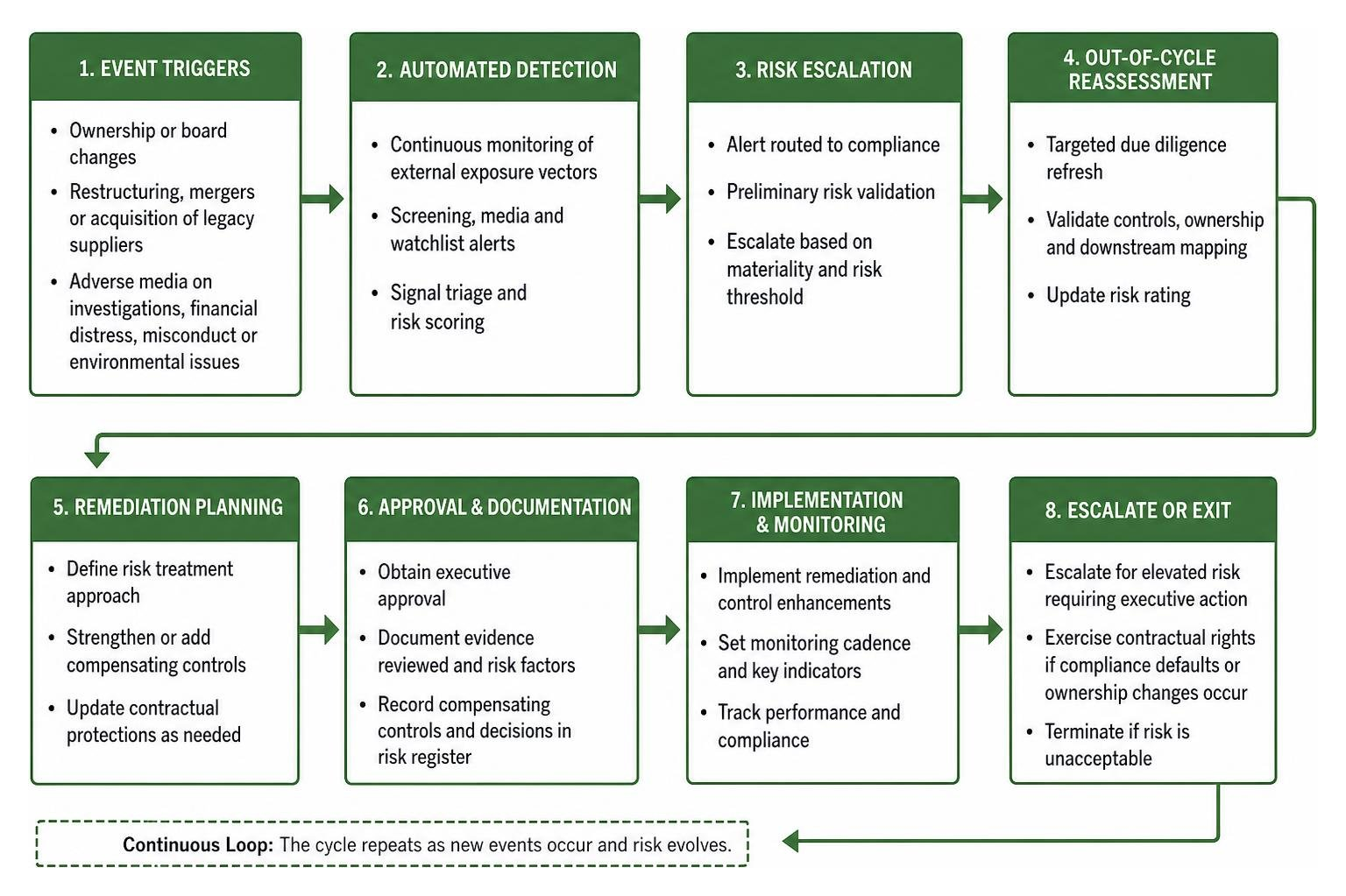
Material changes that must immediately trigger an out-of-cycle risk reassessment include:
- Material modifications in corporate ownership structures, ultimate beneficial ownership, or board composition.
- Corporate restructuring, cross-border mergers, or the inheritance of legacy supplier portfolios during acquisitions.
- Emergence of adverse media covering regulatory investigations, financial distress, executive misconduct, or environmental infractions.
- Sanctions updates, export control reclassifications, or regulatory designations affecting the vendor, its affiliates, or key executives.
- Unauthorised modifications to primary IT architecture, critical data-processing locations, or sub-processor relationships.
Integrating real-time monitoring alerts into continuous vendor compliance monitoring ensures that emerging compliance vulnerabilities are escalated to the legal and compliance function before ripening into public regulatory failures.
Legal and Evidentiary Determinations in Third-Party Governance
Establishing ‘Adequate Procedures’ Under Section 7 of the UK Bribery Act
Judicial and regulatory authorities assess adequacy by evaluating whether an organisation’s compliance framework is proportionate to the specific corruption risks it faces [3]. Enforcement bodies examine whether the enterprise conducted documented, risk-calibrated due diligence, independently verified counterparties, maintained demonstrable senior management oversight, and enforced ongoing monitoring. Relying on self-attested intake questionnaires does not satisfy the statutory threshold. Independent corporate due diligence providing an objective evidentiary record is necessary to support a statutory defence.
Sanctions Exposure Below the 50 Percent Equity Threshold: Ownership Versus Control
Under UK OFSI and EU regulations, an entity is subject to financial sanctions if a designated person holds more than 50 percent of the proprietary rights or exercises practical control over corporate decision-making, irrespective of legal equity percentage [2]. Under U.S. OFAC rules, while the strict 50 Percent Rule applies to aggregate legal ownership by blocked persons, OFAC guidance urges caution and frequently takes enforcement action where designated persons exercise indirect control or where unlisted entities act on behalf of blocked individuals [1]. Defensible compliance requires executing exhaustive sanctions searches and verifying entity compliance status across both direct shareholding chains and practical management control vectors.
Structuring Defensible Residual-Risk Determinations for Critical Counterparties
General Counsel must record risk-acceptance determinations within a governed residual risk register. The evidentiary file must specify the primary intelligence reviewed, the precise nature of identified commercial or jurisdictional risk, the business necessity justifying the engagement, and the specific compensatory controls implemented to mitigate exposure. This documentation must receive formal executive or board committee sign-off and remain indexed alongside the formal enhanced due diligence report preparation to withstand post-incident regulatory scrutiny.
Establishing an Evidentiary Standard for Enterprise Risk Defensibility
Superficial third-party due diligence programmes expose global enterprises to significant regulatory fines, operational disruption, and reputational damage. When an enforcement authority reviews a corporate relationship, defensibility hinges upon the quality, independence, and depth of the investigative evidence collected before and during the commercial engagement.
Rule Ltd provides comprehensive third-party due diligence, corporate intelligence, and enhanced investigations for General Counsel and Chief Compliance Officers worldwide. Moving beyond automated checkbox software, Rule Ltd relies on human analysts who review primary multilingual records, pierce multi-tiered corporate secrecy structures, eliminate false-positive fatigue, and connect disparate risk indicators across international jurisdictions.
Every investigative engagement is delivered with cost certainty under a fixed-price structure. Rule provides a fixed quote within one working day before work commences. Standard screening reports turn around within two to three working days, while complex enhanced due diligence and corporate intelligence investigations are delivered in approximately five working days.
To secure an evidential standard that protects your enterprise against third-party regulatory exposure, review our specialist third-party due diligence capabilities.
Sources
[1] U.S. Department of the Treasury, Office of Foreign Assets Control, Revised Guidance on Entities Owned by Persons Whose Property and Interests in Property Are Blocked (50 Percent Rule).
[2] UK Office of Financial Sanctions Implementation, Financial Sanctions: General Guidance for Financial Sanctions under the Sanctions and Anti-Money Laundering Act 2018.
[3] UK Bribery Act 2010, section 7, and Ministry of Justice Guidance on Adequate Procedures.
[4] U.S. Department of Justice and Securities and Exchange Commission, A Resource Guide to the U.S. Foreign Corrupt Practices Act.
[5] UK Companies House, Guidance for People with Significant Control (PSC) Requirements.
[6] UK Economic Crime and Corporate Transparency Act 2023.
[7] Regulation (EU) 2022/2554 of the European Parliament and of the Council on digital operational resilience for the financial sector (DORA).
[8] Directive (EU) 2022/2555 of the European Parliament and of the Council on measures for a high common level of cybersecurity across the Union (NIS2).
[9] Uyghur Forced Labor Prevention Act (Public Law 117-78) and applicable U.S. Customs and Border Protection operational guidance.
[10] German Supply Chain Due Diligence Act (Lieferkettensorgfaltspflichtengesetz, LkSG).
Sources and legal requirements should be checked against the versions in force at the date of publication. This publication provides general analysis and does not constitute legal advice.