
Defensible Evidentiary Standards for Supplier ESG Risk Assessment
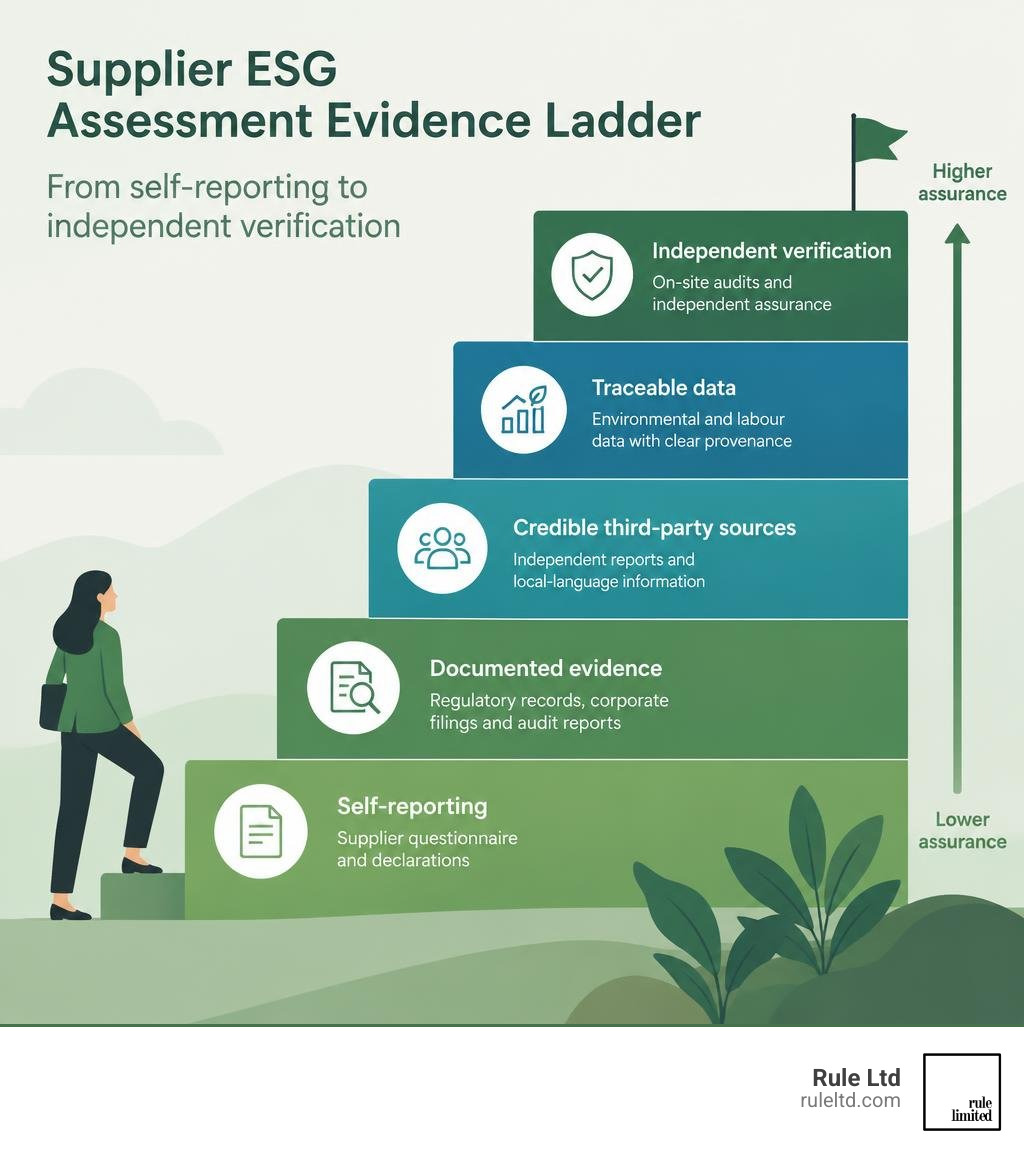
A supplier ESG risk assessment should not treat a completed questionnaire as proof of compliance. Start by ranking suppliers by country, sector, spend, supply chain tier, and product risk. Then test key claims against independent evidence, such as regulatory records, corporate filings, audit reports, credible local-language reporting, and traceable environmental or labour data.
Where evidence cannot be obtained, is inconsistent, or comes only from the supplier, record that gap as a risk finding. It is not proof of misconduct. But it is not a basis for a clean assessment either.
This matters because ESG exposure often sits beyond the direct supplier relationship. Labour abuses, environmental breaches, sanctions links, and opaque ownership can arise at subcontractor, processor, or raw-material level. A supplier’s assurance may be useful, but it must be capable of verification.
The legal position depends on the business, jurisdiction, and facts. The EU Corporate Sustainability Due Diligence Directive, Germany’s Supply Chain Due Diligence Act, the UK Modern Slavery Act 2015, and forced-labour import controls can each create different disclosure, due-diligence, or evidential expectations This article is not legal advice; specific legal and compliance matters must be assessed case by case.
I am Judy Lee, Founder and Chief Executive of Rule Ltd, a UK corporate intelligence and third-party due-diligence firm. Having advised General Counsel and Chief Compliance Officers on ownership opacity, sanctions exposure, and defensible investigations, I approach supplier ESG risk assessment as an evidential exercise, not a questionnaire exercise.
Relevant Rule Ltd risk-assessment resources:
Structural Blindspots in Standard Supplier ESG Risk Assessment Frameworks

Standard third-party evaluation models frequently fail because they mistake procedural completion for empirical verification. In many procurement departments, an assessment is marked complete the moment a vendor returns a self-disclosure questionnaire. This creates a dangerous illusion of oversight. Nearly 80% of organisations experienced supply chain disruptions over the past year, and third-party failures remain the primary cause. When compliance programmes rely purely on unverified vendor submissions, they introduce institutional blindspots that fail to satisfy modern regulatory scrutiny.
These systemic vulnerabilities are detailed in our analysis of third-party risk assessment failures that leave vendor exposure unverified. Desktop reviews rarely penetrate the operational reality of global supplier networks. While approximately 60% of supply chain leaders report visibility into their Tier 1 counterparties, only 30% maintain line of sight into Tier 2 and beyond, marking a steep 26% decline in sub-tier transparency since 2022.
When operational vulnerabilities remain unexamined across lower supplier tiers, catastrophic supply chain failures inevitably follow, exposing buyers to severe legal enforcement and brand damage.
Evidentiary Deficits in Self-Reported Questionnaires
The fundamental weakness of standard due-diligence questionnaires lies in vendor self-certification bias. When contractual awards depend on achieving favourable sustainability ratings, counterparties face an obvious incentive to sanitise their submissions. This dynamic generates widespread greenwashing exposure, where published environmental policies bear little relation to factory-level practices.
Uncorroborated Scope 3 emissions reporting represents a major evidential deficit. Suppliers routinely submit high-level estimates derived from spend-based formulas rather than auditable primary activity data. When these figures are accepted without testing against production volumes, energy utility statements, or transport manifests, the buyer absorbs direct reporting risk under statutory disclosure regimes.
Furthermore, self-reported declarations routinely omit local environmental fines, ongoing worker tribunal disputes, and informal regulatory sanctions. General Counsel must confront the hidden costs of ignoring supply chain risk, as unverified vendor disclosures shift liability directly onto the enterprise once enforcement bodies examine the underlying evidence.
Upstream Opacity Beyond Direct Contractual Tiers
Legal and operational risks multiply exponentially beyond direct contractual counterparties. While a Tier 1 supplier may present immaculate corporate governance credentials, its manufacturing operations often depend on nested networks of subcontractors and commodity processors located in high-risk jurisdictions.
Sub-tier subcontracting presents severe exposure under international trade controls and environmental mandates. In mineral extraction, textile weaving, and agricultural sourcing, raw material provenance is frequently concealed through offshore trading intermediaries and free-trade-zone transshipments.
Managing this cross-border operational exposure requires addressing broader supplier security risk, particularly where local enforcement gaps allow sub-tier contractors to operate without regulatory oversight. When buyers lack verified intelligence on these upstream entities, statutory liabilities cannot be mitigated through standard contractual representations alone.
Cross-Jurisdictional Regulatory Enforcement and Board Liability
Global regulatory frameworks have shifted decisively from voluntary corporate social responsibility reporting to hard, statutory due-diligence mandates backed by severe administrative fines, civil liability, and trade interdictions. For corporate boards, non-compliance creates direct exposure to shareholder litigation, regulatory sanctions, and material commercial disruption.

This evolving enforcement environment amplifies ESG reputational risk into a primary balance-sheet vulnerability. Cross-border regulators increasingly require corporate buyers to demonstrate active, evidence-based oversight across their entire value chain. Incorporating standardised frameworks such as the CDP Supplier Engagement Assessment Methodology provides a structured baseline, but legal defensibility requires rigorous independent corroboration that withstands adversarial examination.
| Regulatory Regime | Jurisdictional Scope | Key Due-Diligence Mandate | Maximum Statutory Penalty / Consequence |
|---|---|---|---|
| EU CSDDD [1] | Large EU and non-EU enterprises meeting turnover thresholds | Mandatory environmental and human rights due diligence across upstream value chains | Administrative fines up to 5% of global net turnover; civil liability for damages |
| German LkSG [2] | Enterprises operating in Germany meeting headcount thresholds | Risk analysis, preventive measures, and remedial mechanisms for human rights and environmental harms | Fines up to 2% of global annual turnover; exclusion from public procurement tenders |
| US UFLPA [3] | Importers of goods into the United States | Rebuttable presumption that goods sourced wholly or in part from Xinjiang involve forced labour | Cargo detention, asset forfeiture, civil penalties, and mandatory exclusion |
| UK Modern Slavery Act (s.54) [4] | Commercial organisations carrying on business in the UK (turnover £36m+) | Annual modern slavery transparency statement detailing supply chain due-diligence steps | High Court injunctive relief, reputational damage, commercial de-listing |
EU CSDDD and German LkSG Statutory Due Diligence Mandates
The European Union’s Corporate Sustainability Due Diligence Directive (CSDDD) establishes binding obligations for large enterprises to identify, prevent, mitigate, and terminate adverse human rights and environmental impacts throughout their chains of activities Under the CSDDD framework, companies face administrative sanctions reaching up to 5% of their global net turnover for failure to implement adequate due-diligence systems, alongside direct civil liability regimes that allow affected parties to claim compensation for preventable supply chain harms before European courts.
Simultaneously, Germany’s Lieferkettensorgfaltspflichtengesetz (LkSG) requires covered organisations to establish robust risk-management mechanisms spanning direct suppliers and, where substantiated knowledge of a violation exists, indirect suppliers Regulated by the Federal Office for Economic Affairs and Export Control (BAFA), the LkSG imposes administrative fines of up to 2% of global annual turnover for large entities that fail to document, remediate, and report on human rights and environmental vulnerabilities. Crucially, both statutes place clear responsibility upon corporate management to demonstrate that due-diligence efforts are active, verified, and continuous.
Forced Labour and Import Prohibition Regimes
Trade enforcement regimes have introduced strict evidential standards that render uncorroborated supplier claims legally useless at national borders. Under the United States Uyghur Forced Labour Prevention Act (UFLPA), customs authorities operate under a statutory rebuttable presumption: all goods manufactured wholly or in part within the Xinjiang Uyghur Autonomous Region, or produced by entities on the UFLPA Entity List, are presumed to be made with forced labour and prohibited from entry
Overcoming this presumption requires clear and convincing evidence, including granular supply chain mapping, purchase orders, factory-level payroll records, production logs, and transportation manifests proving that raw materials were sourced entirely outside prohibited zones.
In the United Kingdom, Section 54 of the Modern Slavery Act 2015 mandates that commercial organisations with an annual turnover exceeding £36 million publish an annual slavery and human trafficking statement detailing due-diligence processes across their supply networks Failure to establish verifiable oversight leaves businesses exposed to High Court enforcement proceedings, customs detentions, and immediate public scrutiny.
Core Evidentiary Pillars in a Supplier ESG Risk Assessment

A defensible vendor evaluation requires assessing multi-dimensional risk indicators across three core pillars: Environmental Materiality, Labour Rights, and Corporate Governance. Relying on double materiality principles, compliance teams must evaluate both the external impacts generated by the supplier and the inward operational, financial, and legal risks that counterparty deficiencies impose on the buying organisation.
Methodologies established under the S&P Global Supplier Risk Management Methodology illustrate how quantitative indicator weighting can segment high-risk vendors. However, institutional buyers must execute rigorous corporate due diligence for vendors by corroborating vendor-provided metrics against independent corporate registries, regulatory enforcement logs, and satellite observations.
Environmental Materiality and Emissions Governance
Environmental due diligence must extend beyond self-reported emissions targets to verify concrete operational compliance:
- Greenhouse Gas Verification: Cross-checking reported Scope 1, 2, and 3 calculations against utility statements, fuel consumption receipts, and logistics manifests using standard GHG Protocol accounting methodologies.
- Effluent and Waste Management: Auditing hazardous material disposal logs, industrial wastewater discharge permits, and local environmental agency inspection histories.
- Resource Exploitation: Evaluating water withdrawal rates and local aquifer impact in water-stressed manufacturing basins.
- Regulatory Citations: Interrogating municipal and national environmental protection registries for unpublicised fines, administrative warnings, or stop-work orders.
Labour Rights, Human Capital, and Operational Safety
Assessing labour risks requires investigating ground-level operational conditions rather than corporate code-of-conduct attestations:
- Forced Labour Indicators: Reviewing recruitment agency arrangements to identify debt bondage, recruitment fee deductions, or passport confiscation practices.
- Worker Grievance Efficacy: Testing the operational independence, accessibility, and resolution rates of internal whistleblower and grievance channels.
- Working Hours and Compensation: Reconciling biometric electronic access logs against wage payment slips to identify systematic overtime falsification or minimum wage evasion.
- Occupational Health and Safety: Cross-referencing facility-level incident reports with public health agency filings and workplace safety inspection records.
Corporate Integrity, Beneficial Ownership, and Governance Oversight
Governance assessments serve as the foundation of supplier integrity, establishing whether a counterparty is legally compliant and transparent:
- Ultimate Beneficial Ownership (UBO): Uncovering complex multi-jurisdictional holding structures to identify the natural persons who ultimately own or control the entity, cross-referencing records such as the UK Companies House PSC register
- Sanctions and PEP Exposure: Screening corporate entities and associated directors against global sanctions lists, politically exposed person (PEP) databases, and enforcement watchlists, applying the OFAC 50% rule and UK OFSI ownership-and-control guidance.
- Anti-Bribery and Corruption Controls: Evaluating the enforcement of internal compliance programmes, commercial gift registers, and third-party intermediary vetting protocols under the UK Bribery Act and US FCPA.
- Trade and Tax Integrity: Verifying customs classification integrity, export control compliance, and offshore transfer pricing arrangements.
Remediation Protocols and Multilingual Intelligence Integration
When an assessment identifies verifiable compliance deficiencies or uncorroborated data gaps, organisations must execute structured remediation protocols rather than simply abandoning commercial relationships or ignoring the finding. Implementing effective vendor compliance monitoring ensures that identified risks are tracked through formal corrective actions and ongoing intelligence gathering.
Contractual Warranties and Legally Binding Corrective Action Plans
General Counsel should ensure that standard procurement contracts incorporate legally enforceable ESG representations, warranties, and covenants:
- ESG Default Clauses: Explicit provisions defining severe environmental breaches, forced labour violations, or beneficial ownership concealment as material contractual defaults triggering immediate termination rights.
- Mandatory Remediation Timelines: Formal Corrective Action Plans (CAPs) specifying mandatory operational milestones, technical upgrades, or policy rectifications within defined timeframes (e.g., 30, 60, or 90 days).
- Audit Access Rights: Clear contractual rights granting the buyer and its appointed investigative agents unrestricted access to facilities, worker payroll records, and lower-tier supply chain documentation.
- Indemnification Provisions: Specific indemnity clauses holding the supplier financially liable for regulatory fines, cargo detentions, or legal expenses arising from non-compliance or fraudulent data submissions.
Multilingual Intelligence and Continuous Supplier ESG Risk Assessment
Desktop screening conducted solely in English misses critical regulatory and reputational warnings published in the supplier’s domestic market. A defensible intelligence process integrates multilingual open-source intelligence (OSINT) and regulatory database scraping across regional jurisdictions.
Our human analysts investigate regional corporate registries, local civil and criminal court dockets, municipal environmental enforcement portals, and vernacular news sources across Asia, Eastern Europe, and Latin America. By combining this local-language scrutiny with specialised external tools, compliance teams can detect regulatory sanctions, labour strikes, and community protests months before they emerge in international English-language media.
Defensible Positions on Supplier ESG Risk Assessment
How does an enterprise establish legal defensibility when vendor ESG data is incomplete?
Legal defensibility under statutory due-diligence regimes requires proving that the enterprise took proportionate, reasonable, and documented steps to identify and address supply chain risks. When a vendor fails to provide complete information, the buying organisation must formally log the evidentiary gap within its risk register rather than leaving the assessment marked as pending or acceptable.
To satisfy statutory scrutiny under the LkSG or CSDDD, the compliance team must preserve an audit trail demonstrating the specific inquiries made, the independent public records examined, the risk-prioritisation criteria applied, and the remedial steps initiated. Commissioning independent corporate intelligence reports on high-risk counterparties establishes concrete proof of proactive due diligence.
Why is uncorroborated vendor data classified as an adverse risk finding?
Treating unverified vendor claims as a clean assessment creates severe regulatory, contractual, and reputational exposure. In compliance audits and customs inspections, uncorroborated assertions carry zero evidentiary weight. If a vendor claims zero deforestation in its palm oil supply chain or full compliance with statutory working hour limits, but refuses or fails to supply verifiable audit trails, shipping manifests, or biometric logs, the lack of substantiation is an operational red flag.
In forensic due diligence, the inability or unwillingness to prove compliance frequently indicates active non-compliance, undocumented subcontracting, or intentional fraud. Classifying uncorroborated data as a risk finding protects the organisation from relying on false assurances during regulatory filings.
What methods verify ESG compliance across Tier 2 and sub-tier suppliers without direct contracts?
Verifying sub-tier counterparties where no direct contractual privity exists requires combining macroeconomic trade mapping with on-the-ground corporate intelligence. Organisations can deploy input-output trade modelling to establish typical material and labour flows across specific product categories.
This macro analysis is supplemented by inspecting international bills of lading, customs import-export records, and freight carrier manifests to identify the intermediary processors and raw material suppliers feeding the Tier 1 vendor.
Once upstream entities are identified, independent investigators examine local-language corporate registries, satellite environmental imagery, and local regulatory enforcement archives to evaluate operational integrity without alerting the target counterparty.
Conclusion
A defensible approach to supplier risk management requires treating due diligence as an evidential, investigative discipline. Relying on passive self-assessments leaves enterprises vulnerable to catastrophic supply chain disruptions, regulatory enforcement under the CSDDD, LkSG, and UFLPA, and severe board-level liabilities. When vendor data cannot be independently verified, compliance teams must classify that gap as an adverse finding and take decisive remedial action.
Rule Ltd delivers corporate intelligence and third-party due diligence services designed specifically for General Counsel and Chief Compliance Officers who require verified, defensible insight. Our human analysts reduce false positives and connect disparate data points across complex global jurisdictions, providing multi-lingual, multi-jurisdictional intelligence that withstands regulatory scrutiny.
We operate on a transparent, fixed-price model with rapid turnarounds: screening reports are delivered within two to three working days, while complex enhanced due diligence and corporate intelligence investigations are completed in approximately five working days. Every engagement is quoted as a fixed price before work begins, providing total cost certainty.
Disclaimer: This article is provided for informational purposes only and does not constitute formal legal advice. Specific legal, regulatory, and compliance matters must be evaluated on a case-by-case basis under the applicable governing laws and factual circumstances.
Sources and Legal Note
[1] European Union, Corporate Sustainability Due Diligence Directive and current implementing materials: https://eur-lex.europa.eu/
[2] German Federal Office for Economic Affairs and Export Control (BAFA), German Supply Chain Due Diligence Act (LkSG): https://www.bafa.de/
[3] U.S. Customs and Border Protection, Uyghur Forced Labor Prevention Act: https://www.cbp.gov/trade/forced-labor/UFLPA
[4] UK Modern Slavery Act 2015, Section 54: https://www.legislation.gov.uk/ukpga/2015/30/section/54
[5] UK Companies House, People with Significant Control (PSC) register: https://www.gov.uk/government/organisations/companies-house
Additional Methodological Authorities: CDP Supplier Engagement Assessment Methodology (2025) and S&P Global Sustainable1 Supplier Risk Management Methodology. This document is intended solely for corporate compliance review and does not constitute legal counsel.*