
A backup supplier is no safeguard if both depend on the same provider
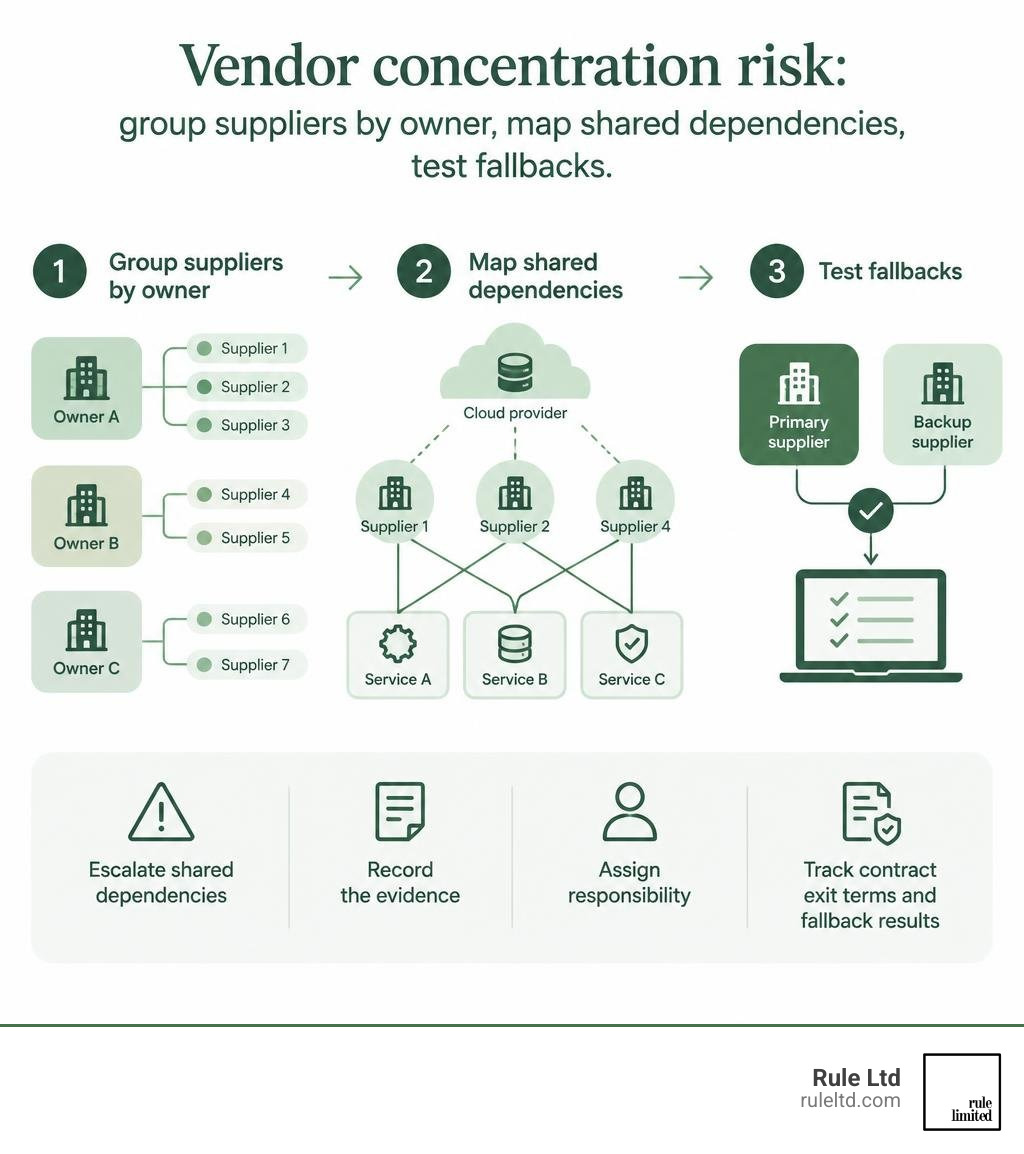
Contractual redundancy offers false reassurance when secondary suppliers share an identical upstream provider, ultimate corporate parent, or technical chokepoint. Vendor concentration risk compounds across unmapped fourth-party dependencies, opaque ownership structures, and untested fallback mechanisms. When shared dependencies threaten multiple critical services simultaneously, defensible oversight demands verifiable proof of operational independence, clear contractual exit mechanics, and documented continuity testing.
Accounts payable ledgers fail to reveal whether distinct vendors rely on the same cloud availability zone, specialised sub-processor, or physical facility. For EU financial entities, DORA mandates that concentration risk be formally evaluated before executing ICT contracts that support critical or important functions.[1]
This article is general information, not legal advice. Specific legal and compliance questions need case-by-case assessment.
Source
[1] Regulation (EU) 2022/2554, Article 29.
Rule Ltd’s assessments of vendor concentration risk, ownership opacity, and decision evidence combine experienced legal leadership with human-led investigative analysis.
Vendor concentration risk further reading:
Systemic Failure Modes: Beyond Direct Spend Exposure

Enterprise risk frameworks routinely mischaracterise vendor concentration as a commercial procurement problem. General Counsel and Chief Compliance Officers increasingly encounter balance-sheet exposure generated not by headline vendor spend, but by correlated failure domains where multiple essential workflows terminate at an identical operational chokepoint.
When a single technological or service provider fails, the resulting disruption extends far beyond contract value. Widespread endpoint security and software update failures illustrate how single-point technology exposure operates in practice, causing substantial operational losses across major enterprises while insurance absorptions remain minimal. Critical transport, healthcare, and financial institutions have experienced severe operational curtailment and non-recoverable expenses from a single upstream dependency. These operational interruptions expose the hidden costs of ignoring supply chain risk across interdependent enterprise systems.
A major driver of modern architectural fragility lies in Non-Human Identities (NHIs). Across enterprise environments, NHIs such as API tokens, service accounts, and cryptographic keys outnumber human identities significantly. A substantial majority of organisations grant third parties direct exposure to their internal NHI environments. When an enterprise concentrates machine identity governance or secrets management within a single provider, a failure or compromise of that control plane invalidates machine-to-machine trust across all integrated systems simultaneously.
Uncovering Hidden Fourth-Party Dependencies and Subcontractor Overlap
Organisations often maintain formal multi-vendor panels that are completely integrated at the infrastructure layer. Two ostensibly competing software vendors frequently host their production environments within the same availability zone of a dominant cloud hyperscaler, rely on identical content delivery networks, or route identity federation through the same underlying provider.
Evaluating these cascading exposures requires active investigation beyond self-certified vendor questionnaires. Rigorous supply chain mapping practices must isolate fourth-party infrastructure overlaps, sub-processors, and shared external APIs to determine whether an operational disruption at an uncontracted fourth party will trigger simultaneous failures across primary suppliers.
Geographic and Critical Route Clustering Vulnerabilities
Geographic concentration introduces severe regional vulnerabilities even across diverse legal entities. If secondary and tertiary suppliers operate within the same municipal industrial corridor, river basin, or power grid, physical and geopolitical events neutralise contractual redundancy.
Critical product categories frequently rely on concentrated jurisdictions for the bulk of global export volumes. Maritime chokepoint disruptions demonstrate physical route concentration by stalling substantial volumes of international trade within days. Establishing operational resilience demands mitigating geopolitical supply chain vulnerabilities by tracking trade chokepoints and evaluating near-shoring viability, as industrial enterprises increasingly pursue regional diversification strategies to decouple from concentrated production zones.
The Evidentiary Blind Spots in Direct Spend and Category Concentration Metrics
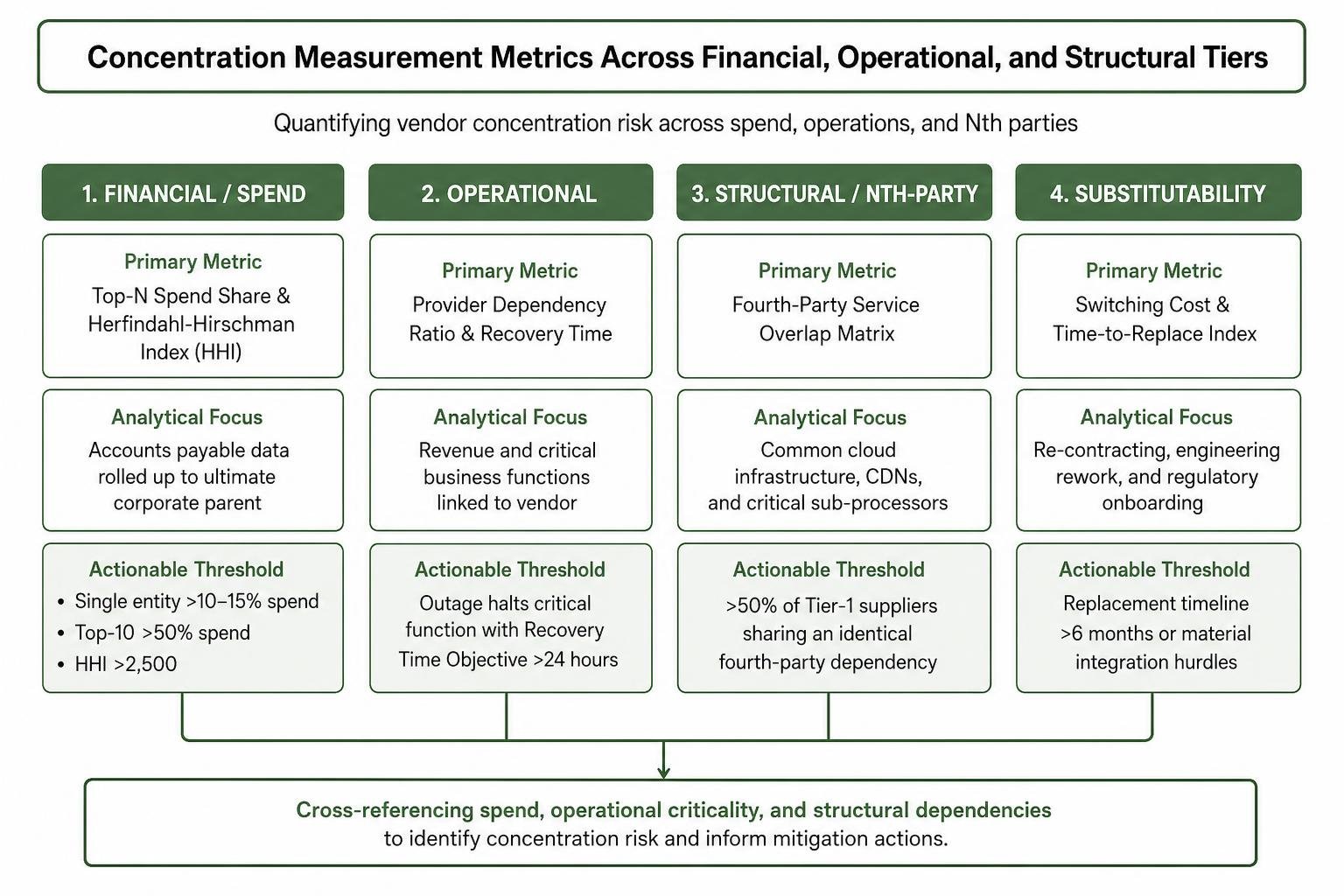
Direct spend figures obscure systemic exposure when procurement ledgers treat distinct legal entities as independent counterparties. Defensible concentration analysis requires cross-referencing disbursements against operational criticality, substitutability indices, and ultimate beneficial ownership structures.
Standard economic concentration measures, such as the Herfindahl-Hirschman Index, fail when disbursements are fragmented across subsidiaries, operating units, or regional billing entities. An enterprise may contract with four distinct vendors across logistics, software, and facilities management, yet all four converge under identical private equity control or beneficial ownership. When exposure is aggregated strictly by direct contracting entity, systemic concentration remains unrecognised until commercial distress or regulatory enforcement strikes the controlling parent.
Operational Criticality Diverges From Procurement Expenditure
Financial weightings rarely correlate with systemic operational exposure. A specialised counterparty representing a negligible percentage of annual procurement spend may provide proprietary algorithms, essential microcode, or sole-source regulatory telemetry whose abrupt interruption paralyses core revenue-generating operations. Applying rigorous supplier risk evaluation criteria enables compliance leaders to distinguish commercially rational vendor consolidation from unmonitored structural fragility.
Assessing structural exposure requires General Counsel and Chief Compliance Officers to make complex legal and operational judgement calls where contractual terms diverge from market realities. Technical lock-in mechanisms, such as proprietary data schemas and punitive egress fees, frequently neutralise ostensibly robust contractual portability clauses. Legal teams must balance theoretical substitution rights against real-world re-qualification timelines, accounting for security vetting, regulatory re-authorisation, and operational onboarding that may exceed acceptable downtime tolerances. Furthermore, cross-border dependency assessments face severe evidentiary limits when evaluating sovereign export controls and regional sanctions exposure across opaque jurisdictions, demanding forensic insight into the top geopolitical risks across modern supply chains to ensure board-level governance structures reflect true counterparty exposure.
Regulatory Mandates and Governance: DORA, Basel, and OCC Expectations

Global prudential regulators have shifted their focus from individual vendor risk to systemic concentration oversight. Supervised entities can no longer treat third-party resilience as an internal procurement matter.
Under the European Union’s Digital Operational Resilience Act (DORA), financial entities must systematically evaluate ICT concentration risk prior to entering critical contracts (Article 29) and maintain an exhaustive Register of Information (Article 28) documenting all direct providers, intra-group service flows, and subcontractor chains [1, 2].
In the United States, the Office of the Comptroller of the Currency (OCC), alongside the Federal Reserve and FDIC, issued interagency guidance mandating that financial institutions assess concentration across shared third-party technologies and geographical corridors [3]. Internationally, the Basel Committee on Banking Supervision’s third-party risk management framework requires institutions to ensure board-approved risk appetites actively address dependencies on critical service providers [4].
Prudential Enforcement Rejects Contractual Redundancy Under DORA and Basel Mandates
Compliance with modern operational resilience frameworks requires formal governance integration. General Counsel must verify that outsourcing arrangements incorporate mandatory contractual safeguards, including audit access, subcontractor notification covenants, and structured transition support, drawing on established standards such as the BITS guidance on contractual concentration protections.
Where systemic concentration cannot be resolved through commercial diversification, legal teams must construct defensible supervisory filings demonstrating compensatory risk controls, isolated testing environments, and verified exit protocols.
Structural Safeguards and Contractual Enforceability in Concentrated Supply Chains
Managing systemic counterparty reliance requires balancing operational efficiency against verifiable legal and structural resilience. Fragmenting spend across dozens of minor vendors often degrades service quality and inflates administrative overhead without mitigating systemic exposure.
Maintaining operational continuity depends on active multi-sourcing architectures across critical workflow tiers. Technology environments mirror this through active-active or active-warm service distributions across distinct cloud providers, preserving failover capability during an outage. In physical supply chains, this requires deliberate supplier diversification strategies that distribute critical production across distinct corporate groups and independent geographic zones.
Contractual Enforceability and Operational Insolvency Vulnerabilities
Standard commercial boilerplate routinely fails during counterparty distress or cross-border insolvency. Defensible third-party governance requires operational covenants that remain enforceable through restructuring and ownership transitions.
Mandatory written consent covenants prevent primary vendors from unilaterally routing critical data flows or core functions to unvetted downstream sub-processors. Simultaneously, transition assistance obligations must establish precise technical cooperation standards, structured data extraction formats, and parallel operating periods to ensure continuity during an unnegotiated migration. These provisions remain effective only when supported by continuous audit access and intelligence rights, enabling legal teams to leverage continuous vendor compliance monitoring to detect emerging financial distress, sanctions liability, or unannounced changes in ultimate beneficial ownership before operational failure occurs.
Evidentiary Defensibility: Demonstrating Concentration Controls to Regulators and Boards
The Operational Reality of Fourth-Party Single Points of Failure
Supervisory authorities increasingly reject compliance assertions based solely on direct supplier contracts. When multiple Tier-1 vendors rely on identical upstream hosting infrastructure, specialised microcode libraries, or regional transit hubs, formal contractual multi-sourcing becomes an illusion. A single disruption at the fourth-party layer cascades across primary suppliers simultaneously, invalidating business continuity assumptions.
General Counsel and Chief Compliance Officers must provide boards and regulatory examiners with verifiable evidence that primary counterparties do not share correlated failure domains. This requires mapping downstream sub-processors and scrutinising infrastructure arrangements rather than accepting self-attested supplier questionnaires.
Evidentiary Standards and Governance Judgement Calls
Demonstrating adequate concentration oversight under regulatory examination exposes distinct evidentiary boundaries. Compliance leadership cannot rely on static corporate registries or vendor self-disclosures when constructing consolidated exposure profiles; corporate restructuring, indirect equity interests, and off-balance-sheet control mechanisms regularly obscure ultimate parental exposure. Governance frameworks must bridge the gap between static contractual warranties and dynamic single-point-of-failure inventories across core workflows.
For General Counsel and Chief Compliance Officers, the primary governance challenge lies in determining when commercial reliance crosses into unmanageable concentration risk. Establishing defensibility requires continuous verification that pre-qualified fallback counterparties can meet operational recovery limits, rather than relying on untested transition covenants. Reconciling cross-border prudential disclosures with mandatory technical registers, such as DORA information templates, ultimately demands evidentiary standards capable of withstanding intrusive supervisory scrutiny during concurrent market disruptions.
Conclusion
Managing vendor concentration risk is an essential governance duty that protects institutional resilience and balance-sheet integrity. Spend analytics, technical mapping, and continuous corporate intelligence ensure executive teams uncover hidden dependencies before operational disruptions occur.
Rule Ltd provides human-analyst-led corporate intelligence, investigative due diligence, and risk assessments for global enterprises. Our investigations combine artificial intelligence with seasoned analytical expertise to map beneficial ownership networks, untangle complex corporate hierarchies, and uncover obscured fourth-party dependencies across multiple jurisdictions and languages.
In contrast to opaque, variable billing structures, Rule Ltd operates on clear, fixed-price engagements agreed before work begins. We deliver straightforward initial screening reports within two to three working days and comprehensive corporate intelligence assessments within approximately five working days. To review your critical supplier dependencies and validate your third-party exposures, examine our comprehensive third-party due diligence capabilities.
This publication provides general operational and risk management analysis and does not constitute formal legal advice. Specific regulatory, compliance, and legal structures must be assessed on an individual case-by-case basis.
Sources
[1] Regulation (EU) 2022/2554 of the European Parliament and of the Council of 14 December 2022 on digital operational resilience for the financial sector (DORA), Articles 28–30. Available at: https://eur-lex.europa.eu/eli/reg/2022/2554/oj
[2] Commission Implementing Regulation (EU) 2024/2956 of 29 November 2024 laying down implementing technical standards for the application of Regulation (EU) 2022/2554 with regard to the standard templates for the register of information. Available at: https://eur-lex.europa.eu/eli/reg_impl/2024/2956/oj
[3] Office of the Comptroller of the Currency, Board of Governors of the Federal Reserve System, Federal Deposit Insurance Corporation (2023), Interagency Guidance on Third-Party Relationships: Risk Management, OCC Bulletin 2023-17. Available at: https://www.occ.gov/news-issuances/bulletins/2023/bulletin-2023-17.html
[4] Basel Committee on Banking Supervision (2026), Basel Consolidated Framework: Operational Risk and Resilience (ORR) – Module 30: Third-Party Risks, Bank for International Settlements. Available at: https://www.bis.org/committees/bcbs/basel-consolidated-guidelines/module/orr/30